
In the Junggar Basin of China’s Xinjiang region, the river-laid rocks of the upper Shishugou Formation held the skeleton of a large meat-eater. Named Sinraptor dongi in 1993, it lived around the start of the Late Jurassic—about 162 to 160 million years ago. It belongs to the metriacanthosaurids, a group of allosauroids that seems to represent the dominant predators of the Shishugou fauna. Indeed, researchers have since described Sinraptor as one of the apex land carnivores of its ecosystem.
Found in 1987 by the Sino-Canadian Dinosaur Project, it was described six years later by paleontologists Philip J. Currie and Zhao Xijin. Since then, studies of its braincase, its teeth, and a bite-scarred skull have added detail. Together, they offer a rare glimpse of a big predator living near the Middle–Late Jurassic transition.
Sinraptor Key Facts
| Keyword | Fact |
|---|---|
| Pronunciation | sien-rap-tor |
| Meaning of name | Chinese Plunderer |
| Group | Theropoda (Allosauroidea, Metriacanthosauridae) |
| Type Species | Sinraptor dongi |
| Diet | Carnivore |
| When it Lived | 162 to 160 MYA |
| Period | Jurassic |
| Epoch | Middle–Late Jurassic (late Callovian to early Oxfordian stages) |
| Length | About 23 feet (7 meters) |
| Height | Not specified |
| Weight | About 2,200 to 3,700 pounds (1.0 to 1.7 metric tons) |
| Mobility | Moved on two legs (bipedal) |
| First Discovery | 1987 by Haijun Wang, during the Sino-Canadian Dinosaur Project |
| Described by | 1993 by Philip J. Currie and Zhao Xijin |
| Holotype | IVPP 10600 |
| Location of first find | Upper Shishugou Formation, 25 km northeast of Jiangjunmiao, Junggar Basin, Xinjiang, China |
Sinraptor Origins, Taxonomy and Timeline
The name Sinraptor is usually rendered in English as “Chinese plunderer,” while the Paleobiology Database lists the simpler common name “China raptor.” Either way, the name points first to the country where the skeleton was found. Together, the name ties a Jurassic hunter firmly to Chinese soil.
Sinraptor is a theropod, the lineage of mostly meat-eating dinosaurs, and it belongs to Allosauroidea. Within that group, it sits in Metriacanthosauridae, a name that Carrano and colleagues in 2012 treated as equivalent to Sinraptoridae. Paleontologist Xu Xing and colleagues place the clade in Europe and Asia—from the Middle Jurassic to the Early Cretaceous. Originally, Currie and Zhao called their animal a “carnosaur” and erected the family Sinraptoridae to unite it with Yangchuanosaurus. They also judged it more advanced than Piatnitzkysaurus but less derived than Allosaurus. However, Carrano’s team later found its closest relative to be Siamotyrannus isanensis, from the Early Cretaceous of Thailand. Sinraptor dongi is the type species, although whether it is the only one remains debated.
Radiometric dates place the Shishugou fauna at roughly 164 to 159 million years ago. The Sinraptor level lies just above an ash bed probably equivalent to one dated elsewhere in the basin at 162.2 million years. Above it, the next dated ash is 160.4 million years old. Paleontologist Christophe Hendrickx and colleagues, like Xu’s team, assign these beds to the Oxfordian stage of the Late Jurassic. However, the current international time scale puts the base of the Oxfordian at about 161.5 million years ago. On that scale, the Sinraptor level sits close to the boundary with the Callovian, the last Middle Jurassic stage. Thus, this predator lived near the hinge of two epochs.
Discovery & Fossil Evidence
The skeleton came to light in September 1987, when Haijun Wang found it northeast of Jiangjunmiao. A joint Chinese–Canadian team then dug it out over 1987 and 1988. It was a find of the China–Canada Dinosaur Project, organized by Phil Currie, Dale Russell, Dong Zhiming, and Zhao Xijin. According to Xu and colleagues, it lay at the base of an ancient river channel deposit. That spot sits about 25 feet (7.5 meters) above the lowest prominent ash bed.
The holotype, IVPP 10600, is a nearly complete skull and partial skeleton held by Beijing’s Institute of Vertebrate Paleontology and Paleoanthropology. Currie and Zhao originally noted that it lacks much of the tail and most of the arms. Later, Hendrickx’s team described it as missing the tail and several forearm bones. Its braincase has since received additional preparation, which allowed CT scans and a latex endocast—a cast of the brain cavity.
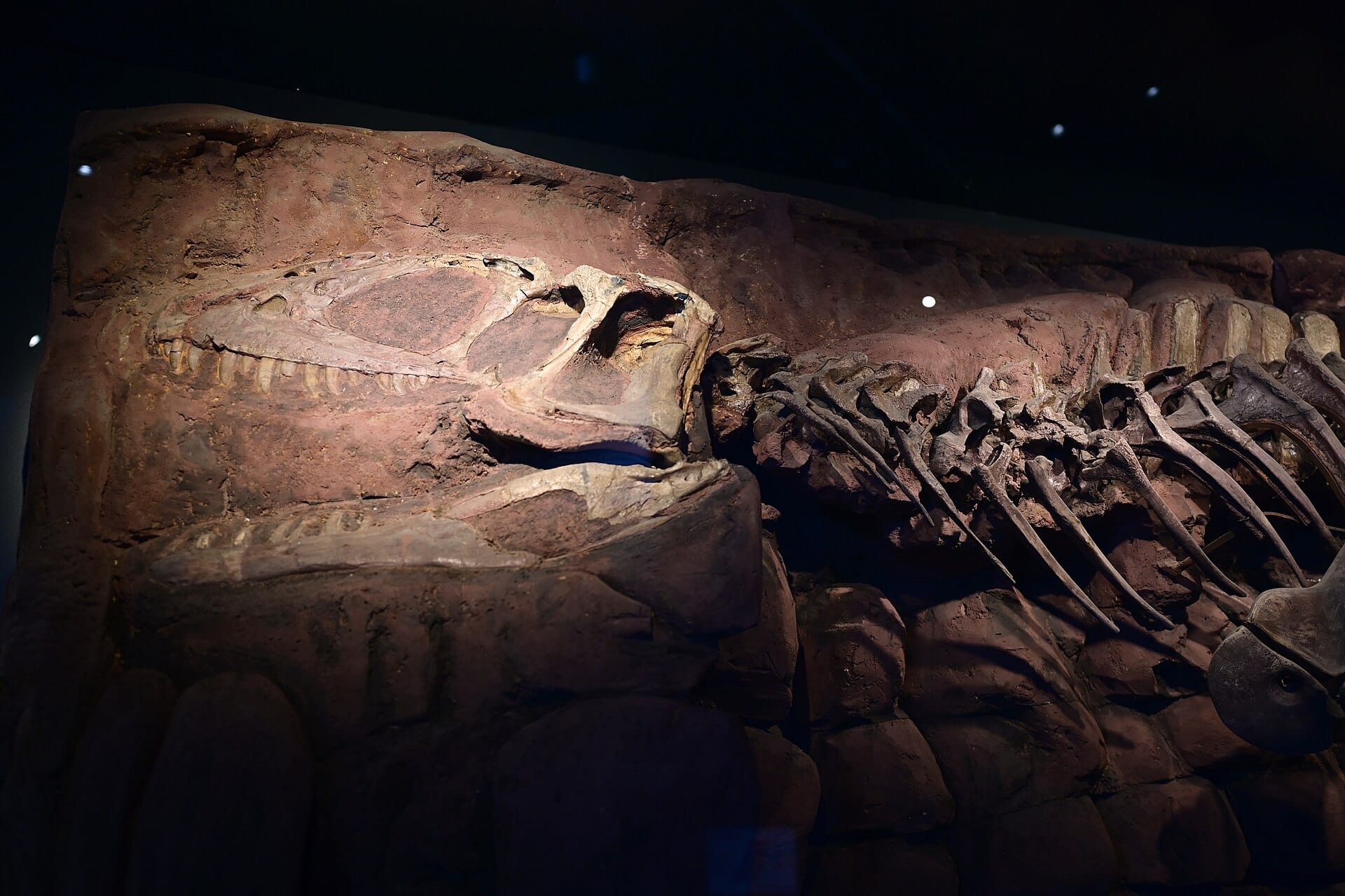

Sinraptor dongi itself is known from this single partial skeleton, yet other finds hint at more. For example, teeth possibly referable to Sinraptor were reported from Wucaiwan in 2011. In 2013, He and colleagues suggested that an isolated metatarsal (foot bone) from there may represent a different species. Earlier, in 2008, Xu and Clark reported a huge tooth from the same upper beds—which they called the largest known from any Jurassic theropod. It may come from an unusually large Sinraptor or a related form. Even so, no additional skeletons of S. dongi have been confirmed outside Jiangjunmiao.
Sinraptor Size and Description
Short description of Sinraptor
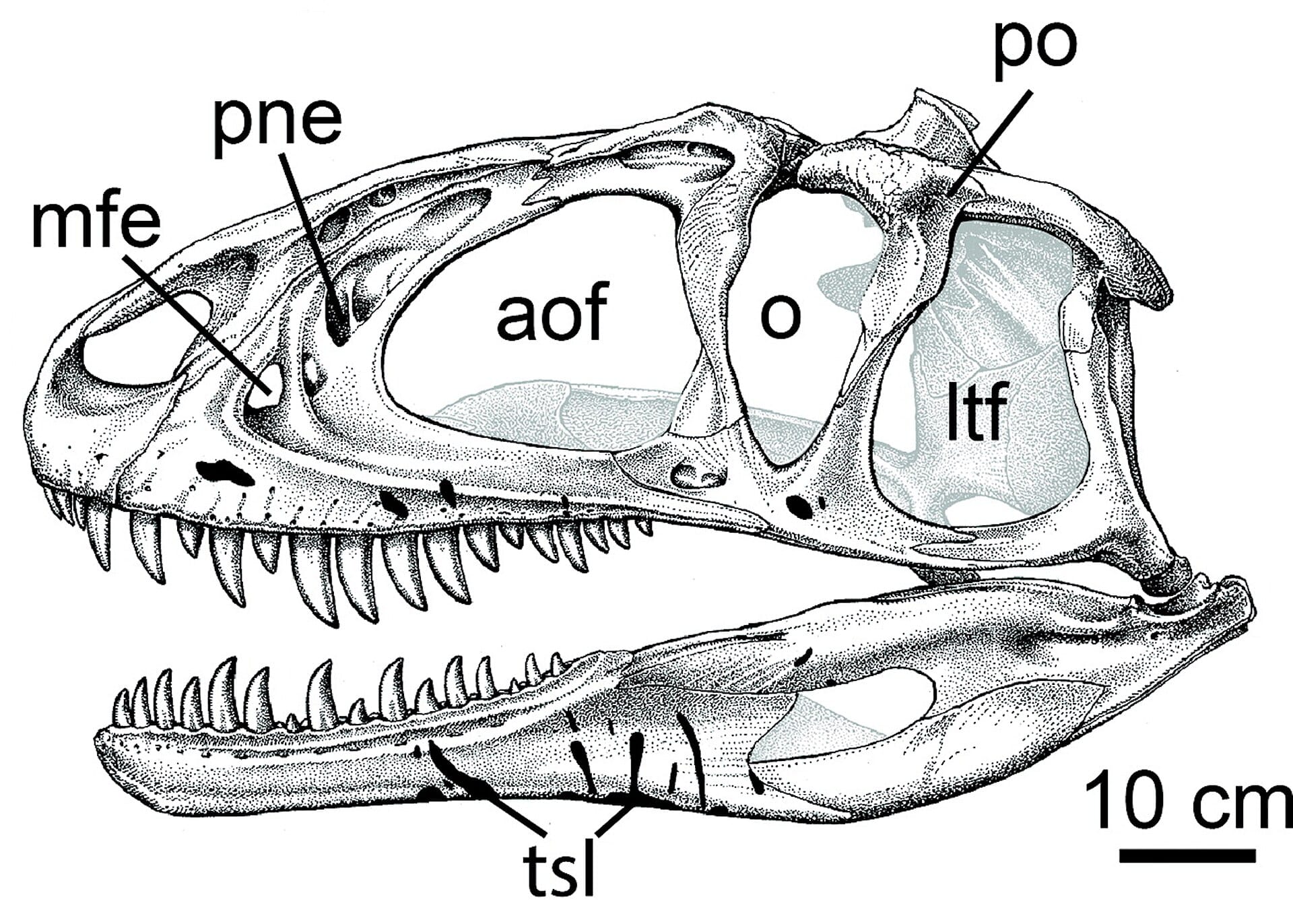
The skull was long in front of the eyes—more so than in Yangchuanosaurus—yet relatively lower in profile. A pronounced rough patch, or rugosity, sat on the postorbital bone behind each eye—what later authors call a postorbital horn. Air spaces also ran through the head, from a large pneumatopore (air-sac opening) in the jugal (cheekbone) to a hollow palatine. In addition, Hendrickx and colleagues highlight an enlarged opening behind the eye and a heavily pneumatized maxilla—the main upper jaw bone.
Each premaxilla, the bone at the tip of the snout, held four teeth. Meanwhile, the left and right maxillae carried 15 and 14 tooth sockets, while the left dentary (lower jaw bone) had 16. Farther back, Xu and colleagues in 2009 read a small bony nub on the outer hand as a possible fifth metacarpal (palm bone).
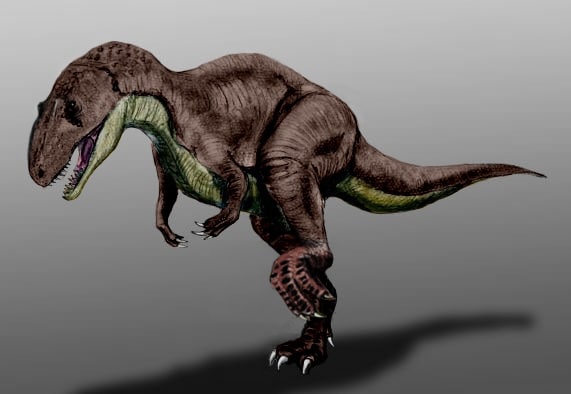

Like other theropods, Sinraptor walked on two legs. No source we consulted describes its skin, so any discussion of its integument is speculative.
Size and Weight of Type Species
Sinraptor dongi measured about 23 feet (7 meters) long, a figure Hendrickx and colleagues cite from Tanke and Currie’s 1998 study. However, that study does not say how the figure was obtained, so it is best read as approximate.
In 2020, paleontologists Nicolás Campione and David Evans compiled four body-mass reconstructions of Sinraptor. These range from about 2,200 to 3,700 pounds (1 to 1.7 metric tons). No peer-reviewed height estimate appears in the sources we consulted. For context, paleontologist Oliver Rauhut and colleagues in 2024 put metriacanthosaurids at about 16 to 26 feet (5 to 8 meters) long. By that yardstick, Sinraptor sat toward the upper end of its family.
In 2023, Moore and colleagues estimated the neck of a sauropod neighbor at more than 45 feet (14 meters)—at least twice Sinraptor‘s full length. Still, the predator appears to have had no large-bodied theropod rival in those upper beds.
The Dinosaur in Detail
What sets this dinosaur apart is a combination of skull features that Currie and Zhao used to diagnose it. They singled out the large pneumatopore in the jugal, the pronounced postorbital rugosity, and a pneumatic palatine. They also pointed to a relatively long intertemporal bar, which makes the postorbital look very short in side view.
Its teeth tell a related story. In 2020, Hendrickx and colleagues found every tooth to be ziphodont—blade-like, serrated, and curved, with no narrowing at the base. They judged the dentition particularly close to that of Allosaurus. The main differences lie in how flattened the crowns are and in the number of snout-tip teeth. Notably, one dental trait unites S. dongi with ‘Yangchuanosaurus‘ hepingensis, but none diagnoses S. dongi alone.

The braincase adds another layer. In 2012, paleontologist A. Paulina Carabajal and Currie measured its endocranial volume at 95 milliliters (3.2 fluid ounces), excluding the olfactory tract and bulbs. Its endocast, they found, more closely resembled those of Allosaurus, Carcharodontosaurus, and Giganotosaurus than that of Acrocanthosaurus. They also described a well-developed caudal tympanic recess—an air pocket at the back of the middle-ear region.
Even so, the genus’s species count remains contested. Currie and Zhao argued that a Sichuan specimen described as ‘Yangchuanosaurus‘ hepingensis is a second species of Sinraptor. Later studies by Carrano’s team in 2012 and Xu’s team in 2022 followed them. In contrast, Gao’s original 1992 description and other studies keep it in Yangchuanosaurus, while Hendrickx’s team set that genus in quotes. Taken together, Sinraptor dongi is a well-documented predator, but the borders of its genus are still open.
Interesting Points about Sinraptor
- Hendrickx and colleagues cite 28 tooth-strike lesions on the holotype’s skull and jaws, including the maxilla, jugal, and dentary.
- The paper naming Sinraptor appeared in an issue dated October 1993, although some later authors cite the name as dating from 1994.
- In 1999, Gao moved S. dongi itself into Yangchuanosaurus, a minority view that later studies cited here do not follow.
- Its original description calls Megalosaurus—the first non-bird dinosaur to be scientifically described and named, in 1824—”a related form.”
- The formation’s name, Shishugou, refers to its abundant fossilized tree trunks, some still standing upright with their roots.
Contemporary Dinosaurs
Towering over the Jiangjunmiao landscape was Mamenchisaurus sinocanadorum, a giant long-necked mamenchisaurid sauropod. Its site lies about 10 feet (3 meters) above the ash bed below Sinraptor, so the two come from closely matched levels. In 1993, Russell and Zheng estimated the whole animal at about 85 feet (26 meters) long from its articulated neck. Although they shared a landscape, no interaction between the two is recorded.
At Wucaiwan, in beds bracketed by the same two dated ashes, lay Haplocheirus sollers. This early alvarezsauroid belonged to a group whose later members were once considered flightless birds. Known from a nearly complete skeleton, it is the best-known alvarezsauroid from before the Late Cretaceous, Xu and colleagues note. Hendrickx’s team counted it among the small to medium-sized carnivores beside Sinraptor, but nothing links the two directly.
Slightly higher within that same bracket came Zuolong salleei, an early-branching coelurosaur—a member of the theropod branch that also includes alvarezsauroids. Known from an associated partial skeleton, it also appears on Hendrickx’s list of small to medium-sized carnivores. No encounter with Sinraptor is recorded.
Sinraptor in its Natural Habitat
Imagine a warm-to-hot, seasonally wet and dry plain, where small rivers wandered among lakes, ponds, and wetlands. Xu and colleagues compare the lower part of this setting to the modern Pantanal. Higher in the section, flooding and volcanic ash falls increased. Seasonally dry conditions, which Eberth and colleagues found had spread across the whole basin by about this time, persisted throughout. Jiangjunmiao had larger river channels than Wucaiwan. It is also famous for a fossil forest, whose stumps still stand about 3 feet (1 meter) tall.
As a carnivore, Sinraptor had teeth suited to contact with bone, and many crown tips are spalled or worn. Hendrickx and colleagues note that Snively and Russell in 2007 grouped it with Allosaurus as a “strike-and-tear” feeder. In that view, its neck muscles suited powerful downward strikes of the head. Hendrickx’s team added that its front teeth suited gripping and pulling on prey—a bite-and-hold style. Its crowns, they noted, could inflict wide cuts and open wounds.
While there is no direct evidence of how Sinraptor lived socially, its scarred skull hints at conflict. Tanke and Currie linked the healed wounds to aggressive biting, possibly by rivals of its own species. They named dominance within a pack and territorial behavior as two of the most likely causes. Because it appears to be the only large theropod of these beds, Hendrickx’s team concluded that face-biting most likely happened within the species. As one of the apex carnivores of the upper Shishugou, it sat at or near the top of a dynamic ecosystem.
Frequently Asked Questions
It is usually translated as “Chinese plunderer,” while the Paleobiology Database gives “China raptor.”
It lived about 162 to 160 million years ago, near the Middle–Late Jurassic boundary. Later studies assign it to the Oxfordian stage.
It was about 23 feet (7 meters) long, and published reconstructions put its weight at about 2,200 to 3,700 pounds (1 to 1.7 metric tons).
It was a carnivore, with serrated, blade-like teeth very close in form to those of Allosaurus.
Its skeleton came from the upper Shishugou Formation, 25 km northeast of Jiangjunmiao in Xinjiang, China.
Its skull combines a large air-sac opening in the cheekbone, an air-filled palatine, and a roughened postorbital “horn.” Its holotype also bears 28 tooth-strike lesions, 25 of them confirmed.
Sources
The information in this article is based on various sources, drawing on scientific research, fossil evidence, and expert analysis. The aim is to provide a comprehensive and accurate overview of Sinraptor. However, please be aware that our understanding of dinosaurs and their world is constantly evolving as new discoveries are made.
- https://doi.org/10.1139/e93-179
- http://hdl.handle.net/1807/100823
- https://doi.org/10.1139/cjes-2019-0231
- https://par.nsf.gov/servlets/purl/10382909
- https://doi.org/10.1111/1755-6724.14996
- https://ivpp.cas.cn/cbw/gjzdwxb/xbwzxz/201204/t20120423_3561443.html
- https://era.library.ualberta.ca/items/01b0f3a0-10b6-4b88-80f4-7b22987946b2
- https://doi.org/10.1080/14772019.2011.630927
- https://doi.org/10.1371/journal.pone.0143369
- https://doi.org/10.2110/palo.2009.p09-028r
- https://doi.org/10.1038/nature08124
- https://doi.org/10.1038/nature04511
- https://doi.org/10.1139/e93-180
- https://doi.org/10.1080/14772019.2023.2171818
- https://doi.org/10.1139/e01-067
- https://academic.oup.com/zoolinnean/article/201/4/zlae090/7731089
- https://paleobiodb.org/data1.2/taxa/opinions.txt?base_name=Sinraptor&op_type=all&show=ref
- https://www.nhm.ac.uk/discover/dino-directory/sinraptor.html
- https://cran.r-project.org/src/contrib/Archive/MASSTIMATE/MASSTIMATE_2.0.tar.gz
- https://stratigraphy.org/ICSchart/ChronostratChart2024-12.pdf
This article was last fact checked: TheDinosaurs Team, 02-11-2026
Featured Image Credit: Jonathan Chen, CC BY 4.0, via Wikimedia Commons
