
On the eastern bank of southern Alberta’s Bow River, a cliff exposes the coal beds of the Foremost Formation. From its base came the scattered skull of Thanatotheristes degrootorum, a large tyrannosaurine theropod named in 2020. Its describers placed it in the mid-Campanian stage of the Late Cretaceous, about 79.5 million years ago. That age makes it, in the words of paleontologist Darla Zelenitsky, “the oldest occurrence of a large tyrannosaur in Canada.” Its skull also points to a northern lineage of long- and deep-snouted predators.
John and Sandra De Groot of the nearby town of Hays found the bones. They had apparently tumbled from the cliff in a small landslide and lay scattered along the shore. The fragments then lay in a drawer at the Royal Tyrrell Museum. Eventually, Jared Voris—then a University of Calgary PhD student—recognized them as a new species and named it with three colleagues. Paleontologist François Therrien hailed it as “the first new species of tyrannosaur to be discovered in Canada in 50 years.” Its story shows how much a few skull bones can reveal about the rise of the great tyrannosaurs.
Thanatotheristes Key Facts
| Keyword | Fact |
|---|---|
| Pronunciation | tha-NAH-toe-THER-ist-ees |
| Meaning of name | Reaper of Death |
| Group | Theropoda |
| Type Species | Thanatotheristes degrootorum |
| Diet | Carnivore |
| When it Lived | About 79.8 to 79.5 MYA |
| Period | Cretaceous |
| Epoch | Late Cretaceous (Campanian stage) |
| Length | About 26 feet (8 meters), lead author’s estimate in a 2020 press release |
| Height | Not specified |
| Weight | Not specified |
| Mobility | Moved on two legs (bipedal), inferred from relatives |
| First Discovery | 2008 by John and Sandra De Groot (brought to the museum’s attention in 2010) |
| Described by | 2020 by J.T. Voris, F. Therrien, D.K. Zelenitsky, and C.M. Brown |
| Holotype | TMP 2010.5.7 |
| Location of first find | Taber Coal Zone, Foremost Formation, Bow River near Hays, southern Alberta, Canada |
Thanatotheristes Origins, Taxonomy and Timeline
The genus name joins Thanatos, the Greek god and embodiment of death, with the Greek theristes, “one who reaps or harvests”—a reaper. The University of Calgary’s announcement rendered the whole as “reaper of death.” Meanwhile, the species name degrootorum honors John and Sandra De Groot. Together, the name reads, as Therrien put it in The Canadian Encyclopedia, “the De Groots’ Reaper of Death.”
Thanatotheristes is a theropod, or meat-eating dinosaur, and a member of the family Tyrannosauridae. Within that family, Voris and colleagues placed it among the tyrannosaurines (subfamily Tyrannosaurinae), as the sister taxon of the late Campanian Daspletosaurus. They argued that the pair belong to a clade of long-, deep-snouted tyrannosaurines found only in northern Laramidia (western North America). In the same paper, Voris and colleagues named this group Daspletosaurini, then made up of Thanatotheristes, Daspletosaurus torosus, and D. horneri. In 2022, paleontologists Elías Warshaw and Denver Fowler added a third species, D. wilsoni. Thanatotheristes degrootorum is the type and only known species.
The original description places the fossils in the Taber Coal Zone, near the top of the Foremost Formation. Citing ash dates from that zone, it gives an age of about 79.5 million years. Later, Warshaw and Fowler bracketed the whole formation at roughly 80.5 to 79.5 million years ago. Older papers, however, gave the same beds about 78 million years. The gap is one of calibration rather than rock. In 2015, Elizabeth Freedman Fowler and John Horner recalibrated an ash from equivalent beds in Montana, moving it from 78.5 to about 79.8 million years. Either way, it was a time when the Western Interior Seaway was retreating eastward.
Discovery & Fossil Evidence
The holotype came from the foot of a cliff about 36 feet (11 meters) high. The site lies a third of a mile (0.5 kilometers) upstream of “The Forks,” where the Bow meets the Oldman. According to Therrien’s encyclopedia entry, the De Groots found the bones in 2008. Then, in 2010, a Royal Tyrrell Museum paleontologist visiting a local school recognized them as tyrannosaurid, and the museum tentatively identified them as Daspletosaurus. By contrast, the University of Calgary release dates the find to 2010, apparently the year of that handover.
The Royal Tyrrell Museum of Palaeontology in Drumheller, Alberta, holds the holotype, TMP 2010.5.7—a partial skull from a large subadult (nearly grown individual). Its pieces include the right maxilla (main upper tooth-bearing bone), jugal (cheekbone), postorbital (bone behind the eye), and surangular (rear lower-jaw bone). Alongside them are the right quadrate (jaw-joint bone), right laterosphenoid (braincase wall), left frontal (skull-roof bone), and both dentaries (lower jaws). Because the fragments lay strewn along 33 feet (10 meters) of shoreline, their exact level is unknown. Still, Voris and colleagues judged that they probably fell from the lower half of the cliff in a small landslide. In all, nine named bones survive, in more than ten pieces.
A second specimen, TMP 2018.16.1, is a partial maxilla from another subadult—the only other one in the original description. It came from Twelve Mile Coulee, about 6 miles (10 kilometers) northeast of Hays, high in the Herronton Sandstone.
Thanatotheristes Size and Description
Only skull bones are known, so every picture of the whole animal leans on its relatives.
Short description of Thanatotheristes
The maxilla preserves 12 teeth but likely held at least 15—a sign of a long snout, as in Daspletosaurus. Meanwhile, the right dentary had 15 tooth positions. The maxilla’s outer surface was extremely rugose (rough-textured) and cut by deep, branching grooves, much as in its sister genus. Below the eye, the jugal had a wide, rounded margin—oval in cross-section rather than blade-like, as it is in Daspletosaurus. The lower jaw nearly matched the largest known Daspletosaurus in depth, yet was much narrower than in individuals of similar size.
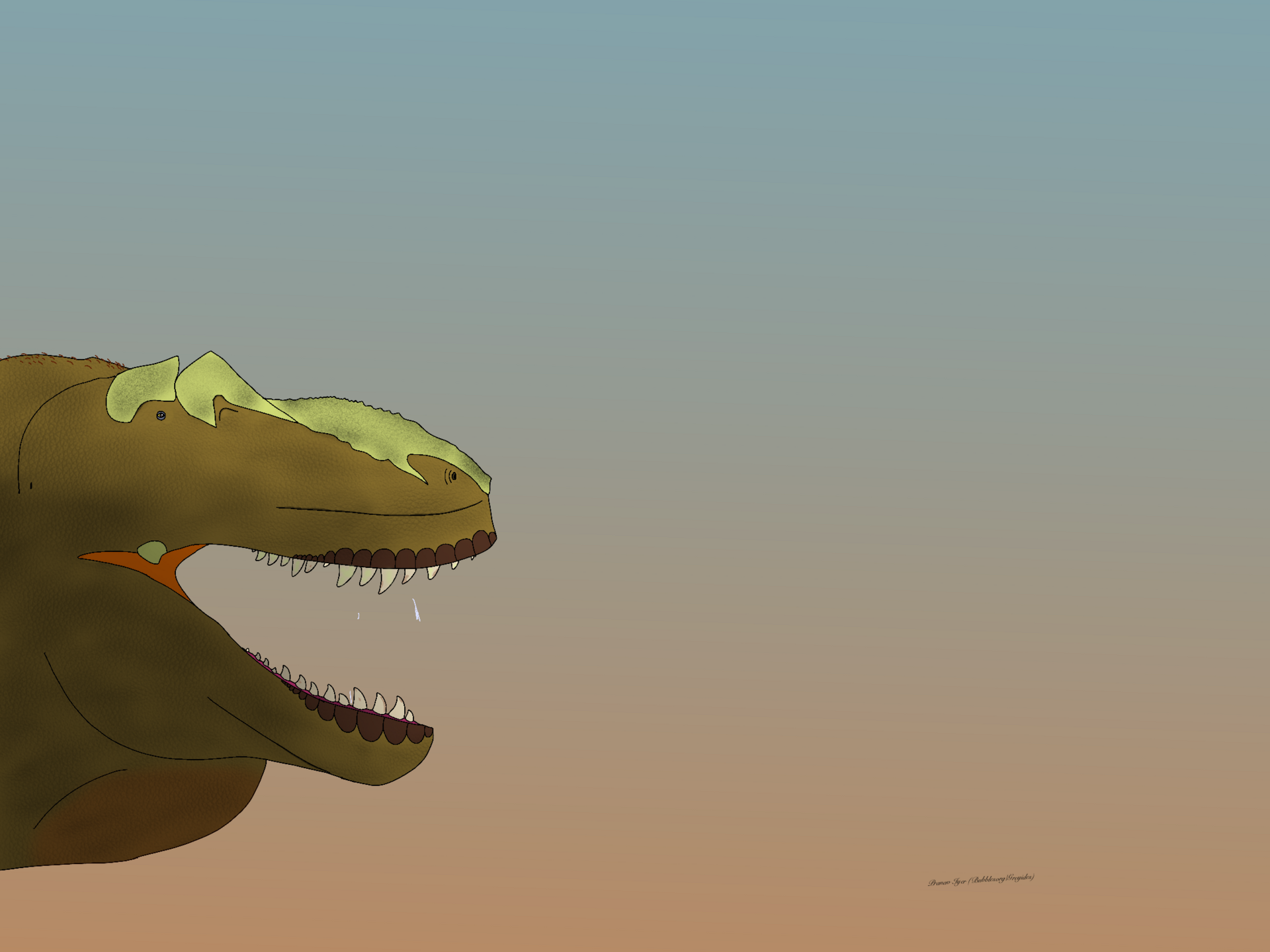

The Canadian Encyclopedia gives it two legs, powerful hindlimbs, and short forelimbs, but that picture comes from its family. Similarly, the skull reconstruction in the original paper fills its gaps with the Daspletosaurus torosus holotype. No skin impressions or soft tissue survive, so its outer covering is guesswork.
Size and Weight of Type Species
With no skeleton known, the original description offers only an indirect skull estimate. Working from the width of the frontal bone, Voris and colleagues put the skull at about 31.5 inches (800 millimeters) long.
Voris later told the University of Calgary the animal was about 26 feet (8 meters) long, without giving his method. By contrast, The Canadian Encyclopedia gives up to 33 feet (10 meters) and 1.3 to 2.5 metric tons. However, those figures cover both Thanatotheristes and Albertosaurus, so they are a general range, not a holotype measurement.
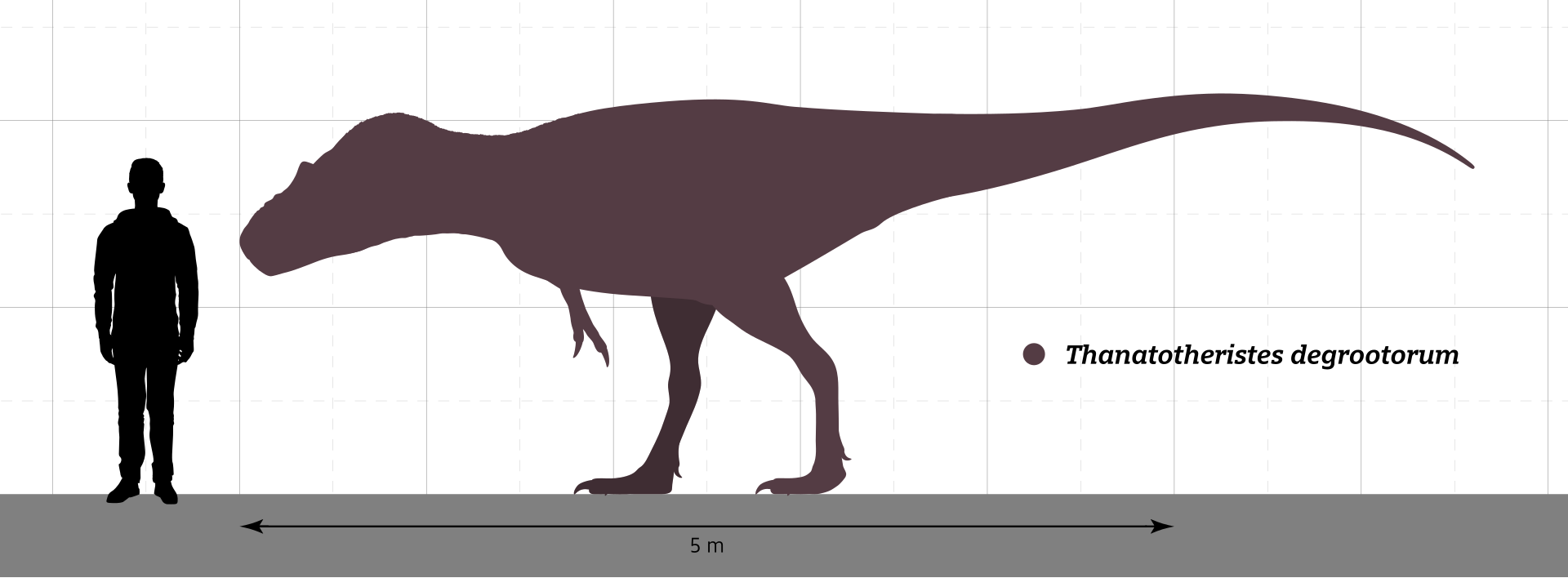

No peer-reviewed body mass has been published, and we found no hip-height estimate either.
The Dinosaur in Detail
What sets this dinosaur apart are five features its describers listed as unique. First, the maxilla bears a single row of evenly spaced, vertical ridges below the antorbital fossa (a recess before the eye). In addition, the jugal has a rounded, inflated rim around the eye socket. A crest on the frontal also runs forward as a broad, rounded ridge. The last two sit where the frontal meets its neighbors—a lacrimal contact at about 60 degrees and a two-pronged prefrontal joint.
Those ridges have since gained a twist. In 2022, Warshaw and Fowler noted that Zhuchengtyrannus, Tarbosaurus, Tyrannosaurus, and Thanatotheristes share maxillary textural ridges, unlike Daspletosaurus. However, the original paper had already drawn a line—those three giants carry two or more rows of uneven ridges. In 2021, paleontologists Caleb Brown and Philip Currie, with Therrien, also ruled out the ridges as bite marks, since they lack remodeled bone.
Real wounds are present, though. The maxilla carries a prominent healed bite mark that drags down to the tooth row at the sixth socket. Brown and colleagues later examined the holotype in their study of facial bite scars. Voris’s team, for their part, judged this subadult probably sexually mature, based on its well-developed facial ornament.
Its link to Daspletosaurus rests on shared traits, such as a coarse maxilla, many teeth, a wide prefrontal, and a dentary “chin.” Later analyses have handled it with care. In 2022, Warshaw and Fowler dropped it from their analysis, since including so fragmentary a taxon collapsed their tree. In 2025, however, Voris and colleagues kept it in a broader analysis, scoring only about a fifth of its characters. Taken together, the skull reads as a close cousin of Daspletosaurus—similar in snout, yet distinct in cheek and jaw.
Interesting Points about Thanatotheristes
- The Royal Canadian Mint honored Thanatotheristes with a $20 engraved silver collector coin in 2021, the year after its naming.
- Its describers argued that Tyrannosauridae was made of several geographically separate clades, not a simple chain of single-genus branches.
- According to Therrien, the find shows that tyrannosaurs were already living in Alberta before 77 million years ago.
- No eggs or eggshell are known for Thanatotheristes—or, for that matter, for any tyrannosaurid.
Contemporary Dinosaurs
Sharing the Foremost landscape was Xenoceratops foremostensis, a centrosaurine ceratopsid (horned dinosaur) known largely from bones of its frill. Therrien’s encyclopedia entry names it among the herbivores that coexisted with Thanatotheristes. The University of Calgary release adds that the reaper likely preyed on it, although no fossil records such an encounter. Earlier work dated its upper Foremost beds to about 78 million years, matching the old Taber Coal Zone figure.
Also present was Colepiocephale, a pachycephalosaur (dome-headed dinosaur). In 2018, Brown counted it as one of only two named Foremost dinosaurs outside microfossil sites. Therrien also lists it among the reaper’s neighbors, and the release names it as likely prey. Its describers place Thanatotheristes in the middle Campanian alongside it. However, the sources we checked give no exact level for Colepiocephale within the formation.
Rounding out the list is Probrachylophosaurus, a brachylophosaurin—a duck-billed dinosaur of the group named for Brachylophosaurus. In 2021, paleontologist Mira Thompson and colleagues referred a partial skeleton and bonebed material from the Foremost to this genus, though not to a species. They called it the oldest hadrosaurid from Canada that can be identified to genus. Sources confirm it only at formation level, so its overlap in time with Thanatotheristes is unverified, and no interaction is known.
Overall, the Foremost dinosaur record is thinner than that of later Belly River Group units, although small fossil sites hint at a reasonably diverse fauna.
Thanatotheristes in its Natural Habitat
The world Thanatotheristes roamed was a subtropical coastal plain on the western shore of the Western Interior Seaway. As the sea withdrew during the Claggett regression, estuaries and shallow seas gave way to coastal and river settings. At the type locality, coal beds alternate with sandstones and mudstones. Near the coast, marginal waters suffered frequent oxygen and salinity stress, and small fossil sites show a mix of fresh and brackish water.
According to The Canadian Encyclopedia, mature tyrannosaurids commonly fed on megaherbivores—very large plant-eaters such as duckbills and horned dinosaurs. While there is no direct evidence of its diet, Thanatotheristes may have crushed and swallowed bone, as other tyrannosaurines did. The same source suggests that its strong jaws let it capture and hold struggling prey. Meanwhile, in 2024, Thompson and colleagues found that ceratopsids and ankylosaurs (armored dinosaurs) declined in relative abundance at microfossil sites. That decline ran from the Foremost into the lower Oldman Formation.
Nothing is known about the social behavior of Thanatotheristes. Its healed facial bite, however, shows that this individual survived at least one bite to the face. Brown and colleagues tie such scars in tyrannosaurids to clashes between members of the same species, which likely began around sexual maturity. For now, this reaper is known almost entirely by its face—and that face bears scars.
Frequently Asked Questions
It means “reaper of death,” from the Greek Thanatos and theristes, and the species name honors finders John and Sandra De Groot.
It lived in the mid-Campanian stage of the Late Cretaceous, about 79.5 million years ago.
Its skull is estimated at about 31.5 inches long. Lead author Jared Voris put the whole animal at about 26 feet.
It was a carnivore that, like other mature tyrannosaurids, may have fed on large plant-eating dinosaurs.
Its skull came from the Foremost Formation on the Bow River, near Hays in southern Alberta, Canada.
Its maxilla bears a single row of evenly spaced vertical ridges, one of five features its describers found in no other tyrannosaurid.
Sources
The information in this article is based on various sources, drawing on scientific research, fossil evidence, and expert analysis. The aim is to provide a comprehensive and accurate overview of Thanatotheristes. However, please be aware that our understanding of dinosaurs and their world is constantly evolving as new discoveries are made.
- https://doi.org/10.1016/j.cretres.2020.104388
- https://tb.plazi.org/GgServer/xhtml/039E87F3FFE7FFDAB92BDBF56DCEFC17
- https://tb.plazi.org/GgServer/xhtml/039E87F3FFE7FFD0B92BDB616B43FA14
- https://doi.org/10.7717/peerj.14461
- https://doi.org/10.1371/journal.pone.0141304
- https://doi.org/10.7717/peerj.4265
- https://doi.org/10.1017/pab.2021.29
- https://doi.org/10.1139/cjes-2020-0007
- https://doi.org/10.2110/palo.2022.061
- https://www.thecanadianencyclopedia.ca/en/article/thanatotheristes
- https://ucalgary.ca/news/new-large-meat-eating-dinosaur-discovered-alberta
- https://www.sci.news/paleontology/thanatotheristes-degrootorum-08109.html
- https://doi.org/10.1038/s41586-025-08964-6
This article was last fact checked: TheDinosaurs Team, 05-11-2026
Featured Image Credit: Sittaco, CC0 1.0, via Wikimedia Commons
