
Along Sand Creek in Carter County, Montana, the Hell Creek Formation yielded a tyrannosaur skull that has long divided paleontologists. Named Nanotyrannus lancensis, it lived late in the Maastrichtian stage of the Cretaceous—within about a million years of the end-Cretaceous extinction. The 1988 paper that gave it its genus name called it “the smallest known tyrannosaurid dinosaur.” Whether it was a genus of its own or simply a young Tyrannosaurus has been argued in print ever since.
The skull was collected on August 16, 1942, by David H. Dunkle during a Cleveland Museum of Natural History expedition. In 1946, Charles W. Gilmore described it as a new species of Gorgosaurus—a paper that appeared after his death in 1945. Paleontologists Robert T. Bakker, Michael Williams, and Philip Currie then gave it a genus of its own in 1988. Since then, new skeletons, bone histology (the microscopic structure of bone), and a precisely dated quarry have reshaped the case.
Nanotyrannus Key Facts
| Keyword | Fact |
|---|---|
| Pronunciation | Not specified |
| Meaning of name | Small Tyrant |
| Group | Theropoda (Tyrannosauroidea) |
| Type Species | Nanotyrannus lancensis (originally Gorgosaurus lancensis) |
| Diet | Carnivore |
| When it Lived | 67 to 66 MYA |
| Period | Cretaceous |
| Epoch | Late Cretaceous (Maastrichtian stage) |
| Length | About 17 to 19.7 feet (5.2 to 6 meters), from press and news reports |
| Height | Not specified |
| Weight | About 1,980 to 3,310 pounds (900 to 1,500 kilograms), the most likely range in Longrich and Saitta 2024, or about 1,500 pounds in 2025–2026 press reports |
| Mobility | Moved on two legs (bipedal) |
| First Discovery | 1942 by David H. Dunkle |
| Described by | 1946 by C.W. Gilmore (as Gorgosaurus lancensis), with the genus named in 1988 by R.T. Bakker, M. Williams, and P.J. Currie |
| Holotype | CMNH 7541 |
| Location of first find | Hell Creek Formation, Sand Creek, Carter County, Montana, USA |
Nanotyrannus Origins, Taxonomy and Timeline
The name Nanotyrannus joins “nano,” which its namers glossed as “small,” with “tyrannus,” Latin for “tyrant.” Its species name lancensis refers to the Lance Formation, Gilmore’s name for the rocks that held the skull. A second species, N. lethaeus, takes its 2025 name from the River Lethe of Greek mythology—the river of forgetfulness—because, as a Stony Brook University release and Science News explain, it went unnoticed for decades. Together, the names tell a story of small size, an old rock name, and late recognition.
Gilmore placed the skull in the tyrannosaur family, then called Deinodontidae, and assigned it to Gorgosaurus because it closely resembled G. libratus and G. sternbergi. Even so, its geologic occurrence, smaller size, and slight differences justified a new species. Later, in 1970, Russell moved it to Albertosaurus as A. lancensis. Bakker and colleagues objected that Gilmore’s assignment would make Gorgosaurus span three faunal ages, implausible for a large dinosaur genus. They placed Nanotyrannus within Tyrannosauridae but argued that its resemblance to T. rex was convergent—it probably descended from a very primitive tyrannosaurid.
Bakker’s team placed the holotype—the specimen on which the name rests—in the Lancian faunal age of the latest Cretaceous. In 2026, Roberts and colleagues dated the quarry of a referred skeleton to about 66.9 million years ago. Locally, the formation spans roughly 67.1 to 66.0 million years ago, about 1.08 million years in all. That places Nanotyrannus in the closing stretch of the Maastrichtian, which ended with the extinction at the Cretaceous–Paleogene boundary.
Discovery & Fossil Evidence
In 1942, a Cleveland Museum of Natural History expedition under Dunkle explored the Lance beds of Carter County. Gilmore listed the skull and its jaws “Among the important discoveries” of that trip. Until then, he noted, only scattered teeth and phalanges (finger and toe bones) had hinted at tyrannosaurs other than Tyrannosaurus in these rocks.
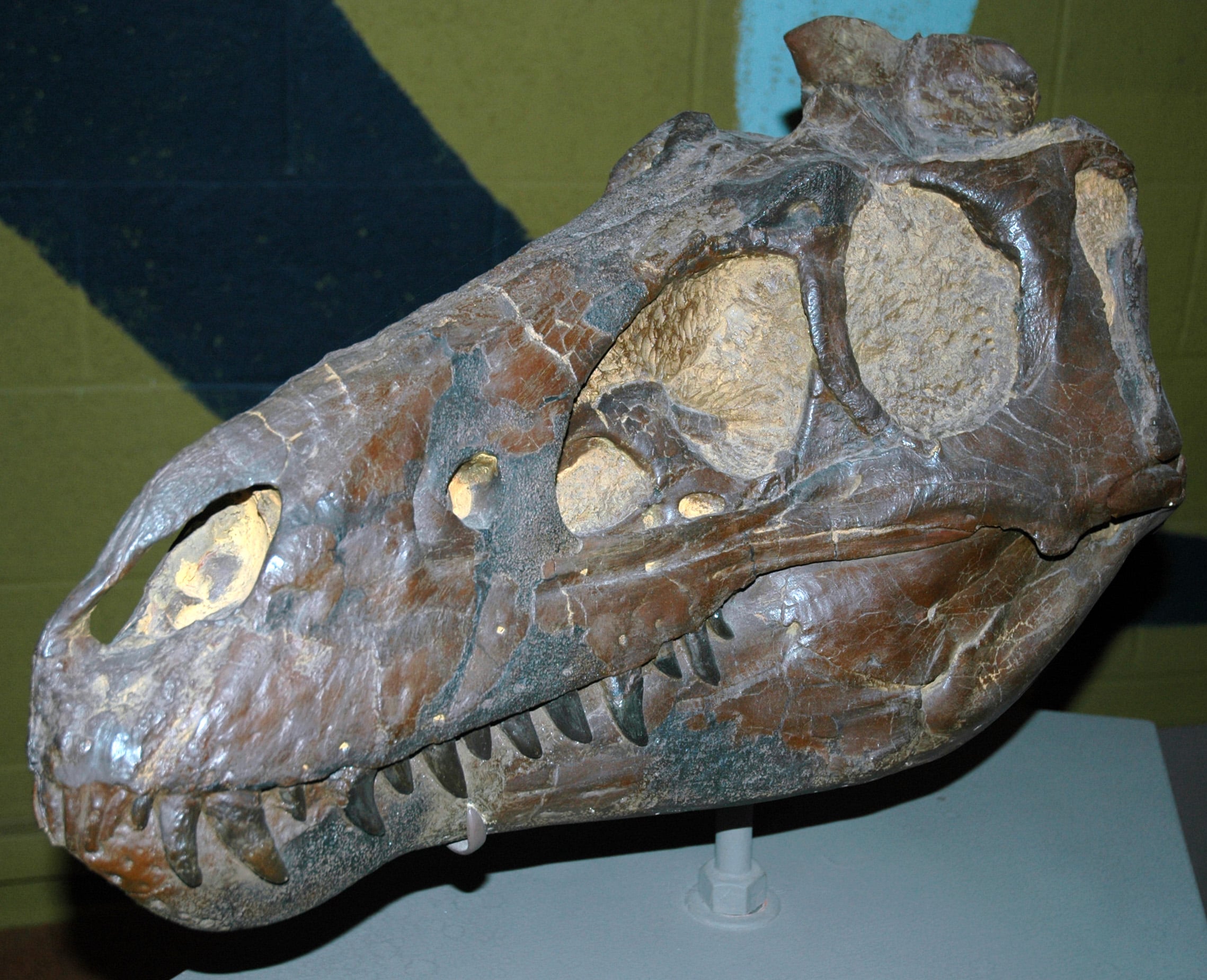
Bakker’s team described the holotype, CMNH 7541, as a “complete skull and lower jaws in occlusion”—that is, with the mouth closed. Gilmore called it nearly complete, although it lacked several bones on its right side, including the squamosal (a rear skull bone). Because the jaws were locked together, the lower teeth stayed hidden, and separating them risked “permanent injury to the specimen.” Gilmore also identified a slender hyoid, or throat bone, about 9.2 inches (234 millimeters) long and still embedded in rock.

In 1988, Bakker’s team also referred three teeth found by D. Reinheimer in 1924 in Corson County, South Dakota. In 2024, paleontologists Nicholas R. Longrich and Evan T. Saitta referred several more skeletons, including one nicknamed Jane (BMRP 2002.4.1) and the Dueling Dinosaurs tyrannosaur. That skeleton, found in 2006 according to NPR, lies entwined with a Triceratops and came from a commercial dig at Murray Ranch, southwest of Jordan, Montana.
Nanotyrannus Size and Description
Because the holotype preserves only a head, much of the body comes from referred skeletons whose identity paleontologists still argue over.
Short description of Nanotyrannus
The skull is long and low. In fact, Bakker and colleagues called its snout longer and lower than in any other tyrannosaurid except Alioramus. At mid-length, the snout is only 13 percent as wide as the skull is long, while the width across the jaw joints reaches 57 percent. The braincase floor—the basicranium—is extraordinarily wide, with two large pneumatic foramina (air-filled openings) near its midline. Its maxillary (main upper jaw) teeth are compressed side to side and blade-like.
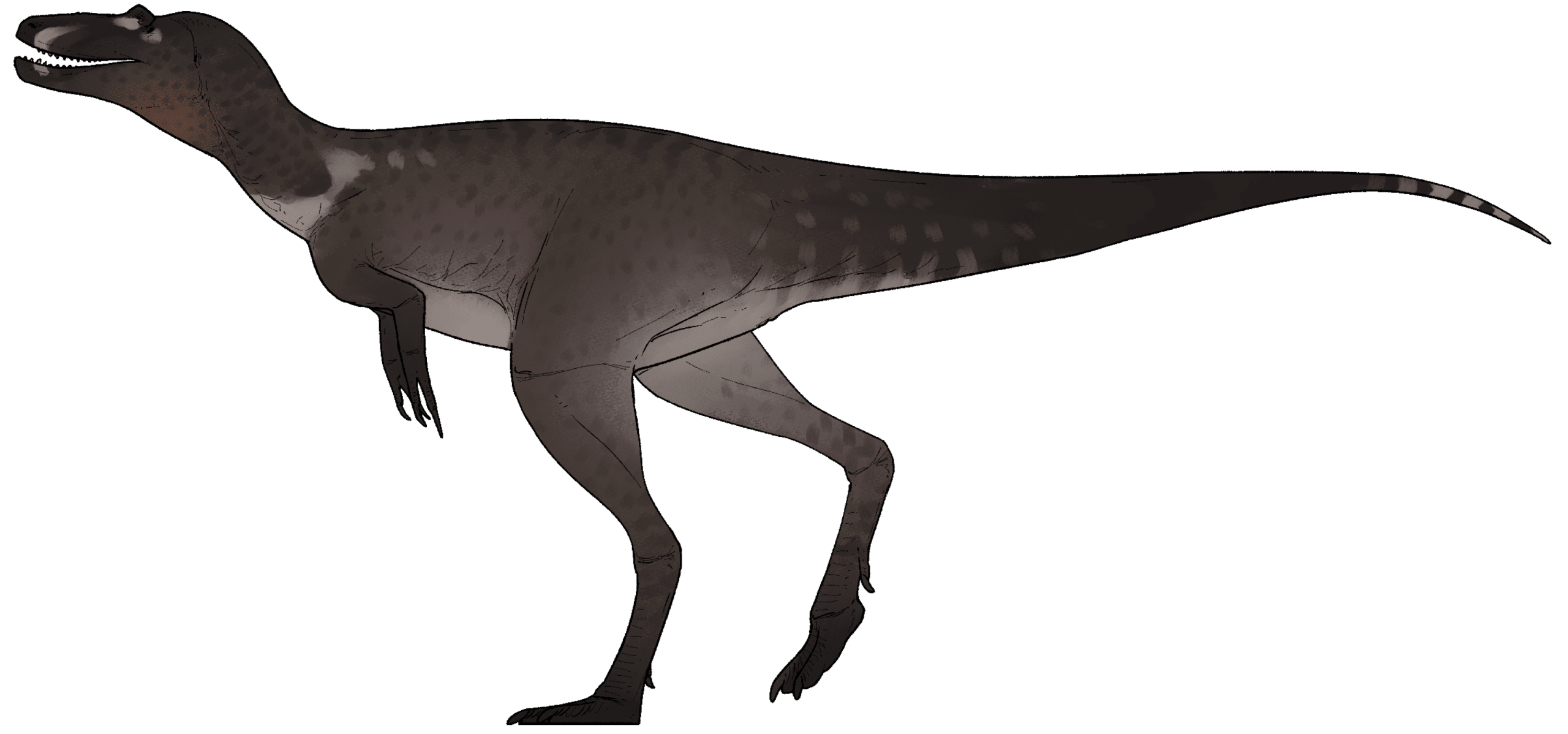
For the body, a North Carolina State University release credited NCSM 40000 with proportionally larger forelimbs, more teeth, and fewer tail vertebrae than T. rex. According to Science News, its tail held 35 vertebrae, compared with about 40 in an adult T. rex. Coauthor Napoli further described “very long arms with a vestigial third finger,” a Stony Brook release reported.
Size and Weight of Type Species
The holotype skull is about 22.5 inches (572 millimeters) long, as measured by both Gilmore and Bakker’s team. In 1988, Bakker and colleagues called it “the smallest adult tyrannosaurid skull known.” By their own measurements, it is 10 to 16 percent shorter than the type skulls of Alioramus and G. sternbergi. However, they gave no body length, and their skeletal outline borrowed a G. sternbergi body scaled to the skull.
For the whole animal, every figure is an estimate. In 2024, Longrich and Saitta used thigh-bone girth and growth curves to estimate adult mass. They judged about 1,980 to 3,310 pounds (900 to 1,500 kilograms) the most likely range. A 2025 Nature Asia press release instead cited a maximum near 1,540 pounds (700 kilograms). It gave roughly 14,800 to 18,100 pounds (6,700 to 8,200 kilograms) for T. rex.
For length, Science News reported about 19.7 feet (6 meters) for NCSM 40000. Zanno told Live Science it was “only half the length and about 1/10th of the mass” of a grown T. rex. Meanwhile, a Natural History Museum of Los Angeles County release gave a mature animal about 17 feet (5.2 meters) and 1,500 pounds.
The Dinosaur in Detail
The Juvenile Hypothesis
What sets Nanotyrannus apart is the long argument over what its bones represent. Gilmore read its fused sutures as a sign of adulthood, and Bakker’s team called it “Without question… fully adult.” They argued that its forward-facing eyes gave it stereoscopic, or depth-perceiving, vision evolved independently of Tyrannosaurus. As Carr later noted, however, Rozhdestvensky had proposed a young T. rex in 1965, and Carpenter raised the idea in 1992.
In 1999, Carr reported immature, striated bone texture across most of the skull and found none of the claimed fusions. He found 13 characters shared with T. rex and judged N. lancensis a junior synonym—a later name for the same species. In 2020, Woodward and colleagues examined the bone histology of Jane and a second skeleton. Both were immature, aged 13 to 15 years, and the results supported folding Nanotyrannus into Tyrannosaurus. That same year, Carr’s T. rex growth series also treated the holotype as a juvenile. In January 2026, however, an expanded PeerJ study led by Woodward found the two skeletons’ growth records “statistically incompatible” with those of other Tyrannosaurus. Its authors added that their data did not settle whether Nanotyrannus is valid.
The Case for a Separate Genus
In 2024, Longrich and Saitta countered with six lines of evidence and 158 characters they argued separate it from T. rex. Finding no intermediates, they suggested it may sit outside Tyrannosauridae as the family is now defined—where, they argued, Bakker’s early-branching tree would also put it. Then, in 2025, Zanno and Napoli reported that NCSM 40000 shares autapomorphies—unique traits—with the holotype. They placed the genus outside Tyrannosauridae in a new family, Nanotyrannidae, with two species. Jane became the holotype of the second, N. lethaeus. Meanwhile, the other 2020 skeleton (BMRP 2006.4.4) went to Nanotyrannus without a species name.

Soon after, Griffin and colleagues examined throat-bone histology in the holotype for a Science paper dated 2026. They concluded it “was nearing or had reached skeletal maturity.” A Los Angeles museum release and National Geographic reported about eight growth rings, against about two in a teenage T. rex.
Reactions have been mixed. In Live Science, Carr accepted the Dueling Dinosaurs animal as a small adult. But he would keep it in Tyrannosaurus as a sister species, Tyrannosaurus lancensis, and still saw Jane as a young T. rex. Brusatte said “I was wrong—at least in part,” yet doubted N. lethaeus because Jane “clearly had not stopped growing.” In National Geographic, Jared Voris suggested the bone’s outer layers might be closely spaced rings, not proof that growth had stopped.
Similarly, Holly Woodward Ballard told Science News she was unconvinced Jane is a new species, or a Nanotyrannus at all. An addendum to her 2026 paper called Zanno and Napoli’s referral “a possible explanation” but proposed “alternative testable hypotheses,” such as growth stunted by illness or scarce resources. A 2026 University of Nebraska–Lincoln release said the question “now appears largely resolved.” Even so, both the genus and N. lethaeus are still argued over in print.
Interesting Points about Nanotyrannus
- The holotype’s lacrimal “horn” near the eye turned out to be plaster restoration, and Bakker’s team saw no clear horn on the bone beneath.
- Zanno coauthored the 2020 histology study that supported merging Nanotyrannus into Tyrannosaurus, then coauthored the 2025 study that separated them.
- Bakker and colleagues proposed that large air-passage openings in its braincase, as in other tyrannosaurs, may have helped cool the brain or sharpen hearing.
- A Cleveland Museum of Natural History release says the throat bone studied by Griffin’s team had sat “in a small box” beside the skull.
Contemporary Dinosaurs
All four neighbors below lived in the Hell Creek Formation during the Maastrichtian. Most census records, however, come from the Fort Peck area, not the holotype site.
Lying beside NCSM 40000 in the same quarry was a Triceratops, cataloged as NCSM 40001. Bakker’s team called this horned dinosaur “the most common large Lancian herbivore,” armed with “very long, sharp horns.” They hypothesized that predators needed depth perception to tackle it. While the pair lie together, no study has established that they died fighting.
Prowling the same landscape was Tyrannosaurus, which Bakker’s team called the most common large predator of the Lancian. In 2011, Horner and colleagues found its skeletons as abundant as Edmontosaurus in the upper Hell Creek. Zanno and Napoli concluded that the two tyrannosaurs coexisted. A Los Angeles museum release also suggested Nanotyrannus likely competed with juvenile T. rex for prey.
Sharing those floodplains was Edmontosaurus, a hadrosaurid, or duck-billed herbivore, counted in the 2011 Hell Creek census. Bakker’s team counted Edmontosaurus annectens among the animals defining the Lancian fauna. Still, no fossil records a direct interaction with Nanotyrannus.
Adding further variety was Pachycephalosaurus, known for a dense, domed skull roof. Horner and colleagues listed it among Hell Creek genera, following Horner and Goodwin’s 2009 proposal to fold Stygimoloch and Dracorex into it. Even so, no contact with Nanotyrannus is documented.
Nanotyrannus in its Natural Habitat
The world Nanotyrannus roamed was an extensive floodplain crossed by meandering rivers, with short-lived backwater deposits. Near the Dueling Dinosaurs quarry, researchers identified 107 species of palynomorphs—fossil pollen and spores—all from land or fresh water. They point to rivers, swamps, and lakes, with swamp fern spores dominating some samples.
As a carnivore, Nanotyrannus had sharp, blade-like teeth that Bakker’s team said “indicate that the bite delivered a long, narrow wound.” In their view, it “could not produce the bone-crushing bite” of Tyrannosaurus. Much later, Zanno described it in a North Carolina State release as “a leaner, swifter and more agile hunter.”
According to the 2025 study, the Dueling Dinosaurs animal was about 20 years old and near somatically mature (close to full size) when it died. Earlier, Longrich and Saitta had found that its specimens gained at most about 330 pounds (150 kilograms) a year in their last years—far below the T. rex peak. Whatever the final verdict, its bones remain a test case for telling young dinosaurs from small adults.
Frequently Asked Questions
It means “small tyrant,” joining “nano,” which its namers glossed as “small,” with the Latin “tyrannus.”
It lived in the Maastrichtian stage of the Late Cretaceous, around 67 to 66 million years ago.
Its skull is about 22.5 inches long. Press reports suggest about 17 to 19.7 feet and roughly 1,500 pounds, while a 2024 study judged 1,980 to 3,310 pounds most likely.
It was a carnivore with blade-like teeth suited, its describers argued, to slicing rather than bone-crushing bites.
Its holotype skull was found in 1942 at Sand Creek in Carter County, Montana, in the Hell Creek Formation.
Studies in 1999 and 2020 concluded it was. Studies since 2024 argue it is a distinct small tyrannosaur, but some experts would keep it within Tyrannosaurus.
Sources
The information in this article is based on various sources, drawing on scientific research, fossil evidence, and expert analysis. The aim is to provide a comprehensive and accurate overview of Nanotyrannus. However, please be aware that our understanding of dinosaurs and their world is constantly evolving as new discoveries are made.
- https://zenodo.org/record/1037529
- https://zenodo.org/records/3239146
- https://repository.si.edu/handle/10088/22800
- https://zenodo.org/record/3371479
- https://pmc.ncbi.nlm.nih.gov/articles/PMC6938697/
- https://peerj.com/articles/9192/
- https://www.mdpi.com/2813-6284/2/1/1
- https://www.nature.com/articles/s41586-025-09801-6
- https://doi.org/10.1126/science.adx8706
- https://pmc.ncbi.nlm.nih.gov/articles/PMC13189327/
- https://pmc.ncbi.nlm.nih.gov/articles/PMC3036655/
- https://pmc.ncbi.nlm.nih.gov/articles/PMC2762616/
- https://paleobiodb.org/classic/basicTaxonInfo?taxon_no=53212
- https://www.natureasia.com/en/info/press-releases/detail/9137
- https://sciences.ncsu.edu/?p=583987
- https://news.stonybrook.edu/newsroom/new-analysis-of-a-fossil-discovery-rewrites-the-story-of-the-tyrannosaurus-rex/
- https://nhm.org/new-nanotyrannus-dinosaur-research-paper
- https://www.cmnh.org/files/assets/prcollearynanoresearch2.pdf
- https://www.npr.org/2025/10/30/nx-s1-5589172/tyrannosaurus-rex-dueling-dinosaurs-fossil-new-species
- https://www.sciencenews.org/?p=3161783
- https://www.livescience.com/animals/dinosaurs/i-was-wrong-dinosaur-scientists-agree-that-small-tyrannosaur-nanotyrannus-was-real-pivotal-new-study-finds
- https://www.nationalgeographic.com/science/article/nanotyrannus-t-rex-dueling-dinosaur-fossil-debate
- https://www.nationalgeographic.com/science/article/nanotyranus-t-rex-throat-bone-cleveland
- https://www.sciencedaily.com/releases/2026/04/260415043619.htm
- https://doi.org/10.7717/peerj.20469
This article was last fact checked: TheDinosaurs Team, 28-10-2026
Featured Image Credit: Connor Ashbridge, CC BY 4.0, via Wikimedia Commons
