
In the finely layered limestones of Las Hoyas, in Spain’s Cuenca Province, the La Huérguina Formation preserves an Early Cretaceous wetland in exceptional detail. Here, in 1994, scientists named Pelecanimimus polyodon, a small ornithomimosaur—a member of the ostrich-like theropod group. It lived during the Barremian stage, roughly 125 million years ago. Unlike the toothless ornithomimids that came later, it carried more than 200 teeth. Its describers also called it the first ornithomimosaur found in Europe. In 2025, a study of two bones from Germany called it the only unequivocal European ornithomimosaur known until then. That study then added its own bones as only the second definitive record of the group in Europe.
The skeleton came to light in 1993, and Armando Díaz Romeral is credited with the find. A year later, paleontologist Bernardino P. Pérez-Moreno and five colleagues at the Universidad Autónoma de Madrid described it in Nature. Their specimen preserves the front half of the animal, along with impressions of soft tissue, including some below the skull. Since then, CT scans have imaged its skull in new detail. Meanwhile, a study published online in 2021 and in print in 2022 redescribed its skeleton behind the skull, with a focus on the hands and breastbone. That study refined its place in the family tree—one fossil, still reshaping a group’s early history.
Pelecanimimus Key Facts
| Keyword | Fact |
|---|---|
| Pronunciation | Not specified |
| Meaning of name | Pelican Mimic |
| Group | Theropoda (Ornithomimosauria) |
| Type Species | Pelecanimimus polyodon |
| Diet | Uncertain (possibly herbivore or omnivore) |
| When it Lived | Around 125 MYA |
| Period | Cretaceous |
| Epoch | Early Cretaceous (Barremian stage) |
| Length | Not specified (hind half unknown) |
| Height | Not specified |
| Weight | About 25 to 26 pounds (11.5 to 12 kilograms), indirect 2013 estimate |
| Mobility | Not specified (hind limbs unknown) |
| First Discovery | 1993 by Armando Díaz Romeral |
| Described by | 1994 by B.P. Pérez-Moreno, J.L. Sanz, A.D. Buscalioni, J.J. Moratalla, F. Ortega, and D. Rasskin-Gutman |
| Holotype | MUPA-LH 7777 (also cited as LH 7777) |
| Location of first find | Las Hoyas, La Huérguina Formation, Cuenca Province, Castilla-La Mancha, Spain |
Pelecanimimus Origins, Taxonomy and Timeline
The name Pelecanimimus joins the Latin Pelecanus, “pelican,” with mimus (from Greek mimos), “mimic.” It evokes a pelican, and later authors have read impressions below the skull as a possible throat pouch. The species name polyodon combines the Greek polys, “many,” and odous (Latinized as -odon), “tooth”—for its many teeth. Together, the name evokes a pelican with a crowded mouth.
In 1994, Pérez-Moreno and colleagues placed Pelecanimimus within Theropoda, in Ornithomimosauria, a group of coelurosaurian theropods. The describers also argued that it strengthened a proposed link between ornithomimosaurs and the Troodontidae, the family of Troodon. That link has not held up—ornithomimosaurs are now usually placed as the sister group of Maniraptora, the larger group that includes troodontids. In 2021, Cuesta and colleagues confirmed several ornithomimosaur synapomorphies (shared derived traits) in it. They concluded that Pelecanimimus “diverged early in Ornithomimosauria.” They also named a new clade, Macrocheiriformes (“long-handed forms”), for Pelecanimimus and more derived ornithomimosaurs. Pelecanimimus polyodon is the type and only known species.
Las Hoyas is now dated to the late Barremian—for example, by Llandres Serrano and colleagues in 2013. Today, the Barremian as a whole spans roughly 126 to 121 million years ago. Likewise, a 2021 university release puts the Las Hoyas wetland at about 125 million years old.
Discovery & Fossil Evidence
Las Hoyas lies in the Serranía de Cuenca, part of the Iberian Range of Castilla-La Mancha. Its lithographic (extremely fine-grained) limestones rank among the most important Early Cretaceous fossil deposits in the world. Yet no non-avian dinosaur had turned up in them before 1993. According to the Universidad Autónoma de Madrid, the skeleton was also the first articulated non-avian dinosaur identified in Spain.
The holotype, MUPA-LH 7777 (also cited as LH 7777), belongs to the Museo de Cuenca. As of 2021, it was on display at the Museo de Paleontología de Castilla-La Mancha. The specimen is the articulated front half of the skeleton, with the skull and the full neck series. It also includes all of the front dorsal (back) vertebrae and some of the rear ones. Finally, ribs, the pectoral girdle (shoulder bones), the sternum (breastbone), and both forelimbs complete the set.
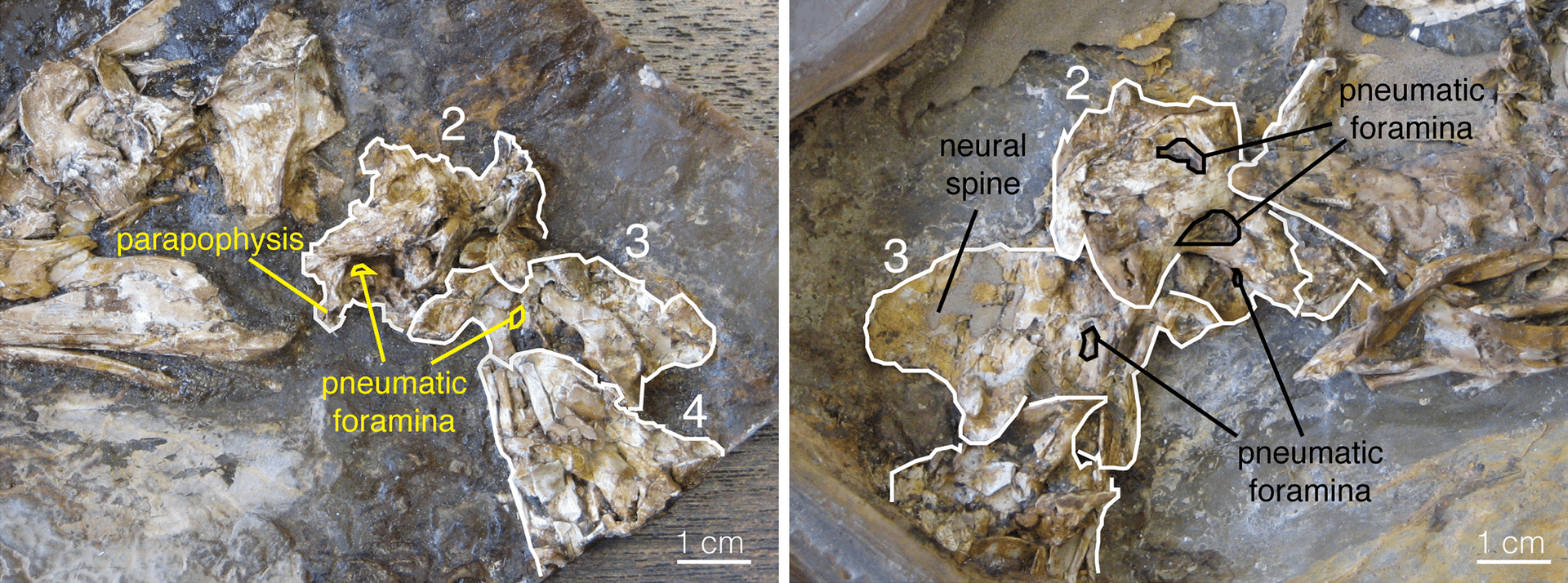

Researchers later CT-scanned the two slabs that hold the skull at the Fukui Prefectural Dinosaur Museum in Japan. The skull itself is complete and almost fully articulated, though split into two halves and slightly deformed. As of 2026, a detailed description of the skull was still in preparation. Pelecanimimus remains known from this single specimen, and no additional specimens have been confirmed outside Las Hoyas.
Pelecanimimus Size and Description
Only the front half of Pelecanimimus survives, so its full outline is part bone and part reconstruction.
Short description of Pelecanimimus
Its teeth were closely packed along the jaws, and a hyoid (tongue bone) is also preserved—one of the “striking” elements its describers highlighted. Behind the neck, the chest carried ossified sternal plates and uncinate processes—small projections on the ribs.
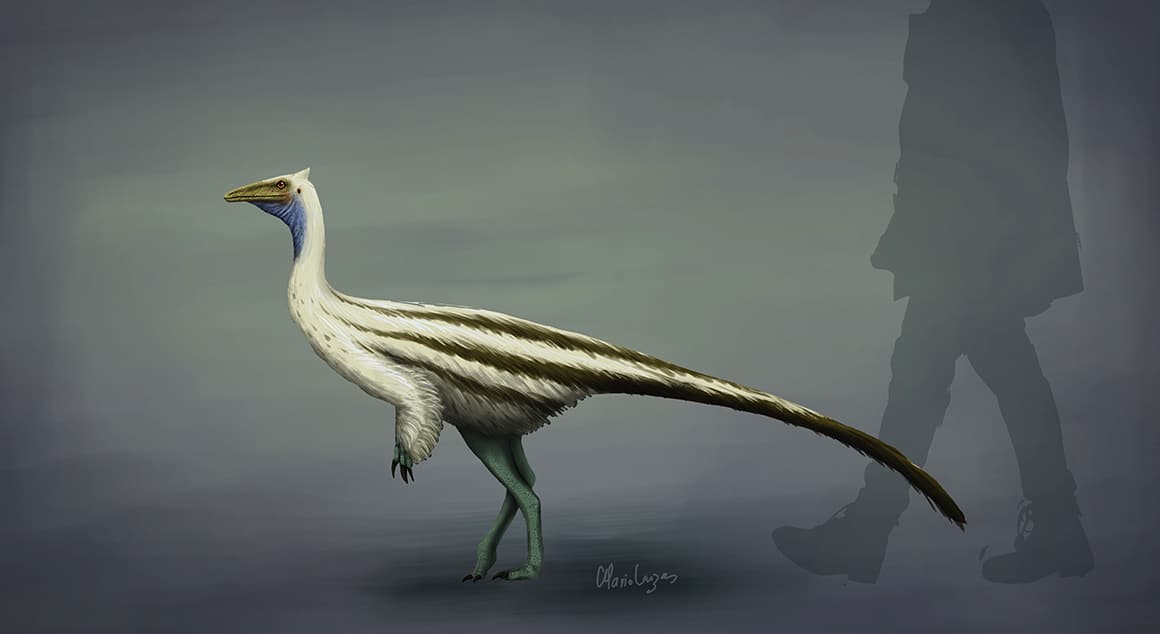
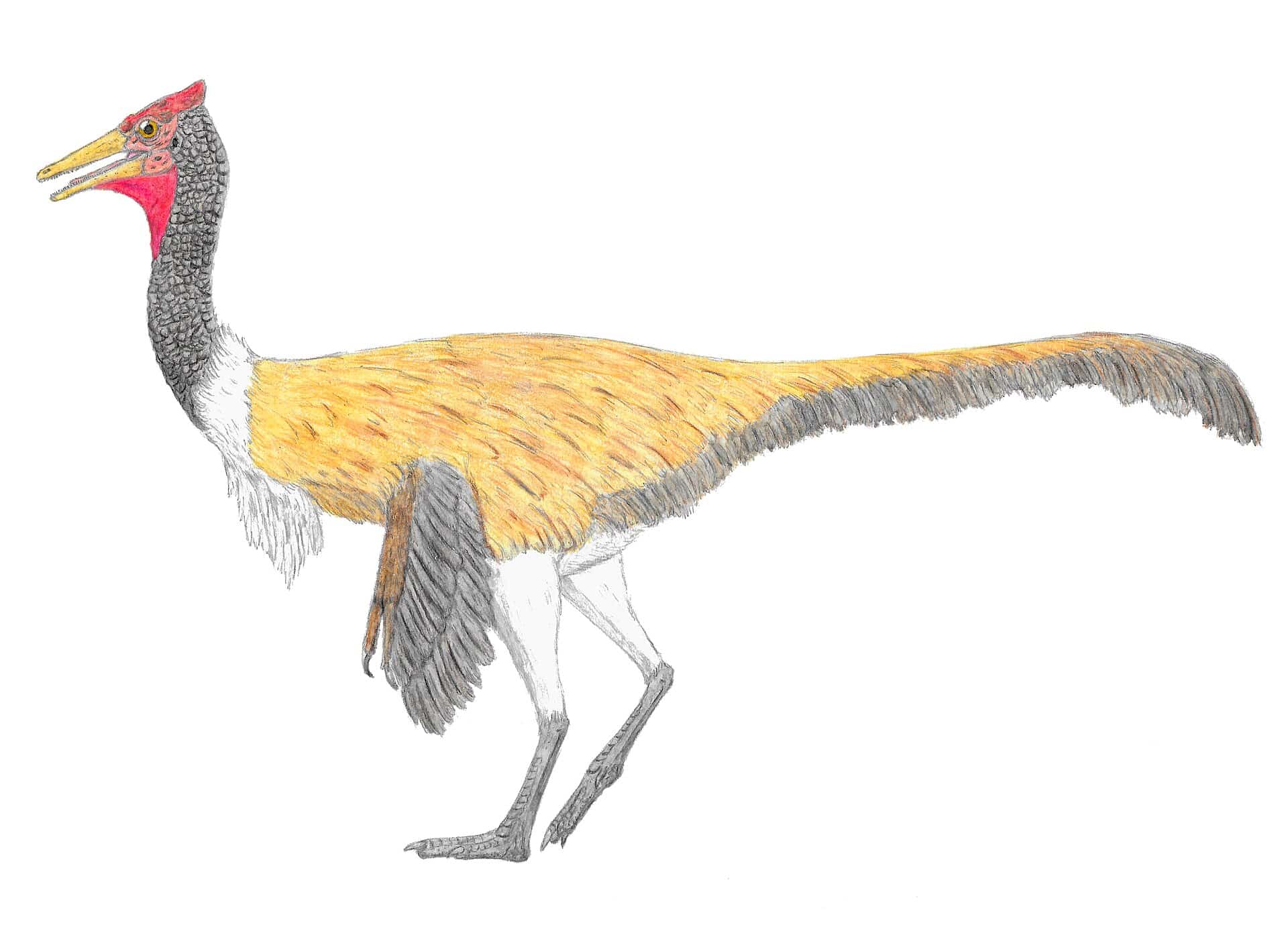
The arms ended in three-fingered hands, and impressions preserved with the skeleton probably correspond to integumentary (skin-related) structures. Later authors interpreted these impressions as either a throat pouch or a soft crest at the back of the head. Either structure therefore remains speculative. Because the hind limbs and tail are unknown, its posture rests on comparisons with relatives.

Size and Weight of Type Species
No length estimate for Pelecanimimus could be confirmed from the sources consulted, although it was clearly a small animal. None of them gives a height at the hips either.
Weight is harder still—the skeleton has no femur (thigh bone). In 2013, paleontologists Lindsay Zanno and Peter Makovicky estimated femur length from skull length. They used ratios in closely related, similarly sized taxa, then derived a mass of about 26 pounds (12 kilograms). Their supplementary data, as reported in a 2026 study, give 11.5 kilograms (about 25 pounds). Either way, the result is an indirect estimate rather than a measurement. Zanno and Makovicky ranked Pelecanimimus and Shenzhousaurus as the smallest ornithomimosaurians known—and some of the oldest.
The Dinosaur in Detail
What sets this dinosaur apart is its mouth, which held more than 200 teeth—an exceptional number for a theropod. According to the 1994 abstract, the teeth also had a distinctive shape. Pérez-Moreno and colleagues proposed that the closely packed teeth could act as a single cutting edge, like a beak. In their view, this was an exaptation—a trait that takes on a new role—leading to the toothless cutting edge of later ornithomimosaurs.
Its describers had already noted a derived hand in this early ornithomimosaur. In 2021, Cuesta’s team described an enlarged hand with a long first metacarpal (hand bone) and elongated distal phalanges (the end bones of each finger). Those features became the basis for Macrocheiriformes. They also reported the only ossified sternal plates among ornithomimosaurs. In addition, they found the first uncinate processes in a non-maniraptoran theropod—which a university release linked to bird-like breathing.
Inside the head, a 2026 study by Calvo-Pérez and Cuesta examined the back of the braincase. The endocast (a cast of the brain cavity) resembles that of Struthiomimus. Its long semicircular canals (balance organs of the inner ear) point to good gaze stabilization. Its best hearing probably lay around 2.5 kilohertz. Taken together, these traits mark an early-diverging ornithomimosaur that already shared key features with its later relatives.
Interesting Points about Pelecanimimus
- Its name means “pelican mimic,” and impressions below its skull have been read as a possible throat pouch.
- With more than 200 teeth, Pelecanimimus had an exceptionally crowded mouth for a theropod, unlike the toothless ornithomimids.
- It was the first non-avian dinosaur found in the Las Hoyas limestones, a site already known for its fossil birds.
- In 2021, Cuesta and colleagues reported its uncinate processes as the first known in a theropod outside Maniraptora.
- A 2025 study of two German bones called Pelecanimimus the only unequivocal European ornithomimosaur known until then. It named its own finds only the second definitive record from Europe.
Dinosaurs from the Same Formation
Also known from the La Huérguina Formation (exact level relative to Pelecanimimus not known): Concavenator, a humped carcharodontosaurian (a lineage of large predators) roughly 20 feet (6 meters) long, from the same Las Hoyas site. No published bed ties it to the Pelecanimimus skeleton, so the two may not have lived at the same time.
Pelecanimimus in its Natural Habitat
Pelecanimimus lived in a subtropical, seasonal freshwater wetland spread across low karstic (limestone) terrain. Alluvial plains, marshes, channels, ponds, and shallow permanent lakes formed a shifting patchwork. In the dry season most ponds dried out, and fire was an active part of the landscape—charcoal is abundant. Microbial mats covered the wetland and, together with low oxygen and rapid burial, explain the site’s exceptional preservation. More than 20,000 fossils have been recovered, from some of the oldest flowering plants to enantiornithine (extinct early) birds such as Iberomesornis, Concornis, and Eoalulavis.
What Pelecanimimus ate remains uncertain. In 2026, Calvo-Pérez and Cuesta, citing a 2011 Zanno and Makovicky study, called a herbivorous or omnivorous diet the better-supported hypothesis. Even so, its many teeth make the case less clear-cut than in toothless relatives. Its sensory evidence, however, pulls in two directions. Earlier scleral-ring (eye-bone) studies, so far published only as conference abstracts, suggested activity at night. By contrast, its short lagena (a hearing organ of the inner ear) points the other way. The authors call the results contradictory.
While there is no direct evidence of how Pelecanimimus lived, its fossil setting is telling. Non-avian dinosaur bones are extremely rare at Las Hoyas, although dinosaur trace fossils are fairly common. Buscalioni and Fregenal-Martínez regard dinosaurs there as incidental, land-dwelling members of an ecosystem dominated by aquatic life. The site has also produced an iguanodontian hindlimb tentatively referred to Mantellisaurus and an indeterminate maniraptoran.
Beyond Las Hoyas, rocks of similar late Barremian age elsewhere in eastern Spain have yielded other dinosaurs. For example, the Arcillas de Morella Formation in Castellón has produced the sail-backed iguanodontian Morelladon.

Frequently Asked Questions
It means “pelican mimic,” while the species name polyodon means “many teeth.”
It lived in the Barremian stage of the Early Cretaceous, around 125 million years ago.
No length estimate could be confirmed, but it was small—an indirect estimate puts its weight at about 25 to 26 pounds.
Its diet is uncertain. A 2026 study favored a herbivorous or omnivorous diet over specialized, highly active nocturnal hunting.
Its only known fossil comes from Las Hoyas, in the La Huérguina Formation of Cuenca Province, Spain.
It had more than 200 teeth, a preserved hyoid (tongue bone), and soft-tissue impressions.
Sources
The information in this article is based on various sources, drawing on scientific research, fossil evidence, and expert analysis. The aim is to provide a comprehensive and accurate overview of Pelecanimimus. However, please be aware that our understanding of dinosaurs and their world is constantly evolving as new discoveries are made.
- https://doi.org/10.1038/370363a0
- https://doi.org/10.1093/zoolinnean/zlab013
- https://doi.org/10.7203/sjp.33856
- https://doi.org/10.1098/rspb.2012.2526
- https://doi.org/10.5209/rev_JIGE.2010.v36.n2.13
- https://doi.org/10.1144/jgs2022-079
- https://doi.org/10.6084/m9.figshare.c.6336914
- https://doi.org/10.1017/S0016756813000095
- https://doi.org/10.1038/nature09181
- https://doi.org/10.1371/journal.pone.0144167
- https://doi.org/10.4202/app.01262.2025
- https://doi.org/10.1016/j.geobios.2024.11.006
- https://doi.org/10.1073/pnas.1011924108
- https://doi.org/10.1371/journal.pone.0145168
- https://www.uam.es/uam/en/noticias/nuevos-datos-pelecanimimus
- https://paleobiodb.org/classic/basicTaxonInfo?taxon_no=64117
- https://stratigraphy.org/ICSchart/ChronostratChart2024-12.pdf
This article was last fact checked: TheDinosaurs Team, 14-11-2026
Featured Image Credit: TotalDino, CC BY-SA 4.0, via Wikimedia Commons
