
In the Bajo del Añelo of Neuquén Province, northwestern Patagonia, the red beds of the Candeleros Formation hold the bones of a heavy-headed predator. Named Ekrixinatosaurus novasi in 2004, it belongs to the Abelisauridae—a family its describers called “big Gondwanic predators.” Those authors placed the rocks in the Albian to Cenomanian stages of the Cretaceous. However, a 2026 dating study argues for an early Albian age, older than the Cenomanian date most later work used. Its single skeleton has even fueled a debate over its size.
The fossil was discovered during excavations for a gas pipeline, after its rocky tomb had been dynamited. In 2004, paleontologists Jorge O. Calvo, David Rubilar-Rogers, and Karen Moreno described it in the journal Ameghiniana. They saw in it support for an early split of the abelisaurid group, before the Senonian, the final stretch of the Cretaceous. They also read it as support for abelisaurids in continental Africa—an idea they offered as a hypothesis. Two decades later, the same bones anchor a small cluster of abelisaurids that, so far, only Neuquén Province has produced.
Ekrixinatosaurus Key Facts
| Keyword | Fact |
|---|---|
| Pronunciation | Not specified |
| Meaning of name | Explosion-Born Reptile |
| Group | Theropoda |
| Type Species | Ekrixinatosaurus novasi |
| Diet | Carnivore |
| When it Lived | About 111 to 106 MYA (Albian, per Maniel et al. 2026)—earlier work placed it in the Cenomanian |
| Period | Cretaceous |
| Epoch | Early Cretaceous (Albian stage) or Late Cretaceous (Cenomanian stage), debated |
| Length | 23.0 to 26.2 feet (7 to 8 meters) in 2004, or about 24.3 feet (7.4 meters) in 2017 |
| Height | Not specified |
| Weight | Not specified |
| Mobility | Not specified |
| First Discovery | No later than 1999 (first reported in a 1999 conference abstract), found during gas pipeline excavations |
| Described by | 2004 by J.O. Calvo, D. Rubilar-Rogers, and K. Moreno |
| Holotype | MUCPv-294 |
| Location of first find | Red beds of the Candeleros Formation, Bajo del Añelo, about 21 miles (34 kilometers) northwest of Añelo, Neuquén Province, Argentina |
Ekrixinatosaurus Origins, Taxonomy and Timeline
The name Ekrixinatosaurus records a moment of real drama. It joins the Greek ekrixi, “explosion,” the Latin nato, “born,” and the Greek saurus, “reptile.” In the authors’ own words, the fossil turned up “after its rocky tomb was dynamited.” Meanwhile, the species name novasi honors paleontologist Fernando Novas for his work on abelisaurid theropods. Together, the name recalls both the blast and a leading student of its family.
Calvo and colleagues placed the new genus within Theropoda, then Neoceratosauria and Abelisauria, and finally the family Abelisauridae. Their preliminary analysis used just 13 characters and eight taxa. It left Ekrixinatosaurus in an unresolved cluster with Majungasaurus and the Carnotaurini—the group that includes Carnotaurus—with Ilokelesia as their sister group. Even so, the authors judged it closer to Carnotaurini than to other neoceratosaurs. Later work moved it into Brachyrostra, a mainly South American abelisaurid clade named in 2009. Ekrixinatosaurus novasi is the type and only known species.
Its age is less settled. The 2004 paper dated the Candeleros Formation to the Albian–Cenomanian, the “Middle” Cretaceous. By 2010, however, it was usually treated as early Cenomanian—the age Novas and colleagues used in 2013. According to Maniel and colleagues, that age rested on a single discordant zircon grain from the underlying Rayoso Formation. It gave a maximum depositional age—an upper limit on the age of the rocks—of 98.6 million years. In 2026, Maniel’s team dated a Candeleros volcanic ash bed, or tuff, from the Picún Leufú sub-basin at about 111.4 million years, early Albian rather than Cenomanian. They did not sample the Añelo site, but they argue the age holds across the whole Neuquén Basin and list Ekrixinatosaurus as Albian. On that view, it lived roughly 111 to 106 million years ago. The older view puts it after about 100 million years ago.
Discovery & Fossil Evidence
Excavations for a gas pipeline, built by the Gasoducto del Pacífico company, revealed the fossil at Bajo del Añelo, about 21 miles (34 kilometers) northwest of the town of Añelo. Unusually, the original paper names neither the year of the find nor its finder. According to the Paleobiology Database, a first report appeared as a 1999 conference abstract, which we could not consult.
The holotype, MUCPv-294, resides at the Museo Universidad Nacional del Comahue in Neuquén. Its bones lay disarticulated—separated from one another—and scattered over about 161 square feet (15 square meters). From the skull came both maxillae (upper tooth-bearing bones), the basicranium (base of the braincase), both dentaries (lower jaw bones), and teeth. Vertebrae from the neck, back, hips, and tail came too, with ribs and haemal arches (bony struts beneath the tail). The ilia, a pubis, and the upper ends of the ischia preserve the hips. Finally, the legs include femora and tibiae (thigh and shin bones), a fibula, ankle bones, foot bones, and a toe claw.
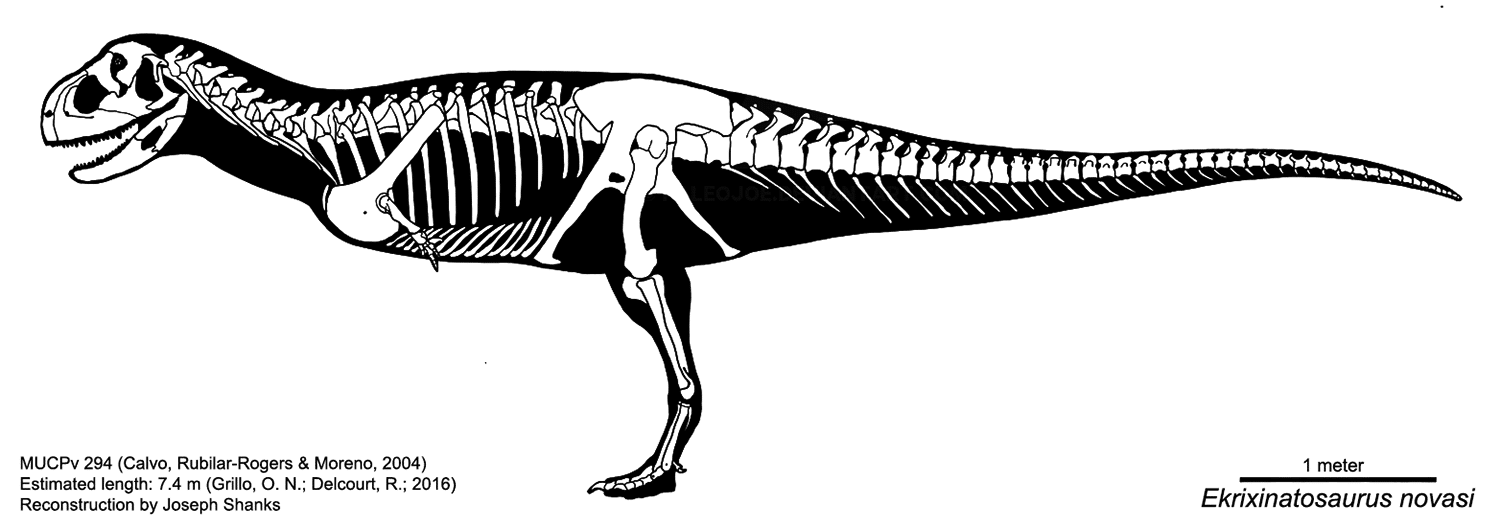

That skeleton remains the only one known. Canale and colleagues examined it firsthand for their study of its relative Skorpiovenator, published online in 2026. When Calvo’s team described it, Ekrixinatosaurus was also the first abelisaurid whose rear tail vertebrae were known. No additional specimens have been referred to the genus, at least in the studies consulted here.
Ekrixinatosaurus Size and Description
Built around a short, deep skull, Ekrixinatosaurus shows how much an incomplete skeleton can reveal—and how much it leaves to estimate.
Short description of Ekrixinatosaurus
The maxilla was short and tall, about 16.5 inches (42 centimeters) long, with 16 tooth sockets. In 2013, Novas and colleagues instead reported 17.6 inches (44.8 centimeters), citing a 2011 study—a figure that does not match. They also gave a skull roof 13 inches (33 centimeters) wide at the postorbitals, against 10.2 inches (26 centimeters) in Carnotaurus. Its teeth were flattened from side to side and serrated along the front and back edges. Below them, the dentary was short, with a convex lower border. By comparison with Carnotaurus and Majungasaurus, the describers estimated the whole skull at about 32.7 inches (83 centimeters).
Behind the head, the neck vertebrae were short from front to back. Their spines stood only as tall as the epipophyses—bony prongs above the rear joints. Farther back, the sacral (hip) vertebrae had fused to their ribs and to the ilium, as in adult ceratosaurs. The mid-tail vertebrae carried side processes whose tips projected both forward and backward. Its forelimbs are unknown, although Novas’s team notes that abelisaurids in general had strongly reduced arms and hands. No soft tissue survives, so any picture of its skin is speculative.
Size and Weight of Type Species
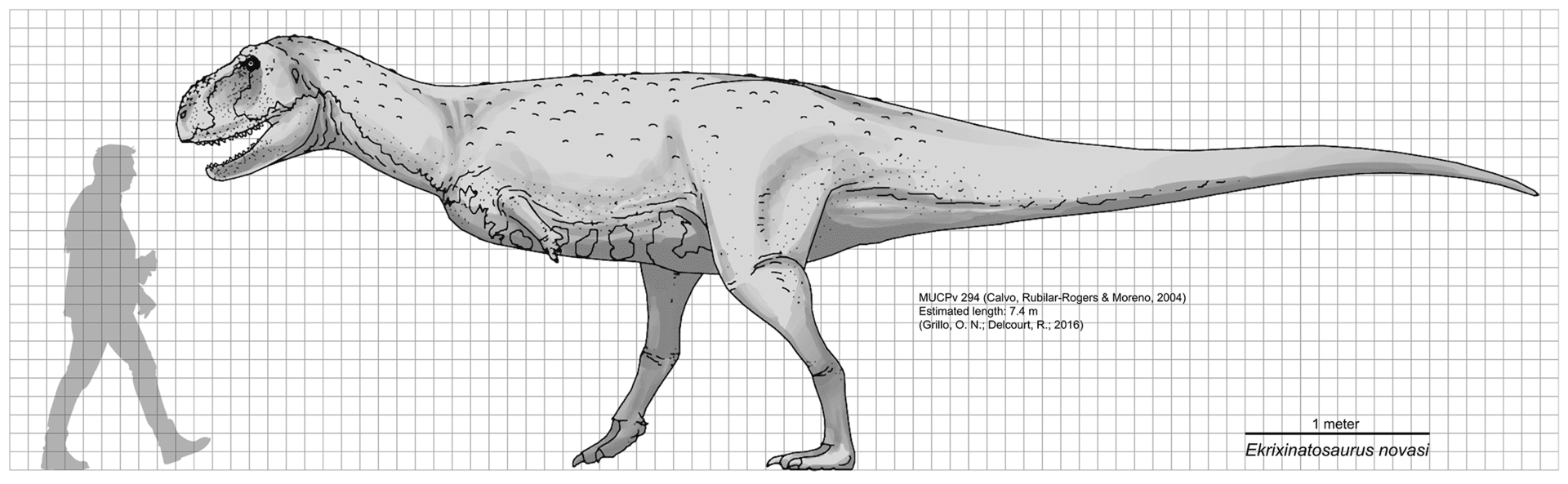
Calvo and colleagues described Ekrixinatosaurus as a large abelisaurid, between 23.0 and 26.2 feet (7 and 8 meters) long. They did not explain their method, offering a skeletal reconstruction and skull and femur comparisons instead.
In 2011, Juárez Valieri and colleagues suggested that it was probably the largest abelisaurid, based on skull size. Novas and colleagues disagreed in 2013, finding the Carnotaurus holotype roughly 15 percent larger, judging from the hindlimb bones. For example, the lower end of its femur is 7.3 inches (18.6 centimeters) wide, against 6.5 inches (16.5 centimeters) in Ekrixinatosaurus. In their view, Ekrixinatosaurus had a proportionally larger skull rather than a larger body.
In 2017, Grillo and Delcourt noted that estimates of 32.8 to 36.1 feet (10 to 11 meters) had also been made. Using regression equations built on the most complete abelisauroids, they estimated about 24.3 feet (7.4 meters), give or take about 2.6 feet. That places it level with Abelisaurus but behind Carnotaurus at 25.6 feet (7.8 meters). None of the peer-reviewed studies consulted here gives a weight or hip height, so both remain unknown.

The Dinosaur in Detail
What sets this dinosaur apart begins at the top of its head. Calvo’s team found an opening, or fenestra, between the postorbital (the bone behind the eye socket) and the frontal, a skull-roof bone. They also described a backward-pointing bump where the parietals meet the paraoccipital process—a bony flange at the back of the skull. They regarded both as autapomorphies, features unique to this species. However, Canale and colleagues liken the opening to the triosseal foramen, a small skull-roof opening in other abelisaurids, and find it close in size to Skorpiovenator‘s. The tibia also swells distinctly at midshaft.
Other traits link it to relatives, such as a bulky, strongly inflated top edge on the postorbital, as in Skorpiovenator and the French Arcovenator. Canale’s team adds paired side bumps on its frontals and faint ornament across its skull roof. In 2022, Gianechini and colleagues further noted extra hyposphene-hypantrum joints—interlocking links between tail vertebrae.
Its proportions stand out. At 30.3 inches (77 centimeters), the femur is shorter than the estimated skull, giving a skull-to-femur ratio of 1.08, against about 0.58 in Carnotaurus and 1.00 in Ceratosaurus. Yet the Carnotaurus femur length is itself an estimate, and later authors suspect its slender hindlimbs are a reconstruction artifact. The shorter, more slender tibia, at 27.2 inches (69 centimeters), had fused with the ankle bones. Even the astragalus’s ascending process—a thin plate of ankle bone rising against the shin—was small, at just 2.4 inches (6 centimeters).
Its family tree has since sharpened. In 2024, Pol and colleagues paired it with Ilokelesia in an early-diverging brachyrostran lineage. Likewise, Canale’s team recovered a clade of Skorpiovenator, Ilokelesia, and Ekrixinatosaurus, backed by six shared traits, as sister to Furileusauria, another branch of Brachyrostra. Taken together, these studies make Ekrixinatosaurus an early South American abelisaurid outside Furileusauria.
Interesting Points about Ekrixinatosaurus
- The name Ekrixinatosaurus means “explosion-born reptile,” because its fossil came to light only after its rocky tomb was dynamited.
- Its bones turned up during excavations for a gas pipeline at Bajo del Añelo, in Neuquén Province, Argentina.
- When Calvo and colleagues described it in 2004, it was the first abelisaurid whose rear tail vertebrae were known.
- Its describers estimated a skull-to-femur ratio of 1.08, nearly double their rough 0.58 for Carnotaurus, whose femur length is itself an estimate.
- Pol and colleagues found that its closest relative was Ilokelesia, another abelisaurid from Neuquén Province.
Dinosaurs from the Same Formation
Also known from the Candeleros Formation (exact level relative to Ekrixinatosaurus not known): Giganotosaurus, Andesaurus, Buitreraptor, Jakapil, Alnashetri and Bicentenaria. None of them comes from the Añelo site, and the formation’s age is still debated, so these animals may not all have lived at the same time.
Ekrixinatosaurus in its Natural Habitat
The world Ekrixinatosaurus roamed lies in red beds that, according to Maniel and colleagues, record an advancing river fan with fossil soils throughout. A 2019 conference abstract and a 2023 doctoral thesis on those soils describe rivers and windblown sand under a temperate, seasonal climate, between semiarid and subhumid. Citing a 2021 soil study, however, Maniel’s team reads the lowest beds as arid to semiarid. At La Buitrera, a different site in Río Negro Province, the upper Candeleros beds preserve dunes of an ancient sand sea, the Kokorkom Desert.
As for diet, scientists see Ekrixinatosaurus as a carnivore because it belongs to a family of large predators. While the sources report no bite marks or stomach contents, its flattened, serrated teeth fit that predatory role. Pol and colleagues describe abelisaurids as arguably the most successful carnivorous dinosaurs of Cretaceous Gondwana.
The Candeleros Formation has also produced rebbachisaurid sauropods and titanosaurs. Beyond dinosaurs, the formation holds the crocodile relative Araripesuchus, a frog, turtles, pterosaur tracks, and many dinosaur trackways. Database records add unnamed abelisaurid, carcharodontosaurid, and sauropod remains from the wider Añelo region.
No study consulted here discusses its behavior. Its lineage appears to have been local, since its clade has turned up only in Neuquén Province. Canale’s team suggests that the Turonian extinction event likely hit this group. Yet the 2026 dating study also places the Huincul Formation, home of Ilokelesia and Skorpiovenator, in the Albian, which would make the whole clade older than usually assumed. In 2022, meanwhile, Gianechini and colleagues described a younger, Santonian tail vertebra from the Bajo de la Carpa Formation that nests within the same clade. How these findings fit together remains open.
Frequently Asked Questions
It means “explosion-born reptile,” and the species name novasi honors paleontologist Fernando Novas.
Its age is debated—either the Albian, roughly 111 to 106 million years ago, or the Cenomanian, under about 100 million years ago.
Its describers estimated 23.0 to 26.2 feet long. A 2017 study gave about 24.3 feet, and the studies consulted here give no weight.
It was an abelisaurid theropod within Brachyrostra, a mainly South American group of predators that includes Carnotaurus.
It turned up during gas pipeline excavations in the Candeleros Formation at Bajo del Añelo, Neuquén Province, Argentina.
Its describers singled out a skull opening and a backward-pointing bump at the back of the skull, though relatives share a similar opening.
Sources
The information in this article is based on various sources, drawing on scientific research, fossil evidence, and expert analysis. The aim is to provide a comprehensive and accurate overview of Ekrixinatosaurus. However, please be aware that our understanding of dinosaurs and their world is constantly evolving as new discoveries are made.
- Calvo, J.O., Rubilar-Rogers, D. & Moreno, K. 2004. A new Abelisauridae (Dinosauria: Theropoda) from northwest Patagonia. Ameghiniana 41(4): 555–563. https://ameghiniana.org.ar/index.php/ameghiniana/article/download/852/1591/10362
- https://doi.org/10.5710/AMGH.20.08.2026.3665
- https://doi.org/10.1111/cla.12583
- https://doi.org/10.1016/j.cretres.2013.04.001
- https://doi.org/10.1016/j.cretres.2016.09.001
- https://doi.org/10.5710/PEAPA.15.10.2022.438
- https://doi.org/10.1016/j.gr.2026.06.020
- https://peerj.com/articles/4558/
- https://www.nature.com/articles/s41598-022-15535-6
- https://paleobiodb.org/classic/basicCollectionSearch?collection_no=49409
- https://naturalis.fcnym.unlp.edu.ar/entities/publication/f6b18ccd-23bb-465a-be06-2615752ff3ca/full
- https://naturalis.fcnym.unlp.edu.ar/bitstreams/917cae6c-dbdb-4860-ad24-e03fdbc36c5c/download
This article was last fact checked: TheDinosaurs Team, 14-11-2026
Featured Image Credit: Henrique Paes / Rebecca Slater (Paleocolour), CC BY-SA 4.0, via Wikimedia Commons
