
On Durdham Down, at the edge of Bristol in southwestern England, quarrymen found bones in the “Magnesian Conglomerate” in 1834. That breccia fills hollows in far older Carboniferous limestone. From it came Thecodontosaurus antiquus, a small, early-branching sauropodomorph that most recent studies place in the Rhaetian, the last stage of the Late Triassic. It is often counted as the fourth dinosaur ever named—and it was the first from the Triassic.
In 1836, Henry Riley, a medical doctor, and Samuel Stutchbury named the genus for the teeth in a broken jaw. Since then, its bones have survived a rivalry, shifting classifications, and a wartime air raid. Today, hundreds of specimens from a second quarry reveal parts its first describers never saw—including the skull.
Thecodontosaurus Key Facts
| Keyword | Fact |
|---|---|
| Pronunciation | Not specified |
| Meaning of name | Lizard With Teeth in Sockets |
| Group | Sauropodomorpha |
| Type Species | Thecodontosaurus antiquus |
| Diet | Herbivore |
| When it Lived | 205.7 to 201.4 MYA (if the Rhaetian age is accepted) |
| Period | Triassic |
| Epoch | Late Triassic (Rhaetian stage, debated) |
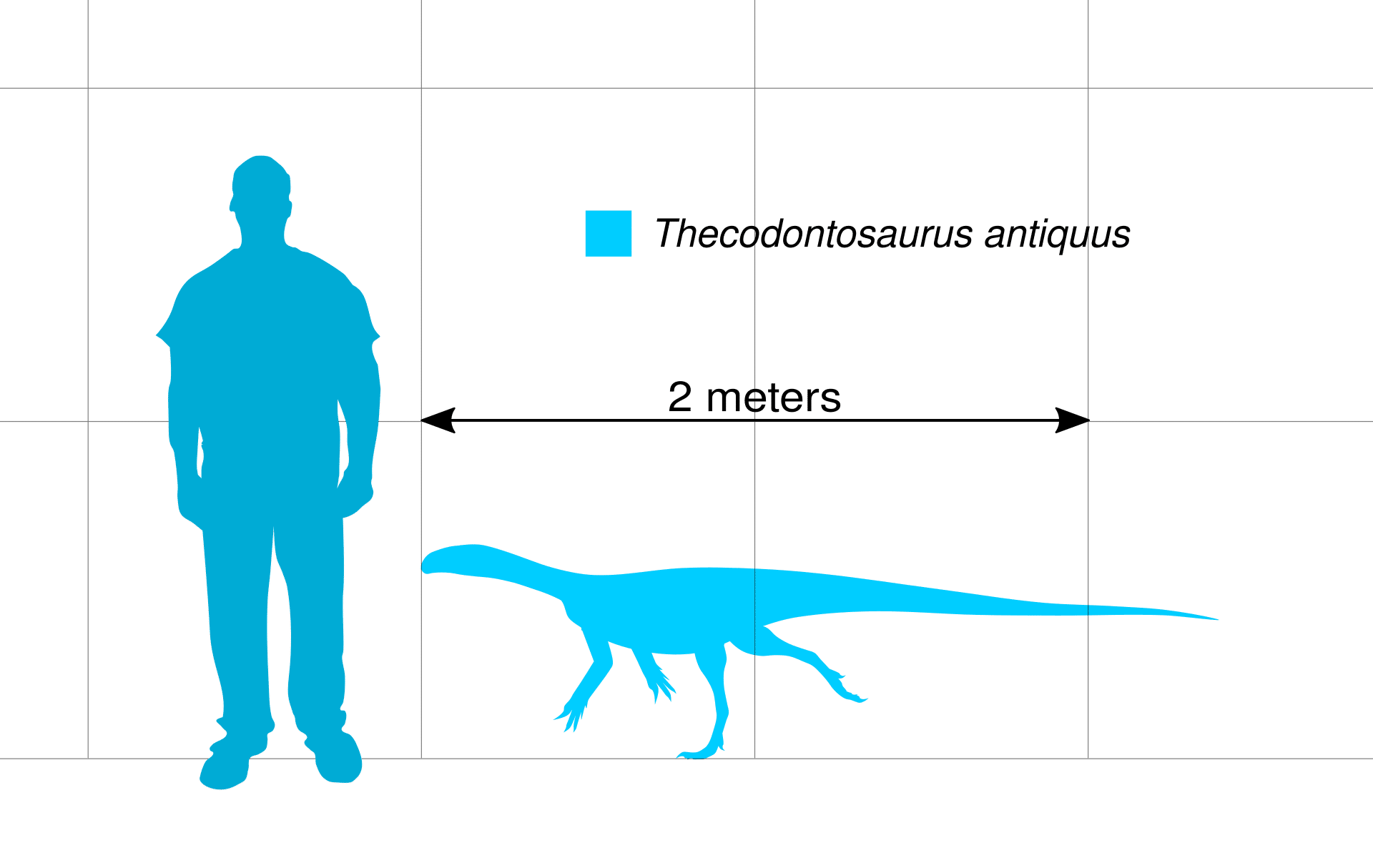
| Length | Up to 8.2 feet (2.5 meters) |
| Height | Not specified |
| Weight | About 9.7 pounds (4.4 kilograms) for one individual, indirect 2025 estimate |
| Mobility | Moved on two legs (bipedal) |
| First Discovery | 1834 by quarrymen on Durdham Down, Bristol |
| Described by | 1836 by H. Riley and S. Stutchbury (genus), with the species name antiquus published in 1843 by J. Morris |
| Holotype | Right lower jaw with 21 teeth (Riley and Stutchbury’s type specimen), specimen number Not specified |
| Location of first find | “Magnesian Conglomerate” fissure fill, Redland, Durdham Down, Bristol, England, UK |
Thecodontosaurus Origins, Taxonomy and Timeline
Riley and Stutchbury built the name around the teeth. Their 1836 abstract founded the genus on tooth structure and on teeth set in distinct alveoli (tooth sockets). The full 1840 paper put it more plainly—this was “a Lizard with alveoli in its jaws.” The species name antiquus came later, when geologist John Morris listed it in his 1843 catalog and credited it to Riley. Together, the name records the anatomy that first set the animal apart.
At first, no one recognized it as a dinosaur. Its describers saw a saurian—a reptile—distinct from crocodiles, monitors, iguanas, and skinks. Anatomist Richard Owen left it out of his new Dinosauria in 1842, and only in 1870 did Thomas Huxley recognize it as a dinosaur. Today, it sits near the base of Sauropodomorpha, the lineage that later produced the giant sauropods. In 2022, paleontologist Antonio Ballell and colleagues called it the earliest-branching sauropodomorph after the Carnian stage.
Most recent studies place the Durdham Down fissures in the Rhaetian stage, roughly 205.7 to 201.4 million years ago. Still, fissure fills—cavities opened in limestone by weathering and faulting—are difficult to date. Published ages for the British examples run from the early Rhaetian to the early Sinemurian. However, some authors argue that certain assemblages are Norian. In 2024, Simms and Drost argued that Britain’s fissures are much older, from the Carnian. In 2025, Weeks and colleagues called the age of the older fissures disputed—Carnian or Rhaetian, some 30 million years apart. If the Rhaetian age holds, it lived at the very end of the Triassic, as a rising sea broke the Bristol area into islands.
Discovery & Fossil Evidence
The first bones came to light in the autumn of 1834 at Redland, at the south-eastern end of Durdham Down. There, the breccia was no more than 20 feet (about 6 meters) thick, with angular limestone fragments set in red or yellow paste. The bones had come apart before burial, and many already carried fractures. Riley and Stutchbury also figured a small jaw fragment owned by David Williams. A country parson and geologist, Williams had described it himself. In 2012, Michael Benton traced how Williams and Stutchbury came to distrust each other.
The key specimen was part of a right lower jaw, broken into three pieces and holding 21 teeth. It measured 3¼ inches (about 8.3 centimeters) and belonged to the Museum of the Bristol Institution. Its catalog number and fate after 1940 are unconfirmed. The breccia also yielded vertebrae, a right femur (thigh bone), and a 7-inch (18-centimeter) radius (forearm bone). Riley and Stutchbury hesitated to assign these bones to either new genus, since none lay with teeth. Even so, in 1840 they tentatively linked some rounded ribs to the jaw. Their other genus, Palaeosaurus, rested on teeth alone. In 2000, Benton and colleagues showed that both its species rest on non-diagnostic, non-dinosaur teeth.

Friedrich von Huene described some 300 to 400 of the bones in 1902, 1908, and 1914. Then, in November 1940, an air raid on Bristol’s museum destroyed nearly everything on display, including the best Thecodontosaurus bones. Still, 184 specimens survived in a railway tunnel, and some 245 from the 1830s collection remain across several museums. Later, Tytherington Quarry in South Gloucestershire produced hundreds more specimens. In 2020, Ballell and colleagues assigned them to T. antiquus, adding previously unknown parts such as the skull. Even so, no one has yet found a complete articulated skeleton.
Thecodontosaurus Size and Description
Piecing Thecodontosaurus together means combining scattered bones from two quarries and nearly two centuries of study.
Short description of Thecodontosaurus
Its teeth gave the animal its name. As Riley and Stutchbury described them, they were pointed, flattened, and lancet-shaped, with serrations angled toward the tip. Each sat in its socket for nearly half its length. The middle teeth were the largest, standing at least a quarter of an inch (about 6 millimeters) above the socket. Farther back, CT scans show an undivided metotic foramen (a nerve opening at the back of the skull). The braincase also has large floccular fossae (hollows for part of the brain) and a rhomboid foramen magnum, where the spinal cord exits.
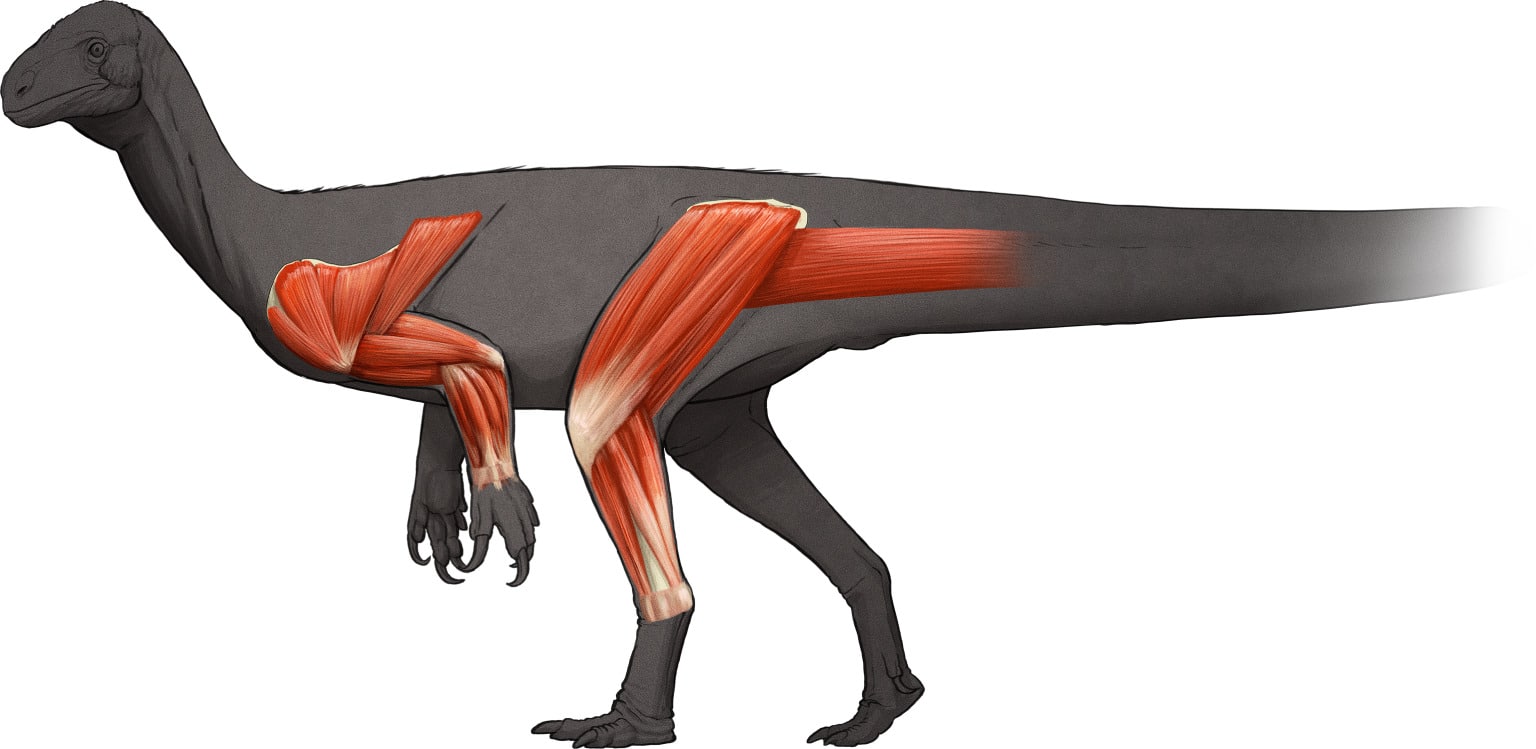
Along the spine, vertebrae from the breccia had deeply concave ends and hourglass-shaped bodies. In 2025, Beeston and colleagues found little or no sign of pneumaticity (air-filled spaces) in its vertebrae, except possibly in the rear neck. Meanwhile, a 2022 muscle study suggests the forelimbs grasped objects and gathered food rather than serving for walking. The hind limbs, by contrast, fit what the same team called “a bipedal, agile dinosaur.”
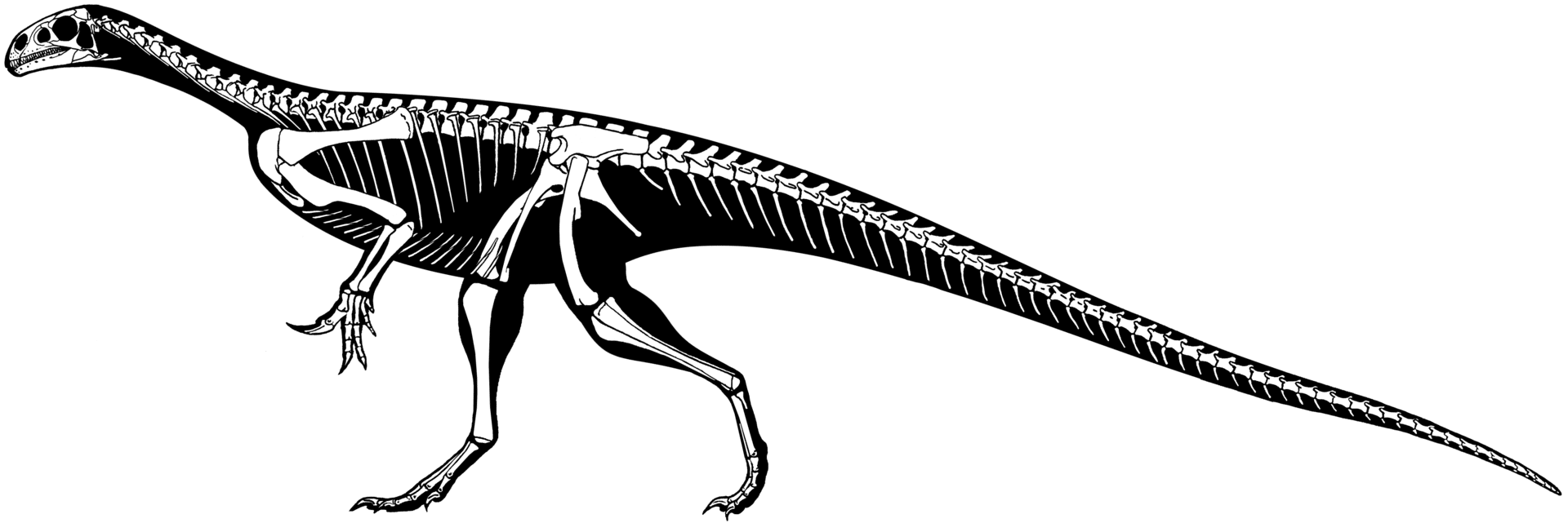

In 2000, Benton and colleagues recognized a gracile and a robust form, which they suggested reflect differences between the sexes. Any discussion of its skin or outer covering is speculative.
Size and Weight of Type Species
In 2000, Benton and colleagues described it as a small, gracile “prosauropod” up to 8.2 feet (2.5 meters) long. Bristol Museums gives the same maximum. However, the abstract does not explain how the team reached that figure, so it remains an estimate.
Body mass comes from a different study and a different measurement. In 2025, Beeston and colleagues calculated about 9.7 pounds (4.4 kilograms) from a single femur circumference in an earlier dataset. That indirect estimate covers one individual, which the main text does not identify—so it may not represent the largest, 8.2-foot animals. For comparison, the same table lists 1.2 kilograms (2.6 pounds) for Pantydraco and 8.5 kilograms (18.7 pounds) for Pampadromaeus.
None of the sources used here gives a hip height. The nearest clue is a right femur from Durdham Down, which measured 10 inches (25.4 centimeters) even with its lower condyles missing. Otherwise, Riley and Stutchbury gave no whole-body size—only measurements of individual bones.
The Dinosaur in Detail
This dinosaur stands at an evolutionary turning point. In 2020, Ballell and colleagues called it one of the most basal sauropodomorphs with skull and tooth traits linked to herbivory. Yet it kept primitive limb shapes and posture. Earlier, Benton and colleagues had diagnosed it partly by a relatively short dentary (the tooth-bearing lower jaw bone). According to Ballell’s 2022 muscle study, it is also the earliest-branching sauropodomorph without the trochanteric shelf—a ridge on the femur—of Carnian relatives.
Its teeth have also faced direct tests, as in 2022, when Ballell and colleagues modeled early dinosaur teeth. Both their biomechanical and shape-based models classified Thecodontosaurus as a herbivore, alongside Plateosaurus, Massospondylus, and Ngwevu. Earlier work had allowed occasional faunivorous (animal-eating) habits, but the team concluded that its teeth suited plant processing well.

Its brain has drawn attention too. In 2020, Ballell and colleagues used CT scans to redescribe braincase YPM 2192 at the Yale Peabody Museum. The endocast—a digital cast of the brain cavity—pointed to a running biped adapted to keep its head and gaze steady. From the inner ear, the team estimated an average hearing frequency of about 1,900 hertz, slightly above most species measured.
Its link to a Welsh cousin remains debated. Welsh material referred to Thecodontosaurus in 1984 became T. caducus in 2003 and Pantydraco in 2007. As early as 2000, Benton and colleagues wondered whether this juvenile belonged to T. antiquus. In 2020, Ballell and colleagues found poor anatomical support for separating the two and raised the possibility that Pantydraco was a juvenile Thecodontosaurus. By contrast, Beeston and colleagues kept the genera apart in 2025, noting that recent analyses consistently recover them as close relatives. Taken together, Thecodontosaurus emerges as a mosaic of primitive and derived traits—plant-processing teeth on a light, two-legged frame.
Interesting Points about Thecodontosaurus
- Named in 1836, Thecodontosaurus was the first dinosaur named from the Triassic, yet Huxley only recognized it as a dinosaur in 1870.
- Its describers compared thigh bones from the same breccia with those of a crocodile and Megalosaurus and saw a resemblance to both. Still, they did not assign those bones to Thecodontosaurus.
- When a November 1940 air raid struck Bristol’s museum, 184 specimens survived in storage in a railway tunnel in the Avon Gorge.
- The 1840 paper calls one 7-inch bone a radius, while the 1836 abstract gives the same length for a humerus.
- Von Huene’s 1932 monograph treated it as a small quadruped, but Benton and colleagues reconstructed it as a biped in 2000.
Thecodontosaurus in its Natural Habitat
The world Thecodontosaurus roamed was a world of islands. Around 205.7 million years ago, a rising Rhaetian sea turned the Carboniferous limestone around Bristol into an archipelago. In 2008, researchers David Whiteside and John Marshall placed the Tytherington reptiles on “a small fire-swept limestone island in the Rhaetian sea.” Its fissures probably held water that swung between salty and fresh, and their sediments match levels in the Westbury Formation.
Among archosaurs, Britain’s Triassic fissure fills preserve aetosaurs, phytosaurs, crocodylomorphs, and both sauropodomorph and theropod dinosaurs, many still undescribed. The fills hold many smaller reptiles as well. The Durdham Down collection also includes Asylosaurus yalensis, although Ballell and colleagues questioned its validity. Farther afield, the Pant-y-ffynnon fissures of south Wales yielded Pantydraco and the small theropod Pendraig milnerae. Those fissures may be of similar age, but Pendraig carries only a broad late Norian to late Rhaetian date. Meanwhile, the large sauropodomorph Camelotia borealis comes from the basal Westbury Formation at Wedmore, Somerset. No study yet places any of them on the same island or in the same bed as Thecodontosaurus. Some researchers have tentatively linked the fissure animals’ small size to island dwarfism, but a 2021 test on Pendraig proved ambiguous.
Its serrated teeth and tooth mechanics point to a diet built on plants. In 2020, Ballell told reporters that plants were its main food but that omnivory was possible. Its grasping forelimbs may have helped it gather that food.
Tytherington’s Thecodontosaurus specimens span different sizes and growth stages. However, they are scattered bones washed into fissures, and they say nothing about group living. Ballell and colleagues called it an important component of Rhaetian island ecosystems in southwestern Britain—an early chapter in the lineage of giants.
Frequently Asked Questions
Its describers founded it on “a Lizard with alveoli in its jaws,” meaning a reptile with teeth set in sockets.
Most studies place it in the Rhaetian stage of the Late Triassic, roughly 205.7 to 201.4 million years ago, though the fissure ages are debated.
It reached up to about 8.2 feet long. A separate 2025 study estimated one individual at about 9.7 pounds.
It was a herbivore with teeth well suited to processing plants, although researchers have not ruled out occasional animal food.
Quarrymen found its first bones in 1834 on Durdham Down in Bristol, England, and many more later came from Tytherington Quarry.
It was the first dinosaur named from the Triassic. A 2022 study also called it the earliest-branching sauropodomorph known from after the Carnian stage.
Sources
The information in this article is based on various sources, drawing on scientific research, fossil evidence, and expert analysis. The aim is to provide a comprehensive and accurate overview of Thecodontosaurus. However, please be aware that our understanding of dinosaurs and their world is constantly evolving as new discoveries are made.
- https://archive.org/details/proceedings218331838geol/page/397/mode/1up
- https://archive.org/details/per_geological-society-london-trans_transactions-of-the-geological-society-of-london_1840_5/page/n365/mode/1up
- https://archive.org/details/catalogueofbriti00morr
- https://doi.org/10.1671/0272-4634(2000)020[0077:AASOTP]2.0.CO;2
- https://research-information.bris.ac.uk/en/publications/osteological-redescription-of-the-late-triassic-sauropodomorph-di/
- https://research-information.bris.ac.uk/en/publications/the-braincase-brain-and-palaeobiology-of-the-basal-sauropodomorph/
- https://academic.oup.com/zoolinnean/article/193/2/541/6032720
- https://pmc.ncbi.nlm.nih.gov/articles/PMC8767213/
- https://pmc.ncbi.nlm.nih.gov/articles/PMC9757754/
- https://pmc.ncbi.nlm.nih.gov/articles/PMC12881877/
- https://pmc.ncbi.nlm.nih.gov/articles/PMC8493203/
- https://doi.org/10.1017/S0016756807003925
- https://doi.org/10.1144/jgs2020-158
- https://www.schweizerbart.de/papers/pala/detail/250/100980/Saurischian_dinosaurs_from_the_Upper_Triassic_of_E
- https://doi.org/10.1016/j.pgeola.2012.07.012
- https://www.smithsonianmag.com/science-nature/tussling-over-thecodontosaurus-42366763/
- https://dinoproject.blogs.bristol.ac.uk/?p=83
- https://museums.bristol.gov.uk/narratives.php?irn=11636
- https://museums.bristol.gov.uk/details.php?irn=25230
- https://paleobiodb.org/classic/basicCollectionSearch?collection_no=51970
- https://stratigraphy.org/ICSchart/ChronostratChart2024-12.pdf
- https://www.sci.news/paleontology/thecodontosaurus-antiquus-neuroanatomy-09154.html
- https://doi.org/10.1016/j.palaeo.2024.112041
- https://doi.org/10.1016/j.pgeola.2025.101112
- https://dml.reptilis.net/2008Mar/msg00145.html
- https://doi.org/10.1144/0016-76492006-032
This article was last fact checked: TheDinosaurs Team, 14-11-2026
Featured Image Credit: Mario Lanzas, CC BY-SA 4.0, via Wikimedia Commons
