On the Río Negro shore of the Ezequiel Ramos Mexía Reservoir in northern Patagonia lie the sandstones of the Huincul Formation. They hold a theropod whose family ties remain unresolved. Named Gualicho shinyae in 2016, it lived during the late Cenomanian to early Turonian stages of the Late Cretaceous. Its describers called it mid-sized, yet its forelimb was strikingly reduced and its hand functionally two-fingered—a combination reminiscent of tyrannosaurids. However, the original study’s family-tree analyses and its comparison of forelimb features both pointed to independent evolution.
Field Museum fossil preparator Akiko Shinya found the holotype on February 13, 2007, during an expedition led by paleontologist Sebastián Apesteguía. In 2016, Apesteguía, Nathan D. Smith, Rubén Juárez Valieri, and Peter J. Makovicky described it in PLOS ONE. Across the original study and later work, it has landed in four different branches of the theropod family tree. Its story shows how much room for debate a single partial skeleton can leave.
Gualicho Key Facts
| Keyword | Fact |
|---|---|
| Pronunciation | Not specified |
| Meaning of name | Named After Gualicho, a Figure of Tehuelche Tradition |
| Group | Theropoda (Tetanurae, exact family uncertain) |
| Type Species | Gualicho shinyae |
| Diet | Carnivore |
| When it Lived | Around 94 MYA (approximate, from the stage boundary at 93.9 MYA) |
| Period | Cretaceous |
| Epoch | Late Cretaceous (late Cenomanian to early Turonian stages) |
| Length | About 25 feet (7.6 meters) (co-author’s media estimate, not peer-reviewed) |
| Height | About 6 feet (1.8 meters) at the hip (same source) |
| Weight | About 1,000 pounds to 1.1 tons (two unpublished estimates, see text) |
| Mobility | Not specified |
| First Discovery | 2007 by Akiko Shinya |
| Described by | 2016 by S. Apesteguía, N.D. Smith, R. Juárez Valieri, and P.J. Makovicky |
| Holotype | MPCN PV 0001 |
| Location of first find | Huincul Formation, northern flank of the Meseta de la Rentería, Río Negro Province, Argentina |
Gualicho Origins, Taxonomy and Timeline
The name Gualicho has a darker ring than most. It comes, via Spanish, from watsiltsüm, the Gennaken (northern Tehuelche) word for a goddess once considered the owner of animals. After Christianity arrived, she came to be seen as a demonic entity. Today rural settlers, or gauchos, treat her as a source of misfortune. The describers chose the name to reflect the specimen’s difficult discovery and study and its contentious history after excavation. Meanwhile, shinyae honors Shinya, Chief Fossil Preparator at the Field Museum. Together, the name pairs a local legend of bad luck with the person who found the bones.
Gualicho is a theropod, the group that includes the predatory dinosaurs. The original paper placed it within two nested theropod groups, Tetanurae and Avetheropoda. Using one data set, the authors recovered it beside Deltadromeus, a nearly coeval theropod from Morocco. Together, the pair came out as basal carcharodontosaurians—early members of the carcharodontosaur lineage—sister to the neovenatorids. That pairing scored 3 on a branch-support measure, while most nodes along the backbone of the tetanuran tree scored only 1. The paper’s abstract, however, calls it a neovenatorid, a label G. Guinard later followed. A second data set instead put Gualicho near the base of Coelurosauria, well away from tyrannosaurids. Gualicho shinyae is the type and only known species.
The original paper dates the Huincul Formation to the late Cenomanian to early Turonian. Other studies give a wider span, from the middle Cenomanian to the early Turonian. Both ranges straddle the Cenomanian–Turonian boundary, which the international timescale places at 93.9 million years ago. In this interval, many Huincul dinosaurs had close relatives in mid-Cretaceous rocks across North Africa, according to the describers.
Discovery & Fossil Evidence
Apesteguía first came across the fossil-rich Huincul outcrops on the reservoir’s Río Negro shore in 1999. They lie along the northern flank of the Meseta de la Rentería, on exposures informally dubbed “Violante’s field.” In 2007, he returned with Smith and Makovicky on a joint expedition. As Shinya explained in a Field Museum release, the team found Gualicho at the very end of the trip. Before its formal naming, the animal had circulated as “Nototyrannus violantei,” a nomen nudum—a name never validly published.
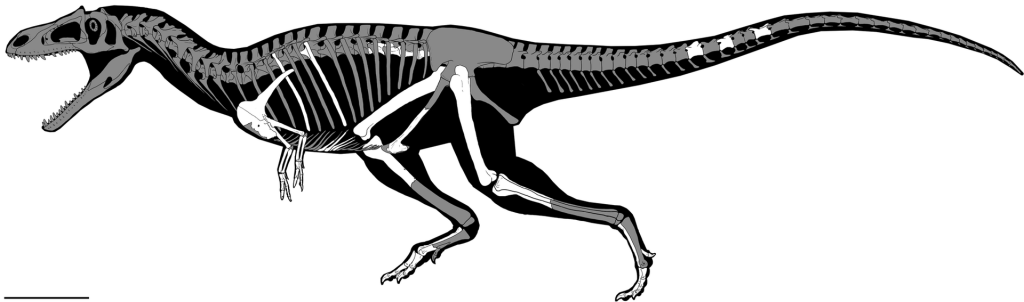
The holotype, MPCN PV 0001, belongs to the Museo Patagónico de Ciencias Naturales in General Roca, whose staff excavated and prepared it. It includes four articulated dorsal centra (the spool-shaped bodies of back vertebrae) and an articulated gastral basket (belly ribs). Also present are a section of the tail, the left scapulocoracoid (shoulder girdle), and the forelimb. The lower ends of both pubes (hip bones), with their “boot,” and parts of both hind limbs complete the list. Erosion had already claimed much of the skeleton, although the forelimb, back vertebrae, belly ribs, and feet remained articulated.
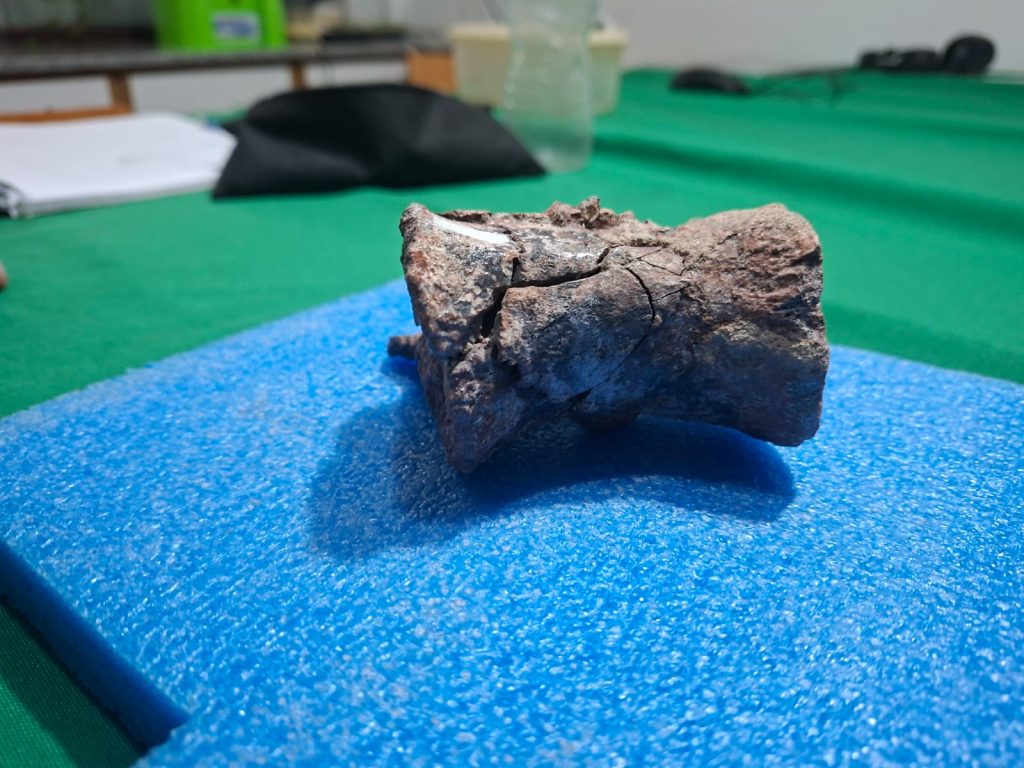

The bones came from a sandstone layer within alternating sandstones and mudstones near the base of the formation. The same expedition also turned up parts of a sauropod skeleton, an abelisaurid maxilla (upper jaw bone) with several vertebrae, and numerous dinosaur coprolites—fossilized droppings. No other specimen has been referred to Gualicho in the literature through 2025, so this partial skeleton remains its only record.
Gualicho Size and Description
Short description of Gualicho
No part of the skull survives, so any image of its head is borrowed from relatives. Farther back, the rear dorsal centra were very elongate—roughly 2.5 times as long as high—and bore slit-like pneumatic openings, the entrances for air sacs. Beneath them lay 16 or 17 rows of gastralia, with at least six arches fused at the midline. The scapula had a narrow, strap-like blade with a sinuous front edge, a feature it shares with Deltadromeus.
The arm, by contrast, was short. Its humerus (upper arm bone) measured 286 millimeters (about 11.3 inches), much shorter than the scapula—unlike in Deltadromeus, where the humerus was the longer bone. By our calculation from the published table, that is only about 37 percent of the femur’s length. The hand was functionally didactyl, or two-fingered, with the third metacarpal reduced to a splint. In the hind limb, the femur had an inclined head and the toe claws bore a small spur. The third metatarsal had an “antarctometatarsal” upper end—wider at the back than at the front—a trait also seen in ceratosaurs. No skin or other soft tissue is listed among the remains, so any discussion of its outer covering is speculative.

Size and Weight of Type Species
The original paper describes Gualicho only as a “mid-sized theropod” and gives no length, height, or mass. No peer-reviewed size estimate has been published, so the best direct measure is the right femur, or thigh bone, which is 775 millimeters (about 30.5 inches) long. Without a skull or a complete backbone, any full-body length must come from comparison with relatives.
In 2016, co-author Makovicky told Live Science that the team estimated a length of about 25 feet (7.6 meters). He gave a hip height of about 6 feet (1.8 meters) and a weight of about 1 metric ton, based on the bones and on related allosaurs. However, the Field Museum’s release gave around a thousand pounds (roughly 450 kilograms)—comparable to a polar bear. Neither is peer-reviewed, so both are rough guides.
The Dinosaur in Detail
What sets this dinosaur apart is its hand. Its first and second metacarpals (palm bones) were joined at their upper ends, while the third was a thin splint that probably lacked a joint at its tip, as in tyrannosaurids. Yet, as the describers stressed, its wrist bones were more complex and its first metacarpal sturdier, with a rectangular rather than triangular upper end. On that basis, they judged that the two-fingered hand evolved separately.
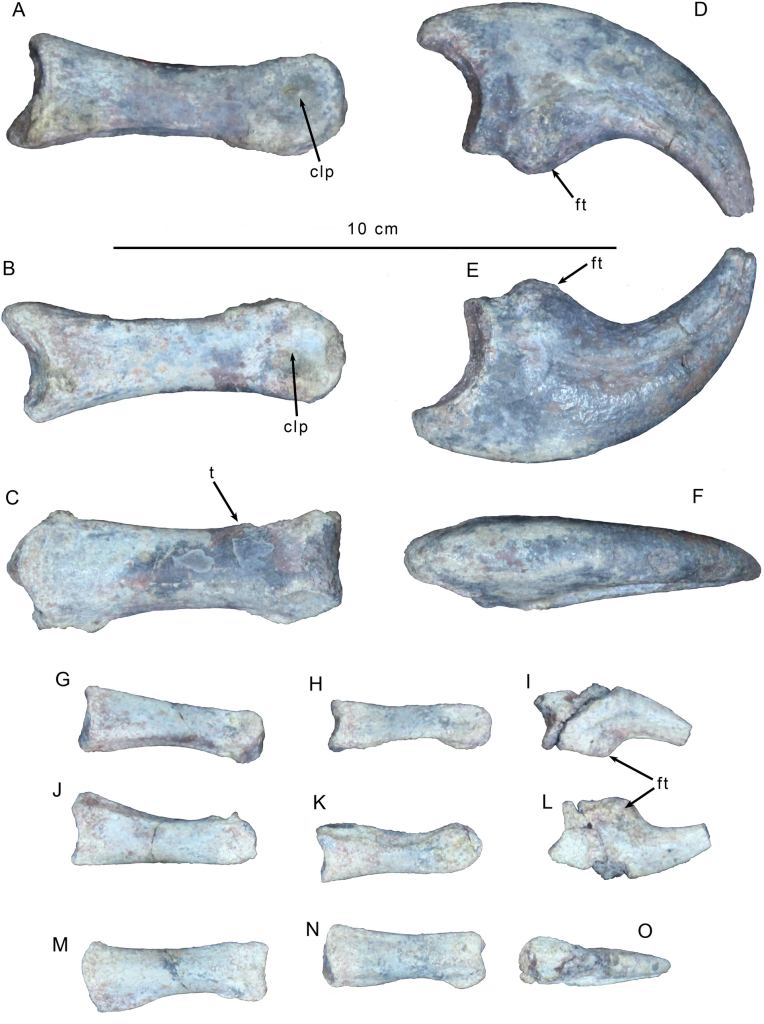

Not everyone accepts that it had only two working fingers. In 2020, paleontologist Nizar Ibrahim and colleagues argued that enough of the third metacarpal survives to suggest a slender, functional third digit. That same year, however, a study by Guinard described total loss of the third digit’s phalanges (finger bones). He called Gualicho “a borderline case” outside the micromelic, or extremely short-armed, spectrum. In the original analysis of forelimb proportions, it plotted nearest Limusaurus and Eoabelisaurus, its arm reduced much as in abelisauroids.
The upper end of the third metatarsal matched ceratosaurs, the describers noted, while the reduced, two-fingered forelimb matched tyrannosaurids. Megaraptorans shared its elongate back vertebrae and a hooked process on the tibia (shin bone). This mosaic, in their words, “renders our understanding of the affinities of Gualicho highly uncertain.”
In 2022, Aranciaga Rolando and colleagues recovered it deep within Tyrannosauroidea, the tyrannosaur lineage. In 2025, Delcourt and colleagues, repeating an earlier unpublished result, recovered both it and Deltadromeus among early ornithomimosaurs, the “ostrich-mimic” lineage, in one of their analyses. That same year, Calvo and colleagues argued that differences in the humerus show it is not closely related to Megaraptor. These studies leave Gualicho without a settled home—”the phylogenetically controversial Patagonian theropod,” as Ibiricu and colleagues put it.
Interesting Points about Gualicho
- The genus name recalls a Tehuelche figure now seen as a bringer of misfortune, chosen to reflect the specimen’s contentious history.
- According to the Field Museum’s 2016 release, the team joked about the “curse of Gualichu” after rolling a truck, though no one was seriously hurt.
- Studies in 2020 and 2022 rejected the idea that Gualicho and Aoniraptor are one animal, and the 2020 study found that Gualicho‘s tail vertebrae, unlike Aoniraptor‘s, lack air spaces.
- Although its hand resembles that of tyrannosaurids, its describers concluded that the two-fingered condition evolved independently in the two lineages.
Dinosaurs from the Same Formation
Also known from the Huincul Formation (exact level relative to Gualicho not known): Taurovenator, Aoniraptor, Tralkasaurus, Mapusaurus, Meraxes, Skorpiovenator, and Argentinosaurus. The first three come from the same Violante farm locality. Taurovenator is a carcharodontosaurid first named from an isolated postorbital (a bone behind the eye socket). In 2024, Aranciaga Rolando and colleagues described a partial skeleton of it. By contrast, Aoniraptor, a mid-sized megaraptoran, is known from sacral and tail vertebrae. Tralkasaurus, named in 2020, was an abelisaurid. Mapusaurus and Meraxes were carcharodontosaurids, Skorpiovenator was an abelisauroid, and Argentinosaurus, a titanosaurian sauropod, ranks among the largest dinosaurs known. The formation spans parts of the Cenomanian and Turonian stages, so these animals may not all have lived at the same time.
Gualicho in its Natural Habitat
The world Gualicho roamed lay in a foreland basin—a basin that sinks in front of a rising mountain belt. Its describers placed it far from the coast, citing the absence of a rich aquatic fauna and of spinosaurids. However, they added that a desert barrier in central Gondwana might also explain the missing spinosaurids. At the Violante farm, sandstones record a highly sinuous river system that gradually straightened. In 2016, Motta and colleagues, citing earlier geological work, described the climate as warm and strongly seasonal. Silicified trunks show cycads and conifers of the monkey puzzle and cypress families. Some early flowering plants also appear.
The original paper does not state what Gualicho ate, but the Field Museum release called it a medium-sized predator. In 2020, Guinard assumed that its skull and jaws were the main predatory organs, as in Acrocanthosaurus. Even so, he noted that “its robust first digit and raptorial claw are to be underlined.” However, the describers proposed no specific use for the short arms, noting only that function likely differed among theropods with reduced forelimbs.
While there is no direct evidence of whether Gualicho lived alone or in groups, its site preserves plenty of other life. Besides the sauropod and the abelisaurid Tralkasaurus, the formation has yielded turtles, crocodiles, fish teeth, and the lungfish Ameghinoceratodus iheringi. In 2020, Motta and colleagues also named Overoraptor, a small paravian from the formation, and grouped it with Rahonavis—so whether it is a bird is debated. These finds point to a rich inland river world.
Frequently Asked Questions
It honors Gualicho, a Tehuelche figure first seen as a goddess owning animals and now as a source of misfortune. Shinyae honors Akiko Shinya.
It lived in the late Cenomanian to early Turonian stages of the Late Cretaceous, roughly 94 million years ago.
The paper gives no size, but co-author Peter Makovicky told reporters about 25 feet (7.6 meters) and 1 metric ton. The Field Museum release said about 1,000 pounds.
It was a carnivore, described in the Field Museum’s 2016 release as a medium-sized predator.
It was found near the base of the Huincul Formation, beside the Ezequiel Ramos Mexía Reservoir in Río Negro Province, Argentina.
Its describers called its tiny hand functionally two-fingered, like a tyrannosaurid’s but evolved independently, though a 2020 study argued for a slender third finger.
Sources
The information in this article is based on various sources, drawing on scientific research, fossil evidence, and expert analysis. The aim is to provide a comprehensive and accurate overview of Gualicho. However, please be aware that our understanding of dinosaurs and their world is constantly evolving as new discoveries are made.
- https://doi.org/10.1371/journal.pone.0157793
- https://journals.plos.org/plosone/article/file?type=supplementary&id=10.1371/journal.pone.0157793.s006
- https://doi.org/10.3897/zookeys.928.47517
- https://doi.org/10.1111/joa.13225
- https://doi.org/10.1038/s41598-022-09272-z
- https://doi.org/10.1002/ar.70085
- https://doi.org/10.1038/s41467-025-63793-5
- https://doi.org/10.1016/j.zool.2020.125756
- https://doi.org/10.2992/007.090.0301
- https://doi.org/10.1016/j.cub.2022.05.057
- http://hdl.handle.net/11336/49904
- https://paleobiodb.org/data1.2/intervals/single.json?name=Cenomanian
- https://www.eurekalert.org/news-releases/562169
- https://www.livescience.com/55394-dinosaur-tiny-arms.html
- https://doi.org/10.1007/s00114-024-01942-4
- https://doi.org/10.1016/j.jsames.2019.102445
- https://doi.org/10.1007/s00114-020-01682-1
This article was last fact checked: TheDinosaurs Team, 18-11-2026
Featured Image Credit: Fredrick Alexander (lineart) and Rebecca Slater (color), CC BY-SA 3.0, via Wikimedia Commons
