In the Lindi hinterland of southeastern Tanzania, the Tendaguru Formation preserves a Late Jurassic coast of tidal flats and lagoons. From its Middle Dinosaur Member comes Veterupristisaurus milneri, a large theropod known only from a few tail vertebrae. When paleontologist Oliver W. M. Rauhut named it in 2011, he placed it in Carcharodontosauridae—the “shark-toothed lizards”—and regarded it as the oldest known member of that group. It lived during the Kimmeridgian to earliest Tithonian stages, roughly 155 to 149 million years ago.
The German Tendaguru Expeditions collected the vertebrae between 1909 and 1913, and Berlin’s Museum für Naturkunde now holds them. In 1925, paleontologist W. Janensch included them in the original material of Ceratosaurus(?) roechlingi. Another 86 years passed before Rauhut’s review of the Tendaguru theropods gave them a name of their own. In 2025, Kellermann, Cuesta, and Rauhut called the genus’s validity questionable, even as their analyses kept it among the carcharodontosaurids. Either way, these few bones bear on when a mostly Cretaceous lineage first appeared.
Veterupristisaurus Key Facts
| Keyword | Fact |
|---|---|
| Pronunciation | Not specified |
| Meaning of name | Old Shark Lizard |
| Group | Theropoda (Carcharodontosauridae) |
| Type Species | Veterupristisaurus milneri |
| Diet | Not specified |
| When it Lived | About 155 to 149 MYA |
| Period | Jurassic |
| Epoch | Late Jurassic (Kimmeridgian to earliest Tithonian stages) |
| Length | About 28 to 33 feet (8.5 to 10 meters), indirect estimate |
| Height | Not specified |
| Weight | Not specified |
| Mobility | Not specified |
| First Discovery | 1909 to 1913 by the German Tendaguru Expeditions (exact year not specified) |
| Described by | 2011 by O.W.M. Rauhut |
| Holotype | MB R 1938 |
| Location of first find | Locality St (EH), Middle Dinosaur Member, Tendaguru Formation, Lindi hinterland, southeastern Tanzania |
Veterupristisaurus Origins, Taxonomy and Timeline
The name Veterupristisaurus borrows its imagery from the sea. Rauhut built it from the Latin veterus, “old,” and pristis, “a large sea monster” often used for sharks. The Greek sauros, “lizard,” completes it. The result, “old shark lizard,” marks its status in 2011 as the oldest known representative of the shark-toothed lizards. Meanwhile, the species name milneri honors paleontologist Angela C. Milner for her many contributions to vertebrate paleontology—she had also been Rauhut’s external PhD supervisor in 2000. Together, the name joins a claim about deep time to a personal note of thanks.
In 2011, Rauhut classified Veterupristisaurus within Allosauroidea, a major branch of large theropods, and then within the family Carcharodontosauridae. He went further, arguing that one tail feature pointed to a possible sister-group relationship—the closest kinship—with Acrocanthosaurus. Veterupristisaurus milneri is the type and only known species.
Rauhut gave the age of the type horizon as Kimmeridgian to earliest Tithonian, citing a 2009 study by Bussert, Heinrich, and Aberhan. That study was more specific, tentatively assigning the Middle Dinosaur Member a late Kimmeridgian age. On the international timescale, the Kimmeridgian runs from about 154.8 to 149.2 million years ago. The earliest Tithonian adds only an unquantified sliver. In 2020, Malafaia and colleagues listed Veterupristisaurus as one of a few Late Jurassic exceptions to the otherwise Cretaceous record of carcharodontosaurians. Alongside it stood fragmentary finds from China, Germany, and Portugal, plus their own new Portuguese genus, Lusovenator.
Discovery & Fossil Evidence
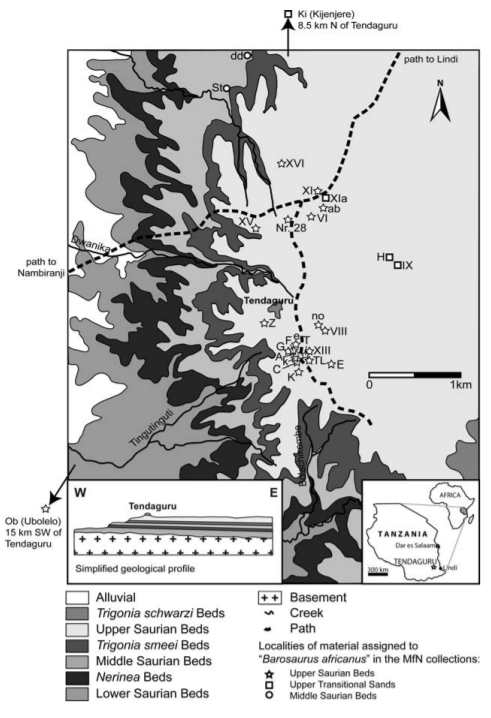
The fossils came from locality St (EH), a site worked by the German Tendaguru Expeditions between 1909 and 1913. It lies in the formation’s Middle Dinosaur Member, and in 2009, Remes likewise placed St in the Middle Saurian Beds (the same unit). Neither the exact year of collection nor the collector’s name appears in the sources. Locality names here can be confusing—Hans Reck renamed several when he took over the expedition lead from Janensch in 1912. Janensch first described the vertebrae in 1925 as part of the material on which he founded Ceratosaurus(?) roechlingi. In 2011, however, Rauhut removed them from that type series and concluded that they cannot be referred to Ceratosauria, the group that name implied.
The holotype—the specimen that anchors the name—is MB R 1938, field number St 270, in Berlin. It is a single isolated middle caudal vertebra, a bone from the middle of the tail. Janensch recorded its centrum, or vertebral body, at a maximum length of 123 millimeters (about 4.8 inches).
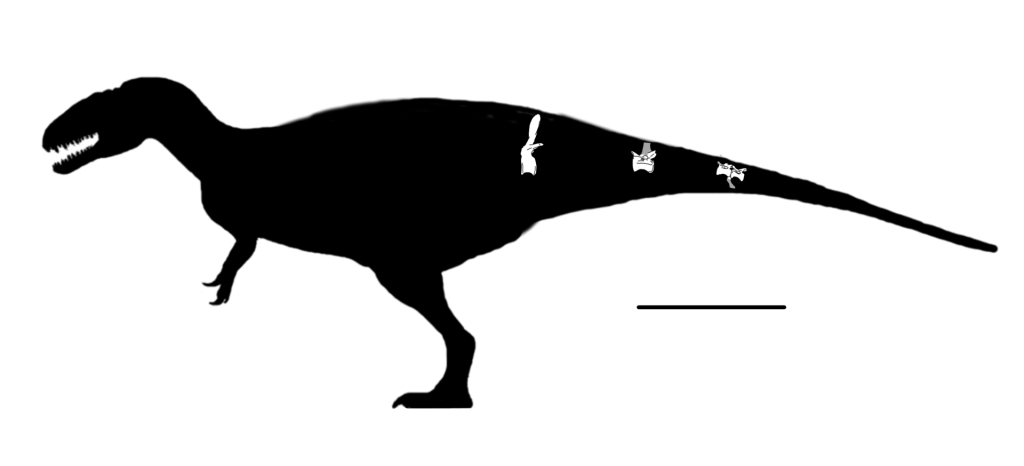

Rauhut also referred MB R 2166 (field number St 757), two partially fused posterior middle caudal vertebrae. They come from the same locality and, Rauhut judged, most probably from the same individual as the holotype. By contrast, the anterior caudal MB R 1940 comes from a different locality, TL, in the younger Upper Dinosaur Member. Rauhut left it as Theropoda indet.—an undetermined theropod—noting only that it might belong to the same taxon. No other material has been assigned to the genus in the sources reviewed, so every firmly referred bone comes from St (EH).
Veterupristisaurus Size and Description
With only tail bones to work from, any portrait of this animal rests on careful comparison.
Short description of Veterupristisaurus
The holotype’s centrum is moderately elongate, about 1.5 times as long as it is tall at the front. Above it, the neural spine—the blade of bone on top of the vertebra—extended over about three-quarters of the centrum’s length but is broken at its base. Underneath, the chevron facets (contact points for the bony struts beneath the tail) are poorly defined and weakly subdivided, possibly partly because of preservation.
Beyond the tail, nothing of the skeleton is known. Its skull, limbs, and posture therefore remain blank, and no source states how it moved. Skin and other soft tissues are not preserved either, so any restoration of its outward appearance is speculative.
Size and Weight of Type Species
Rauhut estimated Veterupristisaurus at between 28 and 33 feet (8.5 and 10 meters) long. That figure is indirect—it comes from comparing tail-bone lengths, not from a measured skeleton.
The 123-millimeter holotype centrum is longer than the 100 to 119 millimeters of comparable vertebrae in Torvosaurus and the 103 to 106 millimeters recorded for Neovenator. Those two animals were estimated at about 30 feet (9 meters) and 26 feet (8 meters) long. However, it falls short of the roughly 160-millimeter tail vertebrae of Acrocanthosaurus, a skeleton estimated at about 38 feet (11.5 meters).
No peer-reviewed height or body mass has been published for Veterupristisaurus. Without more of the skeleton, even the length stays a reasoned bracket rather than a firm figure.
The Dinosaur in Detail
What sets this dinosaur apart is a small detail on its middle tail vertebrae. The spinoprezygapophyseal lamina—a thin bony ridge running from the neural spine to the forward joint process, or prezygapophysis—reaches that process’s outer edge in other theropods. In Veterupristisaurus, by contrast, it extends only to the middle of the joint’s base. A short parallel lamina flanks it on the outside, and this double ridge formed the core of Rauhut’s diagnosis.
Rauhut also pointed to wide centroprezygapophyseal laminae (ridges linking the vertebral body to the forward joint processes), which it shares with Acrocanthosaurus and Mapusaurus. His abstract added carcharodontosaurid synapomorphies (shared derived features) in the vertebrae. On that basis, he inferred that carcharodontosaurids and their neovenatorid relatives had already split before the Kimmeridgian—a framework that later analyses no longer consistently recover.
Its own placement has shifted, too. According to Kellermann and colleagues, a 2020 analysis by Malafaia and colleagues placed it at the base of Carcharodontosauria, outside the family itself. In 2025, Kellermann, Cuesta, and Rauhut instead recovered it within Carcharodontosauridae in all their analyses, though they could not fix its exact position. Support came from a forward-running ridge at the base of the transverse process (the vertebra’s sideways prong) and a funnel-shaped front opening of the neural canal. Yet with 99 percent of its data missing, it was the most incomplete taxon in their dataset.
The same study raised a sharper doubt. Because the double lamina has since turned up in the Portuguese Lusovenator, the authors judged the validity of Veterupristisaurus questionable. Still, they confirmed carcharodontosaurid affinities for both Late Jurassic genera, “thus confirming a Jurassic origin for the clade.” Taken together, Veterupristisaurus may be a doubtful name attached to bones that still point to an early carcharodontosaurid.
Interesting Points about Veterupristisaurus
- Its name means “old shark lizard,” a nod to its status in 2011 as the oldest known representative of the carcharodontosaurids.
- Kellermann and colleagues found it the most incomplete taxon in their 2025 dataset, with 99 percent of its data missing.
- For 86 years, its bones carried the name Ceratosaurus(?) roechlingi, a species Janensch founded on them and other bones in 1925.
- The species name honors Angela C. Milner, who had been Rauhut’s external PhD supervisor in 2000.
- Rauhut’s 2011 size estimate of 28 to 33 feet rests on comparing one tail-vertebra length with those of three other large theropods.
Dinosaurs from the Same Formation
Also known from the Middle Dinosaur Member of the Tendaguru Formation (exact level relative to Veterupristisaurus not known): Giraffatitan, Kentrosaurus, Dicraeosaurus, Elaphrosaurus, and Dysalotosaurus. Together they span two sauropods, a stegosaur, a ceratosaurian, and an ornithopod. Bussert and colleagues listed Giraffatitan as Brachiosaurus brancai, while Taylor treated it in 2009 as generically separate from Brachiosaurus. Giraffatitan, Kentrosaurus, and Elaphrosaurus, as well as a second Dicraeosaurus species, are also listed from the younger Upper Dinosaur Member. The formation as a whole ranges from at least the middle Oxfordian to the Valanginian through Hauterivian, possibly even the Aptian. These animals may therefore not all have lived at the same time.
Veterupristisaurus in its Natural Habitat
The world Veterupristisaurus inhabited was a coast in flux. Rauhut described the Tendaguru Formation as a tidal setting shaped by repeated rises and falls of sea level. Bussert and colleagues interpret the Middle Dinosaur Member itself as a phase when sediment outpaced rising sea level and the coastline built outward. Across the formation, three marginal-marine sandstone units alternate with three finer coastal and tidal-plain units, which hold the dinosaur remains. At the member’s base, sediment settled on tidal flats and in small tidal channels of a lagoon. Higher up, ostracods (tiny shelled crustaceans) record a shift from marine to alternating marine-brackish and finally freshwater conditions. The upper part preserves sabkha-like coastal plains—flat, salt-crusted shores—with short-lived brackish lakes and ponds, while soil calcretes show that the ground was at times exposed to air. Charophytes such as Mesochara and Aclistochara also occur, along with the freshwater alga Ovoidites.

Nothing published says what Veterupristisaurus ate. Its world was not short of theropods, however. According to Rauhut, the Middle Dinosaur Member holds the most diverse theropod fauna at Tendaguru. In all, he recognized at least seven theropod taxa—four ceratosaurs and three basal tetanurans, one of them this carcharodontosaurid. Several remain unnamed or doubtful, such as the member’s abelisauroid “Coelurosaurier B and C” and the basal tetanuran “Allosaurus(?) tendagurensis.” Rauhut also found the Tendaguru theropod fauna closer to Cretaceous Gondwanan faunas than to the contemporaneous Morrison Formation fauna.
The same member has also yielded the pterosaur Tendaguripterus recki, the crocodylomorph Bernissartia, and mammals including Allostaffia aenigmatica, Tendagurodon janenschi, and Tendagurutherium dietrichi. A paramacellodid lizard, lissamphibians, and fishes such as Lepidotes round out the list. While there is no direct evidence of how Veterupristisaurus behaved, its bones place it firmly in this changing coastal world.
Frequently Asked Questions
It means “old shark lizard,” and the species name milneri honors paleontologist Angela C. Milner.
It lived in the Late Jurassic, during the Kimmeridgian to earliest Tithonian stages, roughly 155 to 149 million years ago.
Rauhut estimated a length of about 28 to 33 feet (8.5 to 10 meters) from tail-bone comparisons. No peer-reviewed weight estimate has been published.
It was a theropod placed in Carcharodontosauridae, a placement a 2025 study supported while calling the genus’s validity questionable.
Its fossils come from locality St (EH) in the Middle Dinosaur Member of the Tendaguru Formation, southeastern Tanzania.
Its middle tail vertebrae carry a distinctive double ridge, although the same feature has since been found in Lusovenator.
Sources
The information in this article is based on various sources, drawing on scientific research, fossil evidence, and expert analysis. The aim is to provide a comprehensive and accurate overview of Veterupristisaurus. However, please be aware that our understanding of dinosaurs and their world is constantly evolving as new discoveries are made.
- https://palass.org/publications/special-papers-palaeontology/archive/86/article_pp195-239
- https://doi.org/10.1371/journal.pone.0311096
- https://doi.org/10.1080/02724634.2020.1768106
- https://fr.copernicus.org/articles/12/141/2009/fr-12-141-2009.pdf
- https://doi.org/10.1671/039.029.0309
- https://stratigraphy.org/ICSchart/ChronostratChart2024-12.pdf
- https://doi.org/10.1163/9789004691063_015
- https://doi.org/10.1002/mmng.200800008
This article was last fact checked: TheDinosaurs Team, 17-11-2026
Featured Image Credit: Line art: Robinson Kunz, Colour: Rebecca Slater, Background: Juandev, CC BY 3.0, via Wikimedia Commons
