
In the gray mudstones of Utah’s Cedar Mountain Formation, a single partial leg revives a lost chapter of tyrannosaur history. Named Moros intrepidus in 2019, this small predator lived in the Late Cretaceous—about 99.4 million years ago, by the latest estimate. It is the oldest named Cretaceous tyrannosauroid from North America—only isolated teeth and bones of uncertain identity are older or similar in age. Its describers said it extended the species record there by about 15 million years. Its describers estimated a weight of only about 172 pounds (78 kilograms).
The bones came to light in the early 2010s, when paleontologist Lindsay Zanno saw limb bones jutting out of a hillside. In 2019, Zanno and five colleagues described the animal in Communications Biology. Their study combined bone anatomy, growth lines, and family-tree analyses to portray a lightly built, fast-running predator. Before Moros, the North American record of tyrannosauroid species went dark for about 70 million years. This one leg helps narrow that gap—and shows how small these animals stayed before their later rise in size.
Moros Key Facts
| Keyword | Fact |
|---|---|
| Pronunciation | Not specified |
| Meaning of name | Embodiment of Impending Doom (Moros), Intrepid (intrepidus) |
| Group | Theropoda (Tyrannosauroidea) |
| Type Species | Moros intrepidus |
| Diet | Carnivore |
| When it Lived | Around 99.4 MYA |
| Period | Cretaceous |
| Epoch | Late Cretaceous (Cenomanian stage) |
| Length | Not specified |
| Height | Not specified |
| Weight | About 172 pounds (78 kilograms), range 117 to 187 pounds (53 to 85 kilograms) |
| Mobility | Moved on two legs (bipedal) |
| First Discovery | Early 2010s by Lindsay Zanno |
| Described by | 2019 by L.E. Zanno, R.T. Tucker, A. Canoville, H.M. Avrahami, T.A. Gates, and P.J. Makovicky |
| Holotype | NCSM 33392 |
| Location of first find | Stormy Theropod site, lower Mussentuchit Member, Cedar Mountain Formation, Emery County, Utah, USA |
Moros Origins, Taxonomy and Timeline
The name Moros comes from the Greek for “the embodiment of impending doom.” Its describers chose it to mark the establishment of the Cretaceous tyrannosauroid lineage in North America. The species name intrepidus is Latin for “intrepid,” a nod to the tyrannosaurs’ hypothesized dispersal at this time. Press releases rendered the name more loosely as “harbinger of doom.”
Moros belongs to Theropoda and, within it, to Coelurosauria and Tyrannosauroidea—the tyrannosaurs and their earlier relatives. In one original analysis, it branched off after Dilong, an Early Cretaceous species from Asia. Its describers called it an “intermediate tyrannosauroid” close to mid-Cretaceous Asian forms. Although its foot proportions resemble those of ornithomimosaurs (ostrich-like theropods), details of its femur and fourth metatarsal mark it as a tyrannosauroid. Moros intrepidus is the type and only known species.
The 2019 study placed Moros in the Cenomanian stage of the Late Cretaceous. At the time, laser-dated zircon grains suggested the rock was no older than 96.4 million years. In 2023, geologist Ryan Tucker and colleagues dated four volcanic ash beds with a more precise method. Their age model places the holotype at roughly 99.4 million years old. The same team found that earlier laser-based zircon dates from the member came out too young, likely because of lead loss. They named only dates published in 2020, although the 2019 estimate used the same laser method. Either way, Moros lived shortly before the Cretaceous Thermal Maximum, a peak of global warmth.
Discovery & Fossil Evidence
The holotype comes from the “Stormy Theropod” site in the lower Mussentuchit Member, on Utah state land in Emery County. It lay 20 to 23 feet (6 to 7 meters) above the contact with the older Ruby Ranch Member. National Geographic dates the find to 2013, while Smithsonian reports 2012—the original paper gives no year. An NC State University press release says it followed a decade of searching these rocks. The leg also turned up in the area where Zanno had earlier found the large predator Siats.
The holotype, NCSM 33392, belongs to the North Carolina Museum of Natural Sciences in Raleigh. It is an associated right hind limb from a subadult—an individual not yet fully grown. It preserves parts of the femur (thigh bone), tibia (shin bone), second and fourth metatarsals (foot bones), and two toe bones. Erosion had removed the head and lower joint surfaces of the femur, and the tibia lacks both ends. By contrast, the fourth metatarsal is nearly complete.
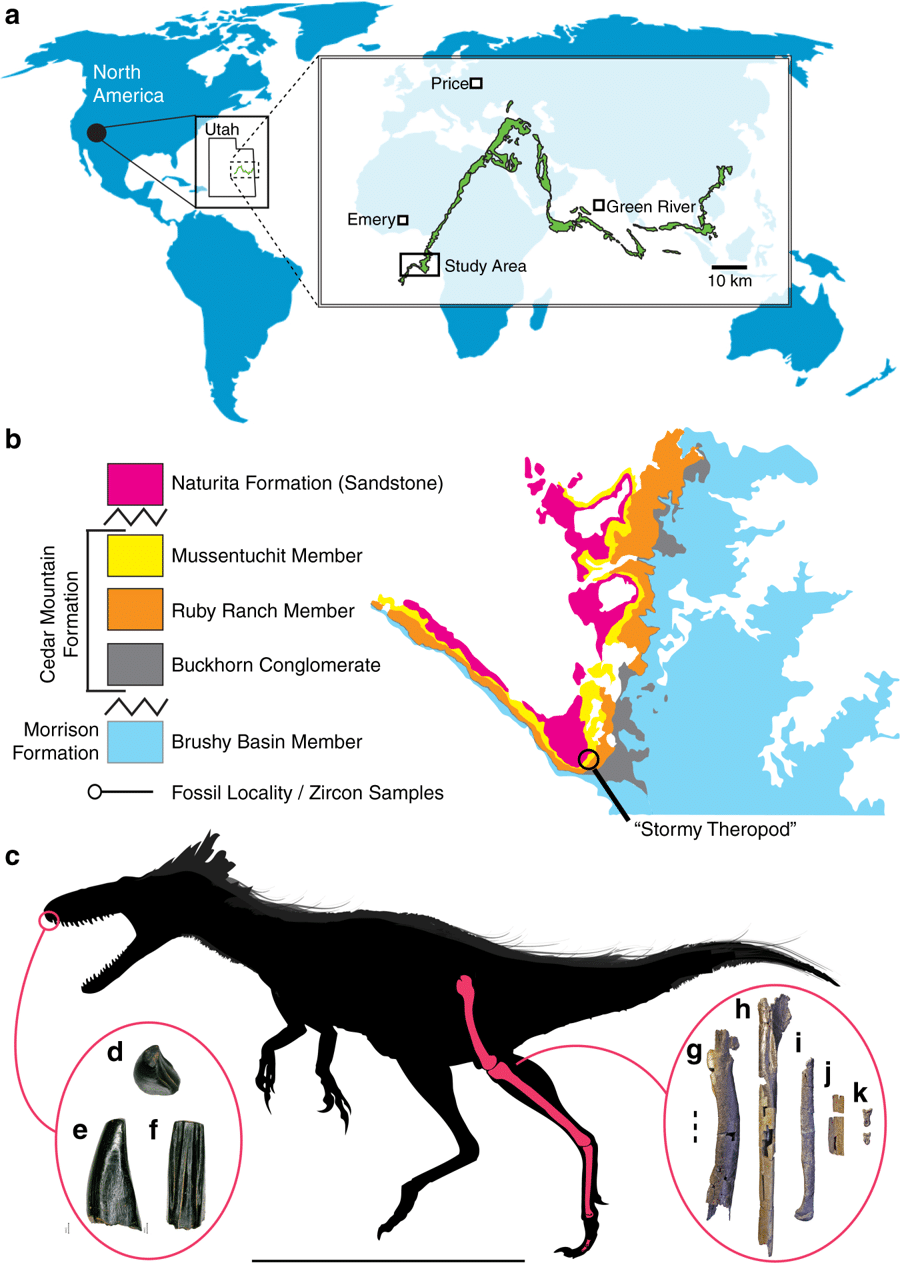

Two isolated premaxillary teeth (teeth from the tip of the upper jaw) come from other sites in the same member. The paper lists them, NCSM 33393 and NCSM 33276, only as indeterminate tyrannosauroids, not as Moros. State statute restricts the exact locality data, which the museum shares with qualified researchers. No additional specimens of Moros have been confirmed beyond the single holotype limb. A similar but distinct tyrannosauroid thigh bone of comparable age, described from Idaho’s Wayan Formation in 2022, suggests Moros was not the only small tyrannosauroid in western North America at the time.
Moros Size and Description
One leg is all that survives, yet it says a great deal.
Short description of Moros
No skull, arms, or backbone of Moros has turned up. By scaling from the Asian tyrannosauroid Xiongguanlong, partly using one of the unassigned teeth, its describers estimated a skull 11.8 to 15.7 inches (300 to 400 millimeters) long. Like its relatives, it walked on two legs, and its tibia was longer than its femur.
The foot was arctometatarsalian—its third metatarsal pinched between its neighbors. Zanno’s team called it unusually gracile, most like the foot of Alectrosaurus. Skin and soft tissue are not preserved, so its covering is unknown.
Size and Weight of Type Species
Zanno and colleagues estimated a hind-limb length of about 3.9 feet (1.2 meters). The joint ends are missing, so the bone lengths are estimates too. They put the femur at about 14 inches (355 millimeters) and the tibia at about 17.3 inches (440 millimeters). Neither body length nor hip height appears in the paper.
Press materials instead likened it to a modern mule deer, three or four feet (about 0.9 to 1.2 meters) tall at the hip. However, these are popular figures, not published measurements.
For body mass, the team used five equations for two-legged dinosaurs, all based on limb bones. Their result was about 172 pounds, within a range of 117 to 187 pounds. By that measure, Moros ranks as one of the smallest Cretaceous tyrannosauroids yet described. It was not quite full-grown, although its bones suggest it was nearing adult size.
The Dinosaur in Detail
What sets this dinosaur apart is a foot built for speed. Its fourth metatarsal measures an estimated 10.6 inches (270 millimeters), roughly 21 times its width at midshaft—a ratio between those of tyrannosaurids and ornithomimids. However, overall foot slenderness clusters with ornithomimids, well outside the range of juvenile tyrannosauroids. The femur preserves the base of a wing-like lesser trochanter (a muscle-attachment crest), as in Alioramus and later tyrannosaurids.
The diagnosis rests on three autapomorphies—traits unique to the species—plus one further feature. They include a semicircular bump on the femoral shaft and a wavy joint where the fourth metatarsal meets the third. In addition, Moros preserves the oldest record in tyrannosaurs of an arctometatarsalian foot with a wedge-shaped third metatarsal. Its describers say this foot type arose in the group no later than the Cenomanian.
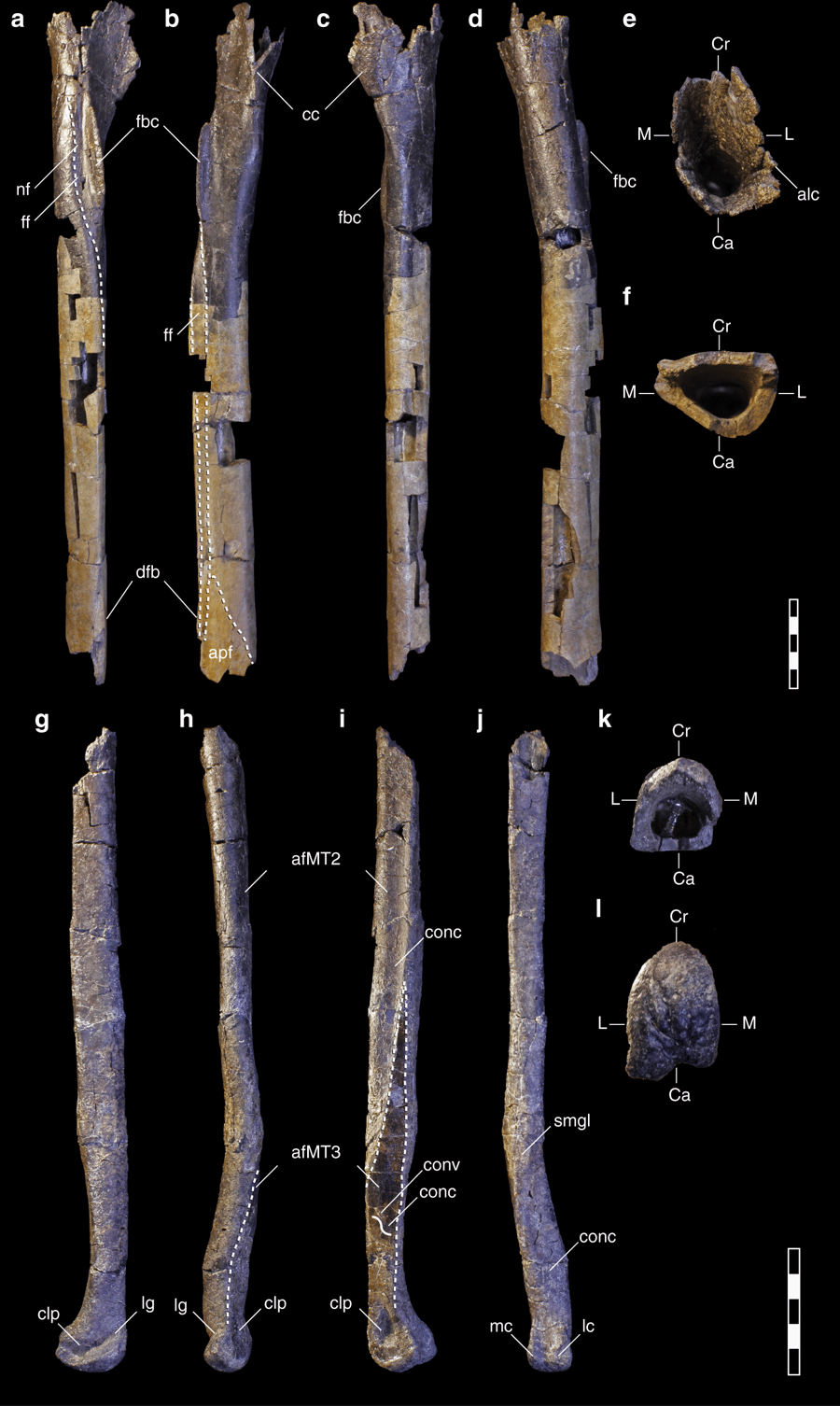

The femur has a wide marrow cavity and relatively thin walls, and the tissue shows tunnels like those left by invading fungi. A femur thin section shows up to 16 lines of arrested growth (marks of paused bone growth). Grouping these into six to seven cycles, the team inferred an age at death of at least six to seven years. Its slow to moderate growth rate resembles that of the early tyrannosauroid Guanlong, unlike the rapid growth of large tyrannosaurids.
Its family tree is unsettled, since the 2019 team’s three data sets gave three placements. Besides the Dilong result, one set put Moros near the base of Eutyrannosauria (“true tyrannosaurs”) in an unresolved cluster. Another made it the sister group to Appalachiosaurus plus all later tyrannosauroids. Taken together, the results tie it to mid-Cretaceous Asian species and to Appalachian forms such as Dryptosaurus. With only a single leg to work from, its exact position may yet shift.
Interesting Points about Moros
- Its genus name invokes the Greek embodiment of impending doom—a nod to its lineage taking hold in North America.
- Before Moros, North America’s tyrannosauroid species record went dark from the Jurassic–Cretaceous boundary until about 81 million years ago.
- Growth lines in its femur suggest the holotype was at least six to seven years old and already slowing its growth.
- Two tyrannosauroid teeth from the same rock unit were not assigned to Moros.
- Its describers argued that North America’s later tyrannosauroids most likely descended from ancestors that arrived from Asia before the Cenomanian.
Contemporary Dinosaurs
Towering over the same coastal lowlands was Siats meekerorum, a giant predator named in 2013 as an allosauroid. Its describers placed it among the megaraptorans and called it the first neovenatorid known from North America, but where megaraptorans belong in the theropod family tree is still debated. Its holotype from the Mussentuchit Member dates to about 99.1 million years ago, roughly 300,000 years after Moros in the 2023 age model. The 2019 authors saw small tyrannosauroids as lower-level predators beneath allosauroids such as Siats, though no fossil records an encounter.
Adding further diversity was Iani smithi, an early-diverging ornithopod named in 2023. It is known from a single specimen, NCSM 29373, from the lower Mussentuchit Member. The same age model dates that specimen to about 99.7 million years ago, close to the age of Moros.
Joining them was Fona herzogae, a small-bodied thescelosaurine—an early-diverging ornithischian—named in 2024. Its describers suggested it may have shared a semi-fossorial (partly burrowing) lifestyle with Oryctodromeus. Its holotype dates to about 99.5 million years ago, the nearest in age to Moros of the three dated holotypes here. Even so, no fossil links the two directly.
Among the plant-eaters of the same member was Eolambia caroljonesa, a basal hadrosauroid known from copious remains. All of its known material comes from the Mussentuchit Member. The 2023 description of Iani, drawing on the new age model, puts its oldest occurrence at about 99.5 million years ago. Still, nothing ties the two together beyond shared rock and age.
Moros in its Natural Habitat
Moros roamed a low, humid coastal plain in the Western Interior Basin, fed by rivers from western highlands. The leg itself lay in gray mudstones laid down on a coastal mudflat with minor short-lived channels and lakes. Geologists have likened the Mussentuchit Member to the modern coastal plain of French Guiana, and its lower part held vast, plant-rich wetlands over brackish groundwater. Meanwhile, the nearby Western Interior Seaway left its mark through brackish groundwater and minor tidal influence, although the plain itself was not flooded by the sea. Humidity ran moderate to high, comparable to a subtropical mid-latitude climate.
Moros was a meat-eater, although no gut contents or bite marks reveal its prey. Its describers called small Cretaceous tyrannosauroids marginal predators that relied on speed and small size. Zanno told Smithsonian that its long feet would have given it incredible speed. It also lived among one of the most diverse early Late Cretaceous land faunas in the world—nearly 100 species so far.
No evidence shows whether Moros lived alone or in groups. The 2019 authors suggested that tyrannosauroids stayed lower-level predators in North America through at least the Turonian. Only after that did they more than double their femur length, within no more than 16 million years. In that light, Moros captures its lineage just before the rise—small, swift, and still in the shadow of larger hunters.
Frequently Asked Questions
Moros comes from the Greek for “the embodiment of impending doom,” and intrepidus is Latin for “intrepid.”
It lived in the Cenomanian stage of the Late Cretaceous, about 99.4 million years ago according to a 2023 age model.
Its describers estimated a weight of about 172 pounds and a hind-limb length of about 3.9 feet. No body length has been published.
It was a carnivore, although no direct evidence such as gut contents or bite marks shows what it ate.
Its only known fossil comes from the lower Mussentuchit Member of the Cedar Mountain Formation in Emery County, Utah.
It is the oldest named Cretaceous tyrannosauroid from North America, with an unusually slender foot suited to fast running.
Sources
The information in this article is based on various sources, drawing on scientific research, fossil evidence, and expert analysis. The aim is to provide a comprehensive and accurate overview of Moros. However, please be aware that our understanding of dinosaurs and their world is constantly evolving as new discoveries are made.
- https://doi.org/10.1038/s42003-019-0308-7
- https://static-content.springer.com/esm/art%3A10.1038%2Fs42003-019-0308-7/MediaObjects/42003_2019_308_MOESM1_ESM.docx
- https://doi.org/10.1130/G51278.1
- https://doi.org/10.2110/jsr.2021.028
- https://doi.org/10.1038/ncomms3827
- https://doi.org/10.1371/journal.pone.0286042
- https://doi.org/10.1002/ar.25505
- https://doi.org/10.1371/journal.pone.0353169
- https://doi.org/10.1371/journal.pone.0045712
- https://doi.org/10.1017/jpa.2022.42
- https://paleobiodb.org/data1.2/taxa/single.json?name=Moros&show=attr,app,class,parent
- https://news.ncsu.edu/?p=485315
- https://www.nationalgeographic.com/science/article/new-tiny-t-rex-relative-moros-fills-north-american-fossil-gap
- https://www.smithsonianmag.com/smart-news/t-rex-cousin-was-about-size-deer-180971543/
- https://www.sciencenews.org/article/t-rex-ancestor-shows-how-fast-tyrannosaurs-became-giants
This article was last fact checked: TheDinosaurs Team, 03-11-2026
Featured Image Credit: Tom Parker, CC BY-SA 4.0, via Wikimedia Commons
