
In the volcanic tuff beds around Lujiatun village in western Liaoning, China, the lowest layers of the Yixian Formation hold a small and surprising relative of Tyrannosaurus. Named Dilong paradoxus in 2004, this gracile carnivore lived during the Barremian stage of the Early Cretaceous—roughly 125.8 to 125.5 million years ago. Its describers identified it as a basal tyrannosauroid, an early member of the lineage that would later produce giant tyrannosaurids. Yet only its skull looked advanced, while the rest of its skeleton stayed strikingly primitive.
In October 2004, paleontologist Xu Xing and five colleagues announced the animal in the journal Nature. A fragmentary specimen described alongside it preserved filaments along its tail. That specimen may belong to a larger related species. The team presented these as the first direct fossil evidence that tyrannosauroids had protofeathers—simple forerunners of true feathers. For a jackal-sized hunter, Dilong carries an outsized share of the tyrannosaur story.
Dilong Key Facts
| Keyword | Fact |
|---|---|
| Pronunciation | Not specified |
| Meaning of name | Emperor Dragon |
| Group | Theropoda (Tyrannosauroidea) |
| Type Species | Dilong paradoxus |
| Diet | Carnivore |
| When it Lived | 125.8 to 125.5 MYA |
| Period | Cretaceous |
| Epoch | Early Cretaceous (Barremian stage) |
| Length | At least 5.2 feet (1.6 meters) |
| Height | Not specified |
| Weight | Not specified |
| Mobility | Moved on two legs (bipedal) |
| First Discovery | Year not specified, reported by a team led by Xu Xing |
| Described by | 2004 by X. Xu, M.A. Norell, X. Kuang, X. Wang, Q. Zhao, and C. Jia |
| Holotype | IVPP V14243 |
| Location of first find | Lujiatun beds (Lujiatun Member), lower Yixian Formation, Lujiatun near Beipiao, western Liaoning, China |
Dilong Origins, Taxonomy and Timeline
The name Dilong comes from the Mandarin words for “emperor” and “dragon.” The species name paradoxus has a story of its own. As co-author Mark Norell explained in a 2004 Chinese Academy of Sciences report, the team chose it because feathers on a Tyrannosaurus relative seemed so counter-intuitive.
Xu and colleagues placed Dilong within Theropoda and Coelurosauria as a new tyrannosauroid—a member of the superfamily that includes Tyrannosaurus and its relatives. They called it basal, meaning it branched off early in that lineage. Their analysis, built on a 2003 dataset by Currie and colleagues, yielded a single shortest family tree. They also hailed it as the earliest known unquestionable tyrannosauroid, although later work pushed the group’s record further back. In 2016, paleontologists Stephen Brusatte and Thomas Carr placed proceratosaurids, a branch including Guanlong, in the Middle Jurassic to Early Cretaceous. Dilong paradoxus is still the type and only named species. Even so, the describers suggested that the feathered specimen might represent a second, larger species.
Its fossil bed belongs to the early Barremian stage of the Early Cretaceous, close to the stage’s lower boundary. Li and colleagues’ 2022 dating of volcanic crystals placed the Lujiatun fossil bed at roughly 125.8 to 125.5 million years ago. An earlier 2006 study by He and colleagues had reached about 123.2 million years. By one 2021 estimate, the entire Yixian Formation in its home basin accumulated in only about 1.6 million years. Meanwhile, Amiot and colleagues estimated in 2011 that East Asia was cold, with mean air temperatures near 50 °F (10 °C) at mid-latitudes.
Discovery & Fossil Evidence
Available records do not say who collected the holotype or in what year. Instead, the record begins with a team led by Xu Xing of Beijing’s Institute of Vertebrate Paleontology and Paleoanthropology (IVPP). Their paper appeared in Nature on October 7, 2004, with Mark Norell, Kuang Xuewen, Wang Xiaolin, Zhao Qi, and Jia Chengkai as co-authors.
The IVPP houses the holotype, IVPP V14243. Figures in the original paper show its skull, scapula and coracoid (shoulder girdle bones), humerus (upper arm bone), and ilium (main hip bone). The skull runs 166 millimeters (6.5 inches) from the snout to the quadrate, the bone forming the jaw joint. The femur, or thigh bone, measures 181 millimeters (7.1 inches), while the tibia (shin bone) reaches 203 millimeters (8.0 inches). Based on neurocentral fusion—the joining of vertebral parts with age—the authors judged the animal not quite adult but close to maturity.
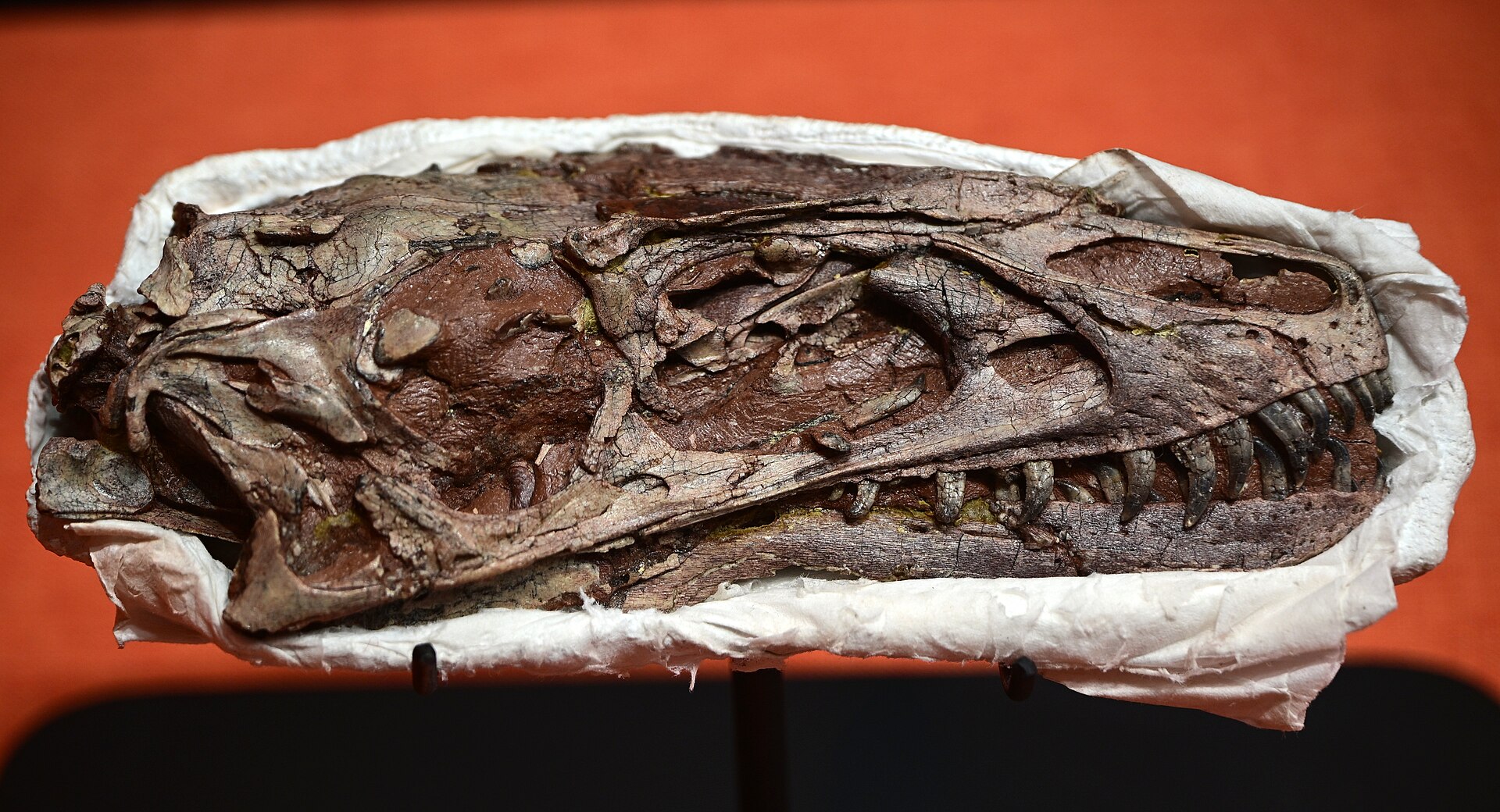

The study drew on two more specimens. Figures of IVPP V14242 show a braincase, a dentary (lower jaw) tooth, and a cervical (neck) vertebra. Its skull measures 132 millimeters (5.2 inches), and its preserved neck vertebrae lack neurocentral fusion. The third, IVPP V11579, is fragmentary. According to the Paleobiology Database, it came from a different level near Sihetun, not from the Lujiatun beds. It preserves skull bones, teeth, a hand, hip and foot bones, and tail vertebrae bearing branched integumentary structures—the famous filaments. The authors estimated its skull at 158 millimeters (6.2 inches).
Dilong Size and Description
Small and lightly built, Dilong looks little like its giant relatives—yet its skull hints at what was to come.
Short description of Dilong
The skull carried a proportionally long snout—in 2022, paleontologists Darren Naish and Andrea Cau listed it with Guanlong among long-snouted tyrannosauroids. Its nasal bones, which roof the snout, had fused together. The axis, the second neck vertebra, bore a single air-sac opening on each side—a primitive condition. According to the original description, Dilong was small and gracile, with relatively long arms ending in three-fingered hands. On the humerus, the deltopectoral crest, a ridge for shoulder muscles, spanned 40 to 50 percent of its length, according to a 2011 comparison by Brusatte and colleagues.
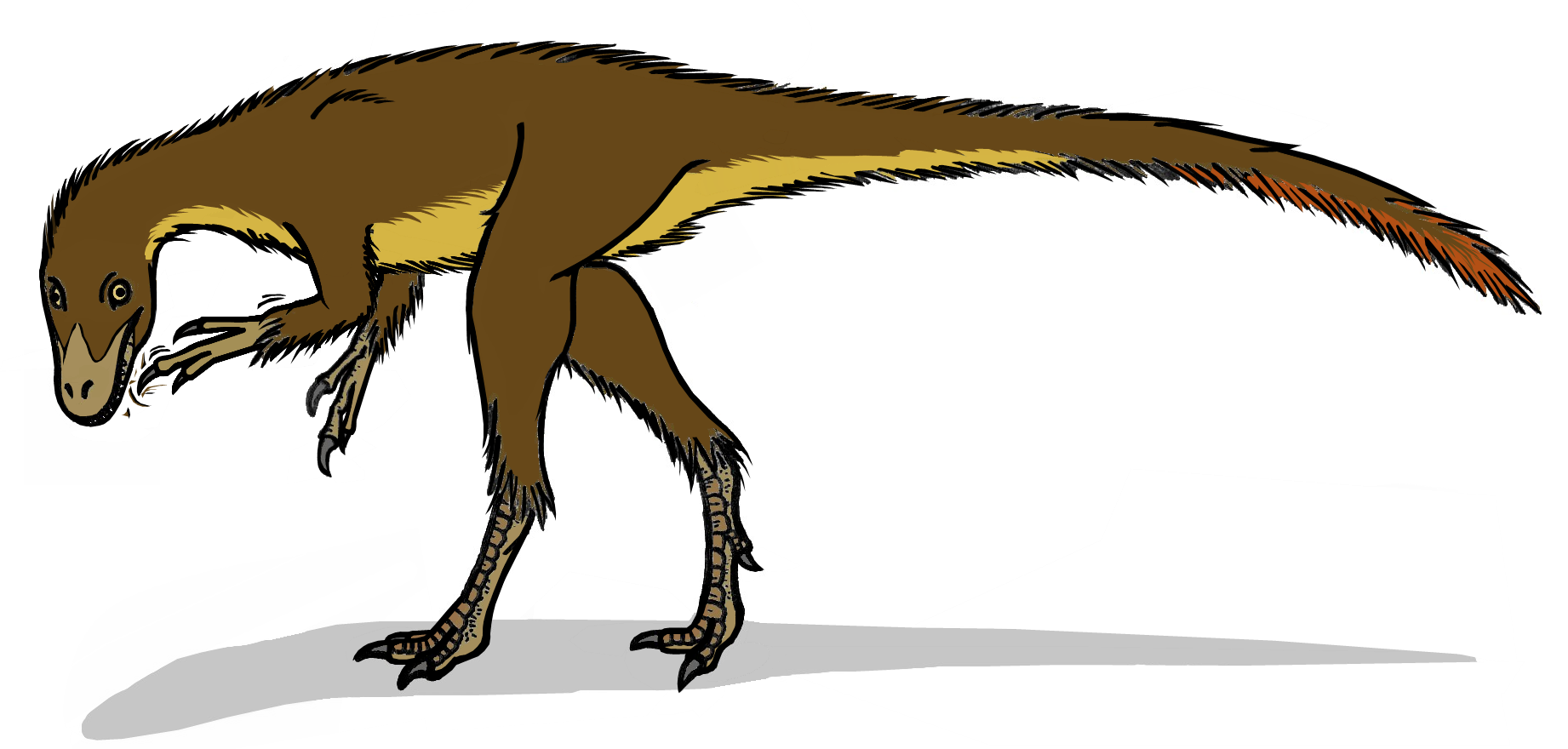
In the hind limb, the shin was longer than the thigh, and like other tyrannosauroids, it walked on two legs. Unlike later tyrannosaurids, its foot was not arctometatarsalian—the outer foot bones did not squeeze the middle one near the ankle. On the feathered specimen, filaments ran along the upper edge of the tail toward its tip. The American Museum of Natural History (AMNH) reported branched filaments about 0.75 inches (1.9 centimeters) long on the tail and left jaw. However, their color and the extent of the covering remain unknown, so any full-body restoration is speculative.

Size and Weight of Type Species
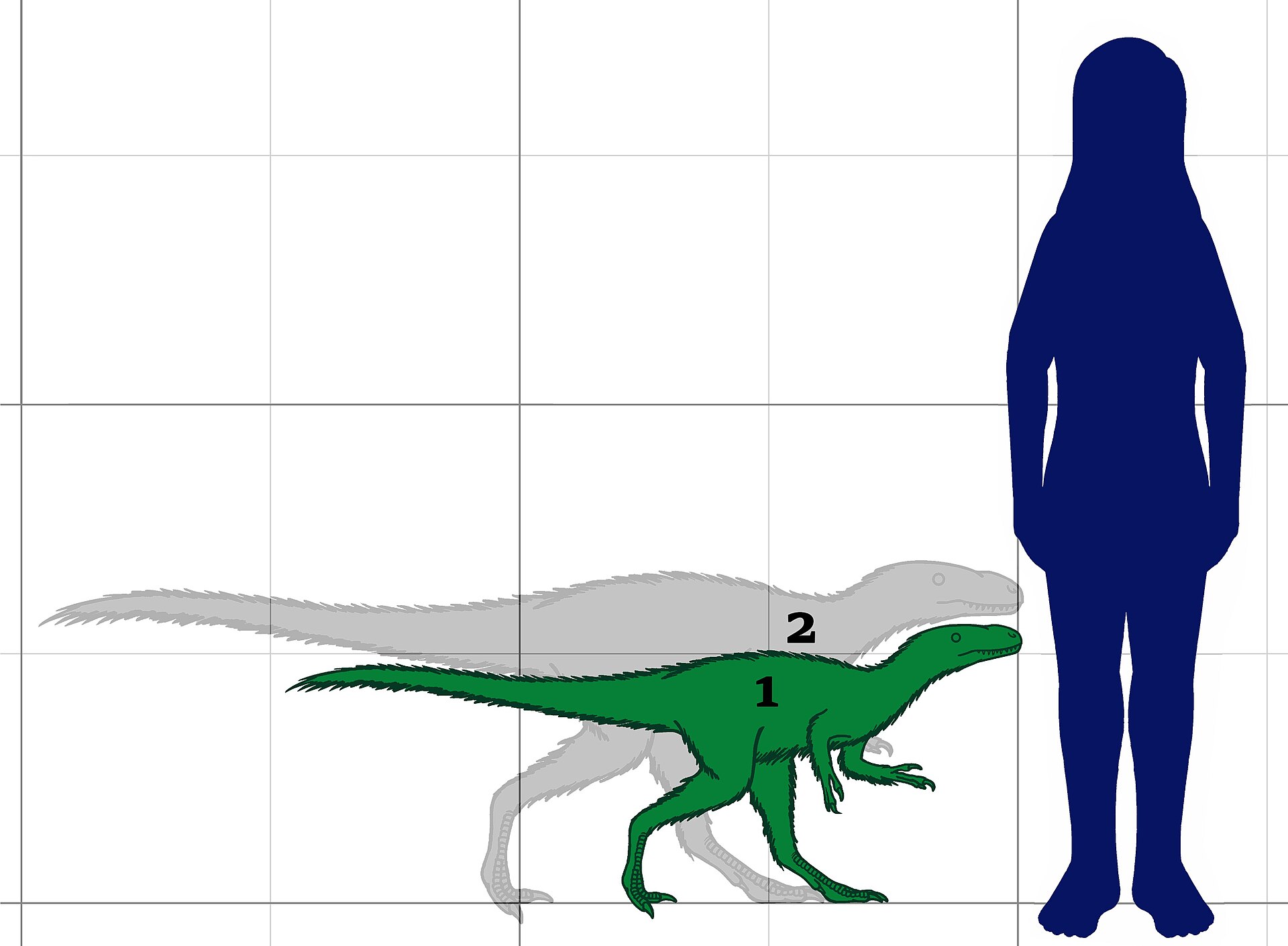
Citing Xu and colleagues, Rowe and Rayfield gave Dilong a minimum length of 5.2 feet (1.6 meters) in 2024. In contrast, the AMNH’s 2004 release described a “two-yard-long” animal, or about 6 feet (1.8 meters).
No dedicated peer-reviewed study of its weight or hip height appears to exist. Size is also a moving target, since the holotype was nearly mature while V11579 was younger yet about the same size. In the supplementary information, the authors therefore suggested that V11579’s species grew larger than Dilong paradoxus when fully grown.
Its famous relatives were far bigger. Using femur length as a size proxy, Zanno and colleagues noted in 2019 a roughly six-fold jump in body size. That leap separates early tyrannosaurs such as Dilong from their large-bodied early Campanian descendants.

The Dinosaur in Detail
What sets this dinosaur apart is its mosaic of primitive and derived traits. Xu and colleagues checked 30 skull features that define tyrannosaurids and found 20 of them in the 2004 specimens. In contrast, only 4 of 24 body-skeleton features typical of tyrannosauroids were present. In the AMNH release, Xu described the skull as “much more advanced than its relatively conservative body skeleton.”
Later studies refined the anatomy. Naish and Cau argued that hollows Xu’s team assigned to the maxilla (main upper tooth bone) more likely belong to the nasals. Meanwhile, Kundrát and colleagues reconstructed an S-shaped brain in 2018, wrapped in thinner meninges (the brain’s membranes) than in Tyrannosaurus. Those authors proposed that increasing body size later imposed a new brain layout during tyrannosaur gigantism.
The filaments drew the most attention, and the original figure legend describes them as showing a simple branching pattern. Reviewing feather evolution in 2025, Xu placed Dilong‘s filaments among bilaterally branched feathers, the second stage of theropod feather evolution. Nevertheless, these structures come from V11579, possibly from a larger related species, not from the holotype.
Its place in the family tree remains disputed. Brusatte and Carr’s 2016 trees put Dilong in an intermediate grade outside Proceratosauridae, alongside Eotyrannus, much as Loewen and colleagues had in 2013. However, in 2022, Naish and Cau recovered Dilong inside Proceratosauridae, an early-diverging branch of tyrannosauroids. Earlier analyses by Senter, by Li and colleagues, and by Rauhut, Milner, and Moore-Fay arranged it differently again. Taken together, the evidence shows a small hunter whose head ran ahead of its body—its exact branch still unsettled.
Interesting Points about Dilong
- Its name means “emperor dragon” in Mandarin, and paradoxus reflects how unexpected feathers on a tyrannosaur relative seemed in 2004.
- Dilong provided the first direct fossil evidence that tyrannosauroids carried protofeathers, preserved on a separate specimen rather than the holotype.
- According to the AMNH, the feathered specimen went unidentified until researchers studied a more complete Dilong fossil.
- The 2004 specimens show 20 of 30 tyrannosaurid skull features but only 4 of 24 tyrannosauroid body features.
- A 2019 study noted roughly six-fold growth in femur length from early tyrannosaurs like Dilong to their large early Campanian descendants.
Contemporary Dinosaurs
Sharing the Lujiatun landscape in overwhelming numbers was Psittacosaurus, here the ceratopsian P. lujiatunensis from the same bed and age. Its uncorrected relative abundance reaches nearly 90 percent locally, according to a 2023 study by Han and colleagues. Even so, no fossil evidence links the two directly.
Also present was Jeholosaurus, an ornithopod listed among the Lujiatun dinosaurs. Faunal lists from 2020 and 2022 place it in the same bed as Dilong. Nothing in the record shows how the two interacted.
Curled up in the same beds was Mei long, a troodontid dinosaur. Its skeleton lies in the stereotypical sleeping or resting posture seen in living birds. The same faunal lists place it in Dilong‘s fossil bed, though no interaction between them appears in the record.
Adding a stranger profile was Incisivosaurus gauthieri, an oviraptorosaur from the lowest part of the Yixian Formation. Its front teeth resembled rodent incisors, and its describers suggested a herbivorous diet. Both animals appear in the same Lujiatun faunal lists, but no direct link between them has come to light.
Dilong in its Natural Habitat
Volcanoes shaped the world Dilong roamed. The Lujiatun Member is the lowest of three members in the lower Yixian, below the Lava and Jianshangou members. Its rocks are alluvial and river-laid volcanic conglomerates, tuffaceous sandstones, and tuffs. Lujiatun village lies about 15 miles (24 to 25 kilometers) south of Beipiao, east of the Sihetun fossil site. Fossils here are often three-dimensional and articulated, earning the bed the nickname “Chinese Pompeii.” How the animals died remains debated, and several teams have proposed a single catastrophic pyroclastic flow or lahar—a volcanic mudflow. In contrast, Rogers and colleagues argued in 2015 for multiple flood events carrying volcanic debris. Researchers also disagree on whether the Lujiatun and lower Jianshangou beds formed nearly together or as separate events.
As a carnivore, Dilong likely hunted small animals. In 2026, Johnson-Ransom and colleagues argued that small early tyrannosauroids lacked the equipment to dispatch large, robust prey. Their models also show Dilong‘s skull under relatively high stress during biting, with magnitudes like those of early juvenile tyrannosaurids. Besides dinosaurs, the bed preserves lizards, mammals, and frogs. One specimen even shows a gobiconodontid mammal and a Psittacosaurus locked in mortal combat—though that struggle did not involve Dilong.
While there is no direct evidence of how Dilong lived socially, its filaments have prompted some functional ideas. Norell argued that protofeathers did not evolve for flight. A 2004 Chinese Academy of Sciences report added that experts thought they most likely served as insulation. Later, Bell and colleagues proposed in 2017 that the extensive feather coverings of some early tyrannosauroids were gone by the Albian stage.
Frequently Asked Questions
It means “emperor dragon” in Mandarin, and paradoxus reflects the surprise of feathers on a tyrannosaur relative.
It lived in the Barremian stage of the Early Cretaceous, about 125.8 to 125.5 million years ago.
It reached at least 5.2 feet (1.6 meters) long, but no dedicated peer-reviewed weight study appears to exist.
It was a carnivore, and researchers suggest that small early tyrannosauroids like it probably took only small prey.
The holotype comes from the Lujiatun beds of the lower Yixian Formation, near Beipiao in western Liaoning, China. However, the feathered specimen came from a different level near the Sihetun fossil site.
A specimen described alongside the holotype gave the first direct fossil evidence of protofeathers in tyrannosauroids. Its skull is also far more advanced than its body.
Sources
The information in this article is based on various sources, drawing on scientific research, fossil evidence, and expert analysis. The aim is to provide a comprehensive and accurate overview of Dilong. However, please be aware that our understanding of dinosaurs and their world is constantly evolving as new discoveries are made.
- https://www.nature.com/articles/nature02855
- https://static-content.springer.com/esm/art%3A10.1038%2Fnature02855/MediaObjects/41586_2004_BFnature02855_MOESM1_ESM.doc
- https://www.nature.com/articles/nature02855/figures/1
- https://www.nature.com/articles/nature02855/figures/2
- https://www.nature.com/articles/nature02855/figures/3
- https://www.amnh.org/research/science-news/2004/newly-discovered-primitive-tyrannosaur-found-to-be-feathered
- https://english.cas.cn/newsroom/archive/china_archive/cn2004/200909/t20090923_40923.shtml
- https://www.bioedonline.org/news/nature-news-archive/feathered-ancestor-t-rex-unearthed/
- https://www.nature.com/articles/srep20252
- https://pmc.ncbi.nlm.nih.gov/articles/PMC9271276/
- https://pmc.ncbi.nlm.nih.gov/articles/PMC3819173/
- https://pmc.ncbi.nlm.nih.gov/articles/PMC6385174/
- https://pmc.ncbi.nlm.nih.gov/articles/PMC6984342/
- https://pmc.ncbi.nlm.nih.gov/articles/PMC11387897/
- https://pmc.ncbi.nlm.nih.gov/articles/PMC13644910/
- https://pmc.ncbi.nlm.nih.gov/articles/PMC11837858/
- https://doi.org/10.1080/08912963.2018.1518442
- https://pmc.ncbi.nlm.nih.gov/articles/PMC5493735/
- https://par.nsf.gov/servlets/purl/10347257
- https://pmc.ncbi.nlm.nih.gov/articles/PMC8288181/
- https://doi.org/10.1029/2005GL025274
- https://pmc.ncbi.nlm.nih.gov/articles/PMC7485509/
- https://pmc.ncbi.nlm.nih.gov/articles/PMC10354204/
- https://doi.org/10.1016/j.palaeo.2015.03.037
- https://pmc.ncbi.nlm.nih.gov/articles/PMC3069172/
- https://paleobiodb.org/data1.2/occs/list.json?base_name=Dilong&show=coll,loc,strat&vocab=pbdb
This article was last fact checked: TheDinosaurs Team, 03-11-2026
Featured Image Credit: Jonathan Chen, CC BY-SA 4.0, via Wikimedia Commons
