
In the hills of Lufeng County, in China’s Yunnan Province, the river- and lake-laid rocks of the Lufeng Formation hold a predator with a striking crown. Named Sinosaurus triassicus, this theropod carried a pair of hatchet-shaped crests on top of its skull. Liang and colleagues have called it the largest and most famous predatory dinosaur from the Early Jurassic in China. In Xing’s 2012 tally, it was also the most common large theropod in its formation—five of the nine carnivore specimens then known.
Chinese paleontologist C.C. Young named the genus in the 1940s—sources give either 1940 or 1948—from little more than a broken upper jaw and a few teeth. Far better skeletons surfaced from 1987 onward, and the first of them became a new species of Dilophosaurus in 1993. Even now, researchers disagree over how many species these fossils represent and where Sinosaurus sits on the theropod family tree. Its story shows how a name founded on a jaw fragment can gather a crowd of skeletons—and arguments—around it.
Sinosaurus Key Facts
| Keyword | Fact |
|---|---|
| Pronunciation | Not specified |
| Meaning of name | China Lizard |
| Group | Theropoda |
| Type Species | Sinosaurus triassicus |
| Diet | Carnivore |
| When it Lived | About 199 to 184 MYA (estimates range from Hettangian to Toarcian) |
| Period | Jurassic |
| Epoch | Early Jurassic (Sinemurian to Pliensbachian stages) |
| Length | About 13 to 20 feet (4 to 6 meters), with the 1987 Kunming skeleton estimated at 18.0 to 18.4 feet (5.5 to 5.6 meters) |
| Height | Not specified |
| Weight | About 1,972 pounds (894.6 kilograms), 2024 volumetric estimate |
| Mobility | Moved on two legs (bipedal), inferred as for all theropods |
| First Discovery | Year not specified (holotype from Dahuangtian, described by C.C. Young) |
| Described by | 1940 or 1948 by C.C. Young (sources differ) |
| Holotype | IVPP V34 (partial maxilla with teeth) |
| Location of first find | Dahuangtian Village, Jinshan Township, Lufeng County (Lufeng Formation), Yunnan, China |
Sinosaurus Origins, Taxonomy and Timeline
The name Sinosaurus, meaning “China lizard,” is about as direct as dinosaur names get. Its date, however, is less tidy. The Paleobiology Database and a 2020 monograph by Marsh and Rowe credit Young with the name in 1940. In contrast, work by Dong, Xing, Currie, and Liang dates the description to 1948. Together, the name is simple—its paper trail is anything but.
Young first placed Sinosaurus in Carnosauria, a grouping then used broadly for large meat-eating dinosaurs. In 2004, Irmis even regarded it as a nomen dubium, or “doubtful name,” because the jaw fragment held so little information. Later, however, Currie and colleagues restudied the holotype and, in a 2019 conference abstract, referred a 1994 skeleton to the same species. Since then, studies have treated it as a theropod.
When first studied, the Lufeng beds were thought to be Late Triassic. Biostratigraphy—dating rocks by the fossils they contain—now points to the Early Jurassic. In 2013, Xing and colleagues reported a Hettangian to Sinemurian age. Newer work, however, points younger. As a 2024 study summarized, magnetostratigraphy (ancient magnetic reversals recorded in rock) puts the Shawan Member in the late Sinemurian to Toarcian. In 2025, Wang and colleagues noted that the Hettangian to early Sinemurian Yubacun Formation lies beneath the Lufeng Formation. The upper Lufeng is therefore probably Sinemurian to Pliensbachian—roughly 199 to 184 million years ago.
Discovery & Fossil Evidence
Young’s type material came from Dahuangtian Village in Jinshan Township, Lufeng County. The collection year is uncertain, although Currie and colleagues placed it half a century before 1994. Even the rock level remains in dispute. Xing’s 2012 thesis lists S. triassicus in the Shawan Member, while the Paleobiology Database places Young’s find in the Zhangjia’ao Member. Currie and colleagues likewise placed the 1987 and 1994 skeletons in the Zhangjia’ao Member.
The holotype, IVPP V34, belongs to the Institute of Vertebrate Paleontology and Paleoanthropology in Beijing. It consists of a partial maxilla (the main tooth-bearing bone of the upper jaw) in three fragments and three isolated teeth. Xing also lists two dorsal (back) vertebrae, IVPP V30 and V31. By contrast, a pelvic girdle found with them was later attributed to Yunnanosaurus, according to Dong Zhiming as reported by Xing. Yunnanosaurus was a sauropodomorph—an early relative of the long-necked sauropods.
In August 1987, the Kunming City Museum collected a skeleton, KMV 8701, in Jinning County. As Currie and colleagues later summarized, Hu described its skull in 1993 as Dilophosaurus sinensis, noting similarities to Dilophosaurus wetherilli. Then, in 1994, the Lufeng Dinosaurian Museum recovered a nearly complete double-crested skeleton, LDM-L10, at Heilongtan Village. It lay within 2 kilometers (1.2 miles) of the holotype site, and Dong judged it similar to Sinosaurus.
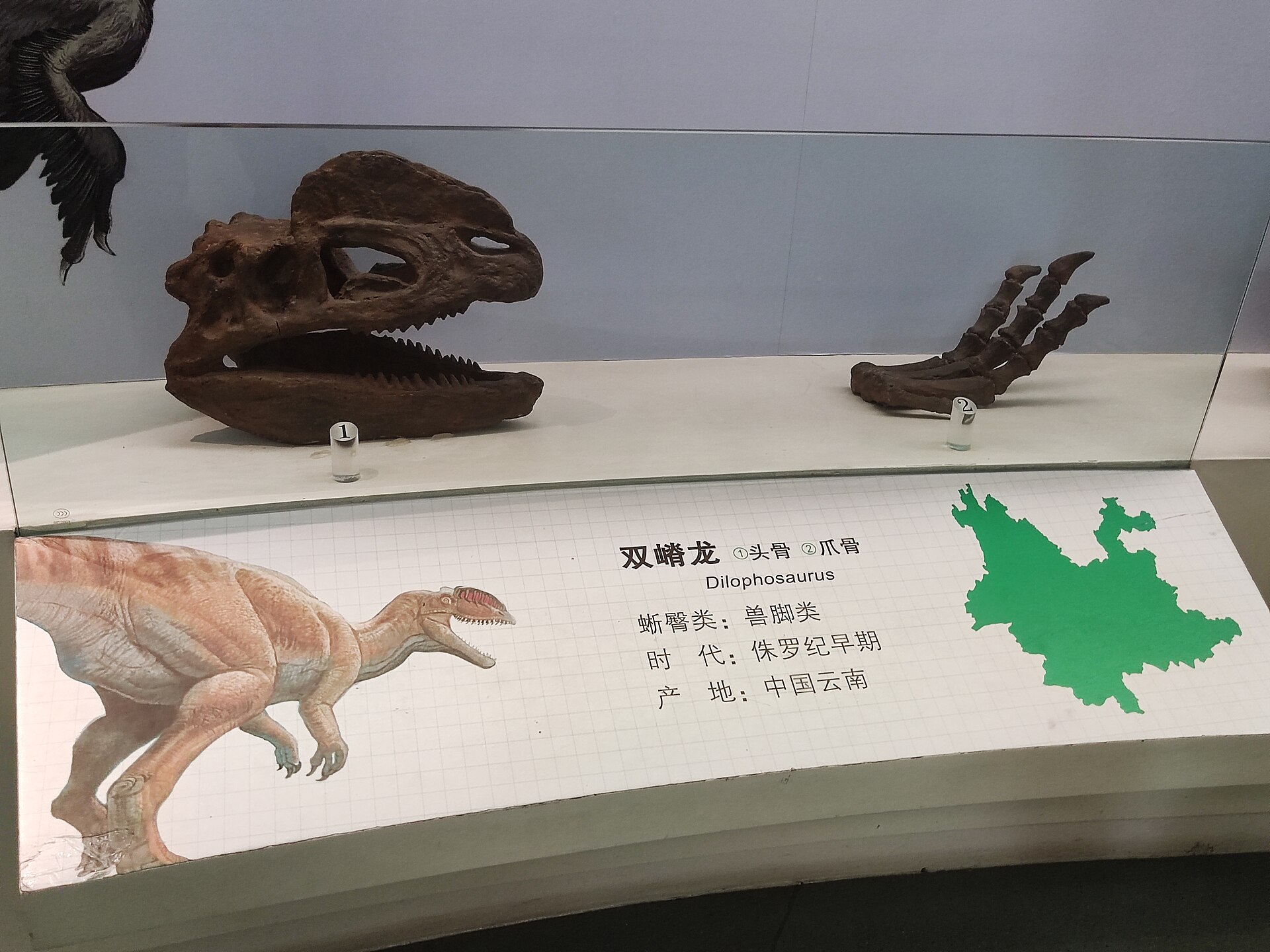

More followed. In 2006, Japanese paleontologist Toru Sekiya found ZLJ0003 at Konglong Hill. A year later, the Lufeng museum recovered ZLJT01, an incomplete skull, from the lowermost Shawan Member at Hewanzi Village. Later, another almost complete skeleton, ZLJ0057, came from the Shawan Member at Heilongtan. In 2023, Zhang and colleagues described another specimen from near the holotype locality. It has a complete skull, lower jaws, and 11 neck vertebrae, and they proposed three new skull features unique to the species.
Sinosaurus Size and Description
These skeletons reveal an animal whose most distinctive features sat on its head.
Short description of Sinosaurus
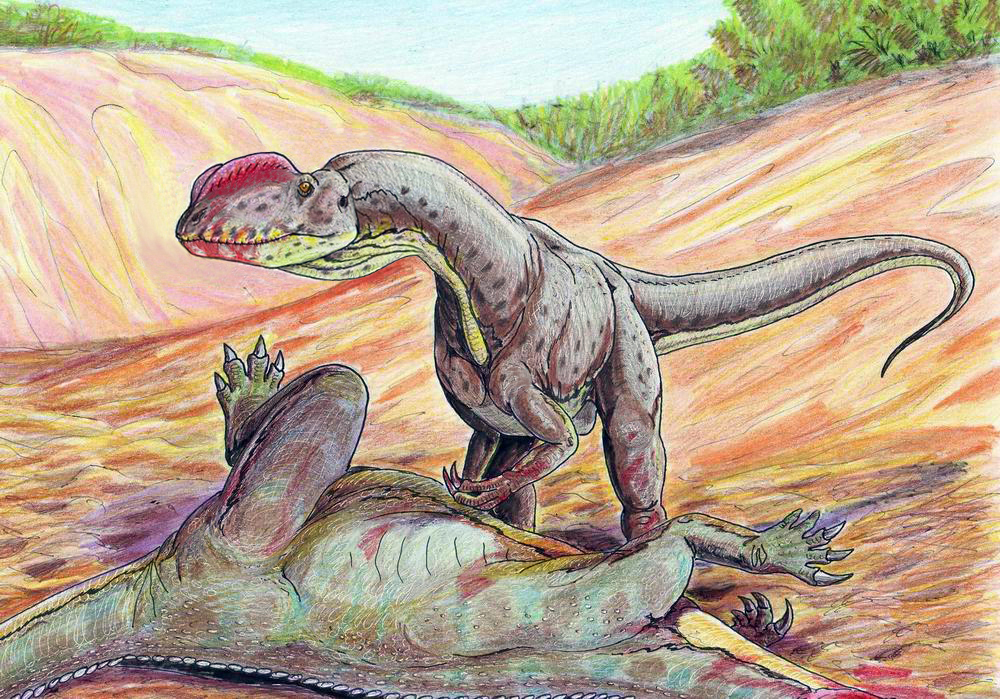
Its skull bore two fan-shaped crests running side by side. According to Marsh and Rowe, the premaxilla, nasal, and lacrimal all contributed to them, as in Dilophosaurus and Monolophosaurus. The partial left crest of ZLJT01 is 110 millimeters (4.3 inches) long. Below the crests, Dong noted a deep notch where the premaxilla (the front upper-jaw bone) meets the maxilla. The cast skull on the ZLJ0057 mount is 52 centimeters (20.5 inches) long. A complete maxilla likely held 13 or 14 teeth, each a serrated blade typical of carnivorous theropods.
Behind the head, the counts reported differ. Xu and colleagues’ 2021 diagnosis, as summarized by Liang and colleagues, lists 9 neck, 14 back, 5 hip, and about 40 tail vertebrae. In contrast, the 2023 specimen preserves 11 neck vertebrae, and a direct count on ZLJ0057 found 13 back and more than 31 tail vertebrae. In addition, its shin and upper foot were 1.44 times the length of the femur, or thigh bone. Liang and colleagues judged its build suited to speed—”a great runner,” in their words.

Size and Weight of Type Species
The best-known skeleton, found in 1987, is estimated at about 18 feet long—Dong put it at some 18.4 feet (5.6 meters) in a 2003 review. Currie and colleagues’ 2019 abstract gave a similar 18.0 feet (5.5 meters), calling it a medium-sized theropod. More broadly, Xing’s thesis describes it as a large theropod, 4 to 6 meters (13 to 20 feet) long.
In 2024, Liang, Falkingham, and Xing built a digital model of ZLJ0057 to estimate its body mass. Their preferred figure is about 1,972 pounds (894.6 kilograms), using expanding convex hulls (digital envelopes fitted around each body segment, then enlarged). Overall, their three volumetric methods spanned roughly 1,567 to 1,972 pounds (711.0 to 894.6 kilograms).
By comparison, simpler equations based on femur size gave only 946 and 1,184 pounds (429 and 537 kilograms), although the authors considered those results unreliable.
The Dinosaur in Detail
One of the most distinctive features of Sinosaurus is that paired crest. In 2015, Xing and colleagues tested it with finite element analysis—an engineering method that simulates stress—and found that the cavity-riddled crests “could not resist high loads.” ZLJT01 also records a dental first—its right maxilla shows alveolar remodeling, a tooth socket healed over after the tooth was lost. In 2013, Xing’s team reported it as the first confirmed case in a dinosaur, most likely after a traumatic, non-fatal injury.
How many species these skeletons represent remains contested. Xing’s 2012 thesis suggested that KMV 8701 and ZLJT01 may represent another species of Sinosaurus. In 2017, Wang and colleagues named the crested Shuangbaisaurus from Yunnan’s Fengjiahe Formation. They likewise suggested that “D.” sinensis could belong in Sinosaurus but probably not in the type species. In contrast, Currie and colleagues’ 2019 abstract argued that the Kunming skeleton possibly belongs to S. triassicus. They explained the differences by strong sexual dimorphism, or differences between males and females. They also placed other recent finds, including the Shuangbaisaurus holotype, within its range of variation.
Its family tree is just as unsettled. Xing’s 2012 thesis listed it under Dilophosauridae within Coelophysoidea, an early group of theropods. Yet the thesis’s own analysis, summarized again by Xing’s team in 2013, recovered it and Cryolophosaurus closer to Averostra (ceratosaurs plus tetanurans) than to Coelophysis and Dilophosaurus. Currie and colleagues’ 2019 abstract, however, reported a coelophysoid. Marsh and Rowe, citing Hendrickx and Mateus, wrote that it probably represents a basal tetanuran. Taken together, the analyses have, in Liang’s words, “no widely recognized conclusions.”
Interesting Points about Sinosaurus
- Its name means “China lizard,” and sources disagree on whether C.C. Young coined it in 1940 or 1948.
- ZLJT01 preserves the first confirmed case of alveolar remodeling, a healed tooth socket, known in any dinosaur.
- One skeleton was first named as a species of Dilophosaurus, but in 2020 Marsh and Rowe wrote that it should not be referred to that genus.
- In Xing’s 2012 tally, it made up five of the nine carnivore specimens then known from the Lufeng Formation (56 percent).
Contemporary Dinosaurs
Sharing the Lufeng landscape was Lufengosaurus, a basal sauropodomorph. In 2013, Xing and colleagues listed it among the animals associated with the Shawan-level beds that yielded ZLJT01. A 2018 study of an abscess on a Lufengosaurus rib from the Fengjiahe Formation named Sinosaurus “a possible suspect” in a failed predator attack. That link remains a hypothesis rather than a recorded encounter.
Yunnanosaurus, also a basal sauropodomorph, appears in the same 2013 list. Its bones turned up both with Young’s type material and beside the 1987 Kunming skeleton, yet no interaction between the two is recorded.
Adding further diversity was Lishulong wangi, an early member of the branch that led to sauropods. Zhang and colleagues named it in 2024 and recovered it as the closest relative of Yunnanosaurus. Its type locality lies in the upper-middle part of the Shawan Member—the same member that produced ZLJT01 and ZLJ0057. Nothing is known of any contact between them.
Among the other predators was Panguraptor, a small coelophysoid described in 2014 as the first well-preserved coelophysoid from Asia. A Paleobiology Database collection from the Lufeng Formation’s Shawan Member holds both genera. In 2018, Xing’s team judged it probably unable to attack a Lufengosaurus, unlike the larger Sinosaurus. All four animals share the Lufeng Formation, although the exact age of its members is still debated.
Sinosaurus in its Natural Habitat
Rivers and lakes crossed the world Sinosaurus roamed, and the formation’s dinosaurs lie in river, floodplain, and lake deposits. In 2021, Shen and colleagues used isotopes from Sinosaurus and sauropodiform fossils to estimate a mean annual temperature of at least 21 ± 3 °C (about 70 °F). Rainfall came to 965 ± 460 millimeters (about 38 inches) a year—a relatively arid tropical savanna. Pollen and spores record conifer forests with abundant ferns. Fish, however, are essentially unrecorded there, although freshwater bivalves are known.
As a carnivore, Sinosaurus sat at the top of the Lufeng food chain, in Xing’s view. Liang and colleagues argued that it needed both its head and forelimbs to take prey. Because its bite was weak, they suggested it fed on small- to medium-sized vertebrates. In 2003, however, Dong suggested it may have scavenged, likening its feet to those of Himalayan vultures and linking them to feeding on large carcasses.
While there is no direct evidence of whether Sinosaurus lived alone or in groups, its skeletons do hint at differences between individuals. Currie and colleagues linked those differences to strong sexual dimorphism—a pattern they suggested ran through all coelophysoids.
Frequently Asked Questions
It means “China lizard,” a name given by Chinese paleontologist C.C. Young in the 1940s.
It lived in the Early Jurassic, roughly 199 to 184 million years ago, although the exact age of its rocks is still debated.
Estimates run from about 13 to 20 feet long, and a 2024 study put its weight at about 1,972 pounds.
It was a carnivore with serrated teeth, and researchers suggest it took small- to medium-sized vertebrates using its head and forelimbs.
Its fossils come from the Lufeng Formation of Yunnan, China, beginning with a partial upper jaw from Dahuangtian Village.
Its twin, hatchet-shaped crests stand out, and one specimen preserves the first confirmed healed tooth socket known in a dinosaur.
Sources
The information in this article is based on various sources, drawing on scientific research, fossil evidence, and expert analysis. The aim is to provide a comprehensive and accurate overview of Sinosaurus. However, please be aware that our understanding of dinosaurs and their world is constantly evolving as new discoveries are made.
- https://doi.org/10.1111/j.1755-6724.1940.mp203-4003.x
- https://doi.org/10.1111/j.1755-6724.1948.mp281-2007.x
- https://doi.org/10.7939/R3HP8F
- https://doi.org/10.1007/s11434-013-5765-7
- https://journals.library.ualberta.ca/vamp/index.php/VAMP/article/view/29349
- https://dl.ndl.go.jp/view/download/digidepo_3501262_po_memoir002-123.pdf?contentNo=1
- https://researchonline.ljmu.ac.uk/id/eprint/23976/1/Virtual%20draft.pdf
- https://doi.org/10.1080/08912963.2024.2385615
- https://ivpp.cas.cn/cbw/gjzdwxb/xbwzxz/201703/t20170329_4765824.html
- https://doi.org/10.1017/jpa.2020.14
- https://doi.org/10.1111/1755-6724.12390
- https://doi.org/10.1002/gj.4168
- https://doi.org/10.1038/s41598-018-23451-x
- https://doi.org/10.7717/peerj.18629
- https://doi.org/10.1038/s41598-025-12185-2
- https://doi.org/10.11646/zootaxa.3873.3.3
- https://paleobiodb.org/classic/basicTaxonInfo?taxon_no=38266
- https://doi.org/10.1080/08912963.2023.2190760
- https://ucmp.berkeley.edu/research/paleobios/paleobios-back-issues/2004-2000
This article was last fact checked: TheDinosaurs Team, 03-11-2026
Featured Image Credit: Liu Chenyu, CC BY 4.0, via Wikimedia Commons
