
In the San Juan Basin of northwestern New Mexico, the river-laid rocks of the Menefee Formation have yielded a partial tyrannosaurid skeleton. Named Dynamoterror dynastes in 2018, this predator lived during the Campanian stage of the Late Cretaceous. Its describers placed it in Tyrannosaurinae—the branch of the tyrant family that also contains Tyrannosaurus. Although much of it broke apart before discovery, it is the first associated tyrannosaurid skeleton reported from the formation.
Eric Gutierrez spotted the first pieces in August 2012. Six years later, paleontologists Andrew T. McDonald, Douglas G. Wolfe, and Alton C. Dooley Jr. named the animal in the journal PeerJ. One researcher has since questioned the name, while later studies have kept treating it as a separate taxon. Still, a pair of skull bones carries most of its story—a reminder of how much can hang on one lucky find.
Dynamoterror Key Facts
| Keyword | Fact |
|---|---|
| Pronunciation | Not specified |
| Meaning of name | Powerful Terror Ruler |
| Group | Theropoda |
| Type Species | Dynamoterror dynastes |
| Diet | Carnivore |
| When it Lived | Around 80 to 79 MYA (tentative estimate) |
| Period | Cretaceous |
| Epoch | Late Cretaceous (Campanian stage) |
| Length | About 30 feet (9.1 meters), estimated indirectly |
| Height | Not specified |
| Weight | Not specified |
| Mobility | Not specified |
| First Discovery | 2012 by Eric Gutierrez |
| Described by | 2018 by A.T. McDonald, D.G. Wolfe, and A.C. Dooley Jr. |
| Holotype | UMNH VP 28348 |
| Location of first find | Juans Lake Beds, upper Allison Member, Menefee Formation, San Juan County, New Mexico, USA |
Dynamoterror Origins, Taxonomy and Timeline
The name Dynamoterror joins the Greek dynamis, meaning “power,” with the Latin terror. Because the species name dynastes is Latin for “ruler,” the full name means “powerful terror ruler.” The name also honors “Dynamosaurus imperiosus,” now a junior synonym of T. rex. Osborn named both animals in the same 1905 paper, then merged Dynamosaurus into Tyrannosaurus a year later. According to the paper, that old name was a particular childhood favorite of the lead author. Together, the name pairs raw power with a tribute to the early history of tyrannosaur science.
In 2018, McDonald and colleagues placed Dynamoterror within Theropoda, Coelurosauria, and Tyrannosauroidea, and more narrowly within the family Tyrannosauridae. Inside that family, they chose Tyrannosaurinae over the albertosaurines, whose skull-roof crests are much lower. Dynamoterror dynastes is the type and only known species. Two tyrannosaurids, the authors noted, are known from the lower Campanian of southern Laramidia, the western landmass. One is Dynamoterror, and the other is Lythronax from Utah’s Wahweap Formation.
The original description placed the bones in the lower Campanian but gave no numerical age for the specimen itself. Instead, it noted that the Menefee Formation spans roughly 84.0 to 78.5 million years ago. In this part of the basin, the overlying Cliff House Sandstone holds the ammonite Baculites perplexus, which corresponds to 78.5 to 78.0 million years ago. Later, in 2021, Mohler and colleagues tentatively estimated the fossil-bearing beds of their study area at around 80 to 79 million years old—the middle Campanian. In 2025, Adrian and colleagues added that the fossils could be somewhat older than 78.0 million years, although radioisotopic dating is still needed. During most of the Late Cretaceous, an inland seaway kept Laramidia apart from Appalachia, the eastern landmass.
Discovery & Fossil Evidence
The bones came from public land managed by the Bureau of Land Management in San Juan County, New Mexico. After Gutierrez found them in August 2012, every element was collected as float—bone already weathered out onto the surface. A crew that included McDonald and Wolfe did the collecting under a federal permit. However, a test dig that year and visits in 2013 and 2018 revealed no further bones.
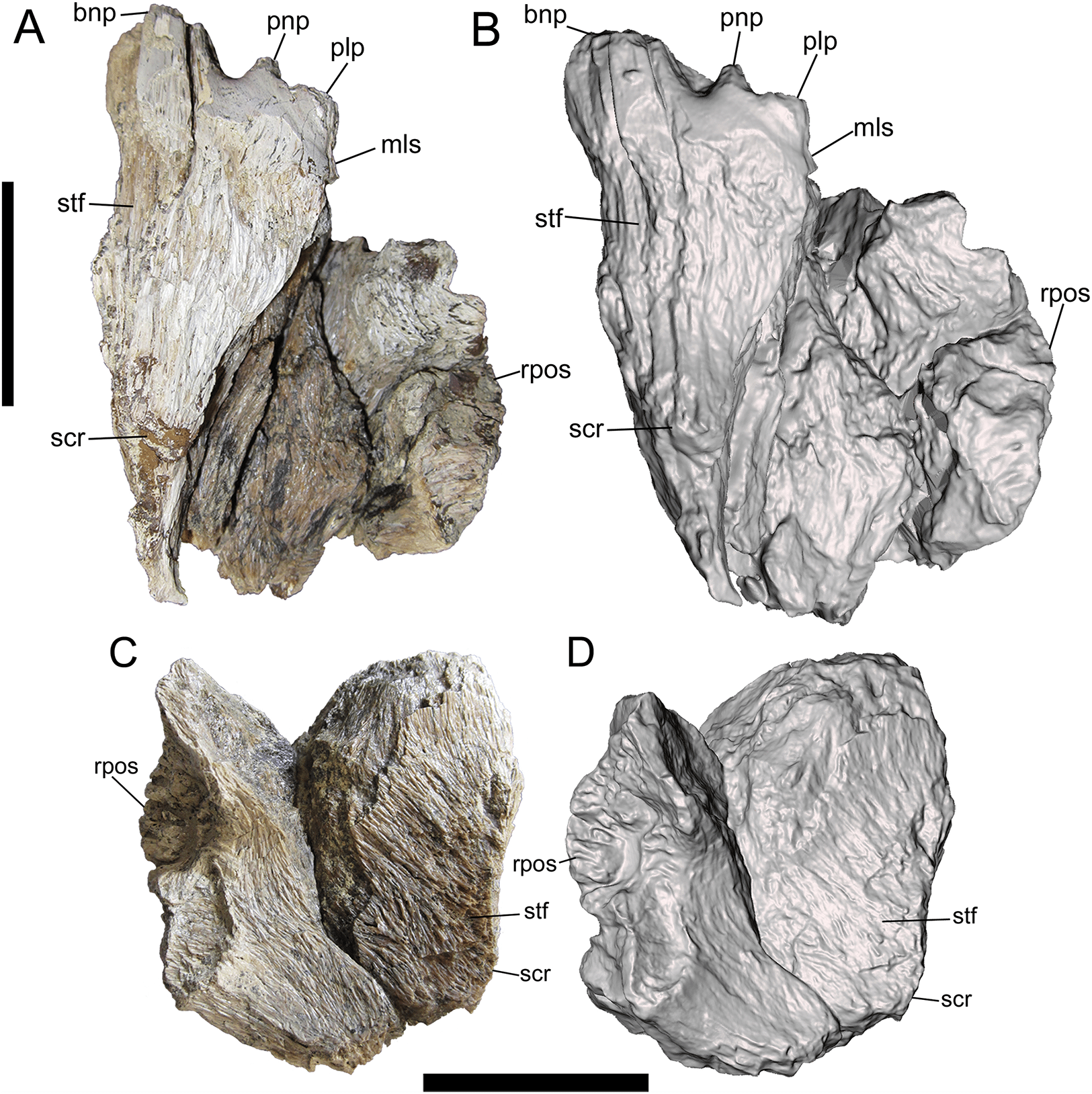
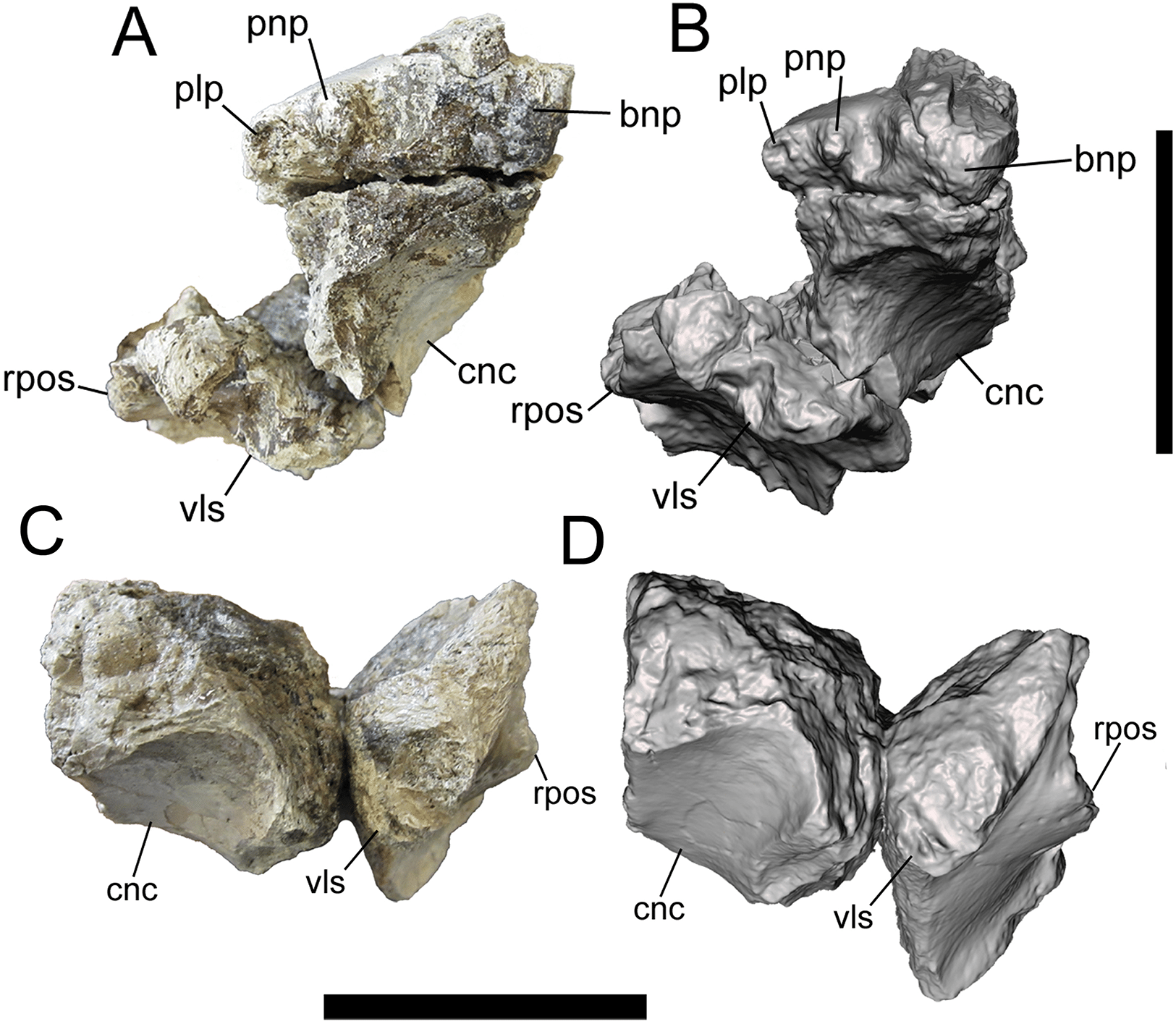
The holotype—the specimen that anchors the name—is UMNH VP 28348, at the Natural History Museum of Utah. It includes both frontals (paired skull-roof bones above the eyes), four broken vertebral centra, and rib fragments. Also present are a hand bone, the right metacarpal II, and the supraacetabular crest of the right ilium—the ridge above the hip socket. Rounding out the list are long-bone scraps and two toe bones from the fourth digit of the left foot. Because nothing is duplicated and the sizes match, the authors treated all of it as one individual. While on loan to the Western Science Center, the bones were laser-scanned by Brett Dooley.

Earlier tyrannosaurid finds from the Menefee were scrappy—tooth fragments and a metatarsal in 1993, and a tooth fragment in 2006. Since none of them overlap with the holotype, McDonald’s team declined to refer them to Dynamoterror. In 2018, Dalman and Lucas reported further tyrannosaurid remains from another part of the Allison Member. These are indeterminate, however, and no one has referred them to Dynamoterror. Accordingly, Condamine and colleagues still listed UMNH VP 28348 as its only specimen in 2021.
Dynamoterror Size and Description
With so little of the body preserved, most of what is known comes from the top of the head.
Short description of Dynamoterror
Between them, the two frontals show nearly the entire bone, missing only the front tip of the nasal process. From their upper surface rose a sagittal crest—a bony ridge along the midline of the skull roof. According to the authors, it would have kept rising beyond the damaged surface and been very tall. On the underside, paired hollows formed the back of the scent-detecting nasal cavity, with a large fossa for the olfactory bulb lying just behind them.
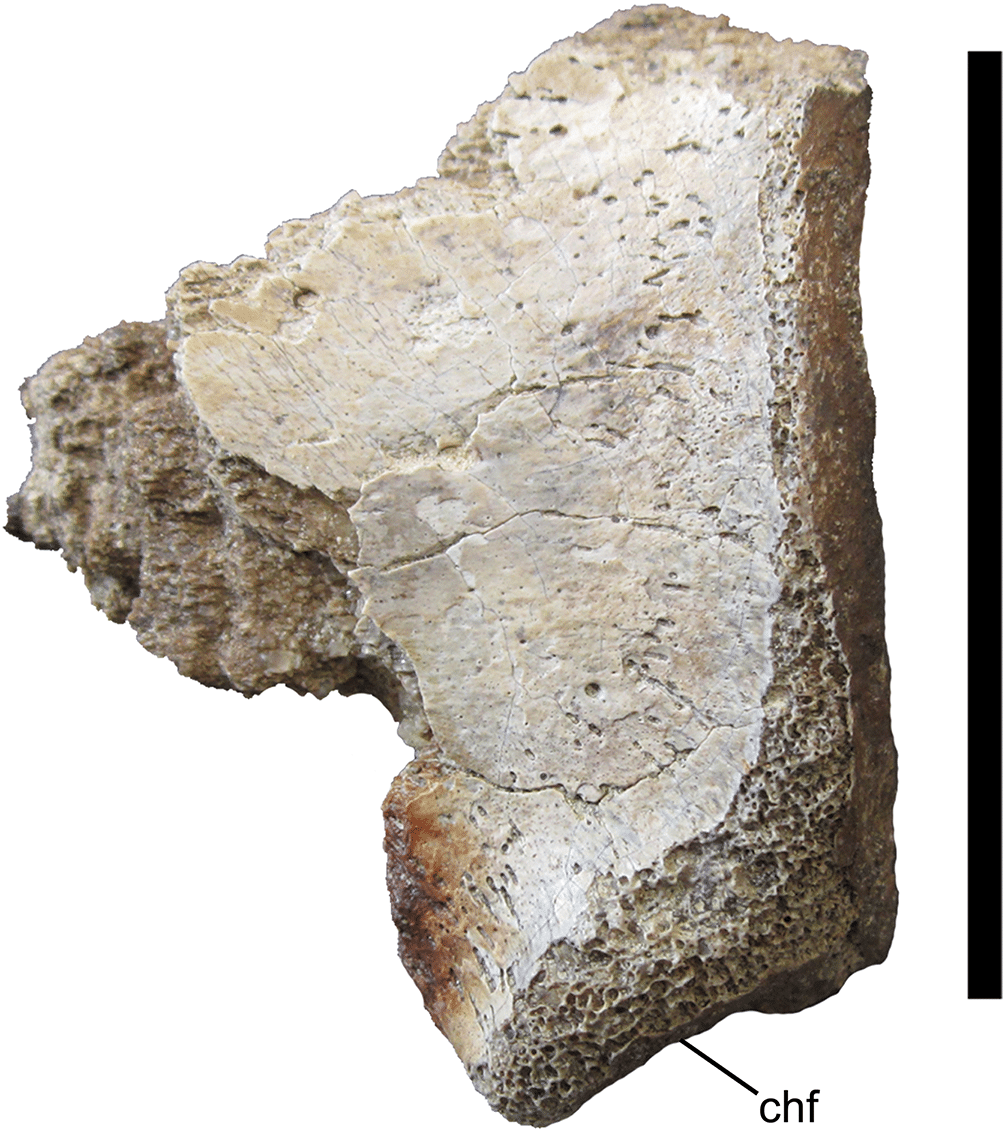
Behind the skull, however, the evidence thins out. The right metacarpal II is nearly straight, and unlike in T. rex, it shows no joint surface for the third metacarpal. One fragment from the middle of the tail carries a pronounced chevron facet, as in T. rex. Likewise, the two toe bones were identified by comparison with that same giant.

Size and Weight of Type Species
Without a fuller skeleton, the size of Dynamoterror has to be estimated indirectly. In 2018, McDonald and colleagues noted that its frontals are similar in size to those of LACM 23845, a subadult T. rex. Molnar had judged in 1980 that this specimen was about 80 percent the size of an adult. On that basis, the authors estimated Dynamoterror at about 30 feet (9.1 meters) long—a medium-sized tyrannosaurid.
They also cautioned that its proportions might have been different. So far, no peer-reviewed study has published a height or body mass. Instead, the frontals themselves give a few direct numbers. Joined, they reach a maximum width of 13.2 centimeters (5.2 inches), and the right frontal is up to 4.8 centimeters (1.9 inches) deep at the midline.
Measured instead by the method Currie set out in 2003, the right frontal is 3.1 centimeters deep and 5.4 centimeters wide—a depth-to-width ratio of 0.57. By comparison, the ratio runs from 0.50 to 0.66 in Daspletosaurus and from 0.59 to 0.67 in T. rex. From this, the authors suggested the bones belonged to a subadult or adult individual.
The Dinosaur in Detail
What sets this dinosaur apart are two details of the frontal. The first is an autapomorphy—a trait unique to one species. Two projections at its front sit close together, split by only a shallow notch. The second sits where the frontal meets the bone behind the eye—a concave, subrectangular surface projecting outward behind a deep groove. However, the authors called this trait provisional, since the region changes with growth. The groove might even match a small opening in T. rex, a possibility awaiting further material.
Other features show where it belongs. The skull-roof muscle hollows meet at the midline, a derived tyrannosauroid trait shared with Bistahieversor and the tyrannosaurids. In 2017, Carr and colleagues identified its tall, single crest as unambiguously shared by “derived tyrannosaurines.” Apart from the provisional trait, the frontals resemble those of Teratophoneus and Lythronax. In the reconstruction, its large fossae and crest anchored enormous jaw-closing muscles.

Placing it on the family tree has proved harder. In 2018, the authors could code it for only nine of 386 characters. As a result, their analysis recovered it in an unresolved polytomy—a branch point with no clear order—alongside Teratophoneus, Lythronax, Daspletosaurus, and others. In 2022, Warshaw and Fowler found Dynamoterror, Lythronax, and Teratophoneus in a three-way split. In 2024, Rivera-Sylva and Longrich recovered it in Teratophoneini, a southern tyrannosaur group with Teratophoneus, Bistahieversor, and Labocania, though such placements remain unstable.
Its validity is disputed too. In 2020, Yun argued that both unique traits appear in other tyrannosaurids, making the name a nomen dubium, or “doubtful name.” In contrast, Condamine’s team listed it as valid in 2021, and Warshaw and Fowler’s 2022 analysis included it as a separate taxon. Taken together, the frontals point to a tyrannosaurine with enormous jaw muscles, but its standing as a genus remains open.
Interesting Points about Dynamoterror
- Its name honors “Dynamosaurus imperiosus,” an old junior synonym of T. rex that was a childhood favorite of the lead author.
- The holotype is the first associated tyrannosaurid skeleton from the Menefee Formation, though much of it broke apart before discovery.
- Quoted by Gizmodo, McDonald explained that features on the right frontal aren’t preserved on the left, and vice versa.
- Only nine of 386 characters could be scored for Dynamoterror in 2018, which the authors blamed for its unresolved position.
- Laser-scanned 3-D models of the bones are on MorphoSource, and the team digitally combined the two frontals into one composite pair.
Contemporary Dinosaurs
Sharing the Juans Lake Beds was Ornatops incantatus, a brachylophosaurin hadrosaurid—a duck-billed dinosaur from the group of Brachylophosaurus. Its holotype, WSC 10058, lay about 120 meters (394 feet) below the Cliff House Sandstone. In 2021, Mohler and colleagues described a local sandstone with the Deinosuchus site just below it. Both holotypes came from above that same sandstone, although they were collected at separate sites rather than from one bed. McDonald’s team called Ornatops contemporaneous, and it is the first brachylophosaurin reported from New Mexico. Since no interaction between the two is recorded, they are best pictured as neighbors on the same landscape.
Also known from the Allison Member of the Menefee Formation (exact level relative to Dynamoterror not known): the nodosaurid Invictarx zephyri, from the same Juans Lake Beds and one of the armored ankylosaurs; and, from elsewhere in the basin, the horned dinosaur Menefeeceratops sealeyi, potentially the oldest recognized centrosaurine. The Menefee Formation spans about 84 to 78.5 million years ago, so these animals may not all have lived at the same time.
Dynamoterror in its Natural Habitat
The world Dynamoterror roamed lay near the western shoreline of the Western Interior Seaway. Its rocks record river channels, floodplains, lagoons, swamps, and estuaries—mostly freshwater, but with some brackish and marine influence. Mohler and colleagues pictured a forested floodplain crossed by smaller rivers and coal swamps that dried out and flooded at times. Silicified wood, including large stumps still in place, and carbonized logs are also abundant throughout the area.
Its describers called the giant tyrannosaurids the apex predators of western North America and Asia at the close of the Cretaceous. The enlarged jaw-muscle area of Dynamoterror may suit that role, yet no fossil records what it ate. A partial ceratopsid skeleton also came from above the same local sandstone as the Dynamoterror holotype.
Non-dinosaurs filled out the scene. Just below that sandstone lay remains of the giant alligatoroid Deinosuchus. Turtles were diverse, from baenids such as Neurankylus baueri and Denazinemys to Adocus, Basilemys, and softshell trionychids. There is no direct evidence of how Dynamoterror hunted or whether it lived alone. Still, earlier vertebrate fossils from the Allison Member were mostly fragmentary, which makes even this broken skeleton especially valuable.
Frequently Asked Questions
It joins Greek dynamis, “power,” with Latin terror, and the full name was meant as “powerful terror ruler.”
It lived in the Campanian stage of the Late Cretaceous, tentatively around 80 to 79 million years ago.
Its describers estimated about 30 feet long, indirectly from frontal size. No height or weight has been published in a scientific study.
It was a carnivore, belonging to the tyrannosaurids its describers called apex predators, though no fossil shows its actual prey.
Eric Gutierrez found it in 2012 in the Menefee Formation of San Juan County, New Mexico.
In 2020, Yun called it a nomen dubium, but a 2021 study listed it as valid and a 2022 analysis included it as a separate taxon.
Sources
The information in this article is based on various sources, drawing on scientific research, fossil evidence, and expert analysis. The aim is to provide a comprehensive and accurate overview of Dynamoterror. However, please be aware that our understanding of dinosaurs and their world is constantly evolving as new discoveries are made.
- https://doi.org/10.7717/peerj.5749
- https://doi.org/10.15407/zoo2020.03.259
- https://doi.org/10.1038/s41467-021-23754-0
- https://doi.org/10.7717/peerj.14461
- https://doi.org/10.7717/peerj.11084
- https://doi.org/10.7717/peerj.11302
- https://doi.org/10.7717/peerj.5435
- https://doi.org/10.7717/peerj.19340
- https://doi.org/10.1007/s12542-021-00555-w
- https://nmgs.nmt.edu/publications/guidebooks/downloads/75/75_p0189_p0198.pdf
- https://gizmodo.com/rare-t-rex-relative-discovered-in-new-mexico-1829629491
- https://doi.org/10.3390/fossils2040012
This article was last fact checked: TheDinosaurs Team, 13-11-2026
Featured Image Credit: Andrew T. McDonald, Douglas G. Wolfe, Alton C. Dooley Jr, CC BY 4.0, via Wikimedia Commons
