
In the red-bed country around Zigong, deep in China’s Sichuan Basin, lies the Lower Shaximiao Formation. Its Dashanpu quarry has yielded more than 200 individual dinosaurs and other vertebrates. Among them is Shunosaurus lii, a sauropod named in 1983 from this very site. This herbivore lived in the Middle Jurassic, although the exact age of its rock layers is still debated. What sets it apart is an unusual combination—a short neck, shearing teeth, and a small bony club at the tip of its tail.
The story began in 1977, when a provincial training class collected a large sauropod from a road cut at Dashanpu. Paleontologist Dong Zhiming and his colleagues Zhou Shiwu and Zhang Yihong later made that specimen the type of a new genus. Since then, several complete skeletons and new skull material have turned up. Today it even lends its name to a whole chapter of Sichuan’s past—the “Shunosaurus Fauna.”
Shunosaurus Key Facts
| Keyword | Fact |
|---|---|
| Pronunciation | Not specified |
| Meaning of name | Sichuan Reptile |
| Group | Sauropoda (early-branching Eusauropoda) |
| Type Species | Shunosaurus lii |
| Diet | Herbivore |
| When it Lived | About 170 to 160 MYA (age disputed) |
| Period | Jurassic |
| Epoch | Middle Jurassic (Bajocian to Callovian stages) |
| Length | About 36 feet (11 meters), 1983 estimate |
| Height | Not specified |
| Weight | About 7,900 pounds (3,600 kilograms), compiled estimate |
| Mobility | Moved on all four legs (quadrupedal) |
| First Discovery | 1977 by a Sichuan provincial training class hosted by the Zigong Museum of the Salt Industry |
| Described by | 1983 by Z. Dong, S. Zhou, and Y. Zhang |
| Holotype | IVPP V9065 |
| Location of first find | Lower Shaximiao Formation, Dashanpu, near Zigong, Sichuan Province, China |
Shunosaurus Origins, Taxonomy and Timeline
The name Shunosaurus is rooted in its home province. “Shu” is the Pinyin spelling of the ancient short name for Sichuan, while “saur” comes from the Greek word for “reptile.” The species name lii honors the hydrologist and magistrate Li Bing. He governed the region for the state of Qin from 256 to 251 BC and built the famed Dujiang dike and its irrigation system. Together, the name ties the animal to its province and to a man who reshaped that land’s waterways.
In 1983, Dong and colleagues placed Shunosaurus within Sauropoda, in the family Camarasauridae and the subfamily Cetiosaurinae. They called it “a moderate-sized primitive sauropod” and compared it with Barapasaurus, Patagosaurus, Rhoetosaurus, and Volkheimeria. Later, some analyses grouped it with Euhelopus, Omeisaurus, and Mamenchisaurus in an East Asian family, Euhelopodidae—a grouping that later studies abandoned. Today, researchers regard it as an early-branching eusauropod (one of the “true sauropods” outside the more advanced neosauropods).
Dong’s team dated the Lower Shaximiao to the Middle Jurassic. Fish and a pliosaur pointed to an Early Jurassic age for the underlying Ziliujing Formation. However, bivalve and conchostracan (tiny clam shrimp) workers placed it in the Middle Jurassic, so the team assigned the beds above to that epoch too. Newer detrital zircon dates (from mineral grains eroded out of older rock) give only a maximum depositional age—the beds can be no older. In 2018, Wang and colleagues reported 159 ± 2 million years from Lower Shaximiao rocks elsewhere in the basin, which would mean an Oxfordian (Late Jurassic) age or younger. In 2022, however, Ren and colleagues obtained about 170 million years near Dashanpu, which would allow a Bajocian age. Dai and colleagues add a figure of 166.0 ± 1.5 million years from Yunyang and call the exact age “still controversial.”
Discovery & Fossil Evidence
The Zigong Museum of the Salt Industry hosted the 1977 training class, which focused on paleontological and archaeological preservation. In the monograph’s 1999 English translation, “This specimen became the Type for Shunosaurus.” The Dashanpu site itself first came to light in 1972, and today it is the type locality of the Shunosaurus Fauna.
The holotype, IVPP V9065, is an incomplete postcranial skeleton (bones from behind the head). It preserves five cervical (neck) vertebrae, 13 articulated dorsal (back) vertebrae, a fragmentary sacral centrum, and two caudal (tail) vertebrae. It also includes a left radius and ulna (forearm bones), a carpal, and a weathered ilium, ischium, and pubis. A left hindlimb adds the femur, tibia, fibula, astragalus (ankle bone), and metatarsals. As Dong and colleagues stated plainly, “Specimen V9065 lacks a skull.”
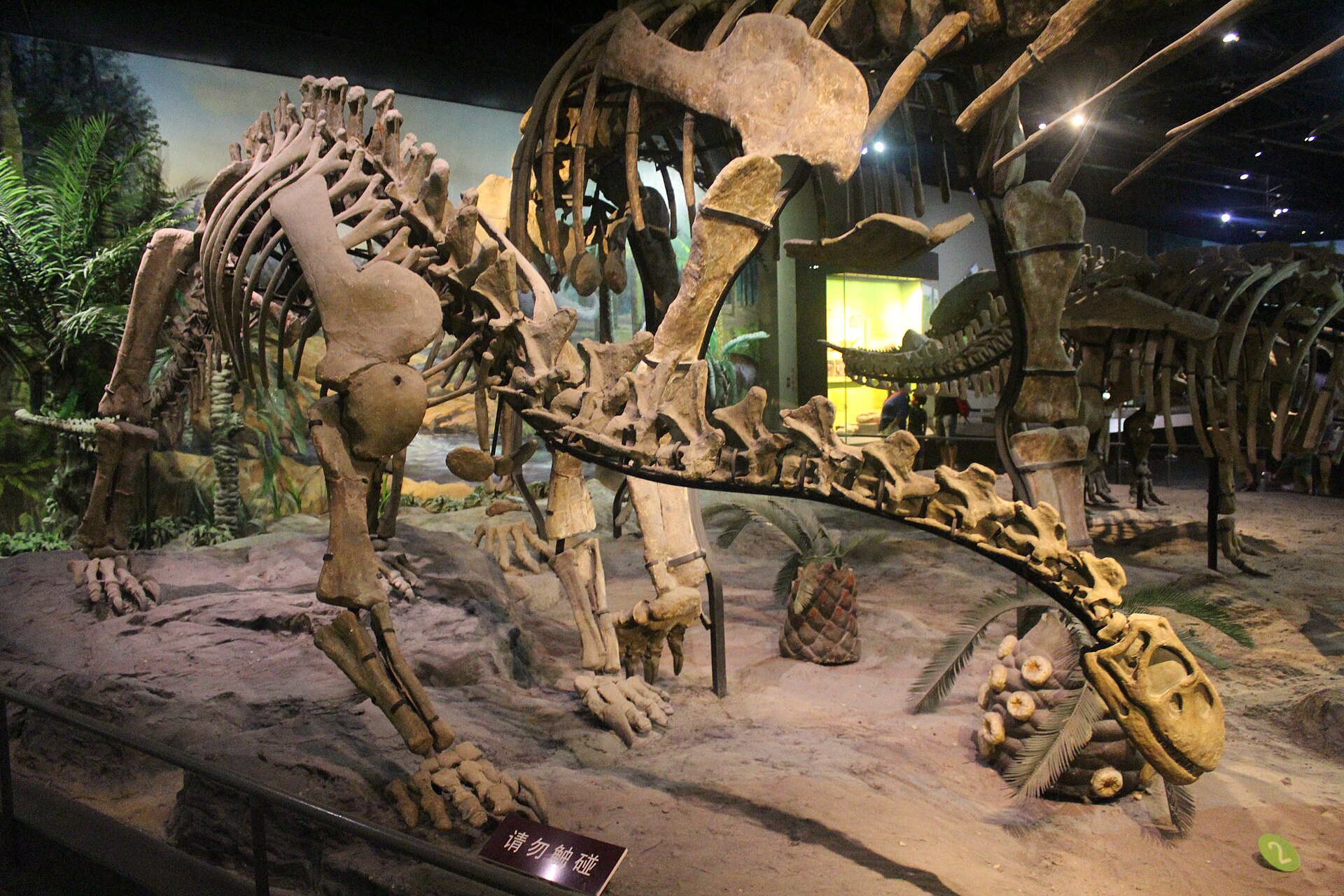

A 1979 excavation confirmed four fused sacral vertebrae and “42±3 caudal vertebrae”—an estimate rather than an exact count. By 2002, several complete skeletons represented Shunosaurus, and new skull material made it the earliest sauropod then known from cranial remains. Two Zigong specimens, ZDM T5402 and ZDM T5401, preserve complete or nearly complete necks. At first, Dong’s team knew the genus only from the Lower Shaximiao Formation of the Sichuan Basin. Later, a juvenile from a Yunyang quarry in Chongqing—the smallest Shunosaurus specimen yet known—expanded its range in China. Found in 2016, that quarry lies in the same formation.
Shunosaurus Size and Description
Short description of Shunosaurus
The skull was “akinetic and monimostylic,” meaning its bones stayed locked together rather than flexing as the jaws worked. Its spoon-shaped teeth sat in upper and lower rows that “interdigitate and shear past each other.” Because one row curved down and the other curved up, the pair worked “like a pair of garden shears.” New teeth replaced old ones in back-to-front waves along alternating positions. Chatterjee and Zheng described its brain as “relatively small, narrow and primitively designed.”
Behind the head came a short neck, which Dong and colleagues estimated at 12 or 13 vertebrae before complete necks such as ZDM T5402 came to light. The back held 13 dorsals, and four fused sacrals braced the hips. Its presacral vertebrae (those in front of the hips) were solid rather than honeycombed. A 2022 study likewise describes its neck and back vertebrae as lacking complicated pneumatic (air-sac) structures. At the far end, the tail finished in a small bony club.
The tibia reached about two-thirds the length of the femur, and each foot had five complete metatarsals. Shunosaurus walked on all four legs, and Dong’s team read its robust astragalus as a sign of “a ponderous gait.”

Size and Weight of Type Species
Dong and colleagues estimated that Shunosaurus reached about 36 feet (11 meters), writing of a “body length that may attain 11 m.” That is a little shorter than a standard 40-foot city bus. By contrast, they measured the holotype’s femur directly at 125 centimeters (49 inches), while its tibia and fibula reach 80 centimeters (31.5 inches).
No published hip height is available. For mass, a 2012 survey of dinosaur body sizes by O’Gorman and Hone lists 3,600 kilograms—about 7,900 pounds. Their table pairs this displacement (volume-based) estimate with a femur of 865 millimeters. However, the authors do not say which specimen the figure comes from.
In 2022, Ma and colleagues found no arrested growth lines in the compact bone, “indicating that body size still increases slowly after maturity.”
The Dinosaur in Detail
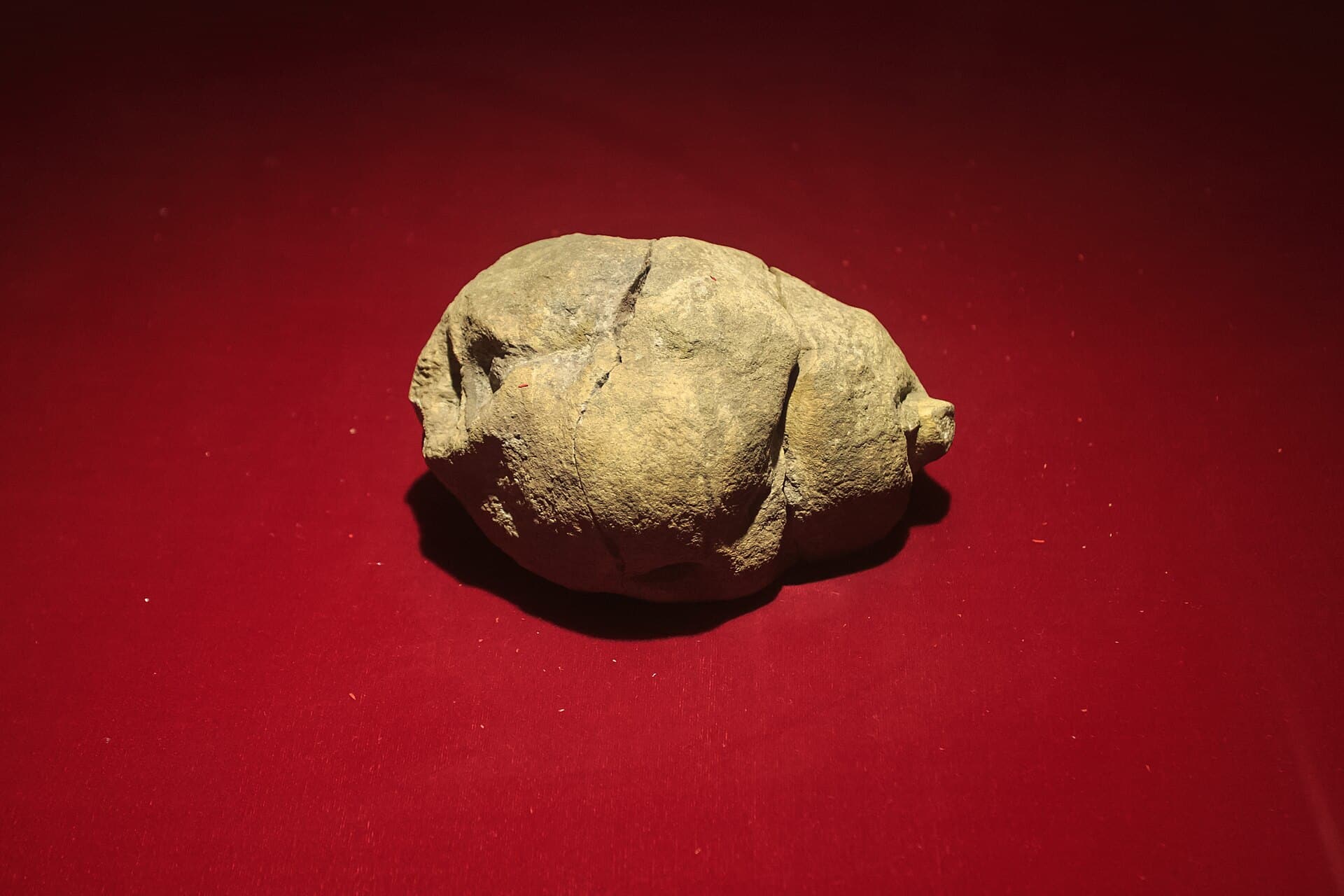
One of the most distinctive features of Shunosaurus is its small bony tail club. In 2002, Chatterjee and Zheng called it “unique among sauropods” in having that club. Yet tail clubs had already been reported in Omeisaurus tianfuensis in 1989 and Mamenchisaurus hochuanensis in 2001, and another surfaced in India’s Kotasaurus in 2024. The club’s purpose is debated, too. The Zigong Dinosaur Museum presents it as evidence that sauropods could actively defend themselves. In 2009, however, Xing and colleagues judged the similar Mamenchisaurus club a limited weapon and more possibly a sensory organ.
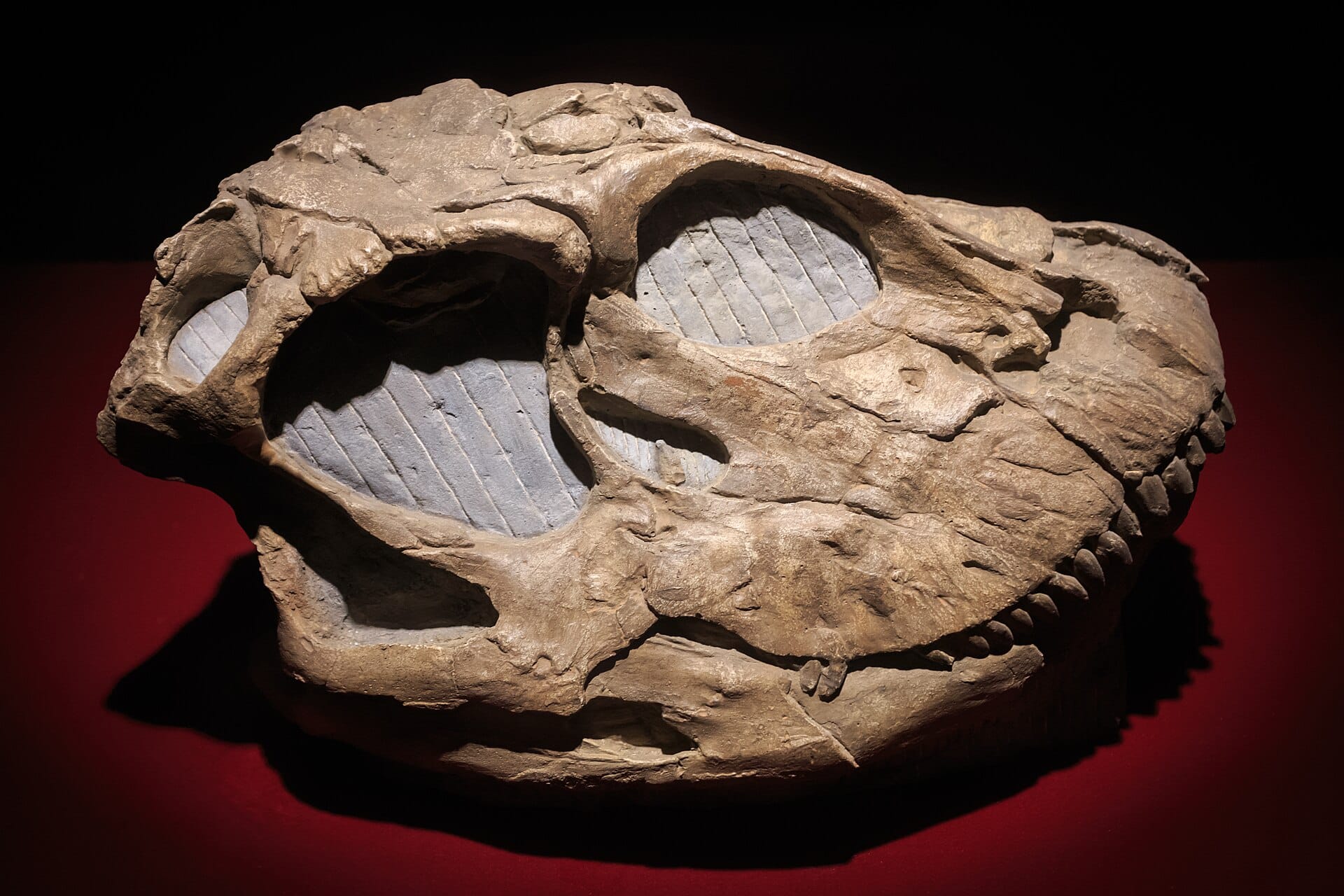

Chatterjee and Zheng found wear facets on the teeth “indicative of coarser plant food.” They concluded that “tooth morphology, skull architecture, and neck posture” suited it to ground feeding or low browsing. Tooth counts, though, remain unsettled. The 2002 study gave a dentary (lower jaw) count of 25 or more. In 2022, however, Dai and colleagues listed just 14 or 15 dentary alveoli (tooth sockets) for S. lii.
The original describers singled out the “incipient bifurcation” of the neck spines (an early split into two prongs) as a defining trait. They also cited a keel beneath the cervicals and a ventrolateral lamina, a thin bony ridge low on each side. Its pelvis “very closely resembles” Barapasaurus, while its femur “particularly resembles” that of Rhoetosaurus. At first, Dong’s team described the pubic opening as “presumably enclosed.” In 2022, however, Ma and colleagues noted that adults lack a pubic foramen and reported one in the Yunyang juvenile.
The describers also viewed Shunosaurus as “an Early to Middle Jurassic transition form” that “retains numerous prosauropod plesiomorphies” (ancestral traits). They even proposed that sauropods “passed through a primitive Shunosaurus phase.” Taken together, these studies describe an early-branching eusauropod with a short neck, solid vertebrae, and shearing teeth.
Interesting Points about Shunosaurus
- Its genus name uses “Shu,” the ancient short name for Sichuan, while its species name honors the Qin-era magistrate and hydrologist Li Bing.
- A provincial preservation training class collected the type specimen from a road cut at Dashanpu in 1977.
- Dong and colleagues named the entire Lower Shaximiao fauna after it, and scientists still use the “Shunosaurus Fauna” label today.
- The 2002 skull study likened its curved, interlocking tooth rows to “a pair of garden shears.”
Contemporary Dinosaurs
Sharing the Dashanpu landscape was Huayangosaurus taibaii, one of the plated dinosaurs. In 1992, Sereno and Dong described it as a basal stegosaur—an early branch of that group—and Maidment and colleagues redescribed its skeleton in 2006. Dong’s 1983 faunal list placed it in the Lower Shaximiao alongside Shunosaurus, but no direct interaction between them is documented.
Also present was Omeisaurus tianfuensis, one of the Dashanpu species of Omeisaurus. Remarkably, a tail club has been reported in this species too, and Omeisaurus was one of six sauropod genera found at the site. This is not the type species O. junghsiensis, which Dong’s team placed in the younger Upper Shaximiao beds.
Far smaller was Agilisaurus louderbacki, a small-bodied ornithischian (bird-hipped dinosaur). In 2005, Barrett and colleagues classified it as Genasauria incertae sedis—a member of that group whose exact position is uncertain. Their study places it in the Lower Shaximiao at Dashanpu, of possible Bajocian age. No interaction with Shunosaurus is recorded.
Rounding out the list is Xiaosaurus dashanpensis, another small ornithischian from the same beds. Barrett and colleagues judged it valid but recognizable only as Ornithischia incertae sedis. It also appears in Dong’s 1983 list of the Lower Shaximiao fauna, where the translation spells it dashanpuensis. With no recorded interaction, it is best pictured simply as a neighbor.
Shunosaurus in its Natural Habitat
The world Shunosaurus roamed was a red-bed basin shaped by lakes and rivers. Its formation consists of lacustrine and fluvial deposits (lake and river sediments), mostly purplish red mudstones. At Dashanpu, the bones lie in a 10- to 16-foot (3–5 meter) layer of grayish green sandstone, low in a formation about 590 feet (180 meters) thick. One study read the quarry as “a lake-shore shallow-bank deposit under low energy conditions.”
As a herbivore, Shunosaurus likely fed close to the ground—just what Chatterjee and Zheng read from its teeth, skull, and neck posture.
While there is no direct evidence of whether Shunosaurus lived alone or in groups, the fossil record holds many individuals. At Dashanpu, researchers have reported six sauropod genera since its discovery. In 2023, Ren and colleagues identified at least two body plans and three tooth types among them. They suggested that these differences may explain how the sauropods coexisted, with “high niche differentiation.”
Frequently Asked Questions
It means “Sichuan reptile,” from “Shu,” the ancient name for Sichuan, and the species name lii honors Li Bing.
It lived in the Middle Jurassic, roughly 170 to 160 million years ago, though the exact age of its rock layers is disputed.
Its describers estimated a length of about 36 feet. A compiled estimate puts its weight at about 7,900 pounds.
It was a herbivore, and its teeth and skull suggest ground feeding or low browsing on coarse plants.
It was found at Dashanpu, near Zigong in Sichuan Province, China, in the Lower Shaximiao Formation.
It combined a short neck and shearing teeth with a small bony tail club, a feature also reported in Omeisaurus and Mamenchisaurus.
Sources
The information in this article is based on various sources, drawing on scientific research, fossil evidence, and expert analysis. The aim is to provide a comprehensive and accurate overview of Shunosaurus. However, please be aware that our understanding of dinosaurs and their world is constantly evolving as new discoveries are made.
- https://naturalhistory.si.edu/sites/default/files/media/translated_publications/Dong%26amp%3B_83.pdf
- https://doi.org/10.1046/j.1096-3642.2002.00037.x
- https://doi.org/10.1130/B31910.1
- https://doi.org/10.1016/j.palaeo.2022.111318
- https://doi.org/10.1080/14772019.2022.2132886
- https://doi.org/10.1080/08912963.2021.1962852
- https://doi.org/10.1671/0272-4634(2005)025[0823:SODFTM]2.0.CO;2
- https://peerj.com/articles/12810/
- https://doi.org/10.1371/journal.pone.0051925
- https://doi.org/10.1038/s41598-025-03210-5
- https://doi.org/10.1038/s41598-025-09796-0
- https://doi.org/10.1098/rsos.220794
- https://doi.org/10.1007/s00114-026-02068-5
- https://doi.org/10.1080/02724634.1992.10011463
- https://doi.org/10.1671/0272-4634(2006)26[944:ROTPSO]2.0.CO;2
- https://iugs-geoheritage.org/?p=10700
- https://paleobiodb.org/classic/basicCollectionSearch?collection_no=24883
- https://stratigraphy.org/ICSchart/ChronostratChart2023-09.pdf
- https://ntlib.org.cn/asset/detail/0/203120997219
- https://commons.wikimedia.org/wiki/File:Zigong_Dinosaur_Museum_Shunosaurus_tail_club.jpg
This article was last fact checked: TheDinosaurs Team, 03-11-2026
