
Near Fort McMurray, Alberta, the marine Wabiskaw Member of the Clearwater Formation gave up a dinosaur that still wears its skin. Named Borealopelta markmitchelli in 2017, this armored herbivore lived during the Early Cretaceous. It belongs to Nodosauridae, a family within the ankylosaurs (the armored dinosaurs). What sets it apart is its covering—armor plates, scales and nearly complete skin still lie in place across its back and flanks.
In March 2011, mining machine operator Shawn Funk found the fossil at the Suncor Millennium Mine, and Mark Mitchell later spent more than 7,000 hours preparing it. Six years after the find, paleontologist Caleb M. Brown and six colleagues described it in Current Biology. Together with later work on its armor and gut, their study offers a rare glimpse of its looks, its likely color, and its last meal.
Borealopelta Key Facts
| Keyword | Fact |
|---|---|
| Pronunciation | Not specified |
| Meaning of name | Northern Shield |
| Group | Ankylosauria (Nodosauridae) |
| Type Species | Borealopelta markmitchelli |
| Diet | Herbivore |
| When it Lived | About 113–110 MYA (early Albian, no direct date) |
| Period | Cretaceous |
| Epoch | Early Cretaceous (early Albian) |
| Length | About 18 feet (5.5 meters), estimated |
| Height | Not specified |
| Weight | About 2,900 pounds (1,300 kilograms) or more, a conservative estimate |
| Mobility | Not specified |
| First Discovery | March 2011 by Shawn Funk |
| Described by | 2017 by C.M. Brown, D.M. Henderson, J. Vinther, I. Fletcher, A. Sistiaga, J. Herrera, and R.E. Summons |
| Holotype | TMP 2011.033.0001 |
| Location of first find | Wabiskaw Member, Clearwater Formation, Suncor Millennium Mine, Fort McMurray, Alberta, Canada |
Borealopelta Origins, Taxonomy and Timeline
The name Borealopelta joins the Latin “borealis” (“northern”) with the Greek “pelta” (“shield”). According to its describers, it refers both to the northern locality and to the preserved scales and osteoderms (bony plates set in the skin). The species name markmitchelli honors Mark Mitchell for the more than 7,000 hours he spent preparing the holotype.
Within Dinosauria, Borealopelta sits in Ornithischia, then Ankylosauria, and finally Nodosauridae. In 2017, Brown and colleagues scored it into a 2016 dataset by Arbour and colleagues, giving a matrix of 47 taxa and 177 anatomical characters. Their analysis grouped it with two other Albian-aged nodosaurids, Pawpawsaurus campbelli and Europelta carbonensis. The much younger Hungarosaurus tormai, from the Santonian stage, came out as the sister taxon to that cluster. Later work unsettled the family itself. In 2023, Raven and colleagues published the first species-level analysis of armored dinosaurs and found that the traditional Nodosauridae is not a natural group. Borealopelta markmitchelli is the type and only known species.
The original description gives the Aptian stage in its locality note but calls the Wabiskaw Member Albian-aged elsewhere. Later, Brown and colleagues (2020) cited combined evidence from ammonites, pollen and microfossils that points to the early Albian. None of the three main studies gives a numeric age for the specimen itself. However, the 2017 paper’s timescale starts the Albian at 113 million years ago—so an early Albian age means roughly 113 to 110 million years ago. In contrast, the Paleobiology Database lists the occurrence as Aptian, matching the original locality note.
Discovery & Fossil Evidence
The fossil came to light in the Suncor Millennium Mine, an open-pit oil sands operation near Fort McMurray in northeastern Alberta. Funk spotted it in March 2011 while crews removed overburden—the rock that sits above the oil sands. Afterward, Royal Tyrrell Museum staff, among them Donald Henderson and Darren Tanke, collected it together with Suncor staff. Plesiosaurs and ichthyosaurs had come out of the Wabiskaw Member before, but never a dinosaur.
The Royal Tyrrell Museum of Palaeontology in Drumheller, Alberta, now holds the holotype, TMP 2011.033.0001. Its head, neck, most of the trunk, and the sacrum (the fused hip vertebrae) remain joined together. It also keeps the complete right forelimb and manus (hand), part of the left forelimb and hand, and part of a pes (foot). Osteoderms and nearly complete skin still cover the back and sides, and the specimen survives in several large blocks.
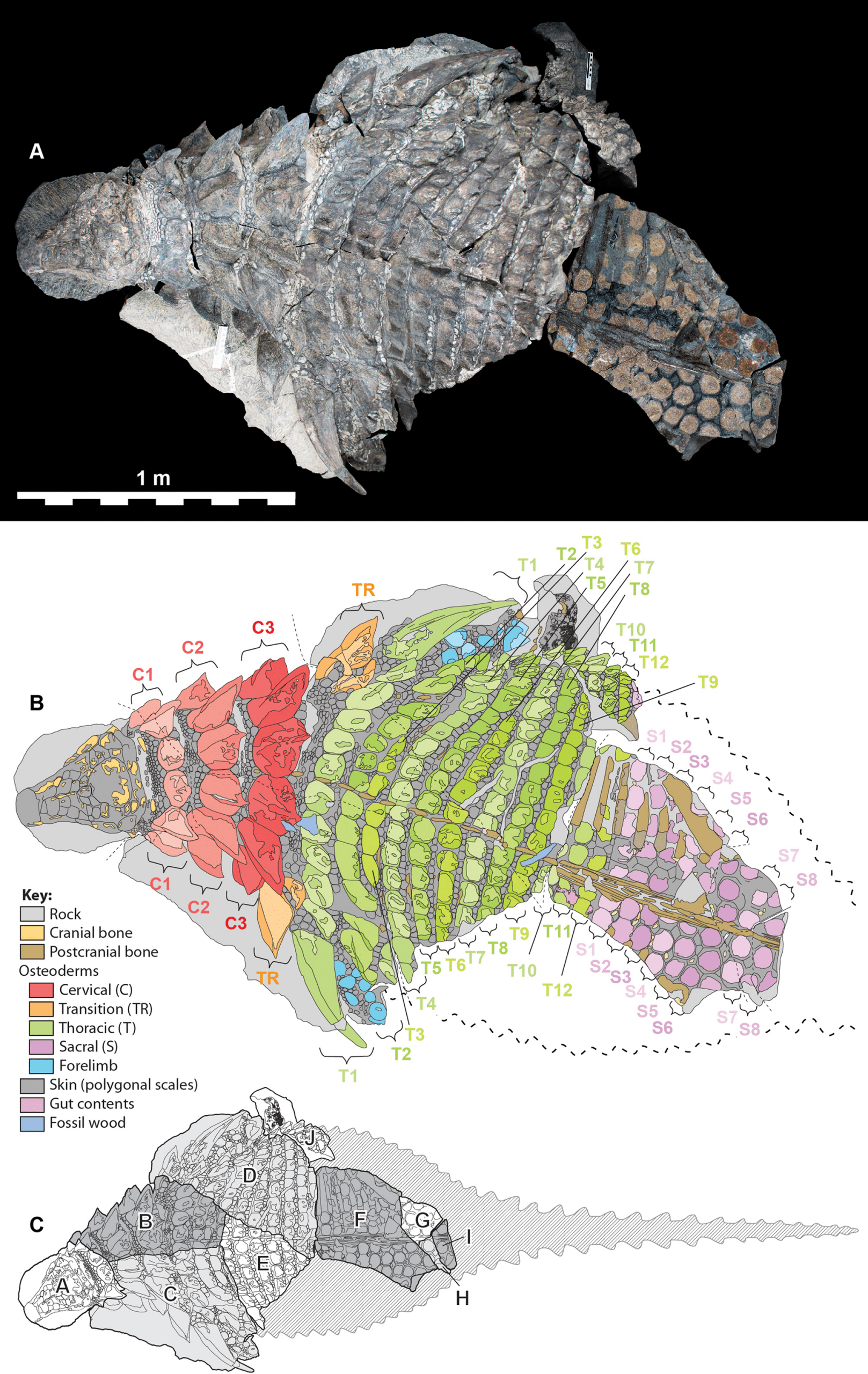

The key to its exceptional fossil preservation was a dense, brittle siderite concretion—a hard, iron-rich rock mass that formed around the body. It reached 20 centimeters (8 inches) thick above the animal and 40 centimeters (16 inches) below. Inside it, scales and osteoderms kept their original arrangement with minimal flattening. Yet that same dense rock defeated CT scanning of the skull, which yielded no useful data. Because skin hides most of the skeleton, the team could code only 58 of 177 characters for the family-tree analysis. The later 2017 and 2020 studies both rest on this same specimen.
Borealopelta Size and Description
Only one individual of Borealopelta has come to light, which limits both its description and its size estimates.
Short description of Borealopelta
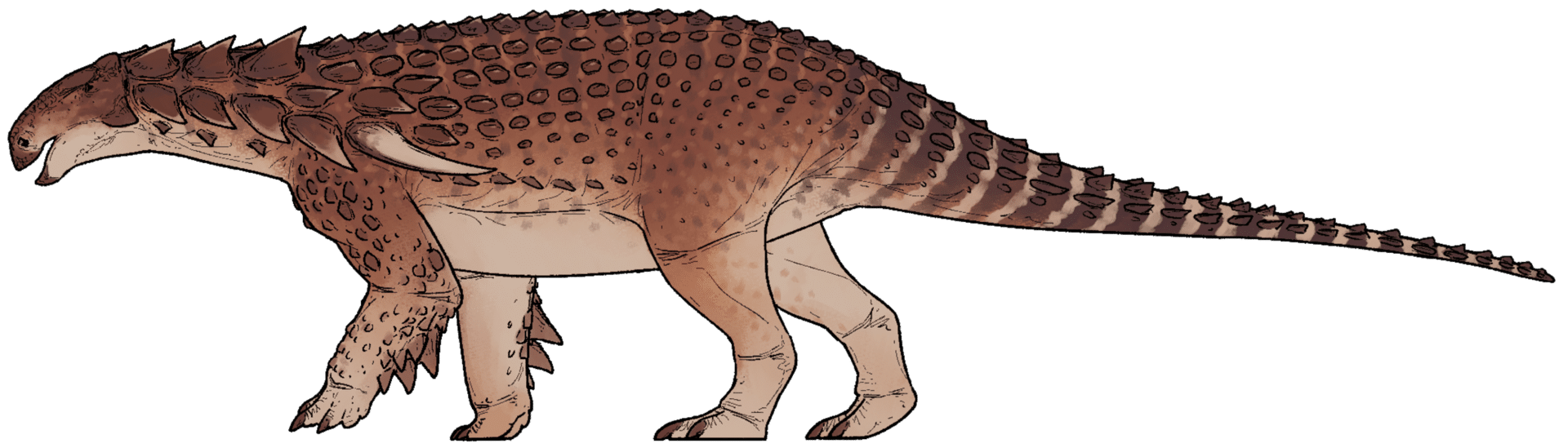
The skull carried more than 20 small dermal plates over the snout and a large hexagonal plate on top. Below each eye sat a triangular, pointed jugal horn (cheek horn) whose base was longer than the eye socket itself. Seen from above, the skull hid its nostrils—a trait shared with Pawpawsaurus. Behind the head, osteoderms ran in continuous bands across the neck and back, with rows of polygonal scales between them.
The largest osteoderm was the parascapular spine, a recurved spike near each shoulder that projected sideways and backward. Thick, pointed keratin sheaths (horn-like coverings) made the neck and shoulder spines substantially longer. Over the back and hips, by contrast, each osteoderm wore a single keratin scale less than a centimeter thick. The 2017 authors judged this one-to-one match of scale and plate most like living crocodilians. Its spine sheaths, meanwhile, broadly resembled the horns of bovids—cattle, antelope and their kin.
The published studies do not describe its posture or gait, and the tail did not survive.

Size and Weight of Type Species
Brown and colleagues estimated Borealopelta at about 18 feet (5.5 meters) long. Because the tail is missing, that figure is an estimate rather than a measurement, and the main paper does not explain the method. None of the studies reviewed here gives a height.
For weight, the team offered a “conservative” estimate of 1,300 kilograms (about 2,900 pounds). Their summary goes a step further and describes the body mass as exceeding that figure. They also noted that it is similar to estimates for the nodosaur Sauropelta, although they cited higher published estimates as well.
Even its last meal was sizable—the fossilized stomach mass measures about 36 centimeters (14 inches) across.
The Dinosaur in Detail
This fossil lets researchers compare its armor with the horn that covered it. In a second 2017 study, Brown took 605 measurements from 172 osteoderms still in place. On the rear back plates, the keratin sheath made up only 2 to 6 percent of their size. On the parascapular spines, by contrast, it made up about a quarter. The horny portions also became disproportionately longer on larger spines—a pattern known as positive allometry.
Color is the other headline. Chemical tests found signals that the authors identified as melanin, the pigment behind much animal coloration, although no melanosomes (pigment-bearing structures) survived. Based on one chemical signal, the authors argued that pheomelanin had pigmented the skin reddish-brown. The back looks darker than the underside, a contrast they interpreted as countershading—camouflage that is darker above and paler below. The shoulder-spine sheaths, in turn, are paler and slightly fluorescent, which may reflect a lighter color in life.
Later reviews urged caution, however. In 2020, Roy and colleagues noted that sulfur from a low-oxygen burial setting could mimic pheomelanin markers. In 2023, Slater and colleagues added that the key signal’s origin has not been conclusively demonstrated. The reddish-brown color remains a hypothesis.
Modern herbivores over 1,000 kilograms generally lack countershading. Brown and colleagues therefore suggested that predation pressure was strong enough to favor camouflage even in an adult this large. As support, they cited large theropod footprints in nearby formations of similar age and Acrocanthosaurus from equivalent formations farther south. At the same time, they proposed that the big shoulder spines may have served more for display. Brown’s follow-up study added that their strong positive allometry fits socio-sexual selection.
Taken together, the 2017 analysis places Borealopelta among Albian nodosaurids such as Pawpawsaurus—yet that rests on a third of the usual characters, and later studies disagree.
Interesting Points about Borealopelta
- Its genus name means “northern shield,” while the species name honors Mark Mitchell, who spent more than 7,000 hours preparing the holotype.
- It was the first dinosaur ever recovered from the Wabiskaw Member, a unit that had previously produced plesiosaurs and ichthyosaurs.
- The carcass reached the seabed on its back, arriving with enough force to deform the sediment beneath it.
- Its abdominal mass meets 14 of the 16 criteria its researchers set for genuine stomach contents, more than any other herbivorous dinosaur example they assessed.
- A twig in its gut with an incomplete outer growth ring suggests that it ate its last meal in late spring to mid-summer.
Contemporary Dinosaurs
Its own rock unit offers no dinosaur neighbors for Borealopelta. The reason is straightforward—the Clearwater Formation is fully marine, and the sandstone that held the fossil formed between fair-weather and storm wave base. Its describers also noted that the fossil lacks the context of its accompanying fauna. Instead, the same sandstone holds marine reptiles, which shared the sea where its carcass came to rest, not the land where it lived.
The first is Athabascasaurus bitumineus, an ichthyosaur—a marine reptile, not a dinosaur—from the same greenish sandstone layer that held Borealopelta. Like the rest of the unit, it dates to the early Albian.
Also from this sandstone comes Nichollssaura borealis, a plesiosaur and another marine reptile rather than a dinosaur. Fittingly, its species name uses the same Latin word for “northern” found in Borealopelta. Any link between them ends there.
Completing the named list is Wapuskanectes betsynichollsae, an elasmosaur—a kind of plesiosaur. Like the others, it belonged to the sea, and no record ties it to Borealopelta.
Borealopelta in its Natural Habitat
The place where Borealopelta came to rest was the floor of a coastal sea—the Wabiskaw Member records a lower shoreface or proximal offshore setting above the bitumen-rich McMurray Formation. Although burrow traces show that the seabed held some oxygen, the carcass bears no sign of scavenging. How a land animal got here, however, remains an open question. In 2018, Mallon and colleagues found that most ankylosaur fossils lie upside down, and they favored a “bloat-and-float” model that may explain nodosaurids in marine rocks. Their study treats the group in general, so a seaward drift for Borealopelta remains an interpretation.
Alberta’s plant record from this time is thin. So in 2020, Brown and colleagues used the early Albian Gates Formation flora as a stand-in, with its ferns, horsetails, conifers, ginkgophytes, and cycads. Flowering plants were probably rare locally, while wildfires in that region may have burned every 20 to 40 years. The plant fragments in its fossilized stomach contents, or cololite, are about 88 percent leaf and 7 percent stem and twig. Among the leaves, leptosporangiate ferns (the group that includes most familiar ferns) make up 85 percent. That points to selective fern feeding, with cycad and conifer leaves eaten incidentally. Rounded stones interpreted as gastroliths, 1.9 to 22.1 millimeters across, suggest a muscular gizzard.
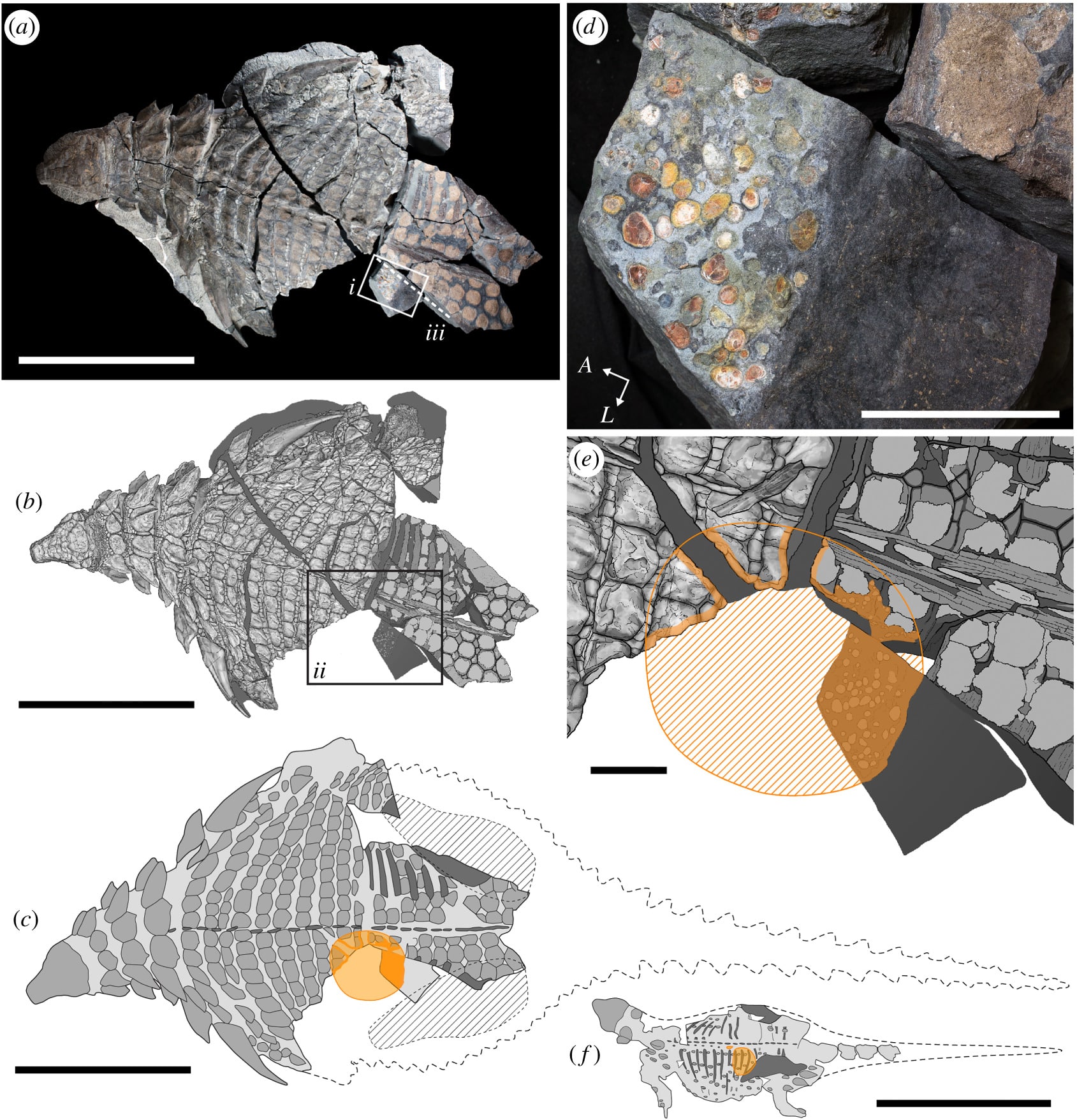

About 6 percent of those plant fragments are charcoal. The 2020 authors read this as a sign of feeding in a recently burned forest where ferns were regrowing. Like many modern herbivores, it may have favored such patches. Still, the authors caution that this is one meal from one animal and may not reflect its usual diet. While there is no direct evidence of whether it lived alone or in groups, its spines may have served in display.
Frequently Asked Questions
It means “northern shield,” and the species name honors Mark Mitchell, who prepared the fossil.
It lived in the early Albian part of the Early Cretaceous, roughly 113 to 110 million years ago. The fossil itself has no direct date.
Its describers estimated it at 18 feet long, with a conservative weight of about 2,900 pounds (1,300 kilograms) or more.
It was a herbivore, and fern leaves dominate its preserved stomach contents.
Shawn Funk found it in the Suncor Millennium Mine near Fort McMurray, Alberta, in the marine Clearwater Formation.
Its armor and skin still lie in place. The original study argued from chemical traces and pigment patterns that it was reddish-brown and countershaded, though the color evidence is debated.
Sources
The information in this article is based on various sources, drawing on scientific research, fossil evidence, and expert analysis. The aim is to provide a comprehensive and accurate overview of Borealopelta. However, please be aware that our understanding of dinosaurs and their world is constantly evolving as new discoveries are made.
- https://doi.org/10.1016/j.cub.2017.06.071
- https://doi.org/10.25405/ncl.34320852
- https://doi.org/10.1098/rsos.200305
- https://doi.org/10.7717/peerj.4066
- https://doi.org/10.1016/j.palaeo.2018.02.010
- https://paleobiodb.org/classic/basicTaxonInfo?taxon_no=371999
- https://bristol.ac.uk/news/2017/august/dinosaur-skin-.html
- https://www.cbc.ca/news/canada/calgary/1.4230912
- https://doi.org/10.1080/14772019.2023.2205433
- https://doi.org/10.1038/s41467-023-40570-w
- https://doi.org/10.1111/brv.12552
This article was last fact checked: TheDinosaurs Team, 28-10-2026
Featured Image Credit: Chris Woodrich, CC BY-SA 4.0, via Wikimedia Commons
