
South of Picún Leufú in Argentina’s Neuquén Province, the red conglomerates and sandstones of the Bajada Colorada Formation hold a remarkable sauropod. Named Bajadasaurus pronuspinax in 2019, this dicraeosaurid lived in the late Berriasian to Valanginian stages of the Early Cretaceous. Its neck bore paired, rod-like spines that curved forward—and, according to its describers, pointed that way whatever the neck’s position. The same fossils also include the most complete skull yet found for its family.
Since 2010, paleontologists Pablo A. Gallina, Sebastián Apesteguía, Juan I. Canale, and Alejandro Haluza had been excavating at the Bajada Colorada locality. In 2013, they collected teeth and bones from a rock block for the museum laboratory at Villa El Chocón. Six years later, the four named the animal in Scientific Reports—and argued that its spines were a passive defense. Although later work has challenged that reading, Bajadasaurus still offers a rare glimpse of sauropod life at the dawn of the Cretaceous.
Bajadasaurus Key Facts
| Keyword | Fact |
|---|---|
| Pronunciation | Not specified |
| Meaning of name | Downhill Lizard |
| Group | Sauropoda |
| Type Species | Bajadasaurus pronuspinax |
| Diet | Herbivore |
| When it Lived | About 140 to 135 MYA (late Berriasian to early Valanginian) |
| Period | Cretaceous |
| Epoch | Early Cretaceous (late Berriasian to Valanginian stages) |
| Length | Not specified |
| Height | Not specified |
| Weight | Not specified |
| Mobility | Not specified |
| First Discovery | 2013 by P.A. Gallina, S. Apesteguía, J.I. Canale, and A. Haluza |
| Described by | 2019 by P.A. Gallina, S. Apesteguía, J.I. Canale, and A. Haluza |
| Holotype | MMCh-PV 75 |
| Location of first find | Bajada Colorada locality, Bajada Colorada Formation, Neuquén Province, Argentina |
Bajadasaurus Origins, Taxonomy and Timeline
The name Bajadasaurus comes straight from the place that yielded it. “Bajada” is Spanish for “downhill,” a reference to the Bajada Colorada locality, while “saurus” is Greek for “lizard.” The species name joins the Latin “pronus” (“bent over forward”) with the Greek “spinax” (“spine”)—a reference to the forward-curving neck spines. Together, the name ties a Patagonian place to the animal’s most striking feature.
Within Sauropoda, Bajadasaurus belongs to Diplodocoidea and its subgroup Flagellicaudata. Narrower still, it sits in Dicraeosauridae, a family in which several members grew elongate neck spines. In 2019, Gallina and colleagues found it “well nested within” that family, as sister to a clade uniting Pilmatueia with Amargasaurus, Brachytrachelopan, and Dicraeosaurus. In 2022, however, Windholz and colleagues ran two analyses with different results. One left Bajadasaurus, Pilmatueia, and Amargatitanis unresolved within a South American clade, while the other paired Bajadasaurus with Lingwulong. In 2025, a larger analysis by Mannion and Moore moved Lingwulong outside the dicraeosaurid lineage. It also used Bajadasaurus and Dicraeosaurus to define Dicraeosaurinae, a Gondwanan subgroup. Under one weighting scheme, the study recovered Pilmatueia as an early diplodocid and Amargatitanis as an early rebbachisaurid. Still, Bajadasaurus pronuspinax remains the type and only known species.
The original paper places the find in the late Berriasian to Valanginian stages. A 2026 study narrows the formation to the late Berriasian–early Valanginian, roughly 140 to 135 million years ago. This was the dawn of the Cretaceous—the red beds rest on marine rocks of the Picún Leufú Formation, beneath the marine Agrio Formation. In 2017, Canale and colleagues likened the local fauna to Middle and Late Jurassic faunas of Africa, Portugal, and central Patagonia. To them, it signaled little dinosaur turnover across the Jurassic–Cretaceous boundary in southern South America.
Discovery & Fossil Evidence
The Bajada Colorada locality lies near Ezequiel Ramos Mexía lake, within the Neuquén Basin of Patagonia. Landowners A. and E.J. Thaux let the team onto their property, and Neuquén’s culture secretariat authorized the fieldwork. One detail stands out—the skull came out in articulation with the front of the neck, alongside another neck vertebra.
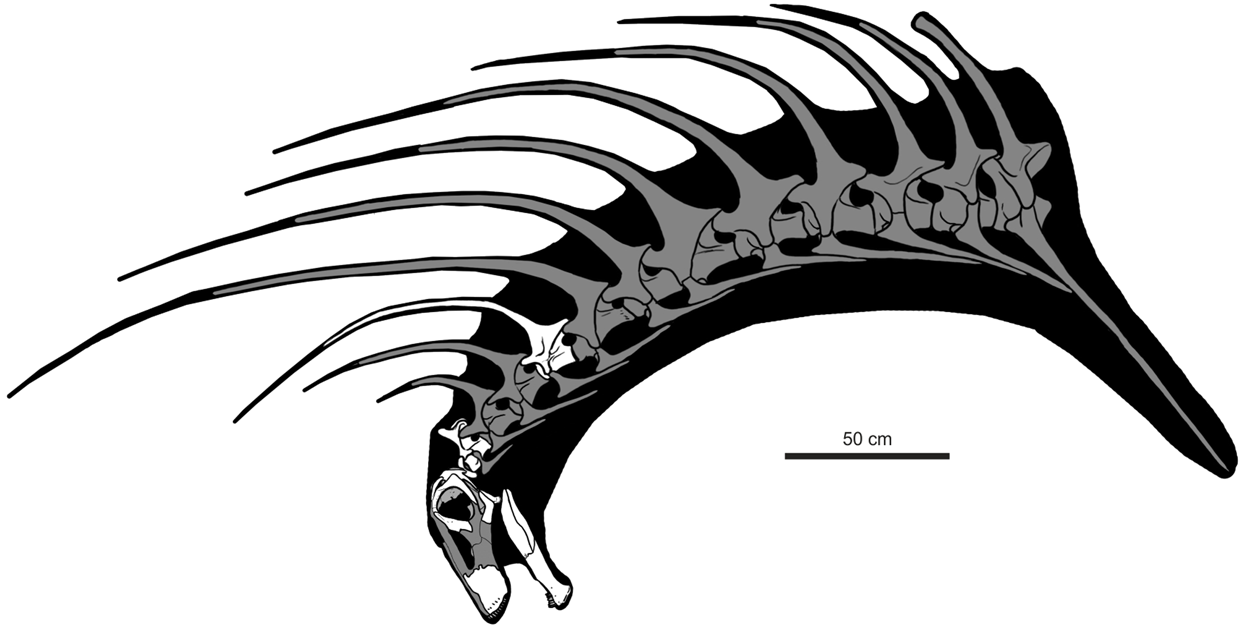

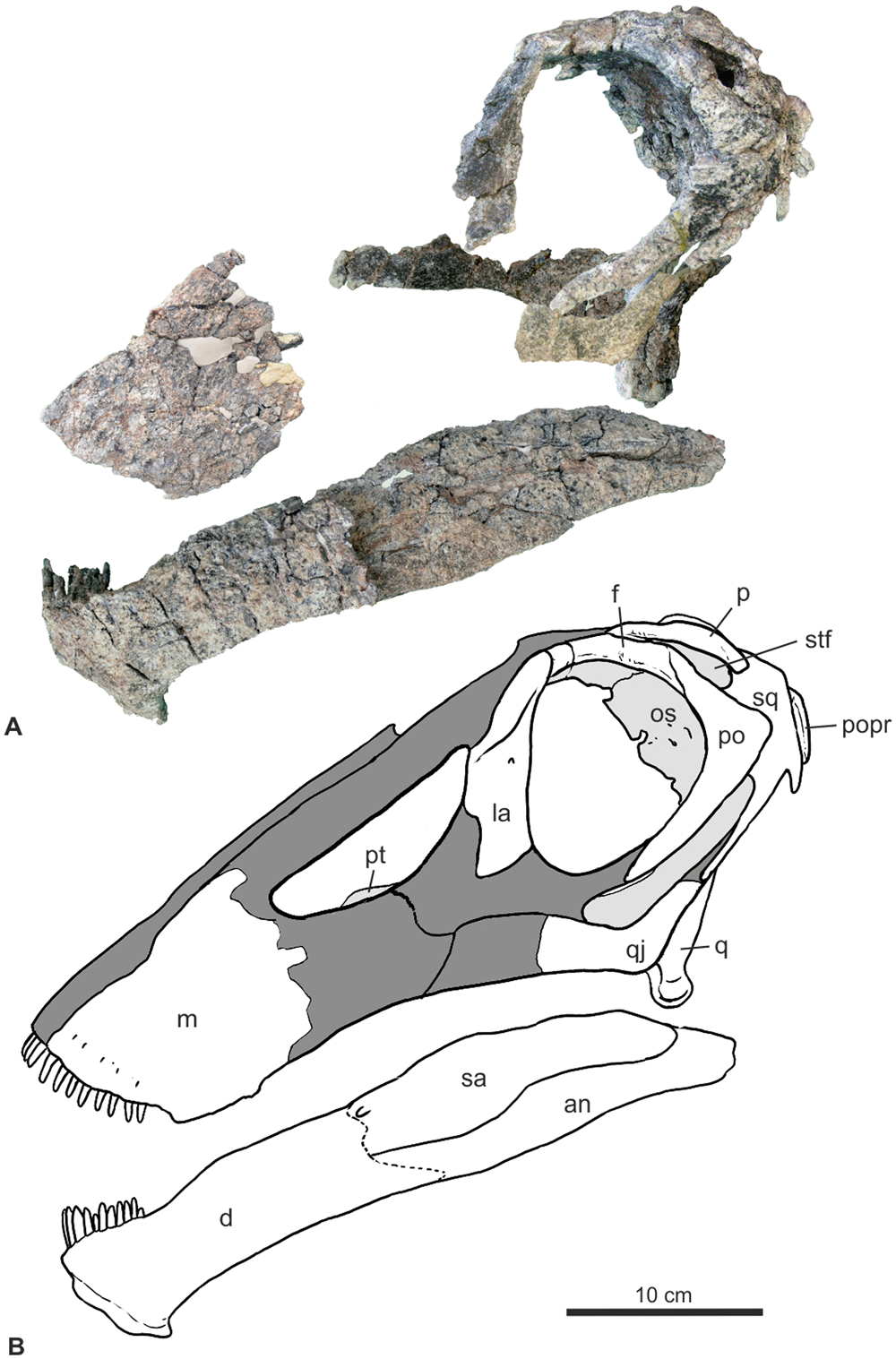
The holotype, MMCh-PV 75, resides at the Museo Municipal Ernesto Bachmann in Villa El Chocón, and at its heart is a nearly complete skull. Preserved parts include the left maxilla (main upper tooth-bearing bone), both dentaries (lower jaw bones), both quadrates (jaw-joint bones), and much of the skull roof and braincase. Behind the head, the holotype also includes the axis (second neck vertebra) and a tentatively identified fifth neck vertebra. Later, in 2023, Garderes and colleagues restudied these cranial bones using a 3D model.
So far, Bajadasaurus is known from this one individual, and the Paleobiology Database records a single occurrence. Earlier, a 2014 paper had noted abundant dicraeosaurid remains at the type locality. However, no study reviewed here ties those bones to Bajadasaurus, and no additional specimens have been confirmed outside this locality.
Bajadasaurus Size and Description
Only the head and the front of the neck survive—a small but revealing core.
Short description of Bajadasaurus
The skull was gracile, with eye sockets exposed toward the top of the head. At the back, its occipital condyle—the knob that joins skull to neck—was flattened. Its basipterygoid processes, struts that brace the palate, were extremely slender and more than six times longer than wide. In the lower jaw, the slim, J-shaped dentary ended in a deep “chin,” with teeth only at its front. These were narrow, peg-like crowns, and some carry tiny, low-angled wear facets. A 2023 restudy also suggested that a cornified sheath covered the front of the muzzle.
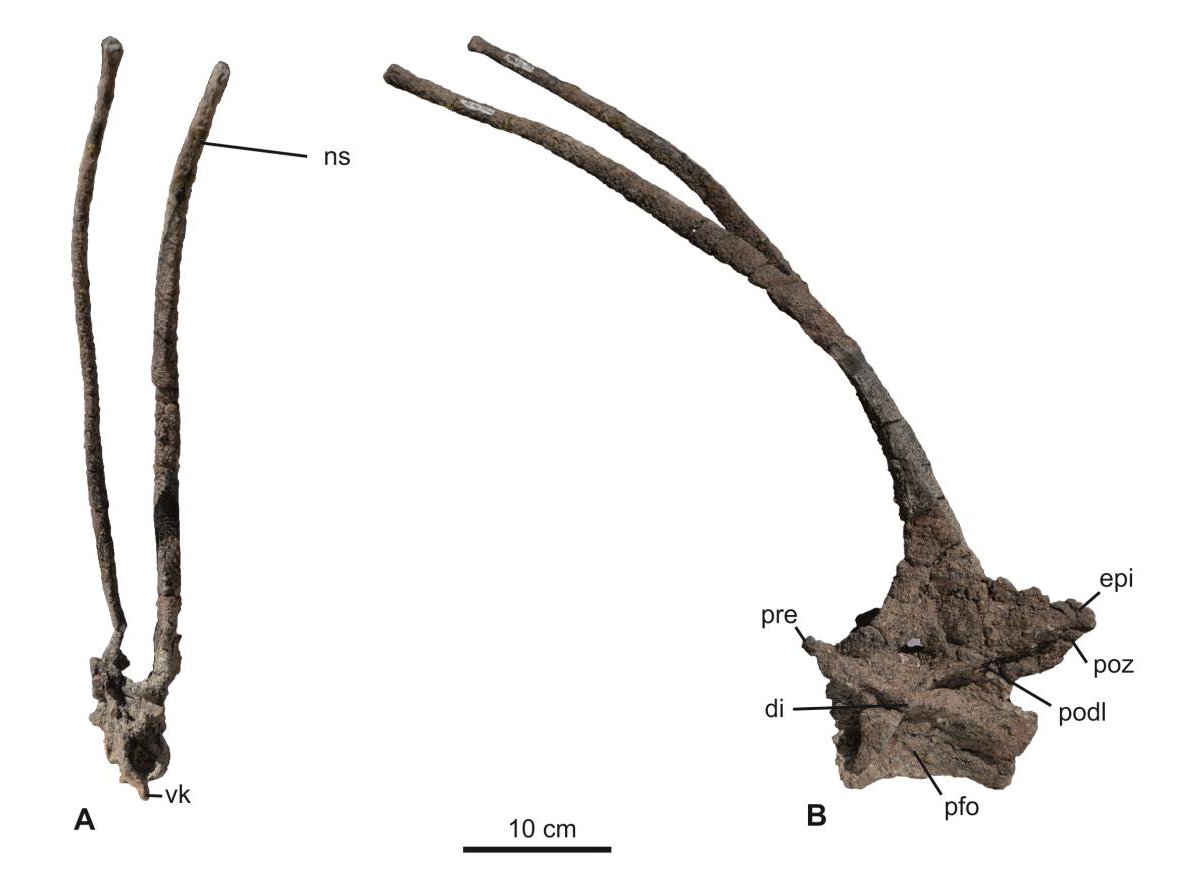
Behind the head, the axis stood twice as tall as its centrum (vertebral body) was long. Farther back, the tentative fifth neck vertebra was four times taller than long. Its spine was bifid—split into two rod-like prongs—and both prongs curved forward. With the rest of the skeleton missing, the published reconstruction borrows its neck count from Amargasaurus. No skin or soft tissue survives, so any discussion of its outer covering is speculative.

Size and Weight of Type Species
No published study has estimated the length, height, or weight of Bajadasaurus. Without a complete skeleton, any estimate would have to rest on better-known relatives.
Instead, the bones themselves give the clearest measure. The left dentary is 144 millimeters (5.7 inches) long, and the left maxilla measures 132 millimeters (5.2 inches). Farther back, the surangular and angular—two rear bones of the lower jaw—reach 208 millimeters (8.2 inches) and 205 millimeters (8.1 inches).
Most striking of all, the spines of that fifth vertebra run 58 centimeters (22.8 inches) long. In the describers’ comparison, only Amargasaurus shows practically the same degree of spine elongation, and its spines point backward instead.
The Dinosaur in Detail
One of the most distinctive features of Bajadasaurus is the direction of those spines. They curve forward and slightly outward, differing, in the describers’ words, “from any other known sauropod.” By contrast, Dicraeosaurus, Brachytrachelopan, and Pilmatueia have forward-leaning spines, but much shorter ones. Unlike the sharp tips seen in Amargasaurus, each tip ends in a slight expansion.
Its describers diagnosed the genus by four autapomorphies—traits found in no other species. Two are the forward spines and the slender basipterygoid processes. The other two are a vertical axis spine and an extended post-temporal fenestra (an opening at the back of the skull). Several features also appear for the first time in a dicraeosaurid skull, such as a narrow lateral temporal opening. In 2023, Garderes and colleagues proposed three more potential distinguishing traits around the jaw joint.
Its dentition was reduced, too—12 full-grown teeth in the dentary and eight visible sockets in its incomplete maxilla. Among diplodocoids, its describers found that low count similar only to Suuwassea, with seven. By comparison, Diplodocus has 10 to 11 maxillary teeth and Nigersaurus 24.

The purpose of the spines remains debated. From the start, Gallina and colleagues argued that they served as passive defenses, with a keratin sheath, the material of horns, guarding the gracile bone against fracture. That sheath, they thought, may have run more than 50 percent longer than the bone core. Even so, they conceded that the spine extension “may be speculative for Bajadasaurus.” In 2022, however, Cerda and colleagues studied spine tissue in Amargasaurus and found no support for a keratin sheath. By parsimony, they extended that result to similar dicraeosaurids and favored a “cervical sail” instead. Taken together, the anatomy is clear, but its function is not.
Interesting Points about Bajadasaurus
- The species name pronuspinax means “bent-forward spine,” a nod to the curved neck spines that define the animal.
- The spines of its one preserved mid-neck vertebra measure 58 centimeters (22.8 inches), rising from a vertebra four times taller than long.
- A 2025 study estimated a mean tooth-replacement time of 40.7 days, with rates varying between the jaw bones.
- About 15 million years separate Bajadasaurus from the younger Amargasaurus, a gap that suggested to its describers that a fence of spines was long adaptive.
- Its holotype preserves the most complete skull known for any dicraeosaurid, still joined to the front of the neck when it was found.
Contemporary Dinosaurs
Sharing the Bajada Colorada Formation was Leinkupal laticauda, a diplodocid sauropod described in 2014 from the formation’s type locality. Its describers called it the first diplodocid from South America and the stratigraphically youngest record of the group anywhere. The Paleobiology Database lists the two sauropods in the same collection from the main bonebed, where diplodocid and dicraeosaurid bones lay intermixed.
Adding further diversity was Ninjatitan zapatai, which its describers suggested could be the earliest known titanosaur. In 2021, Gallina, Canale, and Carballido named it from the same formation, calling the local sauropod fauna “one of the most diverse and unique associations from the lowermost Cretaceous.” The Paleobiology Database places it about 4 meters (13 feet) below the main bonebed at the same locality, making it slightly older, by an unknown span.
From a neighboring region comes Pilmatueia faundezi, a long-spined sauropod from the Mulichinco Formation at Pilmatué, near Las Lajas in Neuquén Province. In 2022, Windholz and colleagues described its Valanginian rocks and the Bajada Colorada Formation as geographically close and “partially synchronous.” A 2026 study also grouped them among Early Cretaceous units with similar dinosaur faunas. Pilmatueia is usually classified as a dicraeosaurid, although a 2025 analysis recovered it as an early diplodocid. Known only from that formation, it is listed here as a regional contemporary.
Bajadasaurus in its Natural Habitat
Rivers shaped the world Bajadasaurus roamed, and the formation’s red and greenish-brown conglomerates and sandstones are banded with siltstones and reddish claystones. Following 1997 mapping by Leanza and Hugo, studies in 2014 and 2017 read these as braided river deposits. However, a 2026 summary of the same mapping describes meandering or anastomosed rivers, sometimes read as a delta. Numerous opalized tree trunks also suggest that trees grew nearby.
Predators here are known only from fragments. A proximal tibia (upper shin bone), found 3 meters (10 feet) below the bonebed, came from a large abelisaurid indirectly estimated at about 6.5 meters (21 feet) long. Meanwhile, a small abelisauroid of about 2.5 meters (8 feet) left an axis and probably two tail vertebrae. Two large, serrated tooth crowns, described in 2017, likely mark the first South American and youngest megalosaurid record. Later work added more theropods and, in 2026, bones and osteoderms with stegosaurian affinities. Still, no bite marks link any of them to Bajadasaurus, so the describers’ “disturbing fence for a loitering carnivore” remains a hypothesis.
For a herbivore with so few teeth, Garderes in 2025 proposed “a plausible low-level specialist-feeding ecological niche.” In 2026, a muscle-leverage study inferred that head-lifting mattered far less in Bajadasaurus than in Camarasaurus. Such animals, its authors suggested, might have foraged at the lower canopies.
While there is no direct evidence of herding, a single known individual leaves its social life unknown. In 2022, Gallina and colleagues argued that early South American flagellicaudatans occupied “the niches of narrow-crowned megaherbivores.” Alongside Leinkupal and Ninjatitan, Bajadasaurus was probably one of several large plant-eaters along these rivers.
Frequently Asked Questions
It means “downhill lizard,” after the Bajada Colorada locality, while the species name pronuspinax means “bent-forward spine.”
It lived in the Early Cretaceous, in the late Berriasian to early Valanginian, roughly 140 to 135 million years ago.
No length, height, or weight has been published for it. Its one preserved pair of forward-curving neck spines, however, measures 58 centimeters (22.8 inches).
It was a dicraeosaurid sauropod and a herbivore, closely related to Amargasaurus and Dicraeosaurus.
Its fossils come from the Bajada Colorada locality in Argentina’s Neuquén Province, in rocks of the Bajada Colorada Formation.
Its extremely long neck spines curved forward, unlike the shorter forward-leaning spines of its relatives, and its skull is the most complete known for its family.
Sources
The information in this article is based on various sources, drawing on scientific research, fossil evidence, and expert analysis. The aim is to provide a comprehensive and accurate overview of Bajadasaurus. However, please be aware that our understanding of dinosaurs and their world is constantly evolving as new discoveries are made.
- https://doi.org/10.1038/s41598-018-37943-3
- https://static-content.springer.com/esm/art%3A10.1038%2Fs41598-018-37943-3/MediaObjects/41598_2018_37943_MOESM1_ESM.pdf
- https://doi.org/10.1371/journal.pone.0097128
- https://doi.org/10.1016/j.cretres.2016.11.010
- https://doi.org/10.5710/AMGH.20.08.2020.3376
- https://doi.org/10.5852/cr-palevol2022v21a45
- https://doi.org/10.1111/joa.13659
- https://doi.org/10.1007/978-3-030-95959-3_6
- https://doi.org/10.1080/08912963.2023.2212389
- https://doi.org/10.1080/08912963.2025.2472157
- https://doi.org/10.5710/PEAPA.11.11.2025.553
- https://doi.org/10.5710/PEAPA.25.11.2025.551
- https://doi.org/10.1080/14772019.2025.2550760
- https://paleobiodb.org/data1.2/taxa/single.json?name=Bajadasaurus
- https://doi.org/10.25250/thescbr.brk246
This article was last fact checked: TheDinosaurs Team, 05-11-2026
Featured Image Credit: Connor Ashbridge, CC BY 4.0, via Wikimedia Commons
