
On the Isle of Wight’s south-west coast, the purple-red mudstones of the Wessex Formation have yielded a long-overlooked predator. Named Invictibellatrix amberina in October 2026, this theropod lived during the Barremian stage of the Early Cretaceous. Its describers call it the first megaraptoran described from Europe—its group later produced apex predators in Gondwana, the southern landmass. It is known from a single partial braincase, yet that small fossil bears on a wider question—where megaraptorans came from.
The fossil itself is far from new. London’s Natural History Museum has held it since 1924, and its story begins with the collector Reginald Walter Hooley. The museum’s register once listed it as Megalosaurus sp., but for more than a century nobody described it. Then paleontologist Cassius Morrison and six colleagues CT-scanned it and named it in Royal Society Open Science. Their study turns a beach-worn museum piece into evidence that small megaraptorans once lived in Europe.
Invictibellatrix Key Facts
| Keyword | Fact |
|---|---|
| Pronunciation | Not specified |
| Meaning of name | Unconquered Female Warrior |
| Group | Theropoda (Megaraptora) |
| Type Species | Invictibellatrix amberina |
| Diet | Carnivore |
| When it Lived | 126 to 121 MYA |
| Period | Cretaceous |
| Epoch | Early Cretaceous (Barremian stage) |
| Length | Up to about 13 feet (4 meters), indirect estimate by Morrison and colleagues |
| Height | Just over 4.9 feet (1.5 meters), per the Natural History Museum’s press release |
| Weight | About 440 to 660 pounds (200 to 300 kilograms), indirect estimate by Morrison and colleagues |
| Mobility | Not specified |
| First Discovery | Year not specified, collected by Reginald Walter Hooley, acquired by the Natural History Museum in 1924 |
| Described by | 2026 by C. Morrison, C.R. Scherer, P. Mannion, L.B. Porro, B. Clark, D.D. Folkes, and P.M. Barrett |
| Holotype | NHMUK PV R6775 |
| Location of first find | Sudmoor Point, near Brook, Wessex Formation, Isle of Wight, England, United Kingdom |
Invictibellatrix Origins, Taxonomy and Timeline
The name Invictibellatrix joins two Latin words—invictus, meaning “unconquered,” and bellatrix, the feminine form of “warrior.” The describers had two aims in choosing it. It honors the later role of megaraptorans as Gondwanan apex predators, while early members were smaller, non-apex hunters. The authors also meant it to give hope and strength to people who are bullied, discriminated against, victimized, or oppressed. The species name amberina nods to the amber in the formation’s plant debris beds—and, per the museum, to the female name.
Morrison and colleagues place Invictibellatrix among the theropods, within Tetanurae, Coelurosauria, and finally Megaraptora. Where Megaraptora itself belongs is still disputed. Recent analyses put it beside or inside Tyrannosauroidea, while earlier studies treated its members as early coelurosaurs or as allosauroids. The authors favor reading it as an early-diverging megaraptoran—one that branched off outside Megaraptoridae, the family of later forms. However, both analyses of one of their two main datasets recovered it inside Megaraptoridae, as the sister of Murusraptor. Invictibellatrix amberina is the type and only known species.
The Wessex Formation dates to the Barremian stage of the Early Cretaceous. The paper gives no numeric age, but the Paleobiology Database places the Barremian at roughly 126 to 121 million years ago. Under the topology the authors prefer, megaraptorans arose in Asia in the earliest Cretaceous. Invictibellatrix likely descended from an Asian population that spread into Europe around 130 million years ago. The authors also argue that megaraptorans had disappeared from Laurasia—the northern landmass—by the early Late Cretaceous, while they diversified in Gondwana.
Discovery & Fossil Evidence
The holotype comes from Sudmoor Point, near Brook on the south-west coast of the Isle of Wight. It turned up at the foot of the cliff, so nobody knows its precise horizon. Even so, the authors consider it most likely to come from the lower plant debris beds, labeled L1 to L5. According to the museum, amateur paleontologist Reginald Walter Hooley found it. Hooley died on 5 May 1923, and the museum acquired the fossil in May 1924. The paper says it was purchased “from Rev. R. W. Hooley,” which matches the donor name in the museum’s register. Neither account gives a collection date.
The specimen, NHMUK PV R6775, is a partial braincase—the bony capsule that housed the brain. It preserves the basioccipital and exoccipitals around the opening for the spinal cord. The basisphenoid and parasphenoid of the braincase floor survive as well. So do the opisthotic and prootic of the ear region, along with possible fragments of the laterosphenoids. Rolled on a beach, the fossil is rather poorly preserved and incomplete. It has lost everything in front of the laterosphenoids and most of the skull roof, though it shows no signs of plastic deformation.
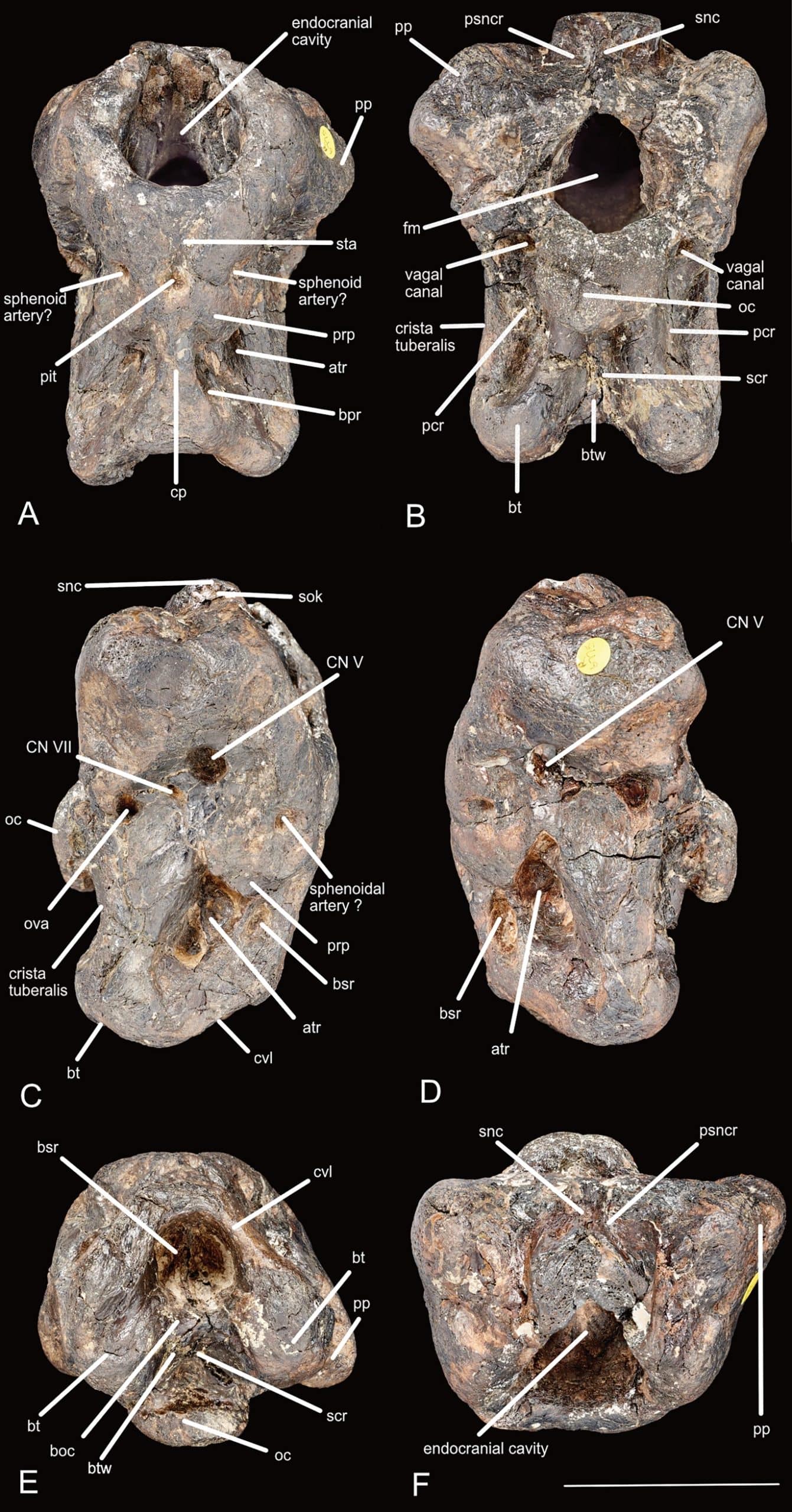

Soon after the fossil arrived in the 1920s, someone made a physical endocast—a cast of the brain cavity. Yet nobody formally described the braincase until Morrison’s team scanned it with micro-CT at the museum’s Imaging and Analysis Centre. From those scans they built 3D digital models of the braincase and its endocast. Morrison put its neglect bluntly—”sitting in a drawer for nearly 100 years.” No second specimen has yet been confirmed.
Invictibellatrix Size and Description
Short description of Invictibellatrix
The braincase was originally slightly longer than tall, unlike the taller-than-long braincases of spinosaurids. At its back sits the occipital condyle—the knob that joined the skull to the neck. It is wider than tall, at 37 by 26 millimeters (about 1.5 by 1 inches). Above it, the foramen magnum, the opening for the spinal cord, is almost oval and slightly taller than wide. Higher still runs a worn nuchal crest, a ridge on the back of the skull 37 millimeters (1.5 inches) long.
Its bone sutures are invisible even in CT scans, a sign to the authors of at least a sub-adult. Elsewhere they call it unlikely to be a juvenile or a sub-adult, so it was no youngster.
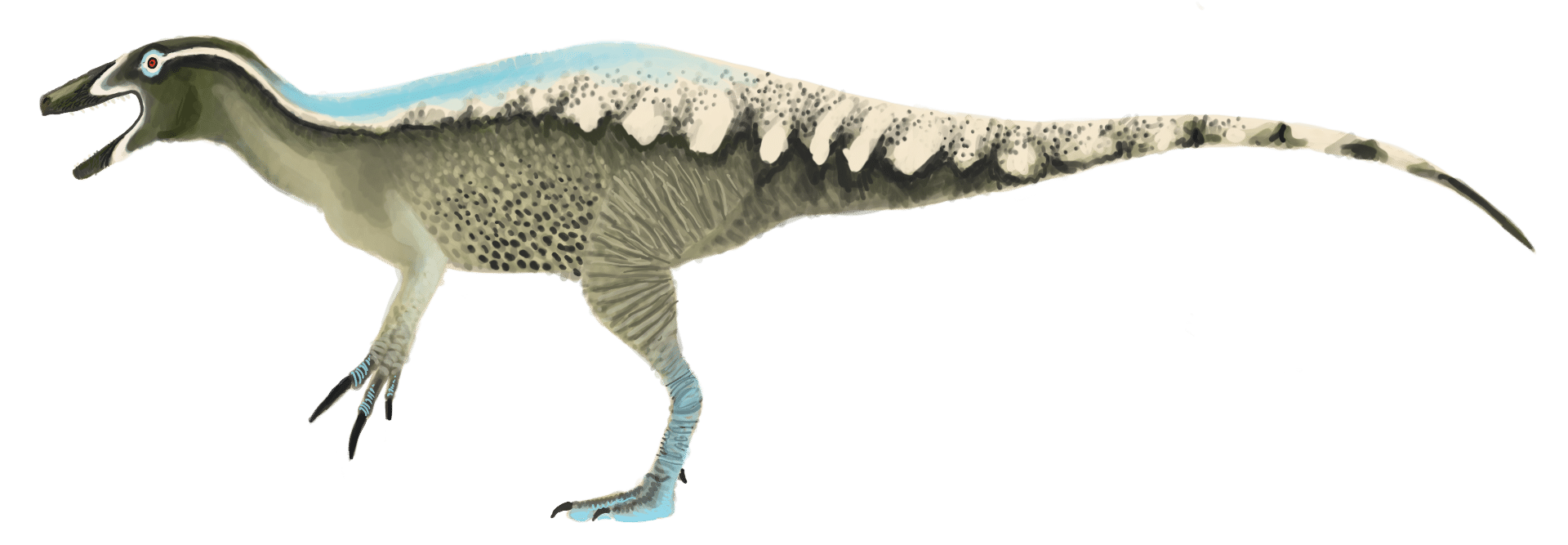
No limbs, claws, or skin are known, so any picture of the living animal is speculative. In the museum’s press release, Morrison says it would likely have had feathers, though the paper itself makes no such claim.

Size and Weight of Type Species
Without a skeleton, researchers must estimate body size through comparisons. The braincase matches that of Timurlengia euotica in size, so Morrison and colleagues inferred a comparable body. That suggests a length of up to about 13 feet (4 meters) and a weight of roughly 440 to 660 pounds (200 to 300 kilograms).
In the press release, Morrison gives a length of 10 to 13 feet (3 to 4 meters), based on its closest relatives. He also adds a height of just over 4.9 feet (1.5 meters)—about as tall as a human. The paper, by contrast, gives no height.
Its describers rank Invictibellatrix among the smallest megaraptorans known, if not the smallest. They note that other megaraptorans reached 20 to 33 feet (6 to 10 meters) or more and likely topped 4,400 pounds (2,000 kilograms). That does not hold for every member, though—Japan’s Fukuiraptor was about 15 feet (4.5 meters) long. The authors read the gap as support for a late arrival of large body size in megaraptoran evolution.
The Dinosaur in Detail
Four braincase features set this dinosaur apart, and three of them are unique to it. On each side, a small pocket tentatively identified as a basipterygoid recess sits in front of the anterior tympanic recess. Slightly pinched from side to side, the nuchal crest has an hourglass shape, and curved, pronounced recesses flank it. Two large, deep, vertically elongated paracondylar recesses beside the condyle complete the set, though they are not unique on their own.
The authors refer it to Megaraptora on three traits—the occipital condyle, a sub-oval foramen magnum, and a midline nuchal crest. Their abstract calls the condyle sub-circular, yet their own measurements make it about 1.4 times wider than tall. Its rear surface closely resembles that of Murusraptor. The foramen magnum’s width is 0.8 times the condyle’s, inside the megaraptoran range of 0.68 to 0.88 and well above tyrannosaurids’ 0.27 to 0.59. That ratio also overlaps spinosaurids and abelisaurids, however, so it supports the referral only alongside other features. The authors judged it unlikely to be a spinosaurid or an allosauroid, and they ruled out both a noasaurid and a maniraptoriform. Nor, they argue, is it likely a junior synonym of Neovenator.
Missing its forebrain, the partial endocast shows a midbrain and hindbrain meeting at about 55 degrees and a cerebellum that is not clearly expanded.
Its exact branch remains open. Both analyses of the Naish and Cau dataset place it beside Murusraptor within Megaraptoridae. Under equal weights, though, each grouping has a Bremer support of only 1—weak backing at best. Another dataset makes it a megaraptoran branching later than Phuwiangvenator, while a Bayesian analysis made it the sister of Fukuiraptor plus Megaraptoridae. A third matrix also keeps it within Megaraptora. The authors favor the early-diverging reading and prefer the second topology for reconstructing its origins.
Interesting Points about Invictibellatrix
- Its describers intended the name “unconquered female warrior” to give hope and strength to people who are bullied or oppressed.
- According to Morrison and colleagues, Invictibellatrix is the first megaraptoran described from Europe.
- A physical cast of its brain cavity dates from the 1920s, yet the braincase waited until 2026 for a formal description.
- Its describers rank it among the smallest megaraptorans known, at an estimated 13 feet (4 meters) or less.
Contemporary Dinosaurs
The exact bed of Invictibellatrix is unknown. Its describers chart the formation’s fauna by level, but their paper does not place any animal below at the same level. Each shared only the Wessex Formation and the Barremian stage, with no recorded interaction.
Looming largest among them was Neovenator salerii, a carcharodontosaurian allosauroid about 23 to 26 feet (7 to 8 meters) long. Its type remains come from a Barremian cliff of the Wessex Formation near Grange Chine.
Adding a very different predator was Ceratosuchops inferodios, a baryonychine spinosaurid named in 2021 by Barker and colleagues. Its type material came from Chilton Chine as blocks on the foreshore, so its original level remains uncertain.
Named in the same 2021 study was Riparovenator milnerae, another baryonychine. Its type horizon lies between the Chilton Chine and Brighstone Sandstones, low in the exposed formation at Brighstone Bay. However, the Invictibellatrix paper does not tie it to Sudmoor Point’s L1 to L5.
Rounding out the group was Eotyrannus, an early tyrannosauroid roughly 15 feet (4.5 meters) long. It came from bed L11, higher than the probable source of Invictibellatrix. The two therefore shared a rock formation rather than a proven moment in time. Morrison’s team found no overlapping bones between them and argued that the braincase does not belong to Eotyrannus.
Invictibellatrix in its Natural Habitat
The world Invictibellatrix roamed was a floodplain within a narrow valley, now preserved as purple-red mudstones and sandstones. Calcrete nodules (lime-rich lumps that formed in the soil) point to a semi-arid climate. So do drought-tolerant ferns and the conifers Pseudofrenelopsis and Watsoniocladus. Barker and colleagues describe a perennial, sinuous river flowing west to east. Similarly, Naish and Cau picture a near-shore floodplain crossed by a meandering river. Flash floods filled oxbow lakes and similar hollows with plant debris, and charcoal in these beds points to seasonal wildfires.
While there is no direct evidence of what Invictibellatrix ate, its describers regard early megaraptorans as smaller, non-apex predators. Morrison also told the museum that it was not the apex predator of its time. Beds L1 to L8, which include its probable source layers, record lowland and coastal habitats and the formation’s greatest observed theropod diversity.
No fossils reveal whether it lived alone or in groups. Most of the formation’s vertebrate fossils come from the plant debris beds—the same layers that hold the amber behind its species name.
Frequently Asked Questions
It means “unconquered female warrior,” from the Latin invictus and bellatrix.
It lived in the Barremian stage of the Early Cretaceous, roughly 126 to 121 million years ago.
By an indirect estimate, it reached up to about 13 feet long and weighed roughly 440 to 660 pounds.
It was a theropod, described by its authors as an early-diverging megaraptoran.
Its braincase comes from Sudmoor Point, near Brook, in the Wessex Formation of the Isle of Wight, England.
According to its describers, it is the first megaraptoran described from Europe, and its braincase shows three features unique to it.
Sources
The information in this article is based on various sources, drawing on scientific research, fossil evidence, and expert analysis. The aim is to provide a comprehensive and accurate overview of Invictibellatrix. However, please be aware that our understanding of dinosaurs and their world is constantly evolving as new discoveries are made.
- https://doi.org/10.1098/rsos.260937
- https://pmc.ncbi.nlm.nih.gov/articles/PMC13682568/
- https://doi.org/10.6084/m9.figshare.c.8654339
- https://www.morphosource.org/media-lists/000904827
- https://nhm.ac.uk/press-office/press-releases/uk-dinosaur-fossil-identified-as-new-long-clawed-predator.html
- https://paleobiodb.org/data1.2/taxa/single.json?name=Invictibellatrix&show=attr,app
- https://doi.org/10.1038/s41598-021-97870-8
- https://doi.org/10.7717/peerj.12727
- https://doi.org/10.1038/s41598-017-03671-3
- https://hantsfieldclub.org.uk/ihr100/profiles-g-h/hooley.html
- https://data.nhm.ac.uk/object/466ec0be-1797-460a-8433-bbcba1d34c11
This article was last fact checked: TheDinosaurs Team, 29-10-2026
Featured Image Credit: TotalDino, CC BY 4.0, via Wikimedia Commons
