
In Carbon County, Wyoming, the Morrison Formation at Como Bluff gave up the bones of a long-legged plant-eater. Paleontologist Othniel Charles Marsh named it Laosaurus altus in 1878, then gave it a genus of its own—Dryosaurus—in 1894. He later called it one of the most “slender and graceful” members of its group. This herbivore lived in the Kimmeridgian and Tithonian stages of the Late Jurassic, roughly 153 to 148 million years ago.
Since 1894, the story has grown more tangled. In 2018, paleontologists K. Carpenter and P. M. Galton named a second species, D. elderae, from Utah’s Dinosaur National Monument. Meanwhile, a close relative from Tanzania has moved in and out of the genus for decades. Even some small Morrison dinosaurs named long ago may turn out to be young Dryosaurus—a sign that old collections still hold surprises.
Dryosaurus Key Facts
| Keyword | Fact |
|---|---|
| Pronunciation | dry-oh-SORE-us (per the Natural History Museum, London) |
| Meaning of name | Oak Lizard (per the Natural History Museum, London) |
| Group | Ornithopoda (Dryosauridae) |
| Type Species | Dryosaurus altus |
| Diet | Herbivore |
| When it Lived | About 153 to 148 MYA (Morrison Formation dating) |
| Period | Jurassic |
| Epoch | Late Jurassic (Kimmeridgian to Tithonian stages) |
| Length | About 12 feet (3.7 meters) per Marsh in 1894, 13.1 feet (4.0 meters) per the Natural History Museum |
| Height | Not specified |
| Weight | About 343 to 372 pounds (156 to 169 kilograms), indirect estimate from an immature specimen |
| Mobility | Moved on two legs (bipedal) |
| First Discovery | Year not specified (before late 1878) by S. W. Williston per Marsh, though PBDB lists W. Reed as collector |
| Described by | 1878 by O.C. Marsh as Laosaurus altus, genus Dryosaurus named 1894 by O.C. Marsh |
| Holotype | YPM 1876 |
| Location of first find | Quarry 5, Como Bluff, Morrison Formation, Carbon County, Wyoming, USA |
Dryosaurus Origins, Taxonomy and Timeline
Marsh’s 1894 paper never explains the name, so the translation, “oak lizard,” comes from the Natural History Museum in London, not Marsh. The second species, D. elderae, honors Ann Schaffer Elder (1958–2009), who helped Carpenter in his studies at the Carnegie Quarry. Together, the names pair one borrowed meaning with one personal tribute.
In 1878, Marsh placed Laosaurus among the Iguanodontidae and wrote that it most nearly resembled Hypsilophodon. By 1894, more fossils showed it was “quite distinct from Laosaurus” and, in his words, intermediate between Camptosaurus and that genus. Modern studies treat Dryosaurus as an ornithopod within Iguanodontia, in the family Dryosauridae. That family covers every animal closer to Dryosaurus altus than to Iguanodon bernissartensis. Although Marsh knew only the type species, Carpenter and Galton now recognize two in the Morrison—D. altus and D. elderae.
Dryosaurus lived during the Kimmeridgian and Tithonian stages of the Late Jurassic, and dating of the formation’s dinosaur-bearing beds points to roughly 153 to 148 million years ago. In 2019, Maidment and Muxworthy estimated that the formation built up over about 7 million years and grows younger toward the north. With its stratigraphic range uncertain, the exact span of D. altus within that window remains open.
Discovery & Fossil Evidence
Marsh’s original account states only that the remains were “found in Wyoming by Mr. S. W. Williston,” and his paper printed no specimen number. His “Atlantosaurus beds” are today’s Morrison Formation, and by 1894 Yale held several specimens, all from Colorado and Wyoming.
Carpenter and Galton identify the holotype—the name-bearing specimen—as YPM 1876, a partial skeleton from Quarry 5 at Como Bluff. Although Marsh figured only a tooth, the left hind leg, and the pelvis in 1878, the skeleton holds much more. It includes a left maxilla (upper jaw bone), both jugals (cheekbones), a braincase, and both dentaries (lower jaw bones). Behind the head come several neck and back vertebrae, a left arm, the lower hip bones, and a left femur (thigh bone), tibia, and fibula.
A second key skeleton came from Utah. On 7 March 1910, Joe Ainge and Clarence Neilsen found CM 3392 at the Carnegie Quarry, and the skull was dug out separately later. Long treated as D. altus by Gilmore and Galton, it became the holotype of D. elderae in 2018. Carpenter and Galton also cite a 2015 study showing Uteodon to be a chimera—a mix of Dryosaurus and Camptosaurus bones. In addition, they reassign a large Wyoming skeleton, CM 1949, to a new, unnamed ornithopod. At present, D. elderae is known only from the Carnegie Quarry, while D. altus is “not very common, but is wide spread.”

Dryosaurus Size and Description
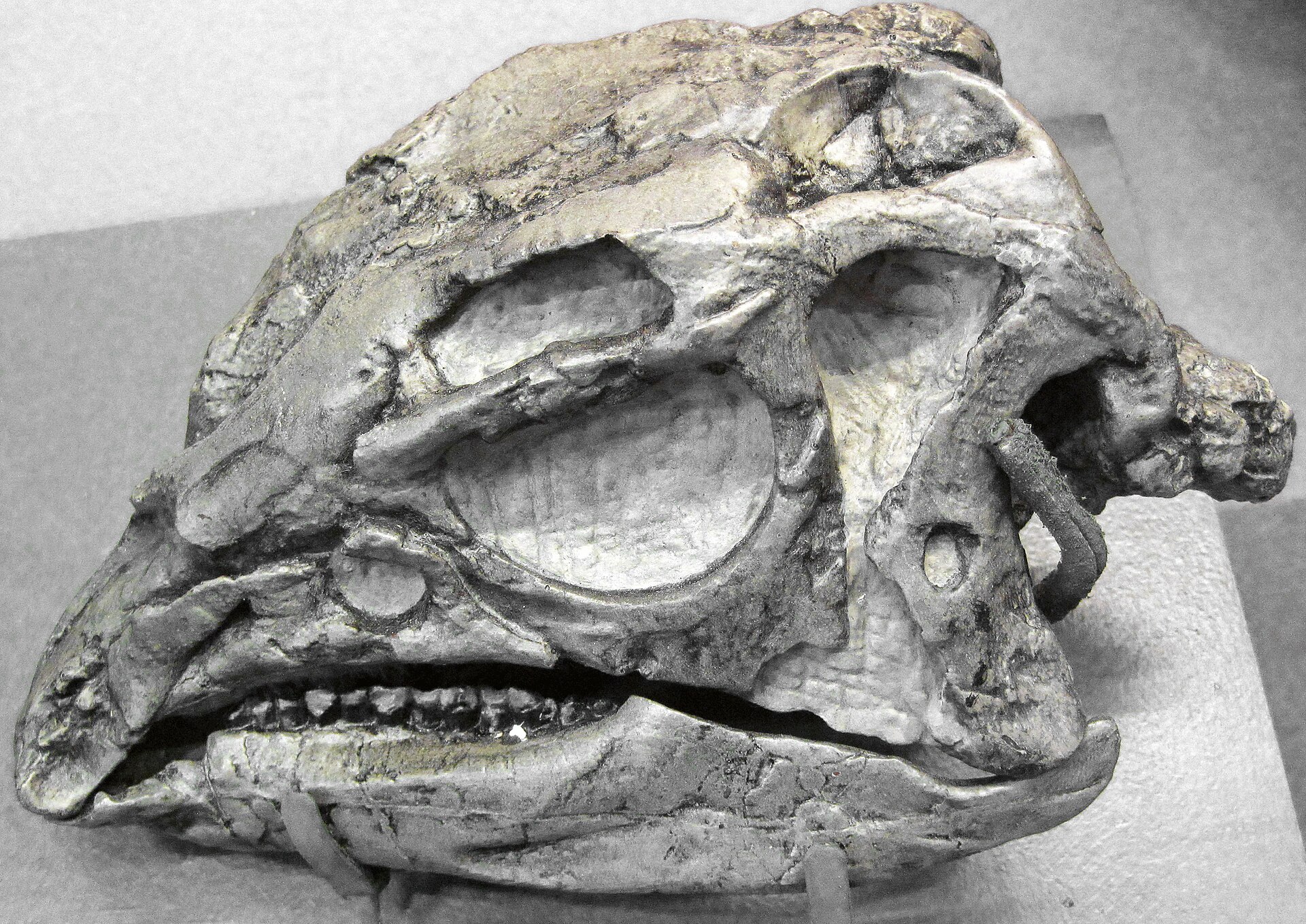
Marsh’s own diagnosis sketches the basic plan—a beaked, small-armed biped built on long, hollow-boned legs.
Short description of Dryosaurus
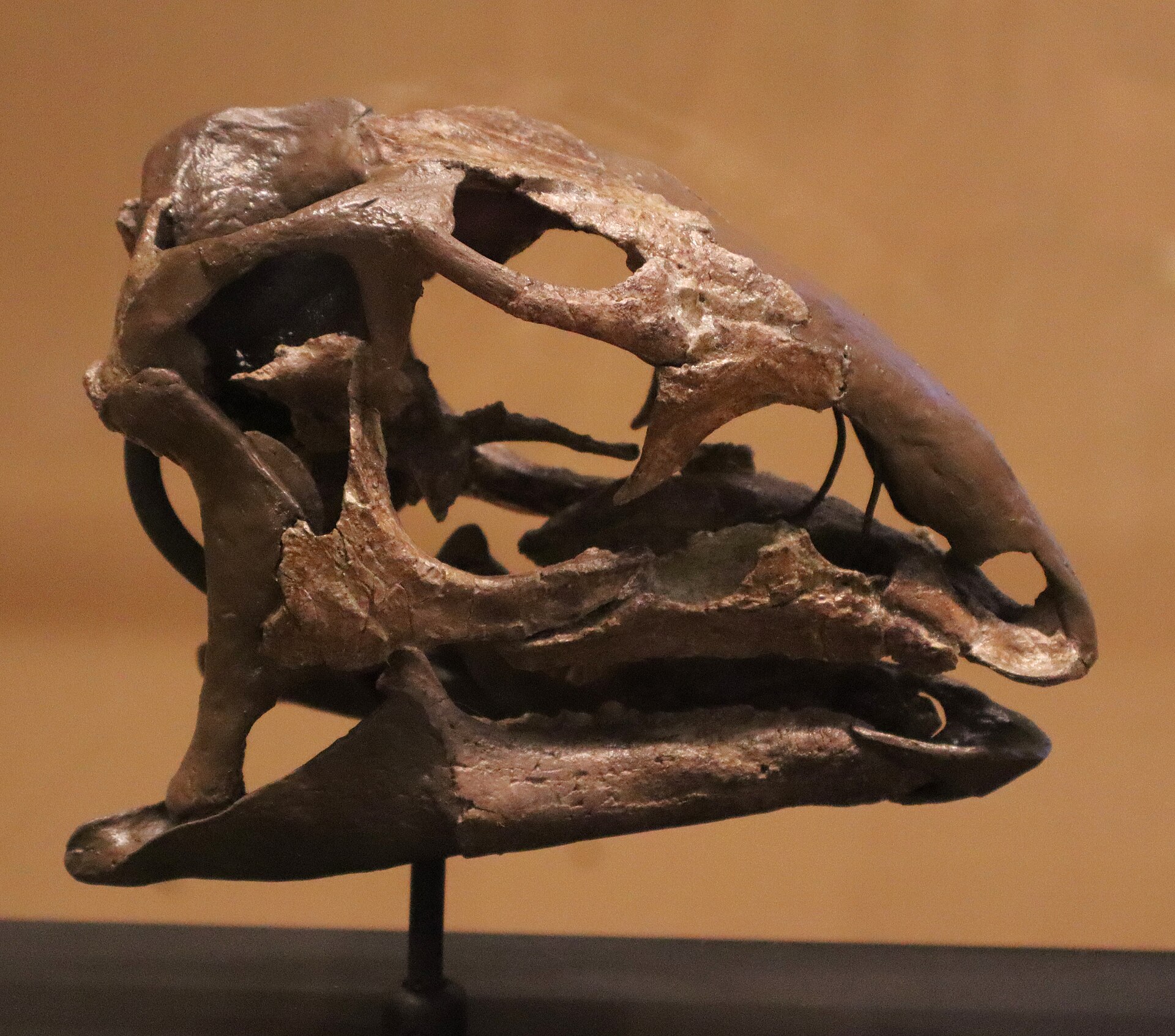
At the front of the skull, Marsh described toothless premaxillae—the bones at the tip of the snout—with a horny beak. The lower jaw was toothless in front, and the cheek teeth were “of moderate size” and very similar to those of Hypsilophodon. Marsh also listed a “supra-orbital fossa” near the eye.
Marsh called the neck vertebrae long and biconcave, meaning hollowed at both ends. Carpenter and Galton later found that the front neck vertebrae are short and tall in D. altus but long and low in D. elderae. Six fused vertebrae formed the sacrum, where the spine joins the hips, and the limb bones were hollow. Marsh thought the sternum (breastbone) never turned to bone, but Carpenter and Galton later illustrated bony sternal plates from a juvenile.
The forelimbs were less than half as long as the hind limbs and ended in five-fingered hands. In Marsh’s view, they “evidently were not much used in locomotion.” By contrast, the hind limbs were very long, with a shin longer than the thigh. His two foot accounts disagree, though, calling the first toe only a remnant in 1878 but complete in 1894. Galton’s 1981 description, cited by Maidment and colleagues in 2025, shows the first metatarsal very reduced and without toe bones.

Size and Weight of Type Species
In 1878, Marsh put the Wyoming remains at about 10 feet (3 meters) long. By 1894, with several specimens in hand, he raised that to about 12 feet (3.7 meters) without describing his method. The Natural History Museum lists 13.1 feet (4.0 meters), though its page also includes Tanzania. None of the sources consulted gives a hip height.
Weight is harder to pin down. In 2014, Benson and colleagues estimated 343 to 372 pounds (156 to 169 kilograms) from the holotype’s limb-bone girth. The lower figure treats it as a biped (thigh bone only), the higher as a quadruped (thigh and upper arm). Because YPM 1876 is flagged as immature, this indirect estimate may not reflect a full-grown animal. Marsh’s own measurements are direct—a tibia of 15.5 inches (393 millimeters) against a femur of 14.2 inches (360 millimeters).
Larger figures exist but are disputed—in 2012, Hübner and Ősi’s team cited a femur of roughly 19 inches (49 centimeters) from Horner and colleagues’ 2009 study. Carpenter and Galton, however, attribute this bone to CM 1949 and argue that the skeleton is not Dryosaurus at all.
The Dinosaur in Detail
A notable feature of Dryosaurus is its chewing equipment. In both species, the enamel is thicker on one side, and opposing teeth form wear surfaces with cutting edges. The dentary does not taper, and the rear teeth are packed into one continuous wear surface—a trait shared with Camptosaurus. In 2024, Ősi, Barrett, and colleagues also found the dentine 18.6 percent thicker on the working side of its teeth, an asymmetry they trace back to Dryosaurus and Camptosaurus.
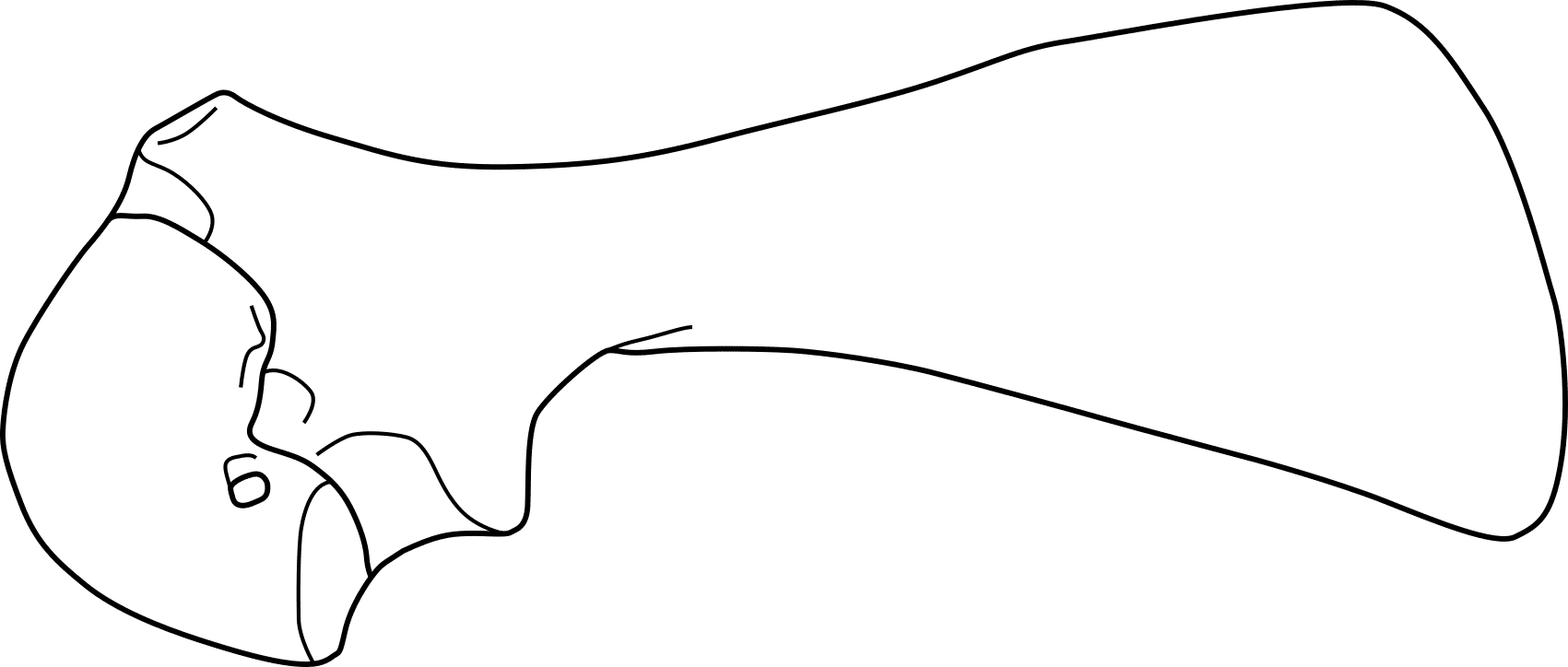
The two Morrison species differ in details of the skull, neck, and hips. Whereas D. elderae has a deep jugal branch below the eye, D. altus has a slender one. The ilium of D. elderae, the main hip bone, is also longer and lower. In the shoulder, a supraglenoid fossa—a hollow above the shoulder socket—links Dryosaurus with Camptosaurus, and according to Carpenter and Galton, other Morrison bipedal ornithischians lack it.

Another open question lies in Tanzania—in 1977, Galton argued that Dysalotosaurus lettowvorbecki from Tendaguru belongs in Dryosaurus. In 2012, however, Hübner reported that an ongoing anatomical revision had found “numerous significant anatomical differences” that support reviving Dysalotosaurus. Boyd’s 2015 analysis also treated the two genera separately. Even so, Carpenter and Galton still called it a “probable third species” in 2018, citing Carpenter and Lamanna’s 2015 rebuttal of Hübner.
Small Morrison bones add another twist—in 2025, Maidment and colleagues cited a review that judged some historic small taxa to be indeterminate or juvenile Dryosaurus. That view clashes with Carpenter and Galton, who kept Nanosaurus valid. Taken together, these studies paint a picture of a well-defined genus whose borders are still being drawn.
Interesting Points about Dryosaurus
- Marsh first named it Laosaurus altus in 1878 and gave it a genus of its own only in 1894.
- Marsh saw Hypsilophodon as the European representative of Dryosaurus, though he noted differences in the front teeth and breastbone.
- By counting daily growth lines in the dentine, Ősi and colleagues estimated that each Dryosaurus tooth took at least 60 days to form.
- Two-legged ornithischians like Dryosaurus make up only about 15 percent of dinosaur specimens from the Morrison Formation.
Contemporary Dinosaurs
Camptosaurus, a larger bipedal ornithopod, is known from both areas that produced the Dryosaurus type specimens. Marsh himself called Dryosaurus “allied to Camptosaurus.” Carpenter and Galton document C. dispar from Quarry 13 at Como Bluff and C. aphanoecetes from the Carnegie Quarry. No direct interaction between them is recorded, however.
Prowling the same landscape was Allosaurus, a Late Jurassic theropod (a two-legged, mostly meat-eating dinosaur). In 2020, Chure and Loewen examined Allosaurus material from the Carnegie Quarry, home of D. elderae, although no bite marks or other direct evidence link the two.
Towering above the floodplain was Diplodocus, a diplodocid sauropod that Marsh named in the same 1878 paper as Laosaurus altus. In 2015, Tschopp, Mateus, and Benson listed Diplodocus hallorum from both the Dinosaur National Monument Quarry and Como Bluff. They dated it to the late Kimmeridgian, though any contact with Dryosaurus goes unrecorded.
Adding further bulk was Apatosaurus, another diplodocid sauropod. The holotype of A. louisae comes from the Dinosaur National Monument Quarry, and Tschopp’s team dated it to the late Kimmeridgian to early Tithonian. Earl Douglass’s field notes put the D. elderae skeleton about 12 feet (3.7 meters) higher in the same quarry. That gap in the rock warns against picturing the two side by side.
Dryosaurus in its Natural Habitat
The world Dryosaurus roamed was a broad lowland basin that the Sundance Seaway had once covered. Marsh read these rocks in 1878 as mainly estuary deposits, but later work describes non-marine river, floodplain, and lake sediments instead. Volcanic ash settled across the basin, and the climate was significantly warmer than today—drier and seasonal to the south, probably wetter to the north. Quarry 5 at Como Bluff records a wet floodplain, while the Carnegie Quarry formed in a coarse channel fill.
Its teeth hint at how this herbivore chose its plants. In 2024, Ősi and colleagues found microwear dominated by pits—tiny marks on the tooth surface—in Dryosaurus, Camptosaurus, and Dysalotosaurus, with very large pits in Dryosaurus. They concluded that these animals were likely selective feeders, favoring nutrient-rich parts such as fleshy leaves, buds, and fruits.
While there is no direct evidence of its social life, a few studies touch on how it grew. In 2012, Hübner found Dysalotosaurus bone tissue most similar to that of D. altus, which suggests a similar growth pattern. According to Hübner, Horner and colleagues found lines of arrested growth (pauses recorded in bone) in three subadult femora and judged the largest still growing. Carpenter and Galton counter that this bone belongs to CM 1949, not Dryosaurus, and call those growth conclusions erroneous.
Frequently Asked Questions
According to the Natural History Museum in London, it means “oak lizard.” Marsh himself gave no derivation.
It lived in the Kimmeridgian and Tithonian stages of the Late Jurassic, roughly 153 to 148 million years ago.
Marsh estimated about 12 feet (3.7 meters) in 1894. An indirect estimate from an immature specimen gives about 343 to 372 pounds (156 to 169 kilograms).
It was a herbivore, and tooth wear suggests it probably picked nutrient-rich parts such as fleshy leaves, buds, and fruits.
The first bones came from Como Bluff, Wyoming. The second species, D. elderae, comes from Dinosaur National Monument in Utah.
Carpenter and Galton recognize two Morrison species, D. altus and D. elderae, while Tanzania’s Dysalotosaurus is still debated.
Sources
The information in this article is based on various sources, drawing on scientific research, fossil evidence, and expert analysis. The aim is to provide a comprehensive and accurate overview of Dryosaurus. However, please be aware that our understanding of dinosaurs and their world is constantly evolving as new discoveries are made.
- https://archive.org/details/sim_american-journal-of-science_1878-11_16_95
- https://archive.org/details/sim_american-journal-of-science_1894-07_48_283
- https://giw.utahgeology.org/index.php/GIW/article/view/30
- https://pmc.ncbi.nlm.nih.gov/articles/PMC3253128/
- https://pmc.ncbi.nlm.nih.gov/articles/PMC12188093/
- https://pmc.ncbi.nlm.nih.gov/articles/PMC11347701/
- https://pmc.ncbi.nlm.nih.gov/articles/PMC4011683/
- https://pmc.ncbi.nlm.nih.gov/articles/PMC3448614/
- https://pmc.ncbi.nlm.nih.gov/articles/PMC4690359/
- https://pmc.ncbi.nlm.nih.gov/articles/PMC8667728/
- https://pmc.ncbi.nlm.nih.gov/articles/PMC4393826/
- https://pmc.ncbi.nlm.nih.gov/articles/PMC6984342/
- https://spiral.imperial.ac.uk/handle/10044/1/73346
- https://www.nature.com/articles/268230a0
- https://paleobiodb.org/classic/checkTaxonInfo?taxon_no=38731
- https://paleobiodb.org/classic/basicCollectionSearch?collection_no=39344
- https://www.nhm.ac.uk/discover/dino-directory/dryosaurus.html
This article was last fact checked: TheDinosaurs Team, 02-11-2026
Featured Image Credit: Jonathan Chen, CC BY 4.0, via Wikimedia Commons
