
In Harding County, South Dakota, the rocks of the Hell Creek Formation hold a crested, toothless theropod from the end of the Age of Dinosaurs. Named Anzu wyliei in 2014, it lived during the late Maastrichtian stage of the Late Cretaceous. It belongs to Caenagnathidae, a family within Oviraptorosauria—the theropod group that also includes Oviraptor. At about 11.5 feet (3.5 meters) long, it ranks among the largest known oviraptorosaurs.
The species rests mainly on three well-preserved partial skeletons from South Dakota and North Dakota. Paleontologist Matthew C. Lamanna and three colleagues described it, and their study gave science its first nearly complete view of a caenagnathid skeleton. In a 2014 university news release, Lamanna said that his team jokingly called it the “Chicken from Hell.” Beyond the nickname, its bones finally put a whole body to a family once pieced together mostly from jaws, hands, and feet.
Anzu Key Facts
| Keyword | Fact |
|---|---|
| Pronunciation | Not specified |
| Meaning of name | Named for Anzu, a Feathered Demon of Mesopotamian Myth |
| Group | Theropoda |
| Type Species | Anzu wyliei |
| Diet | Omnivore (probable, per the describers’ interpretation) |
| When it Lived | About 68 to 66 MYA (2014 Smithsonian news release) |
| Period | Cretaceous |
| Epoch | Late Cretaceous (late Maastrichtian stage) |
| Length | About 11.5 feet (3.5 meters) |
| Height | About 4.9 feet (1.5 meters) at the hips |
| Weight | About 440 to 660 pounds (200 to 300 kilograms), 2014 estimate |
| Mobility | Moved on two legs (bipedal) |
| First Discovery | Before 2000 (first reported in 2000), by Nuss Fossils |
| Described by | 2014 by M.C. Lamanna, H.-D. Sues, E.R. Schachner, and T.R. Lyson |
| Holotype | CM 78000 |
| Location of first find | Hell Creek Formation, about 23 km (14 miles) southwest of Buffalo, Harding County, South Dakota, USA |
Anzu Origins, Taxonomy and Timeline
The name Anzu comes from a feathered demon of ancient Mesopotamian mythology, known in both Sumerian and Akkadian tradition. Lamanna and colleagues chose it as an allusion to the distinctive look of this large, presumably feathered dinosaur. Meanwhile, the species name wyliei honors Wylie J. Tuttle, grandson of Mr. and Mrs. Lee B. Foster, for the Fosters’ support of the Carnegie Museum.
In short, Anzu is a theropod, an oviraptorosaur, and a member of Caenagnathidae. To place it, Lamanna’s team ran phylogenetic analyses—family-tree reconstructions—using 230 anatomical characters scored across as many as 41 taxa. Their results pointed to Caenagnathus collinsi, a Canadian species known definitively only from a lower jaw, as its probable closest relative. The study also recovered Microvenator and Gigantoraptor as early-branching caenagnathids and reaffirmed that the family is a natural group. Anzu wyliei is the type and only known species.
The describers placed every specimen in the uppermost Cretaceous, specifically the upper Maastrichtian. Their paper gives no age in millions of years. However, a 2014 Smithsonian news release put the animal at roughly 68 to 66 million years ago. In 2015, Sprain and colleagues’ work in northeastern Montana further supported an age of about 66.04 million years for the Cretaceous–Paleogene boundary. In other words, Anzu lived at the close of the Age of Dinosaurs.
Discovery & Fossil Evidence
The holotype—the specimen that anchors the name—came from private land roughly 23 km (14 miles) southwest of Buffalo. Nuss Fossils discovered it along with a second skeleton, CM 78001, and Triebold Paleontology, Inc. prepared both. Although the 2014 paper credited Fred Nuss and Robert Detrich, a 2015 correction named Nuss Fossils instead. The original description gives no year of discovery. Still, a brief 2000 report had already announced the Carnegie skeletons as “a new North American oviraptor.”
The Carnegie Museum of Natural History in Pittsburgh houses CM 78000, a disarticulated (jumbled) but closely associated partial skeleton. It includes an incomplete braincase, a nearly complete mandible (lower jaw), both scapulocoracoids (shoulder blades), and both femora (thigh bones) and tibiae (shin bones). CM 78001 adds the premaxillae and maxillae—the main bones of the upper jaw—plus every neck and back vertebra, the pelvis, and hind-limb bones. The two skeletons lay only about 100 meters (330 feet) apart, with CM 78001 some 3.5 meters lower.
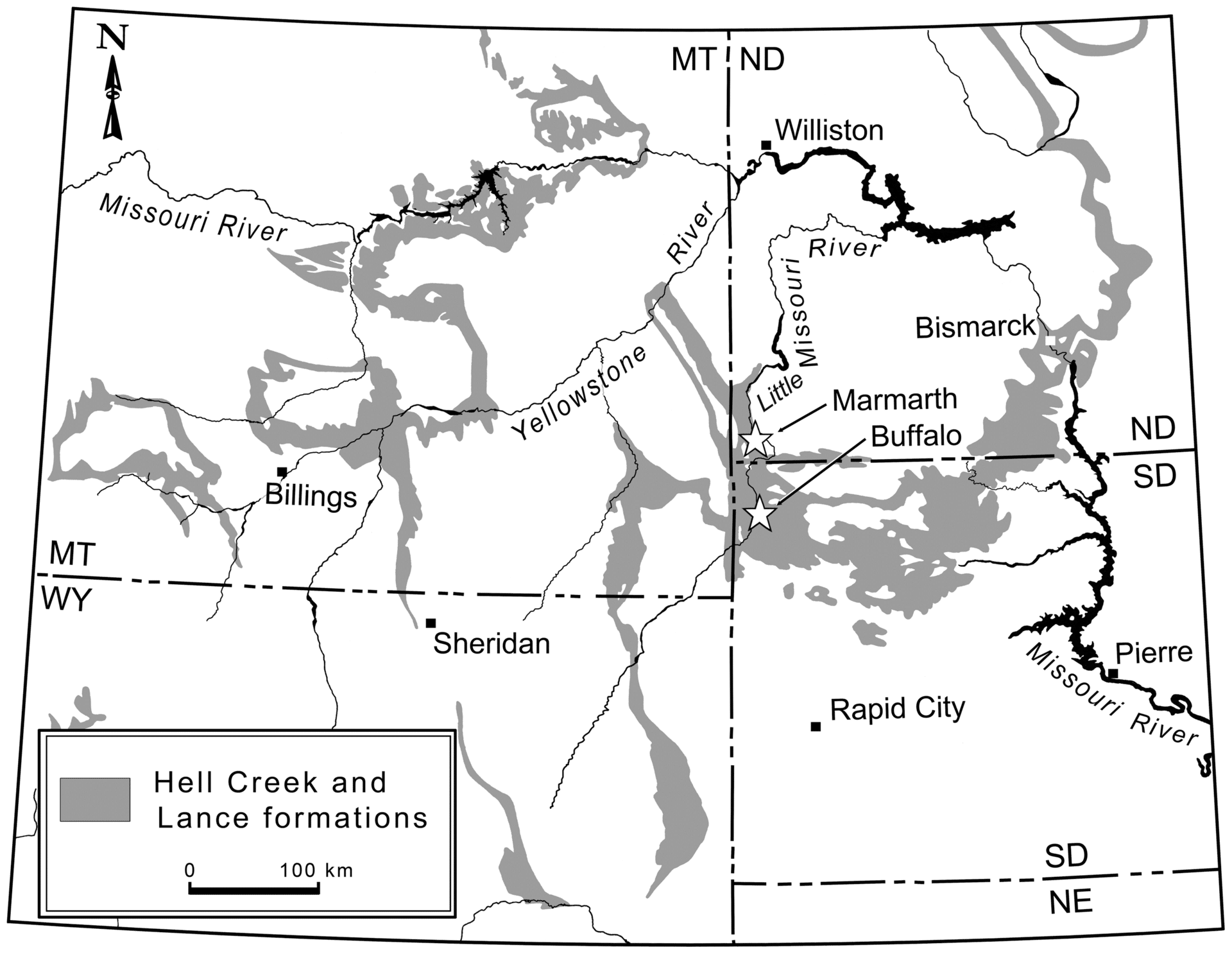

Scott Haire found a third partial skeleton, MRF 319, in the upper third of the formation near Marmarth, North Dakota. It lay in a river-channel sandstone about 5 km (3 miles) northwest of town, alongside gar scales and a water-worn ornithischian bone. This specimen preserves neck vertebrae, a rib, a shoulder blade, and forearm bones. A short 2006 report first presented it as a new specimen of Chirostenotes. Today the Marmarth Research Foundation keeps it, while two other museums were to receive casts. A lone lower-jaw piece at the Field Museum, FMNH PR 2296, comes from Harding County.
Anzu Size and Description
Three skeletons let scientists describe Anzu almost from snout to tail tip.
Short description of Anzu
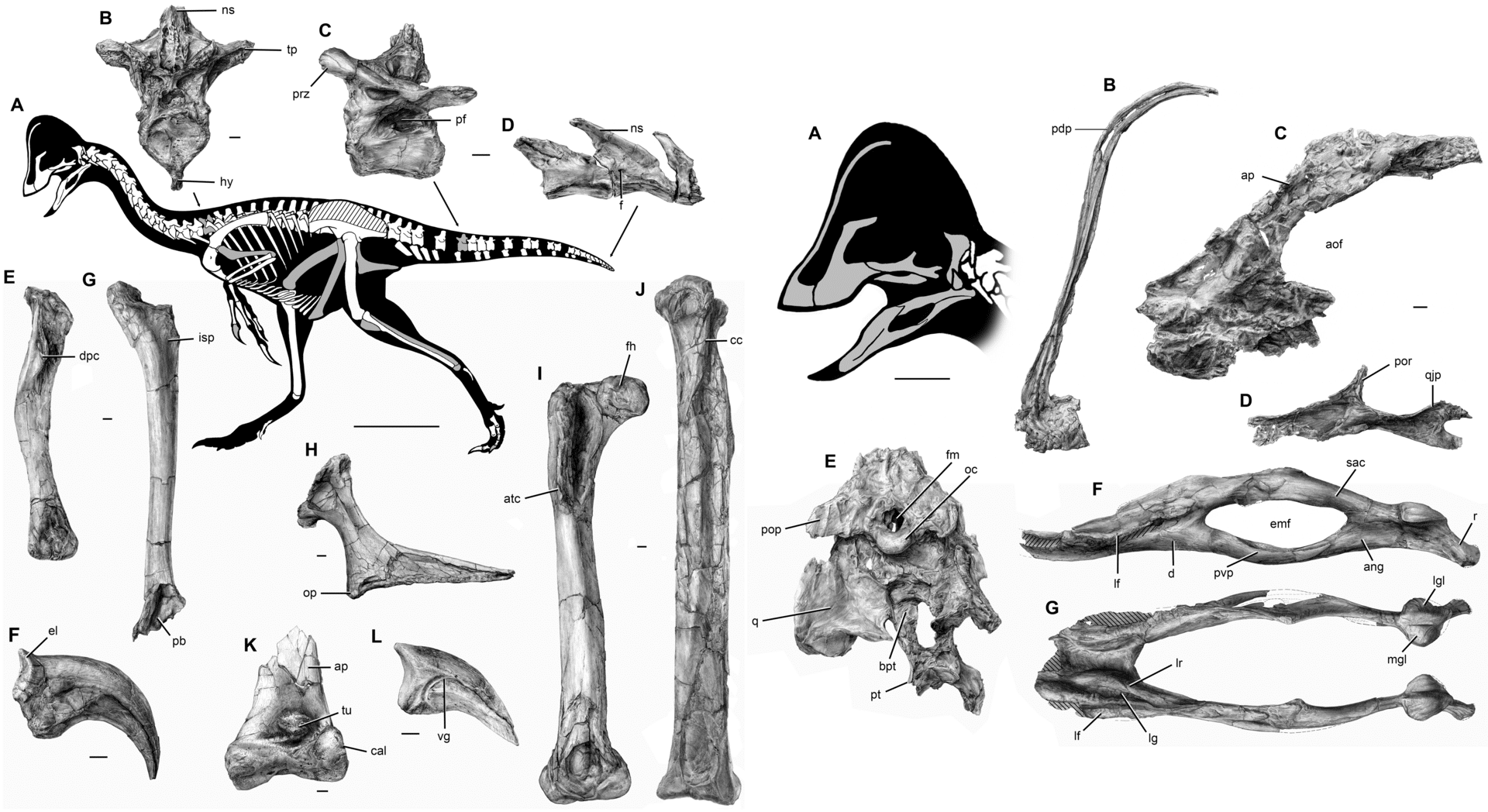
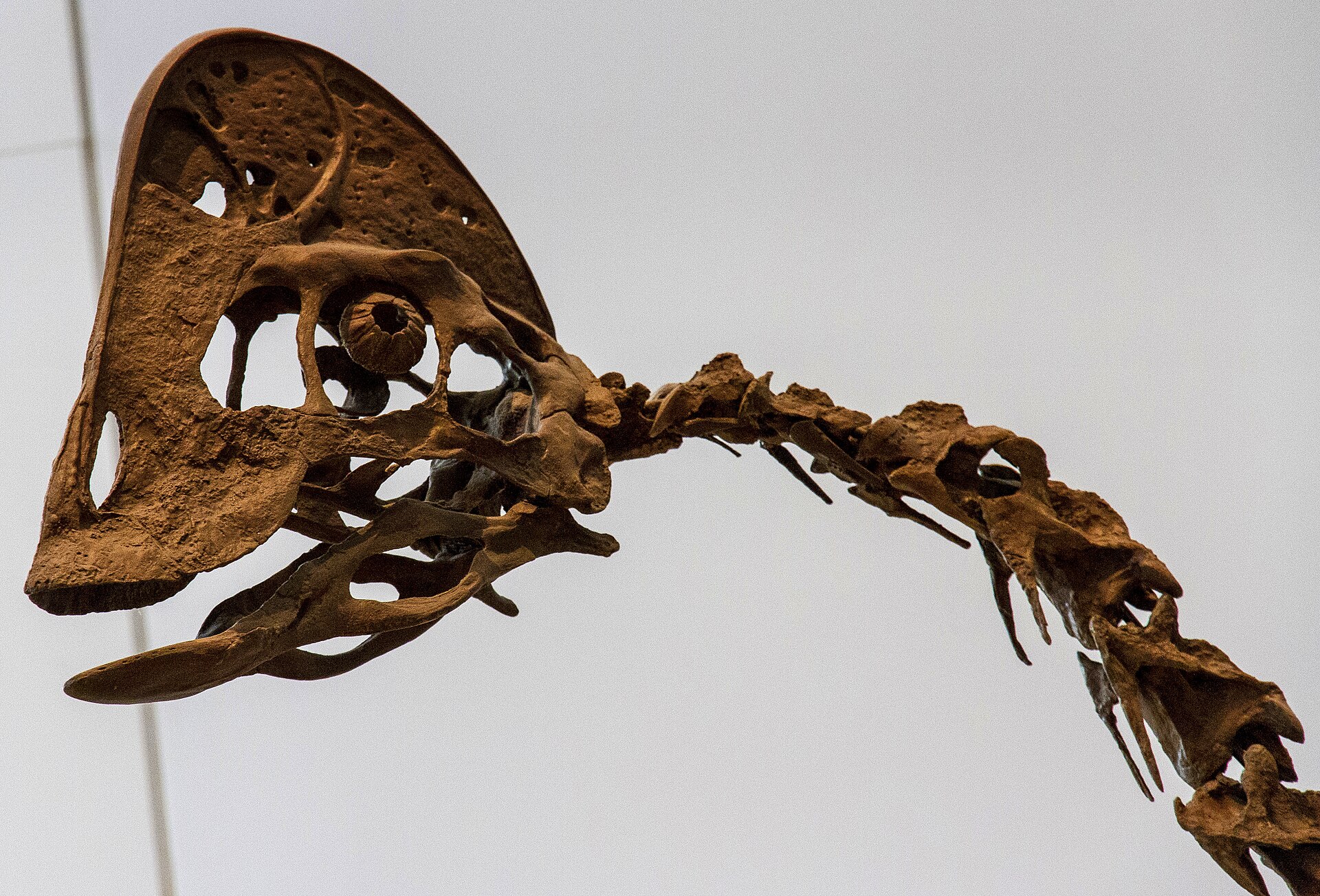
The skull was deep and narrow, crowned by a very tall, crescent-shaped crest formed by the premaxillae, which its describers likened to that of a cassowary. None of the jaw bones carried teeth, and instead the fused lower jaws bore a complex array of ridges and grooves. Behind the head, a long neck of 12 cervical (neck) vertebrae was also wide across its fused cervical ribs, especially toward the back. Ten dorsal (back) vertebrae and a sacrum, or hip section, of six vertebrae followed.
Air spaces riddled the tail, which ended in a pygostyle-like set of highly modified but unfused vertebrae. Up front, the arms ended in proportionally large hands whose claws bore prominent lips on their upper edge. By contrast, the hind limbs were gracile, or slender, with a tibia about 1.25 times the length of the femur. Feathers are not preserved, so any depiction of its plumage is speculative. Still, the describers noted that most if not all oviraptorosaurs had feathers.

Size and Weight of Type Species
Lamanna and colleagues reconstructed Anzu at about 11.5 feet (3.5 meters) long, standing roughly 4.9 feet (1.5 meters) at the hips. Both figures come from their skeletal reconstruction, not from one complete skeleton. By direct measurement, however, the holotype’s femur is 525 millimeters (20.7 inches) long and its tibia 660 millimeters (26 inches).
For weight, the team used two bone-scaling equations—thigh-bone circumference gave 193 kilograms, while thigh-bone length gave 299.5. They concluded that the holotype probably weighed about 440 to 660 pounds (200 to 300 kilograms). In 2024, Atkins-Weltman and colleagues applied a different method and arrived at 445 to 754 pounds (202 to 342 kilograms).
According to the original study, only its probable relative Gigantoraptor was larger among oviraptorosaurs. In 2024, Atkins-Weltman and colleagues still ranked Anzu among the largest North American caenagnathids. Size may also have varied with age. In 2021, Cullen and colleagues reported that a probable Anzu skeleton from Montana was still growing when it died.
The Dinosaur in Detail
What sets this dinosaur apart is an unusual mix of skull traits. Lamanna’s team listed 11 autapomorphies—features unique to Anzu—including the tall crest and an inverted-L-shaped rising branch on the maxilla. Its maxilla also lacks an antorbital fossa (a hollow in front of the eye opening), and an elongated retroarticular process juts backward behind the jaw joint. Yet its jugal, or cheekbone, is deep and split at the back—more like that of theropods outside Oviraptorosauria. Among the related oviraptorids, only Rinchenia has a crest resembling it.

The lower jaw also bears a sideways flange on the dentary (the main lower jaw bone), a trait Anzu shares with Gigantoraptor. According to the describers, this makes caenagnathid jaws resemble those of dicynodonts—an unrelated group—even more than once thought. Similarly, the humerus, or upper arm bone, bows outward as in Gigantoraptor. Elsewhere in the limbs, the radius ends in two rounded processes, and the astragalus (an ankle bone) carries a small tubercle.
The bones also record injuries. A toe bone of the holotype shows a bony outgrowth and possible arthritic cysts, which the authors linked to trauma such as a torn tendon. Meanwhile, a rib of MRF 319 carries a callus, suggesting that it broke and later healed.
For years, however, it was unclear whether smaller Hell Creek caenagnathids were juvenile Anzu or distinct animals. Then, in 2024, Atkins-Weltman and colleagues concluded that one of them, CM 96523, is a separate, smaller species named Eoneophron infernalis. They suggested the formation may have held three caenagnathid species, and they still treated Anzu as valid. Taken together, Anzu remains one of the most completely known caenagnathids, even as its Hell Creek relatives multiply.
Interesting Points about Anzu
- Its genus name honors a feathered demon of Sumerian and Akkadian myth, a nod to the animal’s presumed plumage.
- Debris and tiny shells between one skeleton’s ribs and hips might be gut contents, though river contamination is a likely alternative.
- Its cervical ribs were fused to their vertebrae, a trait the describers also noted in Avimimus and the oviraptorid Heyuannia.
- Unlike oviraptorids from arid settings, most caenagnathids come from river sediments laid down under wetter conditions.
Contemporary Dinosaurs
Towering over this landscape was Tyrannosaurus, known from the latest Maastrichtian rocks of the same formation. In 2011, Lyson and Longrich called it the sole large carnivore of its ecosystem—four years before the giant raptor Dakotaraptor was named. No direct evidence links the two animals.
More common still was Triceratops, a ceratopsid that made up 40 percent of a 2011 census of large-bodied Hell Creek dinosaurs in Montana. Lyson and Longrich also found ceratopsian fossils most often in floodplain mudstones—the same kind of rock that held the Carnegie Anzu skeletons. Still, that reflects where bones were buried, not any recorded interaction.
Adding further diversity was Edmontosaurus, a hadrosaurid herbivore from the same formation. Both 2011 studies include it in the Hell Creek fauna, which Lyson and Longrich placed in the latest Maastrichtian. Even so, no fossil links it directly to Anzu.
Closest of all in place was Dakotaraptor itself, a giant dromaeosaurid reconstructed at about 18 feet (5.5 meters) long. Its type material is mixed, though—in 2016, Arbour and colleagues showed its supposed wishbones were shell bones of a soft-shelled turtle. Its fossils come from the upper Hell Creek Formation of Harding County—home of the Anzu holotype—no more than 20 meters below the Cretaceous–Paleogene boundary. Even so, the relative levels of the two finds are unknown, and nothing records them crossing paths.
Anzu in its Natural Habitat
The world Anzu roamed was a humid coastal plain in western North America. These rocks built up as a spreading wedge of sediment while the Western Interior Seaway retreated. Meandering rivers crossed floodplains dotted with ponds, swamps, and peat swamps that supported a rich megaflora. The holotype lay in greenish-gray mudstone from a quiet floodplain, while CM 78001 came from beside a swampy area marked by an overlying coal seam.
Lamanna and colleagues proposed that Anzu and other derived caenagnathids may well have been ecological generalists that fed on vegetation, small animals, and perhaps eggs. Their jaw joint points to fore-and-aft motion, which could have helped slice plant fodder. Similarly, Lyson and Longrich listed caenagnathids among this landscape’s herbivores. In a 2024 popular article, two Eoneophron authors called Anzu‘s diet debated but still judged it a likely omnivore.
While there is no direct evidence of how Anzu spent its days, its describers raised the possibility that Hell Creek caenagnathids favored floodplains over river margins. That pattern, however, could instead reflect how bones were preserved. Tracks called Saurexallopus could conceivably have been made by Anzu or its close relatives. Since some of those tracks lead into shallow water, they fit the older idea of a wading animal. More recently, Atkins-Weltman and colleagues suggested that differing body sizes helped several caenagnathids coexist.
Frequently Asked Questions
It refers to Anzu, a feathered demon of Mesopotamian myth, while the species name wyliei honors Wylie J. Tuttle.
It lived in the late Maastrichtian stage of the Late Cretaceous, about 68 to 66 million years ago according to a 2014 Smithsonian release.
It reached about 11.5 feet long and 4.9 feet tall at the hips, and probably weighed about 440 to 660 pounds.
Its describers suggested it was probably an omnivore that ate vegetation, small animals, and perhaps eggs.
Its named specimens come from the Hell Creek Formation of Harding County, South Dakota, and Slope County, North Dakota, with probable Anzu bones from Montana.
It gave scientists their first nearly complete look at a caenagnathid skeleton, topped by a tall, cassowary-like crest.
Sources
The information in this article is based on various sources, drawing on scientific research, fossil evidence, and expert analysis. The aim is to provide a comprehensive and accurate overview of Anzu. However, please be aware that our understanding of dinosaurs and their world is constantly evolving as new discoveries are made.
- https://doi.org/10.1371/journal.pone.0092022
- https://journals.plos.org/plosone/article/file?type=supplementary&id=10.1371/journal.pone.0092022.s001
- https://doi.org/10.1371/journal.pone.0125843
- https://doi.org/10.1371/journal.pone.0294901
- https://doi.org/10.1002/spp2.1302
- https://pmc.ncbi.nlm.nih.gov/articles/PMC3049066/
- https://doi.org/10.1371/journal.pone.0016574
- https://journals.ku.edu/paleocontributions/article/download/20303/18292/54389
- https://escholarship.org/uc/item/1m04m6bz
- https://archive.unews.utah.edu/news_releases/a-chicken-from-hell-dinosaur/
- https://daily.jstor.org/a-fresh-hell-chicken
- https://doi.org/10.7717/peerj.1691
This article was last fact checked: TheDinosaurs Team, 02-11-2026
Featured Image Credit: Tadek Kurpaski, CC BY 2.0, via Wikimedia Commons
