
Near the village of Cerro Cóndor in Chubut Province, Patagonia, lie the lake-laid rocks of the Cañadón Asfalto Formation. They hold one of the oldest and most complete tetanuran skeletons from before the Late Jurassic. Tetanurans form a major branch of the theropod family tree, and this one is Asfaltovenator vialidadi. Paleontologists Oliver Rauhut and Diego Pol named it in 2019, describing a large theropod comparable in size to Allosaurus. Its describers placed it in the late Toarcian to Bajocian stages—roughly 176 to 170 million years ago, astride the boundary between the Early and Middle Jurassic.
According to the 2019 paper, Leandro Canesa found the specimen during fieldwork in 2002. News reports, spelling it Canessa, call him a museum technician. Once freed from the rock, its skull proved to mix features of two great theropod lineages—and adding it to a large analysis reshuffled their family tree. The find offers a rare glimpse of the tangled early radiation of tetanurans, when convergent features made the main lineages hard to tell apart.
Asfaltovenator Key Facts
| Keyword | Fact |
|---|---|
| Pronunciation | Not specified |
| Meaning of name | Cañadón Asfalto Hunter |
| Group | Theropoda |
| Type Species | Asfaltovenator vialidadi |
| Diet | Carnivore (inferred, described as a large predator in 2019 news coverage) |
| When it Lived | About 176 to 170 MYA (2019 estimate), though a 2025 study treats its beds as Toarcian, bracketed by dates of about 179 to 178 MYA |
| Period | Jurassic |
| Epoch | Early–Middle Jurassic (late Toarcian to Bajocian stages) |
| Length | About 23 to 26 feet (7 to 8 meters) |
| Height | Not specified |
| Weight | Not specified |
| Mobility | Moved on two legs (bipedal), inferred from its group |
| First Discovery | 2002 by Leandro Canesa (Canessa in news reports), a technician at the Museo Paleontológico Egidio Feruglio |
| Described by | 2019 by O.W.M. Rauhut and D. Pol |
| Holotype | MPEF PV 3440 (also written MPEF-PV 3440) |
| Location of first find | About 1.6 km (1 mile) northeast of Cerro Cóndor village, Cañadón Asfalto Formation, Chubut Province, Argentina |
Asfaltovenator Origins, Taxonomy and Timeline
The name Asfaltovenator joins the Cañadón Asfalto Formation, where the skeleton lay, with the Latin venator, meaning “hunter.” The species name vialidadi honors Chubut’s Administración de Vialidad Provincial and the Dirección Nacional de Vialidad for their help with the museum’s expeditions. That honor has a practical edge—news reports say the provincial agency built the crane’s access road to the fossil. Together, the name ties the animal to its rock and to the people who freed it.
Within Theropoda, Asfaltovenator belongs to Tetanurae. Rauhut and Pol called it a probable basal, or early-branching, member of Allosauroidea—the lineage that includes Allosaurus—and likely the group’s oldest known representative. Later analyses, however, have shifted it around inside Allosauroidea. In 2024, Rauhut and colleagues described Kyrgyzstan’s Alpkarakush and reran the tree. Under one weighting method, Asfaltovenator came out as an allosaurid and the sister taxon of Allosaurus, though under another its position stayed unresolved. Kellermann and colleagues found the same pairing in 2025, though not in every analysis. Asfaltovenator vialidadi remains the type and only known species.
The 2019 paper assigned the bones to the late Toarcian to Bajocian, roughly 176 to 170 million years ago. Its title calls the rocks early Middle Jurassic. That age followed a 2013 study dating the dinosaur beds near Cerro Cóndor as Aalenian to probably Bajocian, along with a 2015 study by Figari and colleagues. Since then, studies in 2020 and 2025 placed the formation’s upper levels at about 178.8 to 178.1 million years ago, within the Toarcian. Neither study dated the Asfaltovenator site directly. Still, in 2025, Pradelli and colleagues—Pol among them—treated the beds of Asfaltovenator, Condorraptor, and Piatnitzkysaurus as bracketed by Toarcian dates. That would make it late Early Jurassic rather than early Middle Jurassic, so its exact age remains debated.
Discovery & Fossil Evidence
Canesa told reporters he spotted loose vertebrae at the bottom of a canyon and traced them to a layer with more still in the rock. Excavation began in 2005, but Pol recalled that the fossil only came out in 2007. First, the provincial road agency built a road to the site, 1,500 meters (about 4,900 feet) from the highway, so a crane could reach it. A museum staff member told the press of four years of field campaigns and a 40-metric-ton crane. The field jacket—a protective cast around the block—weighed about 5 metric tons, the largest the museum had ever made. Afterward, the extremely hard rock took five years to prepare.
The holotype, MPEF PV 3440, resides at the Museo Paleontológico Egidio Feruglio in Trelew. It comprises an almost complete skull, rebuilt from separated cranial bones, and a partial skeleton. The skeleton preserves 10 cervical (neck) and 13 dorsal (back) vertebrae, cervical ribs, both scapulocoracoids (shoulder blades), and both complete forelimbs, including carpals (wrist bones). Less survives behind—the first sacral (hip) vertebra, fused to the last dorsal, and the lower ends of the pubes. The lower two-thirds of the right femur (thigh bone) and the upper ends of the tibia and fibula also survive. A poorly preserved right foot completes the list. Pol told reporters it was about half the skeleton—the whole front half.
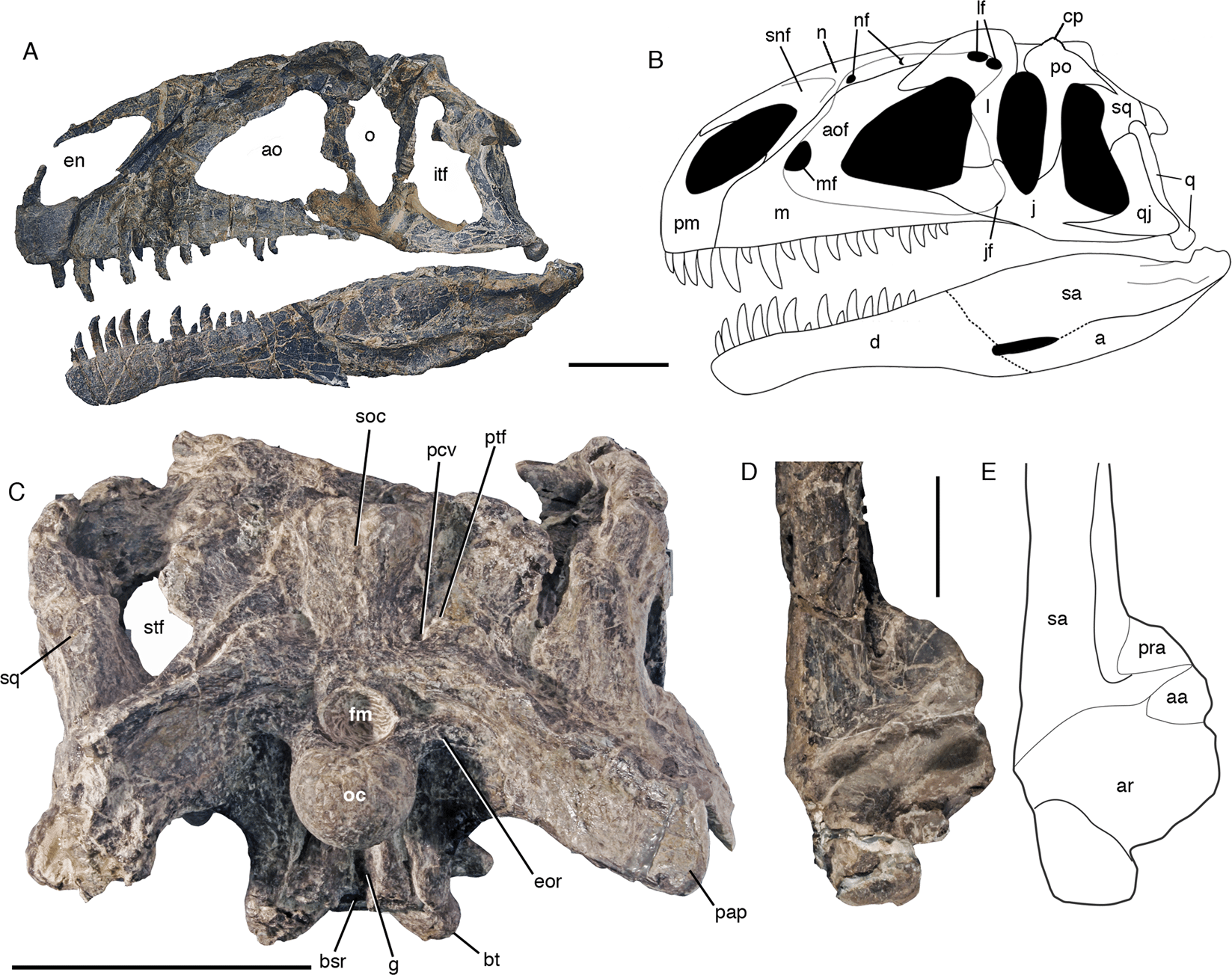

The 2019 supplement lists Asfaltovenator as the fourth medium-to-large theropod and third basal tetanuran described from the formation. The authors separate it from Piatnitzkysaurus by many characters. For example, it has 13 rather than 18 teeth in the maxilla, the main upper tooth-bearing bone. They also distinguish it from Condorraptor, and later analyses have kept it as a separate genus.
Asfaltovenator Size and Description
Asfaltovenator was a large theropod built around a deep head and a short, sturdy forearm.
Short description of Asfaltovenator
The skull was high and slightly arched, similar to those of other allosauroids. At the front, each premaxilla (snout-tip bone) carried four teeth, the first considerably smaller than the rest. Behind them, the maxilla held 13 teeth, while each dentary, or lower jaw bone, held 14 and had a slightly expanded front end. Raised edges of the nasal bones formed a crest running onto the lacrimal, a bone before the eye—much as in Allosaurus. The lacrimal also bore a moderate horn, while the T-shaped postorbital formed a robust brow with a small triangular hornlet.
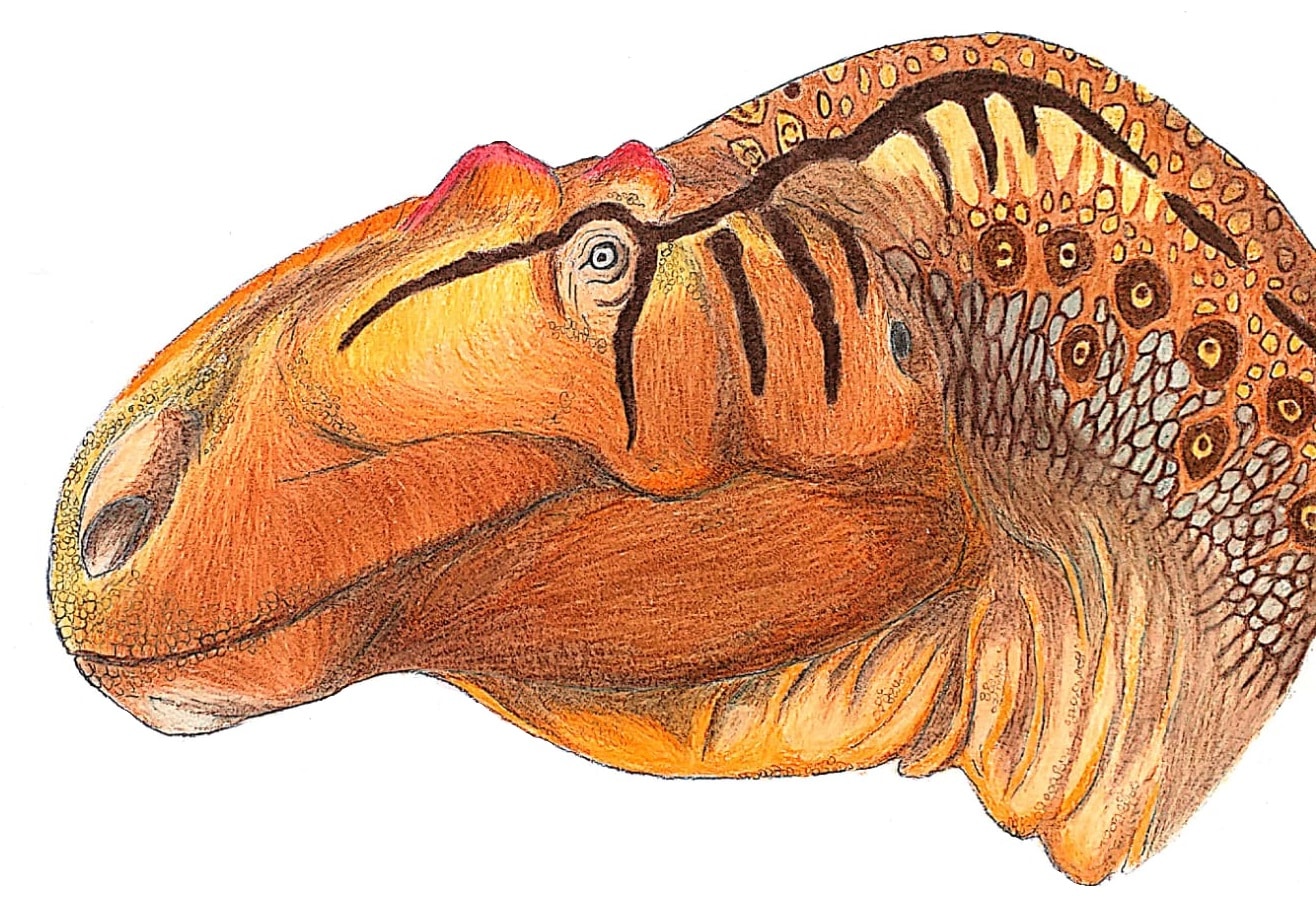

The neck vertebrae were short and stout, flat in front and concave behind. Farther back, the dorsal vertebrae had spool-shaped bodies without pleurocoels—the air-sac openings seen in many theropods. Its humerus (upper arm bone) was robust and almost straight, and a radius only about 60 percent as long made the forearm short and sturdy. Each hand had three fingers, no trace of a fourth metacarpal (palm bone), and a palm broader than long. The first finger was the most robust, while the third was more slender and shorter. No tail vertebrae are known, so the tail’s length is unknown.
Like other tetanurans, it presumably walked on two legs, although its poorly known hind limbs add little direct evidence. No skin impressions are reported, so any discussion of its outer covering is speculative.
Size and Weight of Type Species
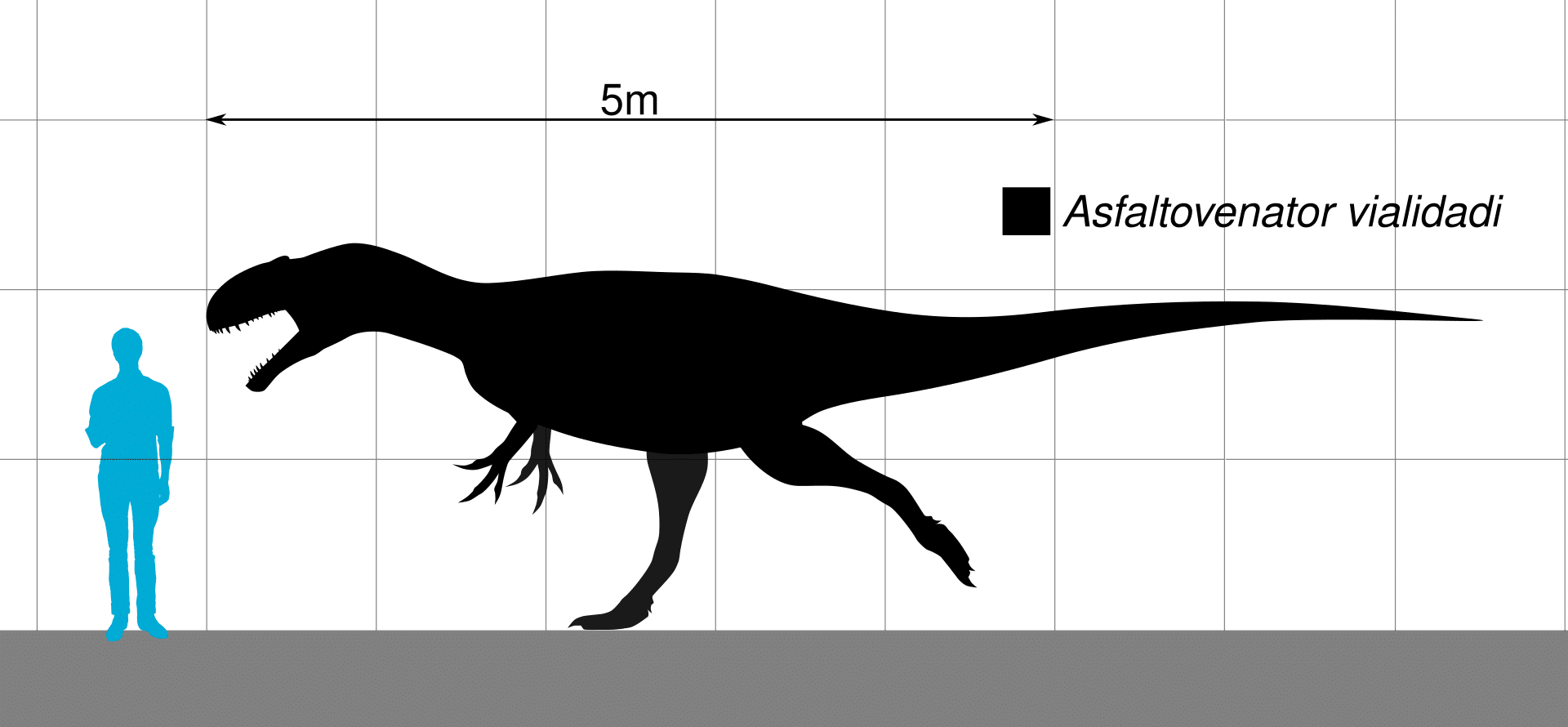
Rauhut and Pol estimated the holotype’s body length at 23 to 26 feet (7 to 8 meters). The paper does not explain that figure, however, so it is best read as an indirect estimate. With little of the hind half preserved, any whole-body figure leans on comparison with relatives. Its describers judged it comparable in size to the well-known Allosaurus. The university press release described the animal as “up to 8 meters long.” One regional report, however, quoted Pol giving a smaller figure of about 20 feet (6 meters).
By comparison, the skull is far better known, at 29.5 to 31.5 inches (75 to 80 centimeters) long. The press release gave 80 centimeters, the top of that range.
Its scientific description gives no estimate of its weight or its height at the hips.

The Dinosaur in Detail
What sets this dinosaur apart is a skull that mixes features once thought to belong to separate lineages. Rauhut and Pol found traits linked to Megalosauroidea, the lineage named for Megalosaurus, alongside supposed hallmarks of Allosauroidea and some primitive features. For instance, the kinked front edge of the maxilla’s rising process resembles that of many megalosaurids. A process on the ectopterygoid, a palate bone, likewise recalls Dubreuillosaurus. In contrast, a stout triangular antarticular bone in the lower jaw had counted as a unique novelty of Allosaurus until this find.
The describers also listed autapomorphies—traits unique to the genus. Its premaxillary teeth had well-developed rear serrations but only minute front ones. Pronounced horizontal ridges crossed the exoccipital, a rear skull bone, beside the opening for the spinal cord. On the neck, the spines of the third and fourth vertebrae were triangular and swept backward. Notably, the third resembles a proposed unique trait of Afrovenator.
This mix had consequences for the family tree. In an analysis of 66 taxa and 355 characters, allosauroids and megalosauroids formed a clade called Carnosauria, as they also did without the new animal. Adding Asfaltovenator, however, broke up the traditional Megalosauroidea. Spinosaurids, megalosaurids, and piatnitzkysaurids instead lined up as successive side branches leading to Allosauroidea. In a pruned summary of 95,142 equally short trees, it sat as sister to a clade of Metriacanthosauridae and Allosauria. Still, the authors cautioned that a traditional Megalosauroidea costs only two extra steps. They also found that homoplasy—similar features evolving independently—clusters at the base of Tetanurae and peaks around the Pliensbachian–Toarcian extinction event. Relaxed selection after the Toarcian Anoxic Event, they suggested, might explain the pattern. Taken together, Asfaltovenator reads as a mosaic of primitive and derived traits—a reminder of how hard the earliest tetanurans are to sort.
Interesting Points about Asfaltovenator
- Its species name honors two Argentine road agencies, one of which reportedly built the road that let a crane lift the fossil out.
- Its 5-metric-ton field jacket was reportedly the largest the museum had ever made.
- A triangular antarticular bone in its lower jaw had been considered unique to Allosaurus before Rauhut and Pol reported one here.
- Its 2019 describers called it the most complete skeleton known from early tetanuran history.
- The data matrix behind its 2019 family tree is deposited on MorphoBank, an online data archive, as project 3267.
Dinosaurs from the Same Formation
Also known from the Cañadón Asfalto Formation (exact level relative to Asfaltovenator not known): the theropods Piatnitzkysaurus, Condorraptor and Eoabelisaurus, and the eusauropods (advanced long-necked sauropods) Patagosaurus and Volkheimeria. Ash layers in the formation have been dated to between about 179.5 and 176.2 million years ago, and not every fossil site has been dated, so these animals may not all have lived at the same time.
Asfaltovenator in its Natural Habitat
The world Asfaltovenator inhabited was a basin of rivers, lakes, and volcanic ash beds. Its skeleton came from lacustrine layers—sediments laid down in lakes. In 2013, Cúneo and colleagues reported that river and lake systems returned around 179 million years ago, after an earlier phase of volcanism. In 2021, Fantasia and colleagues tied the Cerro Cóndor paleolakes to Chon Aike volcanism. Ash beds there date to about 179.5 to 177.3 million years ago. Conifers of the Araucariaceae, Cheirolepidiaceae, and Cupressaceae families, with small scaly leaves, grew in the region during the mid-Toarcian. In the formation’s middle and upper parts, preliminary 2013 observations found abundant conifer wood alongside conifers, seed ferns, and cycads. Classopollis pollen from cheirolepidiaceous conifers dominated there.
While the 2019 description does not discuss its diet, its size and theropod build suggest a meat-eater. Pol has also said that everything indicates it was the largest predator of its time in the region. However, the paper says nothing about its behavior, so how it hunted remains an open question.
Several other named dinosaurs come from the formation, though none has been tied to the exact level of Asfaltovenator. Lower levels hold the sauropod Bagualia, and beds at or near the base of the formation hold the heterodontosaurid Manidens. The upper levels with Piatnitzkysaurus and Patagosaurus are Toarcian in age. A 2025 study places the Asfaltovenator beds in the same bracket, although no date comes from its site itself. Still, Asfaltovenator ranks with Condorraptor and Piatnitzkysaurus among the oldest known tetanurans—all from this one Patagonian formation.
Frequently Asked Questions
It means “Cañadón Asfalto hunter,” and vialidadi honors two Argentine road agencies that aided the museum’s expeditions.
Its describers estimated 176 to 170 million years ago. A 2025 study instead treats its beds as Toarcian, bracketed by dates of about 179 to 178 million years ago.
It reached an estimated 23 to 26 feet in length, with a skull 29.5 to 31.5 inches long. No weight estimate appears in its scientific description.
It was most likely a carnivore, and Diego Pol has said everything indicates it was the region’s largest predator of its time.
Its fossils come from the Cañadón Asfalto Formation, about 1 mile northeast of Cerro Cóndor in Chubut Province, Argentina.
Its skull combines megalosauroid and allosauroid traits, including a lower jaw bone once thought unique to Allosaurus.
Sources
The information in this article is based on various sources, drawing on scientific research, fossil evidence, and expert analysis. The aim is to provide a comprehensive and accurate overview of Asfaltovenator. However, please be aware that our understanding of dinosaurs and their world is constantly evolving as new discoveries are made.
- https://www.nature.com/articles/s41598-019-53672-7
- https://pmc.ncbi.nlm.nih.gov/articles/PMC6906444/
- https://static-content.springer.com/esm/art%3A10.1038%2Fs41598-019-53672-7/MediaObjects/41598_2019_53672_MOESM1_ESM.docx
- https://staff.mef.org.ar/images/investigadores/diego_pol/papers/63.pdf
- https://staff.mef.org.ar/images/investigadores/diego_pol/papers/109.pdf
- https://journals.plos.org/plosone/article?id=10.1371/journal.pone.0311096
- https://academic.oup.com/zoolinnean/article/201/4/zlae090/7736730
- https://academic.oup.com/zoolinnean/article/203/1/zlae176/7979031
- https://collaborate.princeton.edu/en/publications/late-toarcian-continental-palaeoenvironmental-conditions-an-examp/
- https://www.sciencedaily.com/releases/2019/12/191211145711.htm
- https://www.diariojornada.com.ar/261290/magazine/dinosaurios_un_nuevo_hallazgo_en_chubut_da_claves_sobre_la_evolucion_de_los_teropodos
- https://www.lostiempos.com/node/480755
- https://link.springer.com/article/10.1007/s00114-011-0780-5
This article was last fact checked: TheDinosaurs Team, 13-11-2026
Featured Image Credit: GusTrex, CC BY-SA 4.0, via Wikimedia Commons
