
High on the slopes of Mt. Kirkpatrick in Antarctica’s Central Transantarctic Mountains, the ash-rich rocks of the Hanson Formation yielded the first non-avian dinosaur formally named from the continent. Named Cryolophosaurus ellioti in 1994, this crested theropod lived during the Early Jurassic—probably within the Sinemurian to Pliensbachian stages. Its quarry lies at about 13,450 feet (4,100 meters), roughly 400 miles (650 kilometers) from the South Pole. In 2007, paleontologist Nathan Smith and colleagues called it “the largest known Early Jurassic theropod.” Since then, however, the describers of Italy’s Saltriovenator have claimed that title for their 25-foot (7.5-meter) animal.
Geologist David Elliot of Ohio State University found the first bones during the austral summer of 1990–91. A team led by paleontologist William Hammer of Augustana College then excavated them. Hammer and William J. Hickerson described the animal in Science in 1994. Its crest runs across the skull rather than along it—a design later judged unique among theropods. Its describers also saw the fauna as a sign that “a mild climate existed at high paleolatitude.”
Cryolophosaurus Key Facts
| Keyword | Fact |
|---|---|
| Pronunciation | cry-o-loaf-oh-sore-us |
| Meaning of name | Frozen Crested Lizard |
| Group | Theropoda |
| Type Species | Cryolophosaurus ellioti |
| Diet | Carnivore |
| When it Lived | 199.5 to 184.2 MYA |
| Period | Jurassic |
| Epoch | Early Jurassic (Sinemurian to Pliensbachian stages) |
| Length | Between 18 and 21 feet (5.5 and 6.5 meters) |
| Height | Not specified |
| Weight | About 1,025 pounds (465 kilograms) |
| Mobility | Not specified |
| First Discovery | 1990 to 1991 by David Elliot |
| Described by | 1994 by W.R. Hammer and W.J. Hickerson |
| Holotype | FMNH PR1821 |
| Location of first find | Lower Hanson Formation (called the Falla Formation in 1994), Mt. Kirkpatrick, Beardmore Glacier region, Central Transantarctic Mountains, Antarctica |
Cryolophosaurus Origins, Taxonomy and Timeline
London’s Natural History Museum translates Cryolophosaurus as “frozen crested lizard.” The US Antarctic Program gives “frozen crest lizard,” while an Ohio State University education page offers “cold crest lizard.” Meanwhile, the species name ellioti honors David Elliot, the geologist who found the first bones. Together, the name ties the animal to the coldest continent and to its finder.
Cryolophosaurus is a theropod—part of the mostly meat-eating dinosaur lineage—within Saurischia, one of the two great branches of the dinosaur family tree. Hammer and Hickerson saw “some resemblance to the large tetanurans of the Middle to Late Jurassic”—the group that includes Allosaurus and birds. However, they also noted “primitive ceratosaurian features.” At the time, Ceratosauria grouped Ceratosaurus with Coelophysis and Dilophosaurus. Cryolophosaurus ellioti is the type and only known species.
According to Elliot and colleagues in 2007, the describers assigned the dinosaur a Sinemurian to Pliensbachian age. The Paleobiology Database brackets those stages at roughly 199.5 to 184.2 million years ago—stage boundaries rather than a direct date on the bones. Volcanic Ferrar rocks above the Hanson Formation, dated to 183.6 ± 1.8 million years, cap its age. Even so, Elliot’s team cautioned that “the age of the Hanson Fm is not well constrained.” Since then, Barrett and colleagues in 2026, citing a 2017 study of the formation’s dated ash beds by Elliot’s team, have placed it in the late Sinemurian to late Pliensbachian.
Discovery & Fossil Evidence
The quarry sits near the base of the Hanson Formation on Mt. Kirkpatrick, in the Beardmore Glacier region. Hammer and Hickerson reported the bones from the Falla Formation. In 1996, however, Elliot split off the ash-rich Hanson Formation, so the site now falls low in the Hanson. By 2007, the quarry had been worked over two field seasons, in 1990–91 and 2003–04. Hammer then returned to the Beardmore region in 2010–11 with his largest team yet.
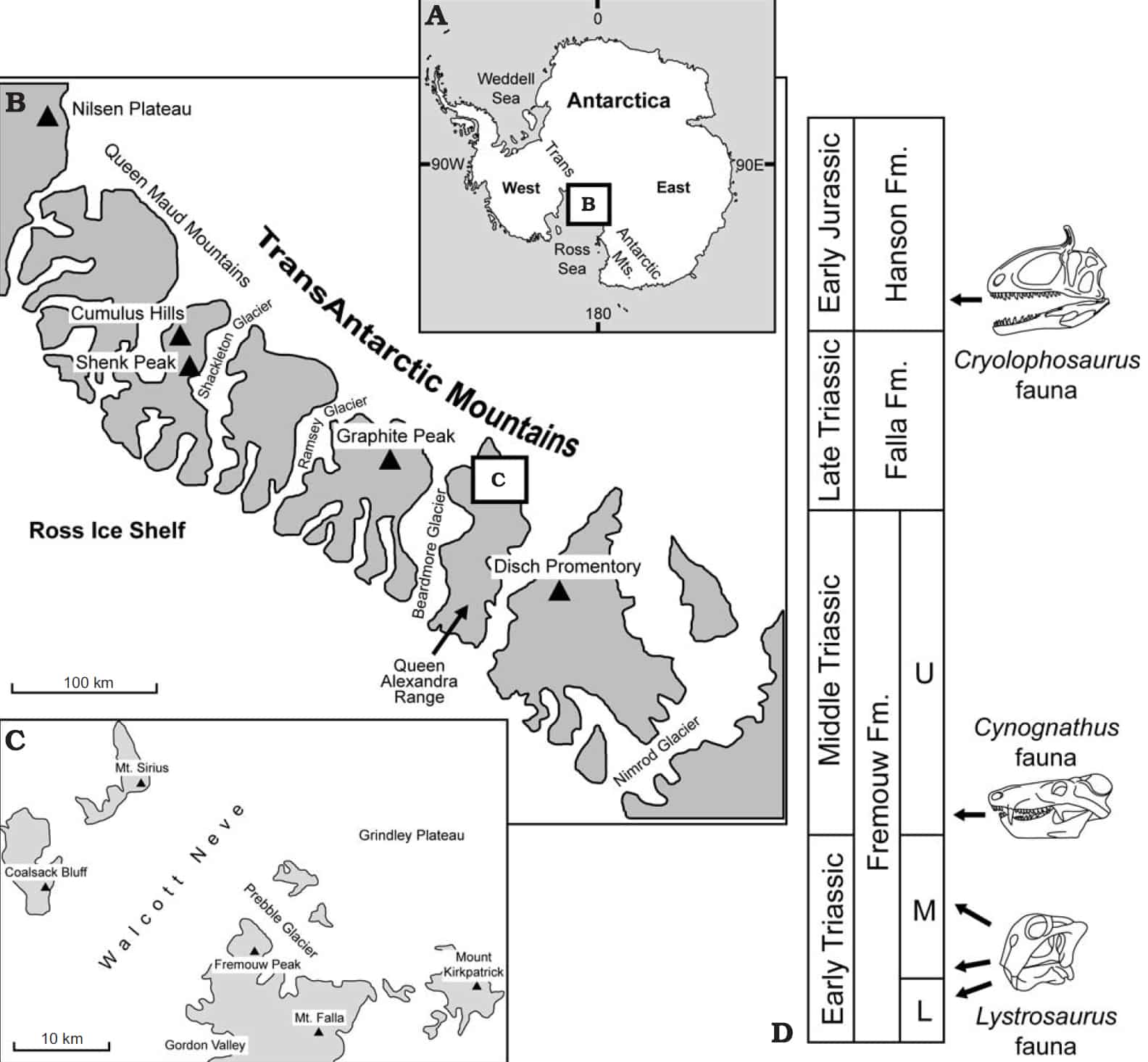

The holotype, FMNH PR1821, is housed at the Field Museum of Natural History in Chicago. The 1994 abstract lists “a partial skull and postcranial elements”—bones from behind the head. Studies published in 2007 discuss bones from much of the body, including the skull, neck vertebrae, hips, femur (thigh bone), and ankle. Several skull bones also turned up nearby as float, or loose pieces weathering out of the slope. The specimen preserves both right and left elements, although sources describe its completeness differently.
One early puzzle concerned the neck. According to Smith and Pol, the 1994 paper cautiously suggested that some rear neck vertebrae might belong to a sauropodomorph, a long-necked plant-eater. Later study, helped by more vertebrae collected in 2003–04, showed the bones belong to Cryolophosaurus itself. Meanwhile, a full-size replica skeleton stands at Ohio State University’s Orton Geological Museum. No Cryolophosaurus specimens from outside this one quarry are reported in the sources consulted.
Cryolophosaurus Size and Description
Many of this animal’s specialized features sit in the skull.
Short description of Cryolophosaurus
The skull’s centerpiece is a tall, furrowed crest that runs crosswise over the head. Smith and colleagues found it built mainly from the lacrimals—paired bones at the front of the eye sockets. Their upper ends expand and pinch the nasal bones between them. Farther back, the squamosal and jugal bones sharply constrict the infratemporal fenestra, an opening behind the eye. Crushing may exaggerate this, the authors noted. In addition, the antorbital fossa, a hollow around the large opening ahead of the eye, extends onto the nasal bone.
The neck is distinctive too. Its cervical ribs carried “extremely elongate” forward processes, and the rear neck vertebrae bear deep, low, elongate hollows unknown in other theropods. Beyond these features, however, much of the skeleton is conservative. Amphicoelous (concave at both ends) neck vertebrae, an S-curved femur, and a low triangular ankle process all retain ancestral theropod traits.
No study consulted describes skin, so any talk of feathers or crest color is speculative.

Size and Weight of Type Species
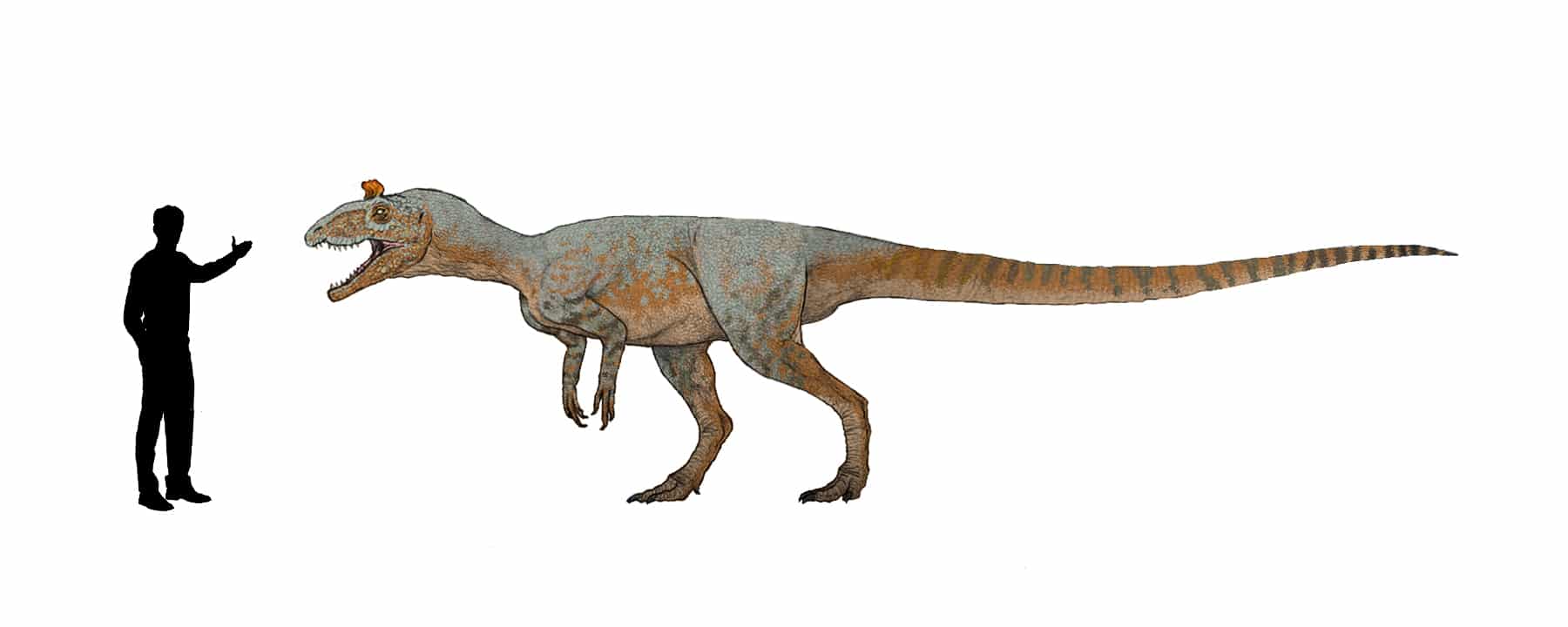
In 2007, Smith and colleagues estimated Cryolophosaurus at between 18 and 21 feet (5.5 and 6.5 meters) long. They gave the same range for Dilophosaurus wetherilli, Dracovenator, and ‘Dilophosaurus‘ sinensis. Museum figures run higher—25 feet (7.6 meters) at the Field Museum and about 26 feet (8 meters) at the Natural History Museum. Neither explains its method.
No hip-height estimate appears in any study consulted. For weight, Smith’s team estimated about 1,025 pounds (465 kilograms), using a limb-bone method published in 1985. By comparison, the Natural History Museum lists about 1,100 pounds (500 kilograms).
Based on femoral length, the 2007 team wrote that it “rivals the largest known specimens of Ceratosaurus.” Its size, they argued, shows that some theropod lineages had already reached large body size by the end of the Early Jurassic. Still, the holotype may not have been fully grown. Although its neurocentral sutures are closed, its fifth sacral (hip) vertebra had not fused to the one in front, and several tail vertebrae still show sutures.
The Dinosaur in Detail
What sets this dinosaur apart is the crest. Smith and colleagues described a “dorsoventrally high, furrowed transverse cranial crest”—tall and set crosswise—”unique among all theropods.” Its construction resembles the rear part of the nasolacrimal crests, bony ridges along the top of the snout, in Dilophosaurus, ‘Dilophosaurus‘ sinensis, and Monolophosaurus. Unlike Dilophosaurus wetherilli, though, it lacks a “kink” on the iliac blade (upper hip bone). Its ischium (lower rear hip bone) is also sturdier. In addition, unlike Dilophosaurus wetherilli and Dracovenator, its attachment for m. depressor mandibulae, the jaw-opening muscle, faces upward.
Its relationships have shifted from one analysis to the next. Before 2007, studies recovered it as an allosauroid (a relative of Allosaurus) or as the most basal tetanuran. Then Smith and colleagues, testing 347 characters across 56 taxa, found it in a clade with Dilophosaurus wetherilli, ‘Dilophosaurus‘ sinensis, and Dracovenator regenti. That group sat as the sister to neoceratosaurs (advanced ceratosaurs) plus tetanurans. Shared jaw and snout details, including nasolacrimal crests, suggested these ties. Even so, the authors cautioned that “support for relationships in this part of the tree is not robust.”
Later work redrew the picture again. In 2020, Marsh and Rowe found no natural Dilophosauridae, placing Dilophosaurus “in a grade with other stem-averostrans such as Cryolophosaurus ellioti and Zupaysaurus.” Stem-averostrans are theropods that branched off before Averostra, the group uniting ceratosaurs and tetanurans. Likewise, Li and colleagues in 2025 placed it in the grade leading to Averostra, unresolved alongside Sarcosaurus and Gojirasaurus. One alternative tree grouped it with Dilophosaurus, Shuangbaisaurus, and Sinosaurus, but with low support.
Taken together, the analyses discussed here place Cryolophosaurus outside the later neoceratosaur–tetanuran radiation. Some summaries, however, still list it as an early tetanuran. Its nearest relatives remain an open question.
Interesting Points about Cryolophosaurus
- Cryolophosaurus was the first carnivorous dinosaur found in Antarctica and the first non-avian dinosaur from the continent to be formally named.
- London’s Natural History Museum spells the species name “elliotti,” but the original 1994 spelling is ellioti.
- Fieldwork on the skeleton spanned two decades, from the first season in 1990–91 to Hammer’s third trip to the Beardmore region in 2010–11.
- In 2007, Smith and colleagues argued that it marks the beginning of theropods occupying the dominant predator niche of the Mesozoic.
Contemporary Dinosaurs
Sharing the same quarry was Glacialisaurus hammeri, “a robust non-eusauropod sauropodomorph”—a heavily built early relative of the long-necked giants—named by Smith and paleontologist Diego Pol in 2007. The fossils include a partial right ankle and metatarsus (foot bones), plus the lower end of a left thigh bone. Its describers suggested affinities with Coloradisaurus and Lufengosaurus, though support for that placement was weak. The name comes from the Latin glacialis, “icy” or “frozen.” Although the two animals shared a landscape, no fossil records any interaction between them.
Later fieldwork added a juvenile early sauropodomorph, FMNH PR 3051, from the lower Hanson Formation on Mt. Kirkpatrick. In a 2022 University of Minnesota thesis, Lynnea Jackson described its mostly complete skull as a new species. Still, it has no formal name, and Barrett and colleagues in 2026 listed such material as unnamed.
In 2003–04, hip bones from a possible sauropod turned up at a separate site, about 100 meters (330 feet) higher in the formation. Press reports in 2011 also described a 2010–11 skeleton identified in the field as a small basal ornithischian (bird-hipped dinosaur). It has not been formally described.
The 1994 abstract also lists “teeth from scavenging theropods” among the finds, without saying which animals shed them. Beyond the dinosaurs, the quarry has yielded a pterosaur humerus—the upper arm bone of a flying reptile—and a single tooth from a tritylodont, a close cousin of early mammals. Together, these finds hint at a fuller community than two named dinosaurs reveal.
Cryolophosaurus in its Natural Habitat
Cryolophosaurus lived at high southern latitude. In fact, an NSF-funded project called the Hanson dinosaurs “some of the highest paleolatitude vertebrates known from the Jurassic.” One Paleobiology Database plate model puts the site near 54 degrees south at the time, against 84 degrees today, though that figure depends on the model. The Hanson Formation built up in an active rift system that formed during the breakup of Gondwana, the southern supercontinent. Its ash-rich beds are reworked fine ash from distant Plinian (highly explosive) eruptions, probably from a volcanic arc on the West Antarctic margin. The database codes the setting as river-laid.
Cryolophosaurus was a carnivore. In 2007, it was the largest known theropod of its age, although Saltriovenator has since claimed that title. While there is no direct evidence of what it ate, it shared its quarry with Glacialisaurus, a heavily built plant-eater.
Its social life remains unknown, and the crest is the main clue to its behavior. Hammer argued in 1997, as cited by Smith’s team, that it probably could not have served in combat. The variety of theropod crests “tempts speculation” about sexual dimorphism or species recognition, Smith and colleagues wrote, though they cautioned against over-reading the evidence. Their 2007 review found species recognition “a particularly intriguing explanation.”
Frequently Asked Questions
London’s Natural History Museum translates it as “frozen crested lizard,” and the species name ellioti honors geologist David Elliot.
It lived in the Early Jurassic, probably from the late Sinemurian to the late Pliensbachian, within roughly 199.5 to 184.2 million years ago.
A 2007 study estimated a length between 18 and 21 feet and a weight of about 1,025 pounds.
It was a carnivore, according to London’s Natural History Museum. However, no stomach contents or bite marks have been reported, so its actual prey is unknown.
Its fossils come from the lower Hanson Formation on Mt. Kirkpatrick, in Antarctica’s Central Transantarctic Mountains.
Its tall, furrowed crest runs crosswise over the skull, a structure a 2007 study called unique among all theropods.
Sources
The information in this article is based on various sources, drawing on scientific research, fossil evidence, and expert analysis. The aim is to provide a comprehensive and accurate overview of Cryolophosaurus. However, please be aware that our understanding of dinosaurs and their world is constantly evolving as new discoveries are made.
- https://doi.org/10.1126/science.264.5160.828
- https://pubmed.ncbi.nlm.nih.gov/17794724/
- https://doi.org/10.1111/j.1096-3642.2007.00325.x
- http://treatment.plazi.org/id/03A487A7FFBAFFD8FEE1CF1DC569FEF4
- https://pubs.usgs.gov/of/2007/1047/srp/srp003/of2007-1047srp003.pdf
- https://app.pan.pl/archive/published/app52/app52-657.pdf
- https://pubs.usgs.gov/of/2007/1047/srp/srp051/of2007-1047srp051.pdf
- https://doi.org/10.1017/S0016756816000388
- https://doi.org/10.1017/jpa.2020.14
- https://doi.org/10.1093/zoolinnean/zlaf034
- https://paleobiodb.org/data1.2/colls/single.json?id=47135&show=strat,stratext,lith,geo,loc,ref,time,paleoloc,env
- https://nhm.ac.uk/discover/dino-directory/cryolophosaurus.html
- https://www.fieldmuseum.org/focus-polar-studies-research
- https://www.usap.gov/news/4583/
- https://beyondpenguins.ehe.osu.edu/?p=455
- https://antarcticsun.usap.gov/science/2407/
- https://doi.org/10.7717/peerj.5976
- https://doi.org/10.4202/app.01315.2025
- https://conservancy.umn.edu/items/47788a2f-4858-4166-b88f-7dd611a6b5c0
- https://www.usap-dc.org/view/project/p0000083
- https://tb.plazi.org/GgServer/xhtml/45258782FF833C5A080D365EFE470474
This article was last fact checked: TheDinosaurs Team, 30-10-2026
Featured Image Credit: James St. John, CC BY 2.0, via Wikimedia Commons
