
On the Willow Creek anticline near Choteau, Montana, the floodplain rocks of the Two Medicine Formation hold dinosaur nests, babies, and thousands of larger bones. Among them is Maiasaura peeblesorum, a duck-billed dinosaur named in 1979. Recent dating places its nesting horizons at about 78 million years ago, in the Campanian stage of the Late Cretaceous. Its describers presented a nest of juveniles as the first tangible evidence of social behavior in a dinosaur group—an idea that also inspired its name.
The story began in 1978, when Marion Brandvold found baby duck-billed dinosaur bones on the Peebles family’s land. That same year, John R. Horner, Robert Makela, and a field crew collected the remains. They found fifteen youngsters, each about 3.3 feet (1 meter) long, lying together in a nest-like structure. At that time, apart from finds in Mongolia and in the Two Medicine Formation itself, the bones of very young dinosaurs were exceedingly uncommon. Since then, decades of research have turned Maiasaura into what scientists call a model organism for dinosaur paleobiology.
Maiasaura Key Facts
| Keyword | Fact |
|---|---|
| Pronunciation | my-ah-SORE-ah (Natural History Museum, London) |
| Meaning of name | Good Mother Lizard |
| Group | Ornithopoda (Hadrosauridae) |
| Type Species | Maiasaura peeblesorum |
| Diet | Herbivore |
| When it Lived | Around 78 MYA (about 78.6 to 77.7 MYA across dated finds, 78.0 to 77.9 MYA at the type locality) |
| Period | Cretaceous |
| Epoch | Late Cretaceous (Campanian stage) |
| Length | Adults 23 to 30 feet (7 to 9 meters) (Horner, de Ricqlès and Padian 2000). Natural History Museum estimate: about 30 feet (9 meters) |
| Height | Not specified |
| Weight | Age three: about 2,780 pounds (1,260 kilograms), about 36% of adult mass (Woodward et al. 2015). Adults, separate estimates from different sources and methods: about 5,510 pounds (2,500 kilograms) (Natural History Museum), or about 3 tons (Montana state bill) |
| Mobility | Juveniles probably moved mainly on two legs (bipedal) and adults mainly on all four (quadrupedal), as hypothesized by Dilkes (2001) |
| First Discovery | 1978 by Marion Brandvold |
| Described by | 1979 by John R. Horner and Robert Makela |
| Holotype | YPM-PU 22405 |
| Location of first find | Willow Creek anticline, Two Medicine Formation, near Choteau, Teton County, Montana, USA |
Maiasaura Origins, Taxonomy and Timeline
The name Maiasaura means “good mother lizard,” a reading given by both Montana’s 1985 state-fossil bill and London’s Natural History Museum. Museum of the Rockies and university scientists describing the site add that the fossils suggested parental care, which inspired the name. The species name peeblesorum honors the Peebles family, a Montana ranch family who owned the land where the discovery took place. Together, the name pairs a hypothesis about behavior with a nod to local landowners.
Horner and Makela identified their nestlings as hadrosaurian (“duck-billed”) dinosaurs. Within Ornithopoda, the lineage of beaked plant-eaters, Maiasaura belongs to the family Hadrosauridae. As summarized in 2018 by paleontologists Albert Prieto-Márquez and Merrilee Guenther, it is a saurolophine hadrosaurid in the tribe Brachylophosaurini, together with Acristavus, Brachylophosaurus, and Probrachylophosaurus. Since 2021, Ornatops has joined them. Some studies still use the older label hadrosaurine—a difference in terminology rather than in relationships. Finally, Maiasaura peeblesorum is the type and only known species.
In 2025, Rogers and colleagues dated the formation in fine detail using volcanic ash beds, called bentonites. They found that the holotype, the nesting horizons, and the large Maiasaura bonebed all lie above an ash dated to 77.968 million years old. These fossils sit below a lake interval that begins about 43 feet (13 meters) above that ash. Thus, the type locality dates to roughly 78.0 to 77.9 million years ago. Across all dated finds, the species spans about 78.6 to 77.7 million years ago. Both ranges fall within the Campanian, deep in the Late Cretaceous.
Discovery & Fossil Evidence
Brandvold’s find came from terrestrial sediments near Choteau. The holotype, YPM-PU 22405, is a partial skull and mandible (lower jaw) of an adult. It belongs to the Princeton University collection, now housed at the Yale Peabody Museum. The 1979 paper placed this adult within 100 meters (about 330 feet) of the nest. Horner and Makela linked the babies to the adult by shared bill and cheek features. However, Prieto-Márquez and Guenther found no premaxilla among the babies and judged only the jugal, or cheek bone, feature useful.
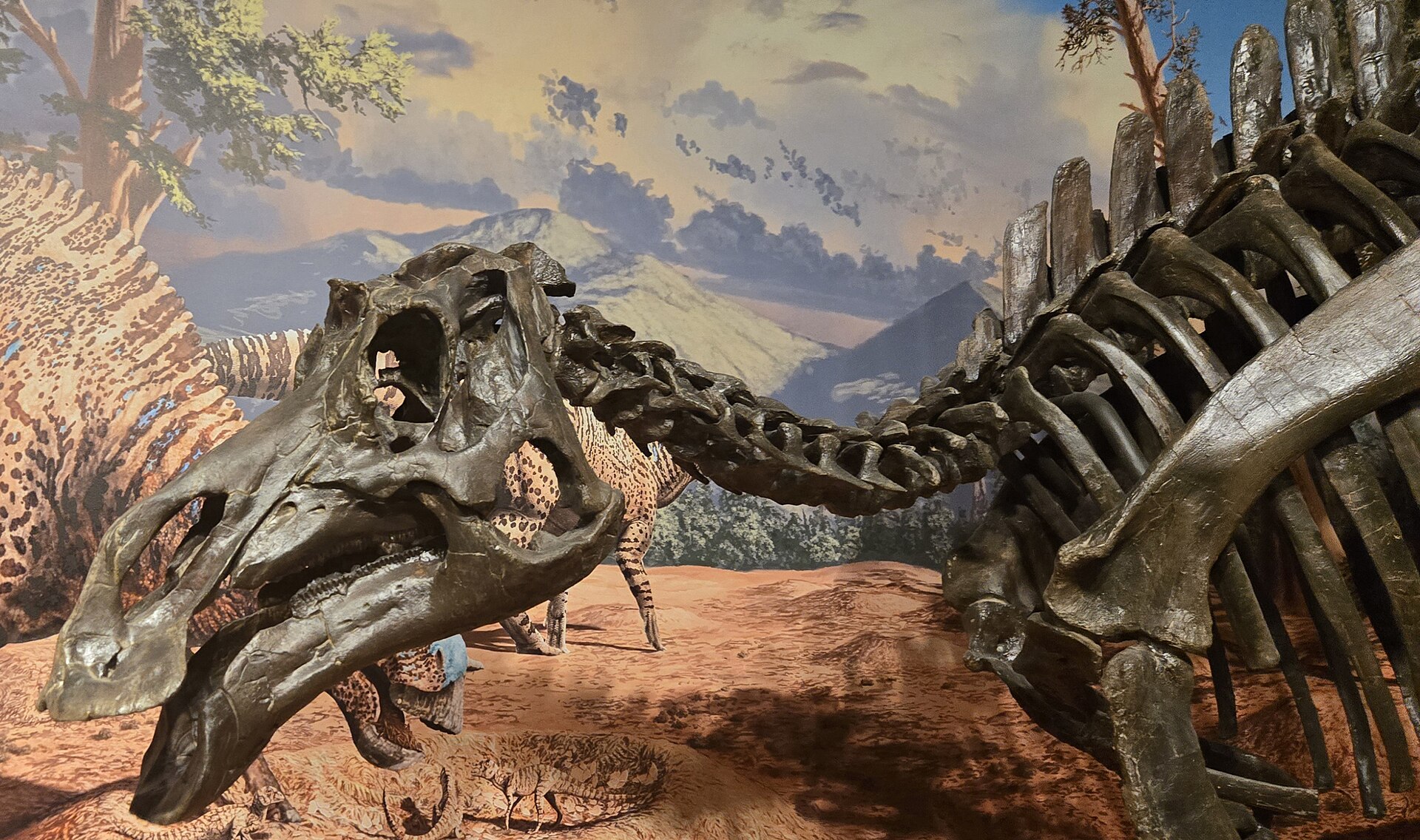

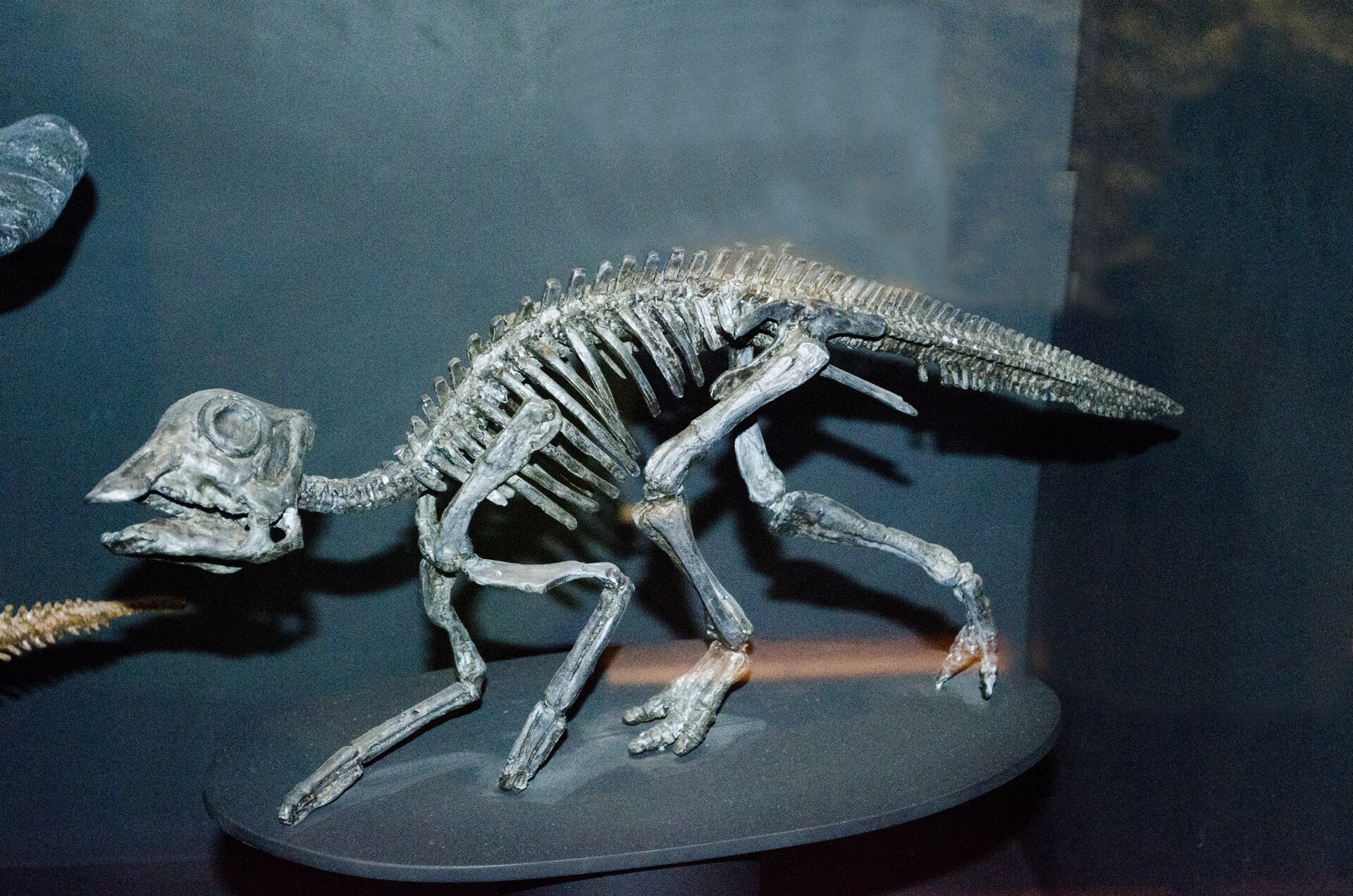
The nest bones share one catalogue number, YPM-PU 22400. For example, this lot includes 24 femora (thigh bones), 16 tibiae (shin bones), and 24 dentaries, the tooth-bearing lower jaw bones. Prieto-Márquez and Guenther restudied these perinates—animals at or near hatching—and kept them in M. peeblesorum. They cited the jugal, a ridge beneath the toe claws, and the nest’s closeness to the adult. Later, in 2013, researchers described an embryonic bone from Willow Creek, still associated with its egg. The Paleobiology Database lists seven occurrences, all from the Two Medicine Formation of Montana, and no skeletal remains from anywhere else.
Maiasaura Size and Description
Fossils of Maiasaura span embryos to old adults, and its body changed a great deal along the way.
Short description of Maiasaura
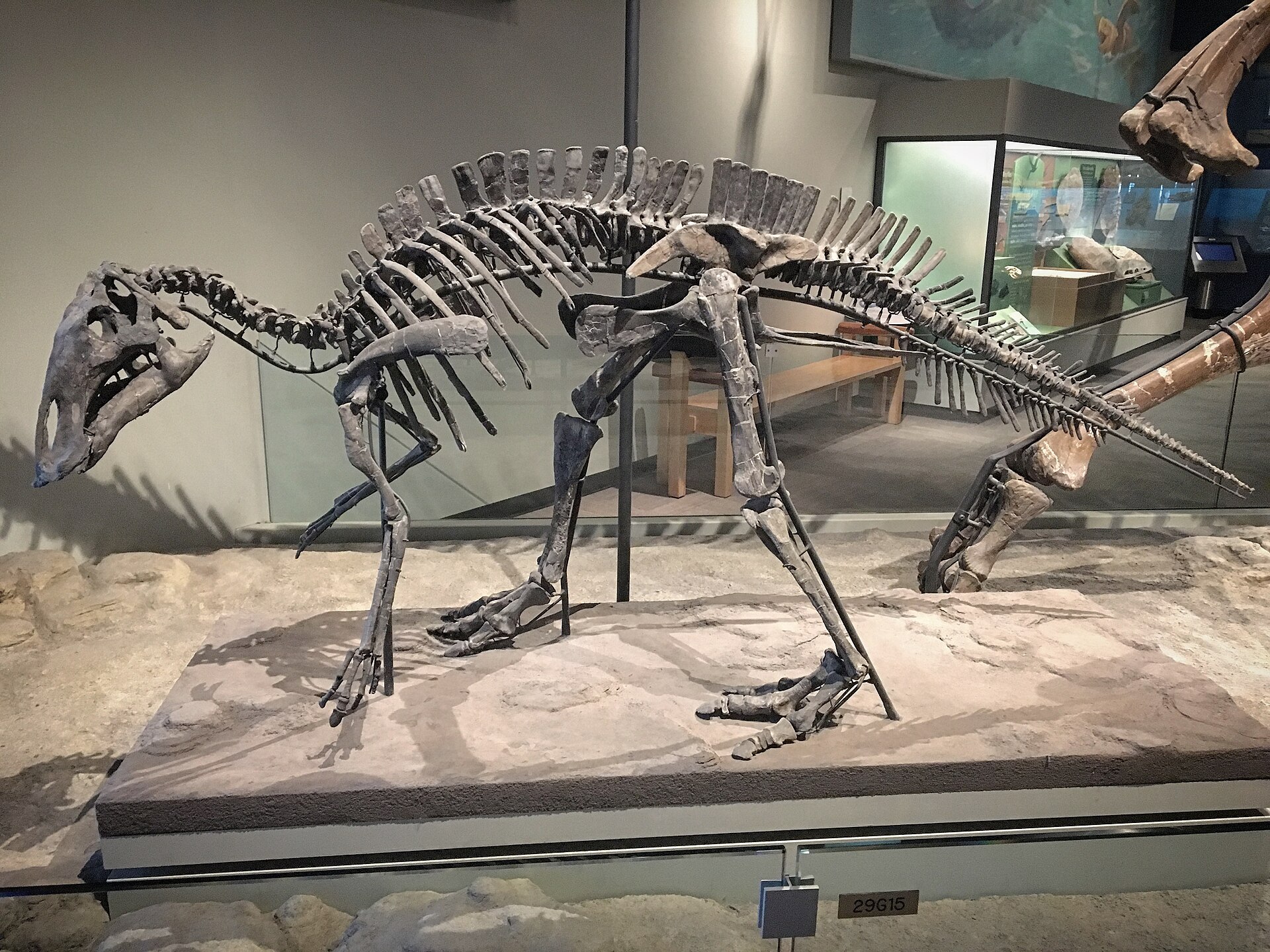
The skull carried a wide, elongate rostrum (snout) and a short, solid crest that rose up and forward between the eye sockets. Adult lower jaws held up to 38 tooth positions, packed into a dental battery with a concave grinding surface. In contrast, the perinates had only 10 to 12 positions, with up to three teeth stacked in each. As the animal grew, its face lengthened dramatically—the snout in front of the eye made up about 40 percent of skull length in perinates but 63 percent in one adult. Meanwhile, the eye socket’s share of skull length fell from about 35 to 20 percent.
Behind the head, the hand lacked a first finger and the foot lacked its first metatarsal, or long foot bone. Its toe claws bore a plantar ridge on the underside, a feature so far seen only in Maiasaura and Brachylophosaurus. In 2001, paleontologist David Dilkes argued that juveniles walked mainly on two legs. Adults, in his view, later shifted to a mainly four-legged stance.

Size and Weight of Type Species
In 2000, Horner, Armand de Ricqlès, and Kevin Padian put adults at 23 to 30 feet (7 to 9 meters) long. Prieto-Márquez and Guenther later based their adult outline on that work. London’s Natural History Museum gives about 30 feet (9 meters), at the top of that range.
For adult weight, the museum lists about 5,510 pounds (2,500 kilograms), while the state bill gives about 3 tons. Neither explains its method, however.
Mass has a firmer estimate at one growth stage. In 2015, Woodward and colleagues estimated that three-year-olds averaged about 2,780 pounds (1,260 kilograms). That figure, they found, was about 36 percent of final adult body mass. By contrast, the 24 femora from the nest average about 5.4 inches (138 millimeters) long. According to Freedman Fowler and Horner, bone histology suggests that its relative Probrachylophosaurus was larger at every growth stage.
The Dinosaur in Detail
What sets Maiasaura apart from its closest relatives is its crest. In 2015, Freedman Fowler and Horner noted that upward projections of both the nasal and frontal bones form it. Brachylophosaurus, in contrast, carries a backward-pointing, paddle-shaped crest. Together with the wide rostrum and the long jugal process, this crest anchors the diagnosis summarized by Prieto-Márquez and Guenther.
However, exactly where Maiasaura sits within Brachylophosaurini depends on the data used. In 2011, Gates and colleagues recovered Acristavus and Maiasaura as sister taxa—each other’s closest relatives. Freedman Fowler and Horner later tested two character matrices. One paired Maiasaura with Brachylophosaurus, with 56 percent bootstrap support in their preferred analysis (64 percent in the first). In contrast, the other left Maiasaura just outside a Brachylophosaurus–Probrachylophosaurus pair. Then, in 2021, the analysis that named Ornatops placed Maiasaura just outside a group of Brachylophosaurus, Probrachylophosaurus, and Ornatops.

Still, the nest raised the boldest questions. At first, Horner and Makela read their nest as evidence of family structure. In 1982, Horner argued that the Willow Creek anticline recorded colonial nesting, with adults returning for many years. He also suggested that the young of some species stayed in their nests after hatching. However, in 1996, Nicholas Geist and Terry Jones compared hatchling hips with those of crocodilians and birds. They concluded that known dinosaur hatchlings were precocial—mobile and fairly independent. Critics also note that no adult skeletons are known from the nests. In contrast, in 2025, Bert and colleagues concluded that newborn Maiasaura were most likely altricial—helpless and dependent at birth. In their view, the young stayed in the nest for roughly 40 to 75 days. Taken together, the good-mother idea remains a carefully argued interpretation rather than a direct observation.
Interesting Points about Maiasaura
- In 1985, Montana’s House Bill 81 made Maiasaura peeblesorum the official state fossil, describing its name as “good mother lizard.”
- According to its geoheritage description, Willow Creek yielded the first dinosaur nests with associated eggs and babies found in the western hemisphere.
- In 2015, Woodward and colleagues sectioned 50 tibiae, which they called the largest histological sample for any extinct tetrapod species at the time.
- A 2020 study of Alberta eggshell assigned to Maiasaura‘s egg type estimated a body temperature of about 111°F (44°C), above environmental temperatures.
- Woodward’s team estimated that nearly 90 percent of young Maiasaura died in their first year, followed by about seven years of peak survival.
Contemporary Dinosaurs
The closest documented neighbor in time is the duck-bill Gryposaurus. Rogers and colleagues place a Gryposaurus bonebed slightly lower in the same rock member, at about 78.97 million years old. The type specimen of Gryposaurus latidens lies lower still, at about 79.56 million years. The same member also holds a pachycephalosaurid, or dome-headed dinosaur, from one Maiasaura skeleton’s level, though it remains unidentified beyond the family.
Later residents of the same area include Orodromeus, a small ornithopod. Horner and paleontologist David Weishampel named it in 1988 as a new hypsilophodontid. Its remains come from Egg Mountain, in lake beds above the Maiasaura nesting horizons. In 2026, David Varricchio and Heath Caldwell dated these beds to about 77 to 76.5 million years ago—roughly a million years after the nests.
From the same lake beds comes the small troodontid theropod known as Troodon. In fact, Rogers and colleagues report that the egg clutches there are mostly referable to it. Its name is under review—a pending ICZN case would fix Troodon formosus on a Two Medicine specimen, while others prefer Stenonychosaurus inequalis. No source documents a direct link between either animal and Maiasaura.
Maiasaura in its Natural Habitat
The world Maiasaura roamed was a river floodplain, now preserved as interbedded mudstones and sandstones. As the shoreline of the Claggett sea moved east, these beds accumulated in more inland settings. Meanwhile, rivers carried debris from eroding uplands and local volcanoes, and falling ash left the bentonites that now date the fossils.
Maiasaura was a herbivore that ground plants with its dental battery. In 2007, paleontologist Karen Chin described large coprolites—fossil dung—holding 13 to 85 percent conifer wood. She wrote that the evidence strongly suggests the dung at one site came from Maiasaura, which ate rotting, fungus-attacked wood. Nestlings may have eaten differently. In 2026, John Hunter and Christine Janis found more crushing wear on nestling teeth than on adult duck-bill teeth, pointing to softer, higher-protein food. They proposed that adults brought richer food to the nest.
While there is no direct evidence of how adults behaved around the nests, the colonial nesting grounds and an extensive bonebed suggest that Maiasaura gathered in large numbers. Its young also grew fast—Woodward’s team estimated bone growth of 86.4 micrometers per day. As a result, the tibia passed half its final girth in the first year. Changes in the third year may mark sexual maturity, whereas skeletal maturity came only after eight years. Such abundant remains let researchers study Maiasaura as a population—the reason scientists now call it a model organism.
Frequently Asked Questions
It means “good mother lizard,” and the species name peeblesorum honors the Peebles family, on whose land Brandvold found it.
It lived about 78.6 to 77.7 million years ago, during the Campanian stage of the Late Cretaceous.
Adults reached about 23 to 30 feet (7 to 9 meters) long. A 2015 growth study found that three-year-olds averaged about 2,780 pounds, roughly 36 percent of adult mass.
It was a herbivore, and coprolites at one site suggest it ate rotting conifer wood. Nestling tooth wear hints at softer, richer food.
It was found on the Willow Creek anticline near Choteau, Teton County, Montana, in the Two Medicine Formation.
Probably, though this is debated. A 2025 study suggested nestlings stayed in the nest for about 40 to 75 days, but others argue hatchlings could move independently.
Sources
The information in this article is based on various sources, drawing on scientific research, fossil evidence, and expert analysis. The aim is to provide a comprehensive and accurate overview of Maiasaura. However, please be aware that our understanding of dinosaurs and their world is constantly evolving as new discoveries are made.
- https://doi.org/10.1038/282296a0
- https://doi.org/10.7717/peerj.4734
- https://doi.org/10.1371/journal.pone.0141304
- https://doi.org/10.1130/B37498.1
- https://par.nsf.gov/servlets/purl/10565300
- https://doi.org/10.1017/pab.2015.19
- https://doi.org/10.1038/332256a0
- https://doi.org/10.1038/297675a0
- https://doi.org/10.1139/e01-016
- https://doi.org/10.2110/palo.2006.p06-087r
- https://doi.org/10.1038/s41598-025-06282-5
- https://doi.org/10.1371/journal.pone.0356249
- https://doi.org/10.1371/journal.pone.0056937
- https://doi.org/10.1126/sciadv.aax9361
- https://doi.org/10.1671/0272-4634(2000)020[0115:LBHOTH]2.0.CO;2
- https://doi.org/10.7717/peerj.11084
- https://doi.org/10.1126/science.272.5262.712
- https://doi.org/10.1016/j.palaeo.2026.113707
- https://iugs-geoheritage.org/?p=10710
- https://www.nhm.ac.uk/discover/dino-directory/maiasaura.html
- https://courts.mt.gov/external/leg/bills/1985/house/HB081.pdf
- https://paleobiodb.org/classic/basicTaxonInfo?taxon_no=38765
This article was last fact checked: TheDinosaurs Team, 29-10-2026
Featured Image Credit: TotalDino, CC BY 4.0, via Wikimedia Commons
