
Near Ganzhou City in China’s Jiangxi Province, the red sandstones of the Nanxiong Formation have yielded a most unusual tyrannosaur. Named Qianzhousaurus sinensis in 2014, it lived during the Maastrichtian, the final stage of the Late Cretaceous. Its skull was long and low—the snout alone made up about 70 percent of its length, against about 60 percent in other large tyrannosaurids.
Paleontologists Junchang Lü, Stephen L. Brusatte, and four colleagues described the animal in May 2014. Their specimen is a single associated individual with a nearly complete skull. Because it was larger and more mature than both Alioramus holotypes, it helped the authors argue that a long snout was not a passing juvenile stage. Its status as a separate genus has since been questioned—even a fine skull can be read more than one way.
Qianzhousaurus Key Facts
| Keyword | Fact |
|---|---|
| Pronunciation | Not specified |
| Meaning of name | Qianzhou Reptile |
| Group | Theropoda |
| Type Species | Qianzhousaurus sinensis |
| Diet | Carnivore |
| When it Lived | 72.2 to 66 MYA |
| Period | Cretaceous |
| Epoch | Late Cretaceous (Maastrichtian stage) |
| Length | Not specified |
| Height | Not specified |
| Weight | About 1,670 pounds (757 kilograms) for the holotype, estimated from femur length |
| Mobility | Not specified |
| First Discovery | Year not specified, found at a construction site in Ganzhou according to news reports |
| Described by | 2014 by Junchang Lü, Laiping Yi, Stephen L. Brusatte, Ling Yang, Hua Li, and Liu Chen |
| Holotype | GM F10004 |
| Location of first find | Nanxiong Formation, Longling Town, Nankang, Ganzhou City, Jiangxi Province, China |
Qianzhousaurus Origins, Taxonomy and Timeline
The name Qianzhousaurus looks back to local history. “Qianzhou” is an ancient name for Ganzhou, the city where the fossils came to light. Meanwhile, the species name sinensis draws on “Sin,” Greek for China, and refers to the specimen’s discovery in that country.
Qianzhousaurus is a theropod and a member of Tyrannosauroidea, the wider tyrannosaur lineage. Within it, Lü and colleagues formally defined the clade (a group sharing one common ancestor) Alioramini—a name Olshevsky had used in 1995. They defined it as every species closer to Alioramus remotus than to Tyrannosaurus rex, Albertosaurus sarcophagus, or Proceratosaurus bradleyi. Besides Qianzhousaurus, the clade holds the Mongolian species Alioramus altai and A. remotus. Their main analysis placed Alioramini at the base of Tyrannosaurinae, as the sister group to a clade of Teratophoneus, Daspletosaurus, Tarbosaurus, and Tyrannosaurus. Qianzhousaurus sinensis is the type and only known species.
The original paper placed the fossil beds in the Maastrichtian stage of the Late Cretaceous. The Paleobiology Database assigns that stage, and the site, to roughly 72.2 to 66 million years ago. However, the 2014 paper cited only a 1984 regional geology volume for the horizon and gave no radiometric date. Later researchers also describe the formation as very poorly dated, so exactly where Qianzhousaurus falls within that window remains open.
Discovery & Fossil Evidence
The skeleton came from Longling Town in Nankang, part of Ganzhou City. According to National Geographic, it turned up at a construction site, but the papers name neither the finder nor the year. That setting fits a wider pattern—a 2016 study called new Ganzhou fossils “the direct result of a burst of construction activity in the region.” In 2014, Lü and colleagues reported that the Ganzhou Museum housed the remains.
The holotype—the name-bearing specimen—carries the catalog number GM F10004 and comes in eight numbered parts. It includes the skull, most of the left lower jaw, nine neck vertebrae, three back vertebrae, and 18 tail vertebrae. Its shoulder survives as a complete right scapulocoracoid (shoulder blade and coracoid) and part of the left one. From the hips come both partial ilia (upper hip bones), while the left hind limb preserves the thigh bone, shin bone, part of the fibula, two ankle bones, and the metatarsals (upper foot bones).
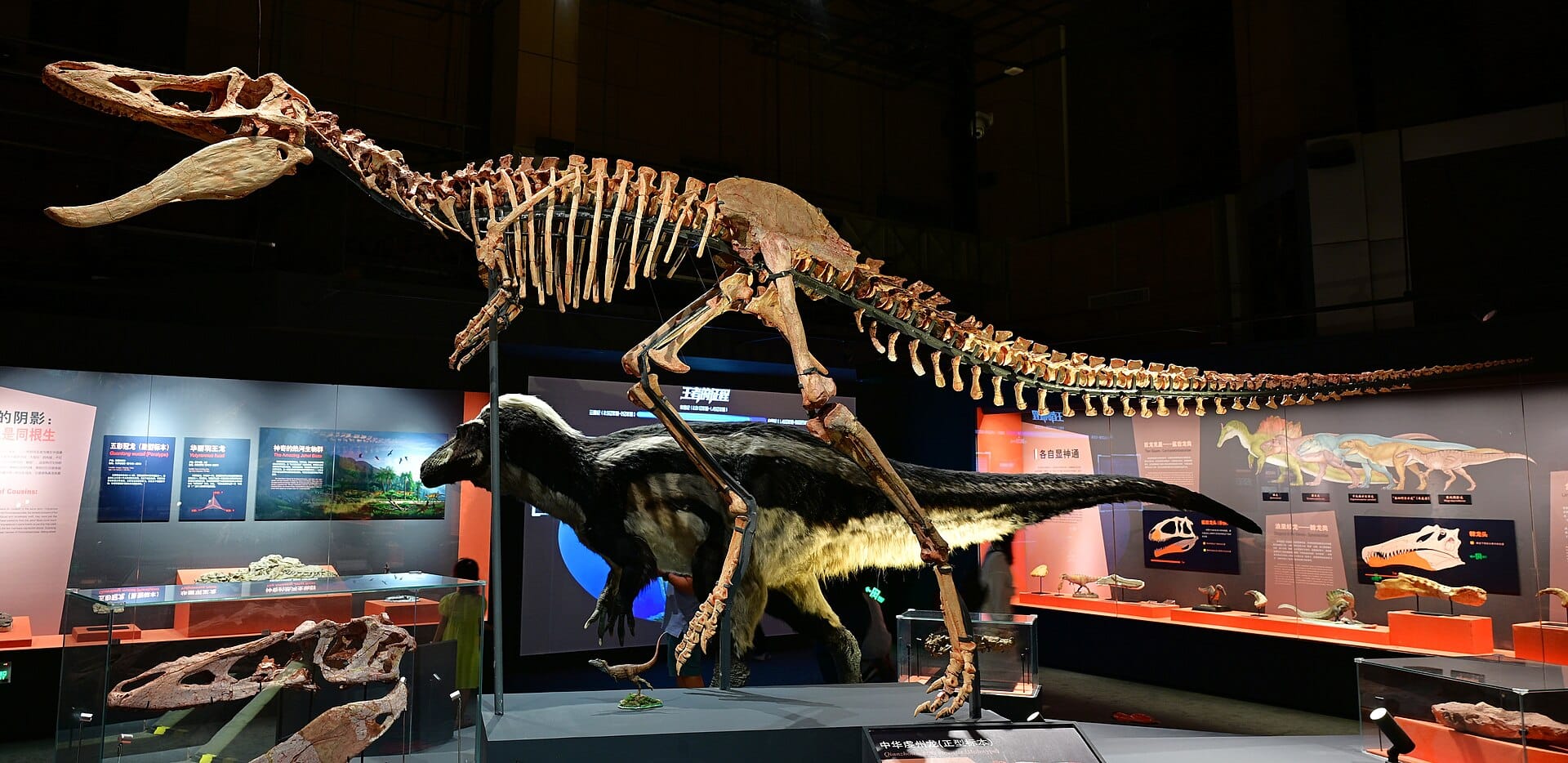

All of these bones lay together and belong to a single individual. The skull is well preserved and nearly complete—missing only a small part of the eye region on its right side. At the time, it was only the third specimen of a long-snouted tyrannosaurid known from the Late Cretaceous of Asia. Its closest relatives come from the Nemegt localities of Mongolia—about 1,860 miles (3,000 kilometers) to the northwest.
Qianzhousaurus Size and Description
Most of what makes Qianzhousaurus unusual lies in its head, though the skeleton adds detail too.
Short description of Qianzhousaurus
At the very front, the premaxilla—the small bone at the snout tip—was extremely reduced, making up only about 2.2 percent of skull length. Behind it, the snout stretched to about 70 percent of the whole skull. Along the top, the fused nasal bones carried a row of pronounced, roughened mounds on the midline. Swollen bony bosses (cornual processes) also rose in front of and behind the eye, and the lower jaw lacked the projecting “chin” seen in all other tyrannosaurids.
Behind the head, the neck vertebrae were highly pneumatic, or hollowed by air sacs, while the tail vertebrae were not. The shoulder blade was more than ten times as long as its narrowest depth. In addition, its foot was arctometatarsalian, meaning the neighboring metatarsals pinched the middle one. The papers report no skin or other soft tissue, so any discussion of its outer covering is speculative.
Size and Weight of Type Species
None of the scientific papers consulted for this article gives a total length for Qianzhousaurus. News coverage in 2014, including National Geographic, reported about 29 feet (9 meters), but that figure does not come from the scientific literature. No source gives its height either.
The thigh bone, or femur, measures about 27.6 inches (70 centimeters)—25 percent larger than the 22-inch femur of Alioramus altai. Using equations based on femur length, Lü and colleagues estimated a body mass of about 1,670 pounds (757 kilograms). That is roughly twice the 810 pounds (369 kilograms) they gave for A. altai.
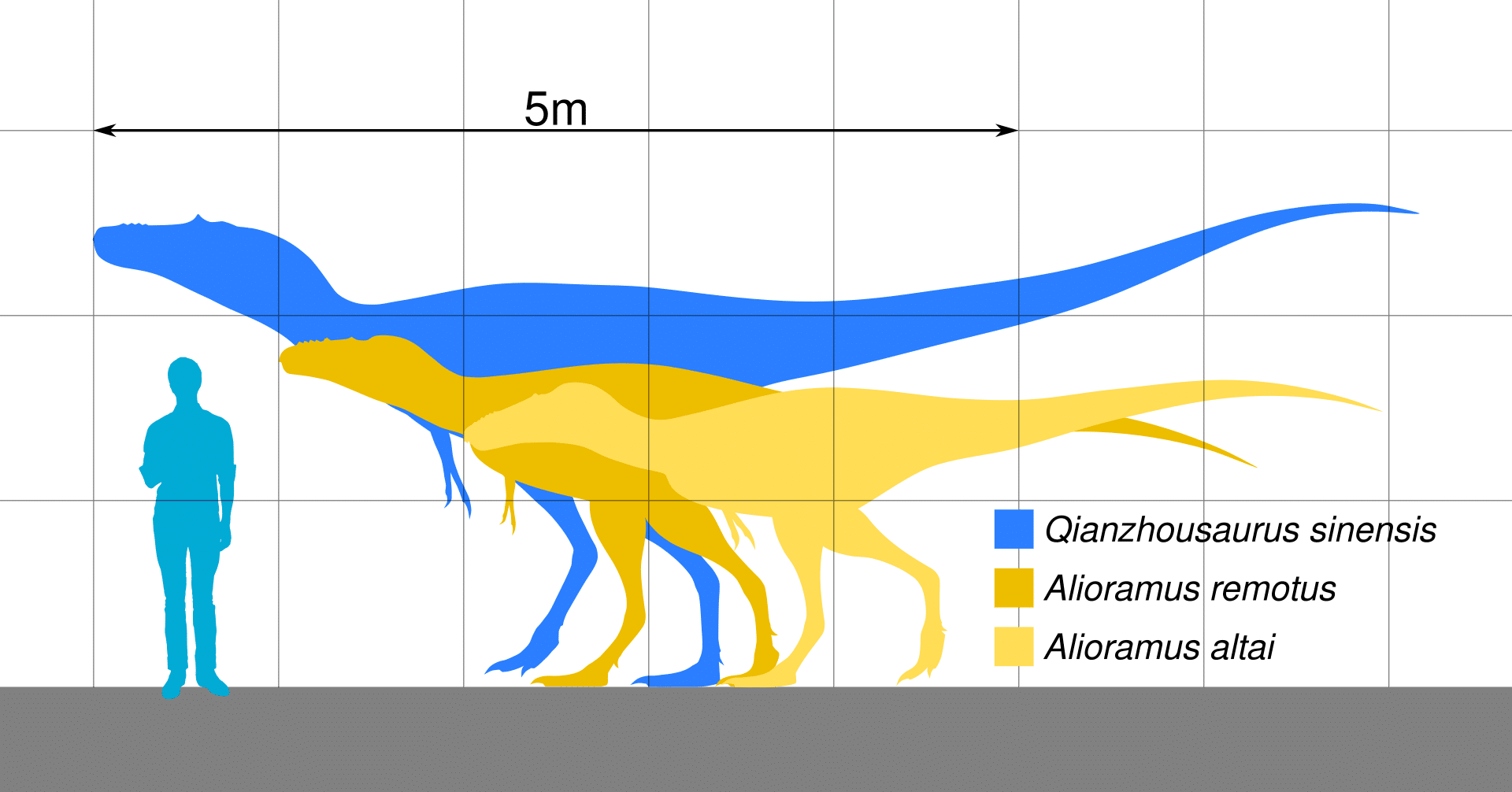

Skull length depends on the landmarks used. Measured to the back corner of the quadrate, the jaw-joint bone, it reaches about 35.4 inches (90 centimeters), against roughly 24.8 inches in A. altai. Measured instead to the tip of the paroccipital process, a bony prong at the back of the skull, it reaches 39.4 inches (100 centimeters). The skull is also 35 percent longer than in a Tarbosaurus with the same femur length. In 2022, Foster and colleagues called it the largest alioramin yet discovered.
The Dinosaur in Detail
Among the most distinctive features of Qianzhousaurus is a large, window-like opening on the maxilla, the main upper jaw bone. Lü and colleagues listed this air-filled fenestra (opening) among its unique traits, along with the tiny premaxilla. The maxilla held 15 tooth sockets, while the dentary (lower jaw bone) held 18.
Later work refined that picture—in 2022, Foster and colleagues proposed further unique traits, including a rod-like fused nasal bone. They also found that the skull’s length came from a lengthened front palate, not the premaxilla. In addition, its jugal (cheekbone) carried a swollen ridge—the same alioramin trait that forms a horn in Alioramus altai.
Its standing as a genus has drawn debate. Its describers admitted it could be a more mature A. altai or A. remotus, but they kept it separate because of its unique traits and distant locality. In 2017, paleontologist T.D. Carr and colleagues regarded Qianzhousaurus as a junior synonym of Alioramus, creating the name Alioramus sinensis. They stressed that this changed the name, not the family tree. However, Foster and colleagues—with Carr as a co-author—kept it as a distinct genus in 2022. Zheng’s team also used the genus name in 2024, although the Paleobiology Database still files the species as Alioramus sinensis.
Maturity is a second open question. Lü’s team judged the holotype not fully grown, since the neurocentral sutures (joints between the body and arch of each vertebra) in its neck and back were only partly fused. In contrast, Foster and colleagues predicted that the skull represents the adult stage for alioramins. Taken together, these studies agree on its place among the alioramins but not on its name or maturity.
Interesting Points about Qianzhousaurus
- News coverage in 2014 nicknamed it “Pinocchio rex” for its long snout, a label from the press rather than the scientific paper.
- In a University of Edinburgh news release, Stephen Brusatte said of the find, “This is a different breed of tyrannosaur.”
- Its lower jaw lacked the projecting “chin” found in all other tyrannosaurids, so the bottom edge of the jaw ran smoothly forward.
- Asiatyrannus (2024) is only the second tyrannosaurid named from the Nanxiong Formation, whose theropods are otherwise mostly oviraptorosaurs.
- Its holotype skull is about 43 percent longer than the skull of the Alioramus altai type specimen.
Contemporary Dinosaurs
The Nanxiong Formation is very poorly dated and up to 23,950 feet (7,300 meters) thick. As a result, a 2016 study warned that the many Ganzhou oviraptorids may not all have lived at the same time. A 2015 study, in contrast, considered the formation’s oviraptorids well constrained in time and place.
Sharing the same rock unit was Asiatyrannus xui, a small-to-medium deep-snouted tyrannosaurine named in 2024. Its skull measured 18.7 inches (47.5 centimeters), and its estimated length was 11.5 to 13.1 feet (3.5 to 4 meters). It came from Shahe Town in Nankang District, yet Zheng and colleagues regard the two as coeval Maastrichtian tyrannosaurids. They proposed that the pair likely fed differently and occupied different niches, though no source records a direct interaction.
Closer to home was Nankangia jiangxiensis, a derived oviraptorosaur named in 2013 from Longling, the same town as Qianzhousaurus. The Paleobiology Database places both in the same fossil collection, and its describers suggested it may have been primarily herbivorous. No source records contact between the two.
Adding further diversity was Banji long, an oviraptorosaurian theropod described in 2010. Its lower jaw ended in a downturned tip. The 2014 paper lists it among the dinosaurs of the same horizon, and it shares a locality with Nankangia. As with the others, no evidence links the two directly.
Rounding out the list was Gannansaurus sinensis, a somphospondylan sauropod—a member of one branch of the long-necked plant-eaters. The 2014 paper names it from the same horizon, and the Paleobiology Database assigns it to the same Longling collection as Qianzhousaurus. Whether the two ever crossed paths remains unknown.
Qianzhousaurus in its Natural Habitat
The Nanxiong Formation, which preserves the world of Qianzhousaurus, spreads across Jiangxi and Guangdong provinces. It is extremely fossiliferous, with large numbers of dinosaur skeletons and eggs. At the type site, the Paleobiology Database records red sandstones laid down on land. Elsewhere in the Ganzhou area, scientists found Tongtianlong in an unusual posture in mudstone.
Lü and colleagues described the new tyrannosaurid as the top predator in its terrestrial ecosystem. Still, there is no direct evidence of its diet, such as gut contents or bite marks. In 2022, Foster and colleagues argued that its skull indicates a much weaker bite than in deep-skulled tyrannosaurids. That difference, they suggested, points to a distinct prey choice and feeding style. Building on that work, Rowe and Rayfield noted in 2024 that earlier researchers had linked long-snouted tyrannosauroids to the pursuit of smaller prey with their more gracile bodies.
While there is no direct evidence of their use, Lü’s team suggested the nasal bumps may have been signals separating alioramins from other tyrannosaurids. Alternatively, they may have served as a sexual display structure. In Mongolia, Alioramus lived alongside Tarbosaurus, and their contrasting body plans may have allowed the two to partition niches. Even so, the only Tarbosaurus reported from the Nanxiong Formation is a 1979 provisional identification based on isolated teeth. As a result, there is no firm evidence the two met. Locally, theropods in these beds were almost all oviraptorosaurs, with more than seven species. In Guangdong, the same formation also yielded the therizinosaurid Nanshiungosaurus, named in 1979.
Frequently Asked Questions
It refers to Qianzhou, an ancient name for Ganzhou, and the species name sinensis refers to China.
It lived in the Maastrichtian stage of the Late Cretaceous, about 72.2 to 66 million years ago.
The holotype weighed an estimated 1,670 pounds and had a skull about 35 inches long. The scientific papers give no total length.
It was a carnivore, which its describers called the top predator of its ecosystem.
Its fossils come from the Nanxiong Formation at Longling Town, Nankang, in Ganzhou City, Jiangxi Province, China.
Carr and colleagues renamed it Alioramus sinensis in 2017, but a 2022 study kept it as a separate genus.
Sources
The information in this article is based on various sources, drawing on scientific research, fossil evidence, and expert analysis. The aim is to provide a comprehensive and accurate overview of Qianzhousaurus. However, please be aware that our understanding of dinosaurs and their world is constantly evolving as new discoveries are made.
- https://doi.org/10.1038/ncomms4788
- https://doi.org/10.1080/02724634.2021.1999251
- https://doi.org/10.1038/srep44942
- https://doi.org/10.1038/s41598-024-66278-5
- https://doi.org/10.1371/journal.pone.0080557
- https://doi.org/10.1038/srep35780
- https://doi.org/10.1038/srep11490
- https://doi.org/10.1016/j.isci.2024.110679
- https://paleobiodb.org/data1.2/colls/single.json?id=147070&show=time
- https://paleobiodb.org/data1.2/taxa/opinions.json?name=Qianzhousaurus&op_type=all&show=ref
- https://paleobiodb.org/data1.2/taxa/single.json?name=Nanshiungosaurus&show=class,app
- https://edwebprofiles.ed.ac.uk/sites/default/files/imports/fileManager/Newly-found-dinosaur-is-long-nosed-cousin-of-Tyrannosaurus-rex-07-05-2014.pdf
- https://www.nationalgeographic.com/animals/article/140507-pinocchio-rex-dinosaurs-tyrannosaurus-science-new-species
This article was last fact checked: TheDinosaurs Team, 02-11-2026
Featured Image Credit: PaleoGeekSquared, CC BY-SA 4.0, via Wikimedia Commons
