
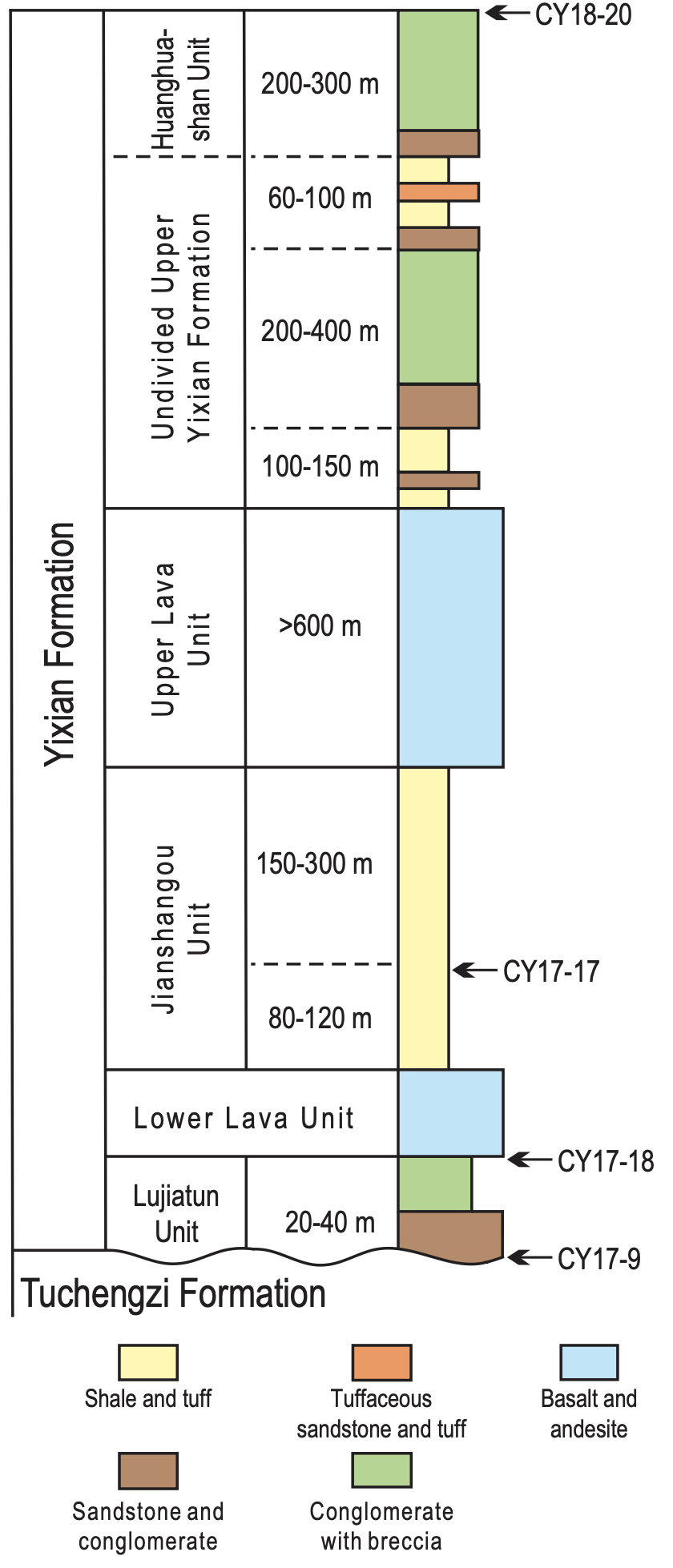
Near the village of Xiawujiazi in China’s Liaoning Province lie the shales and tuffs of the Yixian Formation. Those rocks have yielded a young plant-eater whose skin differs markedly from that of any iguanodontian described before. Named Haolong dongi in 2026, it was an early-diverging hadrosauroid—an early relative of the duck-billed hadrosaurids. Press releases from the describers’ institutions place it about 125 million years ago, in the Early Cretaceous. Above all, hollow spikes dot its neck and chest—and their cells survive in enough detail to show individual nuclei.
A twelve-member team described the animal in Nature Ecology & Evolution, with Jiandong Huang as first author. Paleontologist Pascal Godefroit of the Institute of Natural Sciences in Brussels served as corresponding author. The team combined micro-CT scanning, laser-stimulated fluorescence imaging, chemical analysis and histology of the spikes. As a result, the authors say, the fossil offers unprecedented insight into the microanatomy of non-avian dinosaur skin.
Haolong Key Facts
| Keyword | Fact |
|---|---|
| Pronunciation | Not specified |
| Meaning of name | Spiny Dragon (as reported in news coverage) |
| Group | Ornithopoda (Hadrosauroidea) |
| Type Species | Haolong dongi |
| Diet | Herbivore |
| When it Lived | Around 125 MYA |
| Period | Cretaceous |
| Epoch | Early Cretaceous (Barremian stage) |
| Length | About 8.0 feet (2.45 meters) for the juvenile holotype, as given by the describers. Adult length Not specified |
| Height | Not specified |
| Weight | Not specified |
| Mobility | Not specified |
| First Discovery | Year not specified |
| Described by | 2026 by J. Huang, W. Wu, L. Mao, F. Bertozzo, D. Dhouailly, N. Robin, M. Pittman, T.G. Kaye, F. Manucci, X. He, X. Wang, and P. Godefroit |
| Holotype | AGM 16793 (Anhui Geological Museum, Hefei) |
| Location of first find | Lamagou locality, Yixian Formation (Jianshangou Member according to the Paleobiology Database), Jianchang County, Liaoning Province, China |
Haolong Origins, Taxonomy and Timeline
News coverage translates “Haolong” from Chinese as “spiny dragon,” a phrase the Institute of Natural Sciences also used in its press headline. Meanwhile, the species name dongi honors the late Dong Zhiming, a pioneer of Chinese dinosaur research who died in 2024.
Haolong belongs to Ornithischia, the “bird-hipped” dinosaurs, and within it to Ornithopoda and Iguanodontia—the lineage that includes Iguanodon. More precisely, the describers placed it as an early-diverging, non-hadrosaurid member of Hadrosauroidea. In Godefroit and Filippo Bertozzo’s phylogenetic analysis of 108 ornithischian taxa, mostly iguanodontians, the other Yixian iguanodontians also fell among the early hadrosauroids. Specifically, these were Jinzhousaurus yangi and Bolong yixianensis. Haolong dongi is the type and only known species.
The original description dates the fossil simply to the Early Cretaceous, whereas the Paleobiology Database assigns its locality to the Barremian stage. In 2021, Zhong and colleagues used high-precision zircon dates to bracket the Yixian Formation in the Jin-Yang basin of western Liaoning. By their count, it spans roughly 125.8 to 124.1 million years ago—only about 1.6 million years. Earlier results, they wrote, were “confusing and inadequate,” with duration estimates of about 2 to 7 million years. Older studies also placed these levels anywhere from the middle Barremian to the early Aptian.

Discovery & Fossil Evidence
No openly available source names who found Haolong or when, but the skeleton came from the Lamagou locality in Jianchang County, Liaoning. The Paleobiology Database places that site in the Jianshangou Member, though the paper’s open parts name only the Yixian Formation.
The Anhui Geological Museum in Hefei, Anhui Province, holds the holotype, AGM 16793. It is a near-complete, articulated skeleton, its bones still joined much as in life. The skull preserves the predentary—the toothless bone at the tip of the lower jaw—and even a right stapes, the slender rod of the middle ear. Behind it lie the neck, back and nearly the entire tail, plus the arms, hands, legs and feet. A small fault twisted the back of the skull, so the antorbital fenestra—an opening in front of the eye—presumably looks too large. Chemically, the skin layer differs from the surrounding sediment, so real tissue survived, though fossilization altered it.

This animal was not fully grown. In its back, the neural arches—the bony arches above each vertebra—had not fused to the vertebral bodies. Its sacrum and tail ribs were also unfused. Separately, the authors reconsidered a very young specimen from Ningcheng County in Inner Mongolia, once tentatively referred to Bolong. Since it lacks undeniably diagnostic characters, they called it an indeterminate hadrosauroid. No other Haolong specimen has been confirmed.
Haolong Size and Description
Short description of Haolong
The skull measures 285 millimeters (11.2 inches), and the region in front of the eyes makes up about 61 percent of that length. Its external naris, or nostril opening, was short and narrow, at only 26 percent of the preorbital length. The antorbital fenestra stayed open, with a smaller extra opening behind it. At the front, the predentary carried five pairs of conical projections. Meanwhile, a horny beak covered the roughened front margin of the upper jaw in life. About 10 to 13 tooth positions lined each jaw, and the crowns show extensive wear.
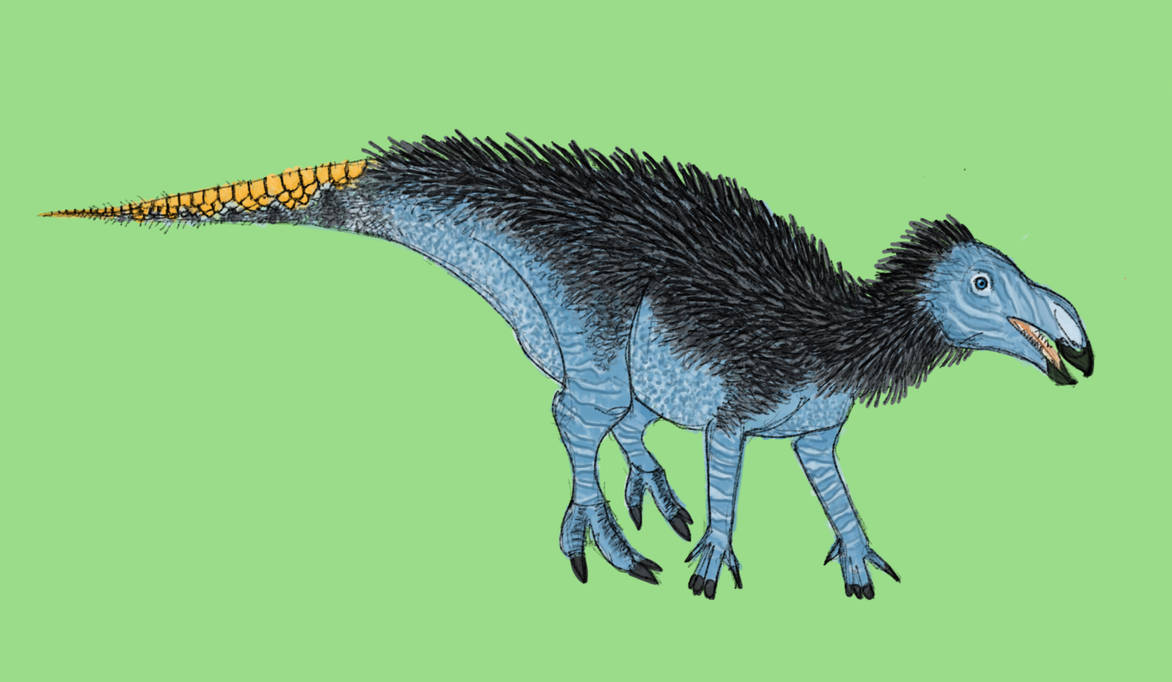
Behind the head came 11 neck vertebrae and 12 back vertebrae, with about 20 ribs still in place. By the authors’ reading, the rib cage was likely relatively narrow. Further back, the tail held 49 vertebrae, minus only the very tip, and made up about half the animal’s total length. Large overlapping scales ran along most of the tail, though four non-overlapping ones covered the top of its base. In addition, news coverage counted nine rows of the overlapping scales on its upper surface. In contrast, tuberculate (bumpy) scales covered the neck and chest, with the spikes interspersed among them.
Size and Weight of Type Species
The describers give the holotype a total length of about 8 feet (2.45 meters), a figure repeated in news reports. Because the animal was a juvenile, its adult size remains unknown.
Some outlets assumed adult sizes from related species, although IFLScience stressed that no one can know how big Haolong might have grown. No height or weight estimate has appeared, but for a sense of scale, the humerus (upper arm bone) measures 192 millimeters (7.6 inches).
The Dinosaur in Detail
Haolong‘s most distinctive feature is the set of spikes in its skin. The describers identified large, medium and small spikes on the neck and chest, scattered among the scales rather than attached to them. Specifically, each was a hollow cylinder—a horny outer layer over a many-layered epidermis, wrapped around a porous core of dermis. Even their skin cells, or keratinocytes, survive down to their nuclei.
Structurally, the spikes differ from both the protofeathers of other non-avian dinosaurs and the scaly spines of living lizards and snakes. Accordingly, the authors say this suggests a distinct evolutionary origin. They proposed a primary role in deterring predators, with possible secondary roles in temperature control or, less likely in their view, touch sensing. However, the published peer review file shows that reviewers were at first unconvinced by this defensive reading. The authors then expanded on thermoregulation and other alternatives. Whether adults kept the spikes is still unknown.
In Jinzhousaurus and Bolong, the lower end of the femur (thigh bone) curves slightly backward, whereas in Haolong it is pillar-like and perfectly straight. Like those of Bolong and Jinzhousaurus, and unlike the conical thumb spike of Iguanodon, its thumb claw is straight, triangular and flattened from side to side. During review, referees also asked why the fossil should not be a juvenile Bolong or Jinzhousaurus. In reply, the authors listed about thirty differences, many in bones they regard as stable through growth. They further noted that several related iguanodontians in one formation is usual, as in Early Cretaceous Spain and the Isle of Wight. Taken together, the describers make their case for a distinct early hadrosauroid. However, as far as we could find, no independent study had tested it by late 2026.
Interesting Points about Haolong
- News coverage translates the name as “spiny dragon,” and the species honors Dong Zhiming, a pioneer of Chinese dinosaur research.
- Its skin cells survive down to their nuclei, which the describers say offers unprecedented insight into non-avian dinosaur skin.
- The longest spike reported in news coverage measured about 44.2 millimeters long and 7.8 millimeters wide at its base.
- The skull preserves a tiny stapes, and the describers tentatively read a patch beside it as a fragment of eardrum.
- Ossified tendons along its back and tail form a double-layered diamond lattice, like those of Iguanodon and Mantellisaurus.
Contemporary Dinosaurs
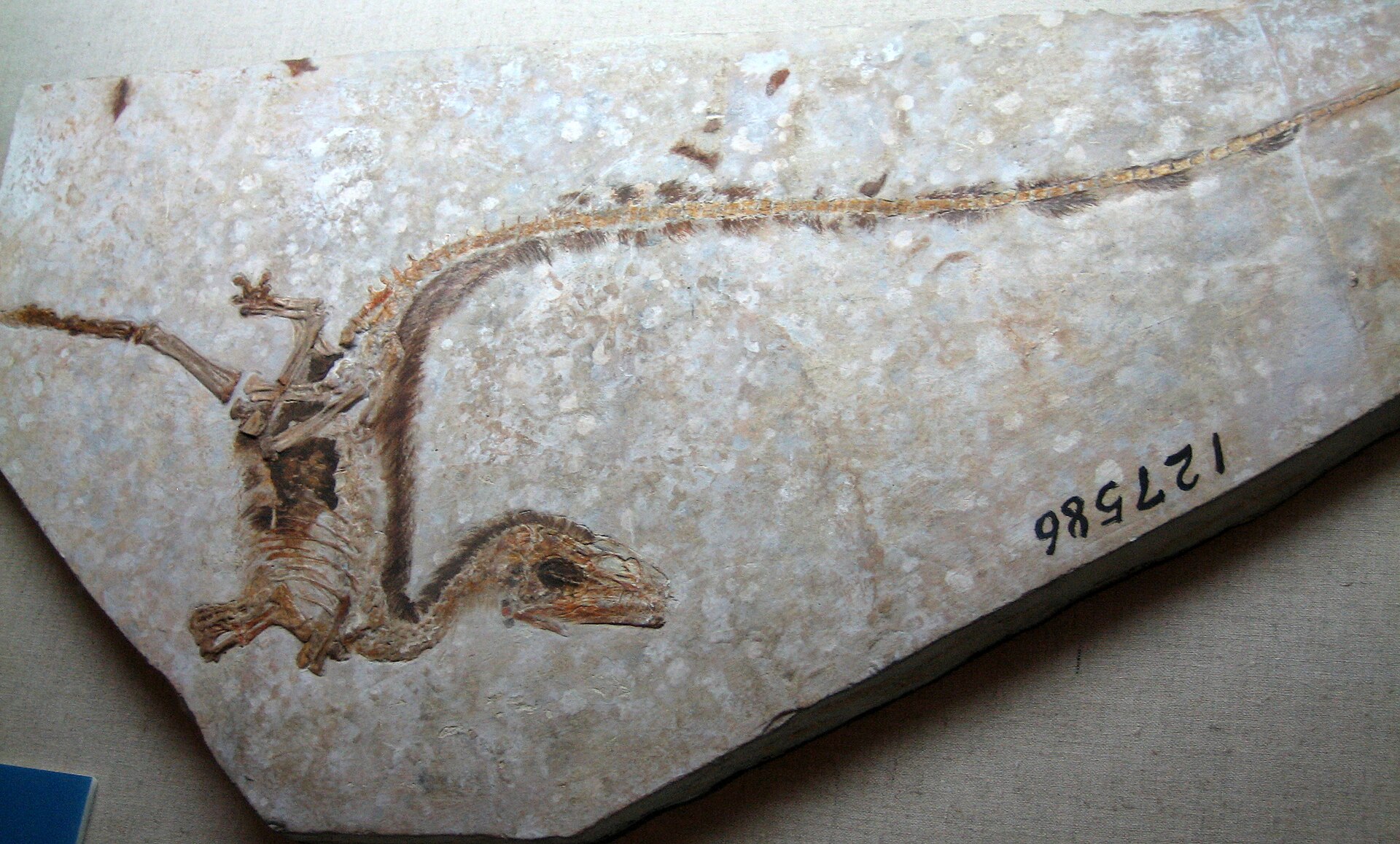
Also from the Yixian Formation, and from the Jianshangou levels to which the Paleobiology Database assigns Haolong, was Sinosauropteryx. Chen and colleagues, writing in 1998, considered this small theropod close to Compsognathus. They reported that it had the longest tail of any known theropod, plus skin structures bearing on the origin of feathers. In 1999, Wang and colleagues placed it in a lower Yixian assemblage dated to about 125.4 to 125.5 million years ago. Still, no fossil links the two directly.
The Jianshangou Member also yielded Sinornithosaurus, a dromaeosaurid—a member of the raptor family—with a filamentous body covering. Its type specimen comes from Sihetun, yet nothing ties it directly to Haolong.
Adding further diversity was Beipiaosaurus, a therizinosauroid theropod with integumentary filaments. Its 1999 describers reported it from the Yixian Formation, and the Paleobiology Database places it in the Jianshangou Member at Sihetun. It, too, has no recorded link to Haolong.
From the higher Dakangpu Member of the same formation, and so somewhat younger, comes Jinzhousaurus yangi, a large iguanodontian named by Wang and Xu in 2001. Its type specimen was found at Baicaigou, and the Haolong describers count it among the three early hadrosauroids of the Yixian Formation. Barrett and colleagues later ranked it, with an unnamed sauropod, among the largest but least abundant Jehol animals.
Zhong and colleagues’ Jin-Yang basin dates put the whole formation within about 1.6 million years. If those dates hold across western Liaoning, all four lived close in time to Haolong, with Jinzhousaurus somewhat later.

Haolong in its Natural Habitat
The world Haolong roamed was one of lakes and occasional rivers in a volcanic landscape. Its own skeleton lay in shales and tuff, a rock formed from volcanic ash. In 2011, Amiot and colleagues studied East Asian climates from the Barremian to the early Albian. They estimated mean air temperatures of about 50 °F (10 °C) at around 42 degrees north, comparable to cool temperate climates today. As further evidence, they cited temperate Xenoxylon wood and the absence of heat-loving reptiles such as crocodilians in northeastern China.
As a herbivore, Haolong likely cropped plants with its horny beak, and its teeth show extensive wear. In addition, each tooth position held only one functional tooth at a time. While there is no direct evidence of its diet, it may have browsed on gymnosperms. Their fossils turn up in the lower Yixian alongside fish, turtles, pterosaurs and birds.
Whether Haolong lived alone or in groups remains unknown from a single juvenile skeleton. Meanwhile, a CNRS press release describes it as a herbivore under predation pressure from small carnivorous dinosaurs. That picture fits the defensive role the describers proposed for its spikes. Taken together, Haolong adds a young, spiny plant-eater to a Jehol fauna in which large dinosaurs were rare.
Frequently Asked Questions
News coverage translates it from Chinese as “spiny dragon,” and the species name honors Chinese paleontologist Dong Zhiming.
It lived around 125 million years ago, in the Barremian stage of the Early Cretaceous.
The describers give the juvenile holotype a length of about 8 feet (2.45 meters). Its adult size is not known.
It was a herbivore that likely cropped plants with a horny beak, and its teeth show heavy wear.
It was found at Lamagou, in the Yixian Formation of Jianchang County, Liaoning Province, China.
Hollow spikes on its neck and chest preserve skin cells down to their nuclei, and their structure suggests a distinct evolutionary origin.
Sources
The information in this article is based on various sources, drawing on scientific research, fossil evidence, and expert analysis. The aim is to provide a comprehensive and accurate overview of Haolong. However, please be aware that our understanding of dinosaurs and their world is constantly evolving as new discoveries are made.
- https://doi.org/10.1038/s41559-025-02960-9
- https://static-content.springer.com/esm/art%3A10.1038%2Fs41559-025-02960-9/MediaObjects/41559_2025_2960_MOESM1_ESM.pdf
- https://static-content.springer.com/esm/art%3A10.1038%2Fs41559-025-02960-9/MediaObjects/41559_2025_2960_MOESM3_ESM.pdf
- https://paleobiodb.org/classic/displayCollResults?collection_no=278538
- https://pmc.ncbi.nlm.nih.gov/articles/PMC8288181/
- https://doi.org/10.1073/pnas.1011369108
- https://naturalhistory.si.edu/sites/default/files/media/translated_publications/Wang%26amp%3B_99.pdf
- https://www.app.pan.pl/archive/published/app54/app54-035.pdf
- https://www.nature.com/articles/34356
- https://www.nature.com/articles/45769
- https://www.nature.com/articles/20670
- https://www.naturalsciences.be/en/science/news/spiny-dragon-reveals-hidden-secrets-of-dinosaur-skin-after-125-million-years
- https://www.cnrs.fr/en/press/dinosaur-spikes-exhibiting-unprecedented-properties-discovered-china
- https://www.discoverwildlife.com/dinosaurs/haolong-dongi-china
- https://www.iflscience.com/125-million-year-old-fossilized-skin-reveals-juvenile-dinosaur-that-was-spiky-like-a-hedgehog-82505
- https://www.sci.news/paleontology/haolong-dongi-14545.html
- https://newsweek.com/fossils-paleontology-dinosaur-spikes-china-haolong-dongi-11549633
- https://blog.everythingdinosaur.com/?p=68411
This article was last fact checked: TheDinosaurs Team, 05-11-2026
Featured Image Credit: Connor Ashbridge, CC BY 4.0, via Wikimedia Commons
