
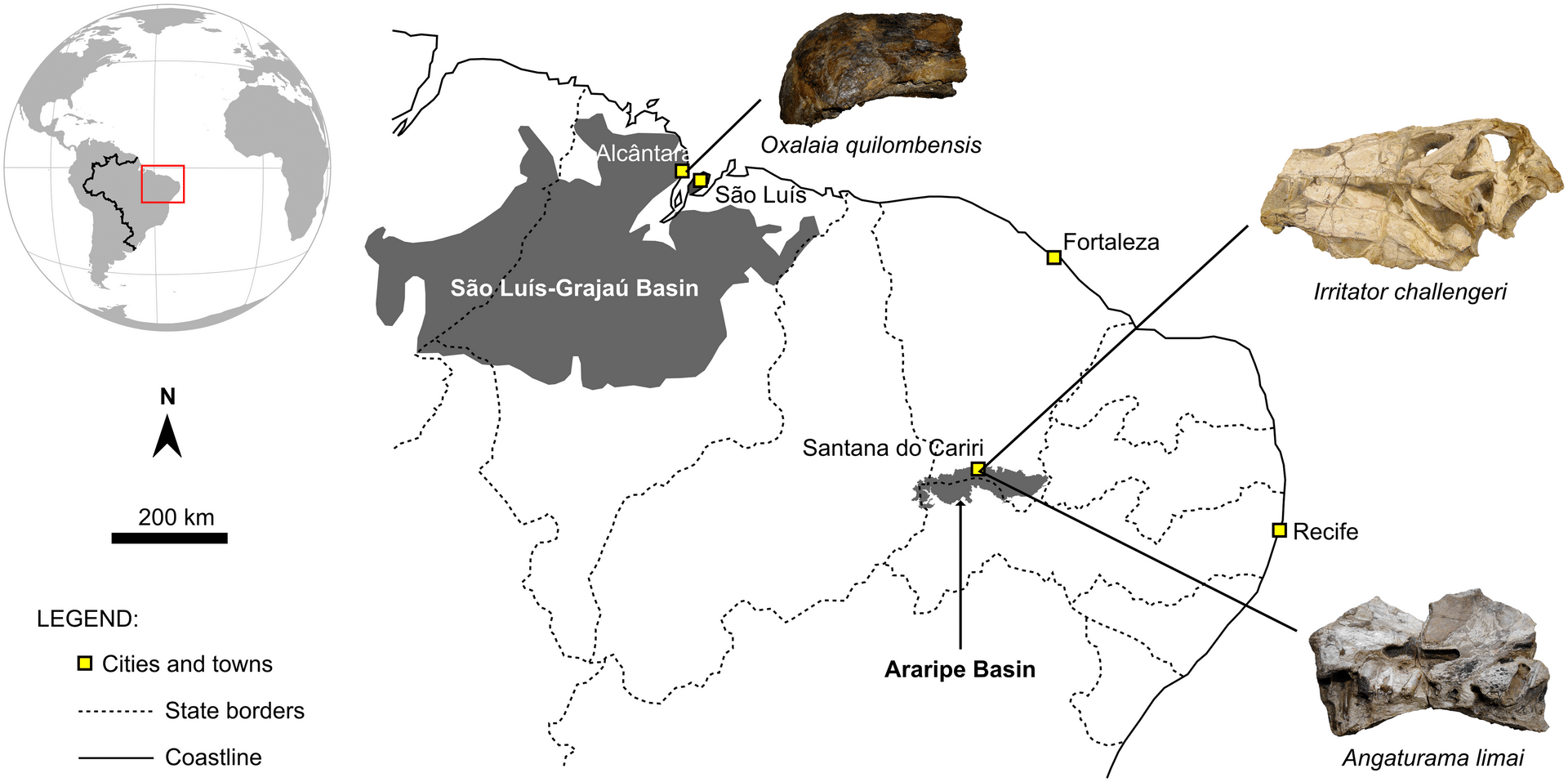
On Cajual Island, off the coast of Maranhão in northeastern Brazil, tides and waves wash fossils out of the Alcântara Formation. Among them lay the snout tip of Oxalaia quilombensis, a spinosaurid theropod named in 2011. It lived during the Cenomanian stage of the Late Cretaceous—roughly 100.5 to 93.9 million years ago. Although only a fraction of its skull survives, its describers called it the largest theropod then known from Brazil.
The holotype came from Laje do Coringa, a beach bone-bed where strong tides tend to destroy the fossils they expose. Unusually, this specimen was found still in situ—lying where it had been buried. Paleontologist Alexander W.A. Kellner and four colleagues at the Museu Nacional in Rio de Janeiro described it as the first formally named dinosaur species from Brazil’s Cenomanian rocks. From a fused snout tip and a jaw fragment, they argued that it appeared closer to North African spinosaurids than to its Brazilian cousins.
Oxalaia Key Facts
| Keyword | Fact |
|---|---|
| Pronunciation | Not specified |
| Meaning of name | Named for Oxalá, From the Quilombo |
| Group | Theropoda |
| Type Species | Oxalaia quilombensis |
| Diet | Carnivore |
| When it Lived | 100.5 to 93.9 MYA |
| Period | Cretaceous |
| Epoch | Late Cretaceous (Cenomanian stage) |
| Length | 39 to 46 feet (12 to 14 meters), indirect 2011 estimate |
| Height | Not specified |
| Weight | 5 to 7 tons as published (about 11,000 to 15,400 pounds if metric), indirect 2011 estimate |
| Mobility | Not specified |
| First Discovery | Not specified |
| Described by | 2011 by A.W.A. Kellner, S.A.K. Azevedo, E.B. Machado, L.B. de Carvalho, and D.D.R. Henriques |
| Holotype | MN 6117-V |
| Location of first find | Laje do Coringa, Cajual Island, Alcântara Formation, Maranhão State, Brazil |
Oxalaia Origins, Taxonomy and Timeline
The genus name honors Oxalá, whom Kellner and colleagues described as “the most respected masculine deity in the African pantheon, introduced in Brazil during slavery.” Meanwhile, the species name quilombensis comes from the Portuguese quilombo—a place where the quilombola, descendants of formerly enslaved Brazilians, live. Cajual Island, the authors noted, is one of these places. Together, the name ties the animal to its island and to the people who live there.
In 2011, Kellner’s team placed Oxalaia within Theropoda and Spinosauroidea, and then in Spinosauridae, a family they called “this bizarre and poorly known group.” Within it, they assigned the new genus to Spinosaurinae, closely related to Spinosaurus cf. S. aegyptiacus and an Algerian spinosaurid. In 2026, Lewis and colleagues listed that subfamily as including Irritator, Oxalaia and Spinosaurus, all with unserrated, conical teeth. Oxalaia quilombensis is the type and only known species.
Kellner and colleagues placed the Laje do Coringa beds in the early Cenomanian, a stage spanning roughly 100.5 to 93.9 million years ago. However, a 2011 study of the same formation by Candeiro and colleagues used the broader label “Albian–Cenomanian.” Lewis’s team later suggested that spinosaurids reached South America from Africa in at least two waves, before the continents fully separated in the latest Albian.
Discovery & Fossil Evidence
Laje do Coringa lies on the easternmost beach of Cajual Island, in Alcântara Municipality. Geologically, the site belongs to the Alcântara Formation of the Itapecuru Group, within the São Luís Basin. The 2011 paper calls it one of Brazil’s few bone-beds—a deposit holding hundreds of isolated elements, some probably reworked. Neither the finder nor the year of collection appears in the description.

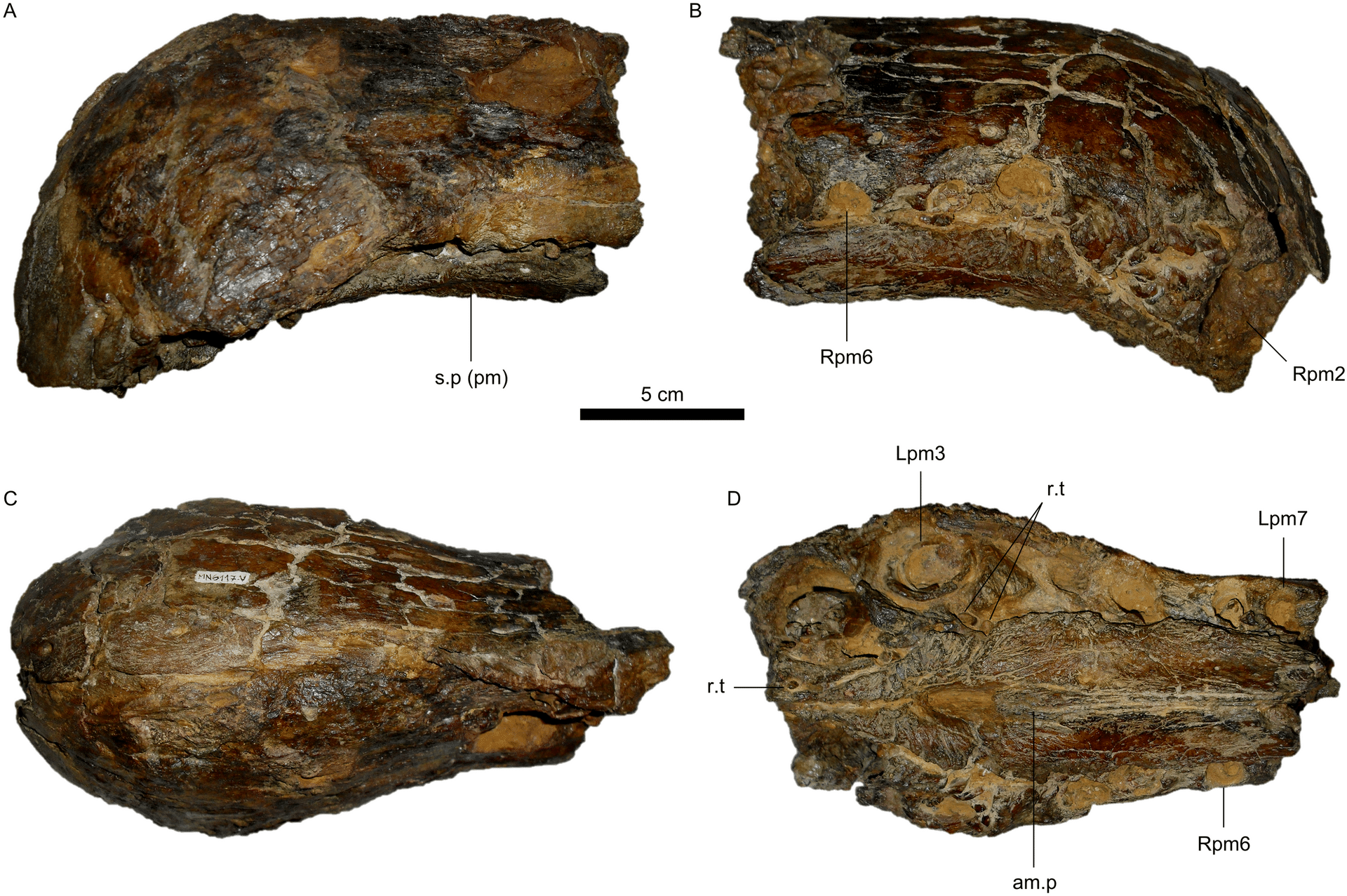
The holotype, MN 6117-V, consists of fused premaxillae—the paired bones that form the tip of the upper jaw. Measured directly, it is about 7.9 inches (201 millimeters) long, 4.5 inches (115 millimeters) wide and 4.1 inches (103 millimeters) high. The 2011 paper lists it in the collections of the Museu Nacional/UFRJ in Rio de Janeiro.
A second specimen, MN 6119-V, is an incomplete left maxilla, the main tooth-bearing bone of the upper jaw. Unlike the holotype, it turned up as surface float, and its outer face shows extensive abrasion. The authors referred it to Oxalaia only tentatively. In 2006, Medeiros reported hundreds of spinosaurid teeth of two types from these deposits. The Oxalaia teeth compare well with the first type. Even so, no further specimens of Oxalaia have been confirmed beyond these two bones from Cajual Island.
Oxalaia Size and Description
With only a snout tip and a jaw fragment, any picture of Oxalaia beyond its mouth leans on its relatives.
Short description of Oxalaia
At the front, the premaxillae flare into the typical spinosaurid rosette—a broad, rounded expansion at the snout tip. The premaxilla holds seven alveoli (tooth sockets), the same count seen in Angaturama, Suchomimus, Cristatusaurus and the Algerian spinosaurid. The first tooth was small, while the second and third sockets were the largest. A gap called a diastema separated the third and fourth teeth, and a second gap lay between sockets five and six.
None of the preserved teeth carry serrations, and in cross-section they are oval rather than blade-like. A row of nutrient foramina (small openings for blood vessels) runs above the tooth bases. Along the front edge, the snout bears large, deep pits that the authors interpreted as neurovascular foramina, openings for nerves and blood vessels. Underneath, the palate side is well ornamented, unlike the smoother surface in other spinosaurids. In 2017, Sales and Schultz described these sculptured bones as a convex secondary palate—the bony roof of the mouth—but noted that other spinosaurids share it.
The maxilla fragment preserves two complete sockets and part of a third. On its upper surface, a depression likely formed part of the rear edge of the external naris, or nostril opening. Everything behind the jaws is unknown, including how Oxalaia stood or moved. With no skin or soft tissue preserved, any restoration of its body is speculative.

Size and Weight of Type Species
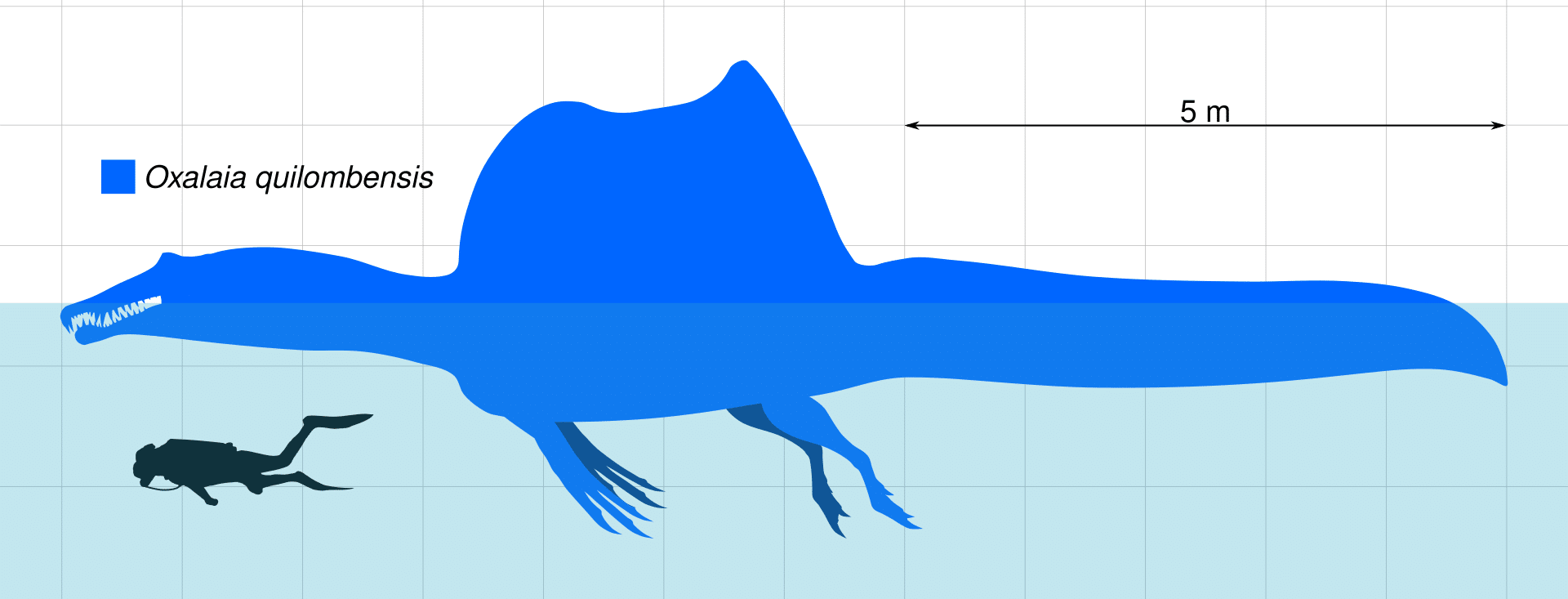
Kellner and colleagues estimated a total length between 39 and 46 feet (12 and 14 meters). This is an indirect figure, reached by comparing the premaxillae with a large Spinosaurus snout cataloged as MSNM V4047. Comparisons with other spinosaurids also gave them a skull length of around 4.4 feet (1.35 meters).
Their weight estimate was 5 to 7 tons, or about 11,000 to 15,400 pounds if metric tons are meant. No height at the hips has been published. We found no later estimate, so the 2011 figures remain the only ones on record.
In 2017, Sales and Schultz repeated that Oxalaia likely reached about 12 to 14 meters. They also judged the holotype intermediate in size between the baryonychines, a second spinosaurid subgroup, and the giant MSNM V4047. Taken at face value, these numbers made it the largest theropod known from Brazil in 2011—a title the 2017 paper repeated.

The Dinosaur in Detail
What sets this dinosaur apart are small details of the snout. The 2011 diagnosis lists unserrated teeth and a diastema between sockets five and six that is shorter than in Spinosaurus. It also names four autapomorphies—traits found in no other species. They are a premaxilla widest between sockets three and four, a very thin maxillary projection on the palate, two replacement teeth in the third socket, and a heavily sculptured underside. Sales and Schultz later questioned two of these, since other spinosaurids share the palate and can have similarly thin processes.
Compared with Angaturama, another Brazilian spinosaurid, Oxalaia lacks a crest along the snout’s midline and has a wider rostrum (snout). Its terminal expansion is also rounder than in Spinosaurus cf. S. aegyptiacus and the Algerian spinosaurid. For Kellner’s team, the original Spinosaurus holotype offered no comparison—it lacked an upper jaw and was destroyed in World War II.
Sales and Schultz separated Oxalaia from African spinosaurines by its oval, rather than mushroom-shaped, premaxillae seen from above. They cautioned that diastema length and tooth counts are “not a reliable characteristic for taxonomic purposes.” Likewise, the paired replacement teeth might simply be intraspecific variation—differences between individuals of one species. Studies in 2022 and 2023 reported the same pairing in Iberospinus and Irritator.
Sales and Schultz recovered Angaturama and Oxalaia as successive outgroups—step-by-step more distant relatives—of MSNM V4047. In 2021, Lacerda, Grillo, and Romano instead found Oxalaia closest to a pairing of MSNM V4047 and Irritator, with Angaturama outside them. In contrast, Smyth, Ibrahim and Martill concluded in 2020 that Oxalaia falls within Spinosaurus aegyptiacus, making it a junior synonym. Even so, later studies, including Lewis and colleagues in 2026, still treat it as a separate genus, so its status remains a matter of debate.
Interesting Points about Oxalaia
- Its species name refers to quilombos, communities of descendants of formerly enslaved Brazilians, and Cajual Island is one of them.
- It was the first formally described dinosaur species from Brazil’s Cenomanian deposits.
- Its holotype was found still in situ, a rarity at a beach site where strong tides usually destroy exposed fossils.
- Its third tooth socket held two replacement teeth at once, a feature its describers called unusual among theropods.
- A 2026 study proposed that its lineage reached South America from Africa before the two continents fully separated in the latest Albian.
Contemporary Dinosaurs
Also found in the Alcântara Formation is Itapeuasaurus cajapioensis, a rebbachisaurid diplodocoid sauropod named by Lindoso and colleagues in 2019. Its bones come from Itapeua Beach in Cajapió, Maranhão, rather than Laje do Coringa. Lindoso’s team described it from the Cenomanian Alcântara Formation, and a 2026 study by Farah and colleagues kept that assignment. The two animals therefore share a formation and a stage, but no source records any interaction between them. Farah’s team placed the Itapeua bones in a transitional to marginal-marine setting where tides may have reworked them, though how they moved remains unclear.
Laje do Coringa itself has yielded large teeth with wrinkled enamel that were referred to Carcharodontosaurus sp. In fact, Medeiros and colleagues found in 2014 that carcharodontosaurid and spinosaurid teeth dominate the site’s theropod record. However, the identification rests on teeth alone, and those authors note it may or may not be the North African species. In the neighboring region of eastern Morocco, the Cenomanian Kem Kem Group (Gara Sbaa and Douira formations) has produced a partial skull of Carcharodontosaurus saharicus, according to Ibrahim and colleagues. Medeiros’s team found the Laje do Coringa fauna “remarkably similar to the chronocorrelate fauna of Northern Africa” and compared it directly with the Kem Kem beds.
Oxalaia in its Natural Habitat
Imagine a tidal estuary along the edge of a young, widening ocean. Lewis and colleagues describe the Alcântara Formation as sandstones, shales and minor conglomerates laid down in a tidal estuarine environment. Earlier, Sales and Schultz linked its deposition to the opening of the equatorial South Atlantic. Its assemblage mixes continental, coastal and marine animals. Although the reworked bone-bed is somewhat time-averaged, Sales and Schultz noted that most of them might have been coeval during part of the Cenomanian.
While there is no direct evidence of what Oxalaia ate, its describers grouped spinosaurids among predatory dinosaurs, and its unserrated, conical teeth match those of other spinosaurines. Sales and Schultz linked spinosaurid skull and tooth evolution to trends toward semiaquatic and/or piscivorous (fish-eating) habits. However, that is a group-level idea, and Lewis’s team called spinosaurid ecology “one of the most contested aspects of theropod research.” Whether Oxalaia itself hunted fish remains unknown.
Nothing is known about its social behavior. Hundreds of spinosaurid teeth come from these deposits, but rapid replacement and reworking make tooth counts a poor guide to abundance. Its lineage, however, was nearing its end—as Lewis and colleagues summarize, spinosaurids apparently disappeared by, or near, the Cenomanian–Turonian boundary.
Frequently Asked Questions
It honors Oxalá, a deity of the African pantheon introduced in Brazil, and the species name refers to quilombo communities.
It lived during the Cenomanian stage of the Late Cretaceous, roughly 100.5 to 93.9 million years ago.
Its describers estimated 39 to 46 feet long and 5 to 7 tons. Both figures are indirect, based on comparison with Spinosaurus.
It was a carnivore, like other spinosaurids, but no direct evidence of its prey has been found.
Its fossils come from Laje do Coringa on Cajual Island, Maranhão, in Brazil’s Alcântara Formation.
Its describers cited a rounded snout tip, a heavily sculptured palate and paired replacement teeth, though other spinosaurids share the palate.
Sources
The information in this article is based on various sources, drawing on scientific research, fossil evidence, and expert analysis. The aim is to provide a comprehensive and accurate overview of Oxalaia. However, please be aware that our understanding of dinosaurs and their world is constantly evolving as new discoveries are made.
- https://doi.org/10.1590/S0001-37652011000100006
- https://www.scielo.br/j/aabc/a/4gBcsdPPQJKCYcJ3BYwyZgq/?lang=en&format=pdf
- https://doi.org/10.1371/journal.pone.0187070
- https://doi.org/10.1016/j.cretres.2020.104520
- https://doi.org/10.1080/08912963.2021.2000974
- https://doi.org/10.1080/08912963.2022.2069019
- https://doi.org/10.1371/journal.pone.0262614
- https://doi.org/10.26879/1242
- https://doi.org/10.1016/j.jsames.2014.04.002
- https://doi.org/10.1098/rsos.260994
- https://cris.unibo.it/handle/11585/104809
- https://doi.org/10.3897/zookeys.928.47517
- https://doi.org/10.1016/j.cretres.2019.104191
- https://doi.org/10.1016/j.cretres.2026.106495
- https://paleobiodb.org/data1.2/taxa/single.txt?name=Oxalaia&show=attr,app
This article was last fact checked: TheDinosaurs Team, 02-11-2026
Featured Image Credit: PaleoGeekSquared, CC BY-SA 4.0, via Wikimedia Commons
