In China’s northwestern Gansu Province, the lake-laid mudstones of the Xiagou Formation are famous for birds, not dinosaurs. More than 100 partial bird skeletons have come from its Changma Basin beds, many still bearing traces of feathers and skin. Among them lay one shoulder and arm from a very different animal—a microraptorine dromaeosaurid named Jian changmaensis in 2026. It lived during the early Aptian stage of the Early Cretaceous, roughly 124 to 120 million years ago on its describers’ older timescale.
An excavation team from a provincial fossil research center in Gansu collected the specimen in 2008. Two years later, paleontologist Matthew Lamanna and colleagues first reported it in a conference abstract. Then, in 2026, Ling-Qi Zhou and five co-authors formally named it in the Annals of Carnegie Museum. As Lamanna put it, Changma has yielded “more than a hundred bird fossils” but “only this single non-avian dinosaur specimen.” Consequently, Jian offers a rare glimpse of the non-avian dinosaurs that shared this bird-rich lake.
Jian Key Facts
| Keyword | Fact |
|---|---|
| Pronunciation | Not specified |
| Meaning of name | Named for the Jiān, a One-Winged Bird of Chinese Mythology |
| Group | Theropoda (Dromaeosauridae, Microraptorinae) |
| Type Species | Jian changmaensis |
| Diet | Carnivore, according to co-author Jingmai O’Connor in news coverage (not stated in the 2026 paper) |
| When it Lived | 124 to 120 MYA on an older timescale (the Aptian now begins 121.4 MYA) |
| Period | Cretaceous |
| Epoch | Early Cretaceous (Aptian stage) |
| Length | Not specified |
| Height | Not specified |
| Weight | Not specified |
| Mobility | Possibly volant (able to fly), according to its describers, though O’Connor says it probably glided rather than truly flew |
| First Discovery | 2008 by the Changma excavation team of the former Fossil Research and Development Center, Gansu Province |
| Described by | 2026 by L.-Q. Zhou, M.C. Lamanna, A.W. Poust, D.-Q. Li, H.-L. You, and J.K. O’Connor |
| Holotype | GSGM-D050 |
| Location of first find | Near Changma village, Changma Basin, Xiagou Formation, Gansu Province, China |
Jian Origins, Taxonomy and Timeline
The name Jian comes from the Jiān (鹣), which the describers call “a one-winged bird in Chinese mythology.” The choice nods to the bird-like and possibly volant—able to fly—nature of the animal. It also refers to a holotype that preserves only one shoulder and forelimb, while the species name changmaensis honors Changma, where the fossil turned up.
Jian belongs to the theropod branch of the dinosaur family tree, within the family Dromaeosauridae—the so-called raptors. More precisely, it sits in Microraptorinae, the subgroup named for the small Chinese genus Microraptor. In the 2026 analysis, Jian fell inside a cluster of derived microraptorines alongside Sinornithosaurus, Changyuraptor, and six other forms. By contrast, the same study placed Shanag outside the group and Yurgovuchia among the Eudromaeosauria, or “true dromaeosaurs.” Jian changmaensis is the type and only known species.
The Changma beds date to the lower Aptian, an age that rests mainly on a 2013 study by Suarez and colleagues. They matched the rocks’ carbon-isotope shifts to the early Aptian record of Oceanic Anoxic Event 1a—a global spell of oxygen-poor seas. However, their 124 to 120 million-year figure uses an older timescale than today’s international chart, which starts the Aptian at 121.4 million years ago. Meanwhile, some recent work argues for a younger span, from late in the early Aptian to the early Albian. Even so, the describers favor the isotope-based age. On it, the Changma birds appear “at least roughly contemporaneous” with the Jehol Group’s upper Yixian and Jiufotang birds.
Discovery & Fossil Evidence
Changma’s fossil fame began in 1981, when paleontologists searching for fossil fish found the holotype of the bird Gansus. It was “the first Mesozoic bird to be found in China.” Renewed exploration began in 2002, and in 2008 a Changma excavation team recovered Jian near the village. Gui-Hai Cui later prepared the specimen. Before Jian, the basin’s only described non-avian dinosaur evidence was a set of sauropod and ornithopod footprints reported in 2017.
The holotype, GSGM-D050, is kept at the Gansu Geological Museum in Lanzhou. It consists of an articulated partial left pectoral girdle (shoulder girdle) and forelimb. The preserved bones are a complete scapulocoracoid (fused shoulder blade and coracoid) and the humerus (upper arm bone). Both the radius and ulna (forearm bones) survive, but the carpus (wrist) and manus (hand) are missing. All lie partly articulated in yellowish-gray mudstone, and compaction slightly crushed every element without apparently changing their overall lengths.
In 2019, the team imaged the slab in three scans using micro-computed laminography, a high-resolution X-ray method. Together with a surface study, the scans revealed a fully fused scapulocoracoid and smooth, “finished” bone surfaces. Both features indicate that the animal was probably mature, or nearly so, when it died, and it remains the only known specimen.
Jian Size and Description
With only one arm to work from, any portrait of Jian begins at the shoulder—and ends at the wrist.
Short description of Jian
The front half of the scapulocoracoid is strongly arched, giving it what the describers call a “‘J’-shaped contour.” Its coracoid is extremely elongate, at more than half the length of the scapula. A large, elliptical opening called the supracoracoid fenestra pierces it, spanning about half its length at 0.7 inches (18.6 millimeters). Meanwhile, the humerus is longer than the scapula and has a hollow shaft. Its deltopectoral crest—a ridge for the chest and shoulder muscles—runs slightly less than a third of the bone’s length.
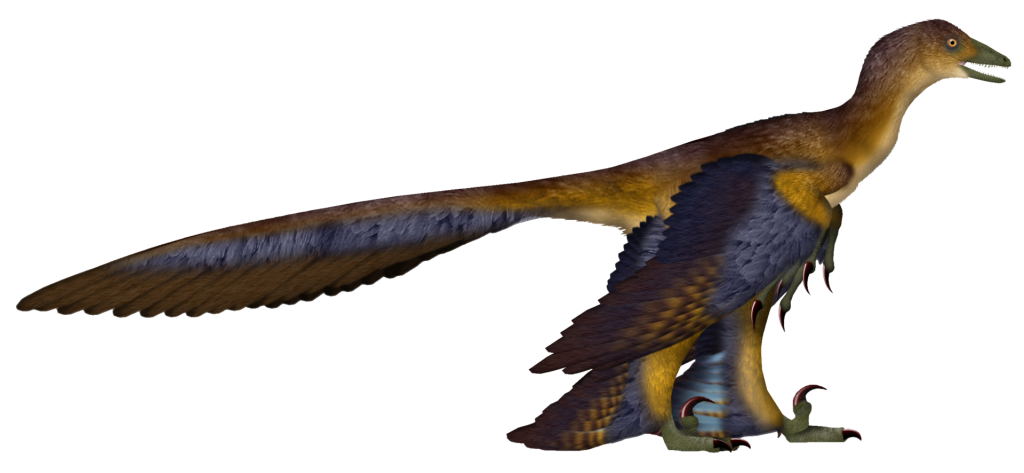
In the forearm, the rod-shaped radius is much narrower than the gently bowed ulna, which ends in a well-developed olecranon (the elbow’s bony point). No ulnar papillae, or “quill knobs,” are evident, though any present would be minute and hard to detect. No feathers are preserved either, so any discussion of its plumage is speculative. Even so, O’Connor told reporters the team suspects it had long arm and leg feathers, like its fellow microraptorines.

Size and Weight of Type Species
No peer-reviewed source gives a body length or mass for Jian, but the describers did measure its bones directly. The humerus is 4.0 inches (101.6 millimeters) long, and the ulna is 3.5 inches (89.2 millimeters). The radius measures 3.3 inches (84.9 millimeters), the scapula about 2.7 inches (69 millimeters), and the coracoid about 1.5 inches (37 millimeters).
From these bones, Zhou and colleagues judged Jian a “medium-sized” microraptorine, intermediate between adult Microraptor zhaoianus and Sinornithosaurus millenii. The paper lists four larger forms—the biggest Sinornithosaurus specimens, Changyuraptor, and the probable microraptorines Zhenyuanlong and Tianyuraptor. By contrast, Wulong and Zhongjianosaurus were smaller.
In news coverage, O’Connor said it “probably had something like a four-foot wingspan, around the size of a barn owl.” No method for this 1.2-meter estimate has been published. She also called it “one of the biggest microraptor specimens,” and indeed its humerus is longer than any Microraptor humerus in the paper.
The Dinosaur in Detail
Above all, its shoulder sets Jian apart, with a coracoid about 36 percent of humerus length, the highest ratio of any microraptorine. The next closest values are about 35 and 33 percent. The angle between scapula and coracoid is only slightly over 90 degrees, versus about 105 degrees in Microraptor.
Two other traits mark it out. First, the distal condyles—the rounded joint surfaces at the elbow end of the humerus—sit on the bone’s front surface. This is a local autapomorphy—unique to Jian within Microraptorinae—though other theropods such as Erlikosaurus and birds share it. Second, its radius bears a well-developed foramen (small opening) on its ventral surface near the elbow, unreported in other dromaeosaurids. Its cylindrical upper end also resembles that of animals “capable of significant pronation and supination”—turning the palm down and up.
Among theropods, the describers know a comparable fenestra only in four microraptorines: Microraptor, Sinornithosaurus, Wulong, and Zhongjianosaurus. In 2025, however, Moutrille and colleagues reported a similar opening in Shri rapax, a Late Cretaceous eudromaeosaurian from Mongolia. So the feature is not strictly limited to microraptorines. Zhou and colleagues then expanded a 2020 matrix by Pei and colleagues to 167 taxa and 853 characters. The run yielded 810 equally short trees, leaving Jian in an unresolved cluster of nine derived microraptorines. However, a reduced analysis without the scrappiest taxa grouped it with Microraptor and Zhongjianosaurus in 85 percent of trees.
Still, of the eight traits uniting derived microraptorines, the describers could score only one in Jian. That one trait—a radius less than half as wide as the ulna—is present. Although this study supports Tianyuraptor and Zhenyuanlong as microraptorines, two other recent analyses place both closer to Eudromaeosauria. Taken together, Jian is clearly a microraptorine, but its exact branch remains open.
Interesting Points about Jian
- Jian is the first non-avian dinosaur body fossil from Changma, a site that has yielded more than 100 partial bird skeletons.
- Its name honors a one-winged bird of Chinese mythology, a fitting nod to a one-armed holotype.
- Found in 2008 and first reported in a 2010 conference abstract, the fossil waited 18 years for its formal name.
- O’Connor calls Jian the team’s “best guess” for the maker of pellet-like clumps of shattered bird bones, an idea absent from the paper.
Dinosaurs from the Same Formation
Also known from the Xiagou Formation (exact level relative to Jian not known): Qiaowanlong kangxii, a sauropod from the Yujingzi Basin, a different basin from Changma. Its 2009 describers called it a brachiosaurid from the late Early Cretaceous Xinminpu Group. Later analyses, however, recover it as a somphospondylan—part of the sauropod branch that includes the titanosaurs. In 2021, Liao and colleagues, citing a 2018 review, assigned its beds to the Aptian Xiagou Formation. At Changma, by contrast, the formation dates to the early Aptian, though some argue it reaches the early Albian. The formation may therefore span several million years, so these two dinosaurs may not have lived at the same time.
Jian in its Natural Habitat
The world Jian inhabited centered on a lake. At Changma, the Xiagou Formation’s gray-black and gray-green mudstones and shales alternate with sandstones, conglomerates, gypsum, and carbonate beds. In 2024, Sun and colleagues concluded that the lake was stratified and, judging from thin gypsum beds, possibly saline. Meanwhile, a 2017 clumped-isotope study by Suarez and colleagues points to “seasonally warm, arid conditions.” It also suggests a mean annual air temperature of about 68.4 °F (20.2 °C). Around 120 million years ago, during Oceanic Anoxic Event 1a, methane-fueled food webs also operated in the lake’s open waters.
Birds dominated, and ornithuromorphs—the lineage leading to modern birds—outnumber the extinct enantiornithines, or “opposite birds,” about ten to one. The abundant Gansus yumenensis shared the lake with forms such as Changmaornis houi and Jiuquanornis niui. Sinemydid turtles, an osteoglossomorph (bonytongue) fish, and an undescribed salamander round out the reported vertebrates, though no pterosaurs have turned up yet. While there is no direct evidence of its diet, O’Connor said in news coverage that Jian “was a carnivore.” She added that Jian and other microraptorines “probably weren’t capable of true, powered flight” but “could probably glide like a flying squirrel.” The paper itself does not discuss gliding.
Its behavior and ecological role remain unknown, but a pattern beyond Changma stands out. Changma’s theropods closely resemble those of Sihedang, a Jehol Group site in western Liaoning about 2,000 kilometers (1,240 miles) away. Sihedang has produced the tiny microraptorine Zhongjianosaurus and Zhenyuanlong, which the describers regard as a probable microraptorine. Like earlier researchers, they suspect both sites record “a specific paleoenvironment that is otherwise poorly represented” in the Jehol Group. However, the idea remains untested, and Sihedang has been assigned to both the Yixian and Jiufotang formations. So these animals remain relatives rather than proven neighbors of Jian.
Frequently Asked Questions
It honors the Jiān, a one-winged bird of Chinese mythology, while changmaensis refers to Changma, where the fossil was found.
It lived in the early Aptian stage of the Early Cretaceous, roughly 124 to 120 million years ago on its describers’ older timescale. Today’s chart starts the Aptian about 121.4 million years ago.
No published length or weight exists, but its describers call it a medium-sized microraptorine, with an upper arm bone 4.0 inches (101.6 millimeters) long.
It was a microraptorine dromaeosaurid whose exact position is unresolved, though a reduced analysis grouped it with Microraptor and Zhongjianosaurus in 85 percent of trees.
It came from the Xiagou Formation near the village of Changma, in Gansu Province of northwestern China.
It is the first non-avian dinosaur body fossil from Changma, and its coracoid is proportionally longer than in any other microraptorine.
Sources
The information in this article is based on various sources, drawing on scientific research, fossil evidence, and expert analysis. The aim is to provide a comprehensive and accurate overview of Jian. However, please be aware that our understanding of dinosaurs and their world is constantly evolving as new discoveries are made.
- https://carnegiemnh.org/wp-content/uploads/2026/06/Jian-changmaensis-Annals-of-Carnegie-Museum.pdf
- https://doi.org/10.7717/peerj.11957
- https://doi.org/10.1038/srep11775
- https://ivpp.cas.cn/cbw/gjzdwxb/xbwzxz/201704/t20170410_4772854.html
- https://doi.org/10.1073/pnas.2411413121
- https://www.ncbi.nlm.nih.gov/pmc/articles/PMC3795672/
- https://sciencedaily.com/releases/2026/06/260621060311.htm
- https://sci.news/paleontology/jian-changmaensis-14819.html
- https://www.sciencealert.com/mysterious-predator-that-butchered-ancient-birds-is-finally-unmasked
- https://doi.org/10.1144/SP382.1
- https://doi.org/10.2110/jsr.2017.31
- https://doi.org/10.1080/10420940.2016.1244054
- https://doi.org/10.1098/rspb.2009.1278
- https://doi.org/10.1080/02724634.2017.1396995
- https://stratigraphy.org/ICSchart/ChronostratChart2024-12.pdf
This article was last fact checked: TheDinosaurs Team, 17-11-2026
Featured Image Credit: Connor Ashbridge, CC BY 4.0, via Wikimedia Commons
