North of Como Bluff in Albany County, Wyoming, lies Bone Cabin Quarry West, cut into the Upper Jurassic Morrison Formation. There, a partial skeleton of a predator with strikingly long legs came to light. Named Tanycolagreus topwilsoni in 2005, this theropod is now placed in the Kimmeridgian and Tithonian stages of the Late Jurassic. Its describers found it most like Coelurus, but later analyses pulled it toward the early relatives of tyrannosaurs—and, more recently, away from them again.
A team from Western Paleontological Laboratories, Inc., of Lehi, Utah, collected the skeleton in 1995. At first, researchers identified it as Coelurus fragilis, a small theropod from Como Bluff. However, a direct comparison with that species’ type material showed that the bones belonged to something new. In 2005, paleontologist Kenneth Carpenter and his colleagues Clifford Miles and Karen Cloward named the genus in the book The Carnivorous Dinosaurs. Their study concluded that small to medium-size Morrison theropods were considerably more diverse than previously thought.
Tanycolagreus Key Facts
| Keyword | Fact |
|---|---|
| Pronunciation | Not specified |
| Meaning of name | Long-Limbed Hunter |
| Group | Theropoda |
| Type Species | Tanycolagreus topwilsoni |
| Diet | Carnivore |
| When it Lived | Within 156 to 147 MYA (span of the whole Morrison Formation, which is younger to the north) |
| Period | Jurassic |
| Epoch | Late Jurassic (Kimmeridgian to Tithonian stages) |
| Length | About 10.8 feet (3.3 meters) for the immature holotype, about 13.1 feet (4 meters) for a larger individual |
| Height | Not specified |
| Weight | About 113 pounds (51 kilograms), indirect 2014 estimate for the holotype |
| Mobility | Not specified |
| First Discovery | 1995 by Western Paleontological Laboratories, Inc. |
| Described by | 2005 by K. Carpenter, C. Miles, and K. Cloward |
| Holotype | TPII 2000-09-29 |
| Location of first find | Bone Cabin Quarry West, Morrison Formation, Albany County, Wyoming, USA |
Tanycolagreus Origins, Taxonomy and Timeline
The name Tanycolagreus comes from three Greek roots. “Tany-” means “long” or “stretched out,” “kolon” means “limb,” and “agreus” means “hunter.” In their acknowledgments, Carpenter and his coauthors credited Ben Creisler with the moniker. Meanwhile, the species name topwilsoni honors George “Top” Wilson, a retired member of the United States Marine Corps. Together, the name pairs a portrait of the animal’s build with a tribute to a retired Marine.
The original authors placed Tanycolagreus within Theropoda, in Maniraptora and the family Coeluridae. They judged it “phyletically closest to Coelurus fragilis,” although they ran no cladistic (family-tree) analysis of their own. Tanycolagreus topwilsoni is the type and only known species. Several later studies treat it as a basal coelurosaur—an early member of the theropod branch that includes tyrannosaurs and birds. Some of them go further and call it an early tyrannosauroid.
The 2005 paper gave only “Upper Jurassic” for the animal. Its introduction dated the Morrison as a whole to the Oxfordian through Tithonian stages. Later, in 2015, Hendrickx and colleagues listed Tanycolagreus from the Kimmeridgian and Tithonian of Wyoming. The type quarry itself has no published radiometric date, though. For the whole formation, Maidment and Muxworthy concluded in 2019 that deposition spanned about 156 to 147 million years ago. Their abstract, however, puts most of it in about 7 million years of the late Kimmeridgian and Tithonian, with the rocks growing younger to the north. Farther southwest lies the Utah quarry that yielded one paratype. There, an ash bed just above the quarry has a potassium-argon date of about 147 million years.
Discovery & Fossil Evidence
Bone Cabin Quarry, north of Como Bluff, is a multi-taxa bone bed—though researchers have described little of its material. Western Paleontological Laboratories renewed digging a few tens of meters to the west, calling their site Bone Cabin Quarry West. Among its numerous finds was a partial theropod skeleton, collected in 1995. A figure in the 2005 paper maps how its bones were distributed.
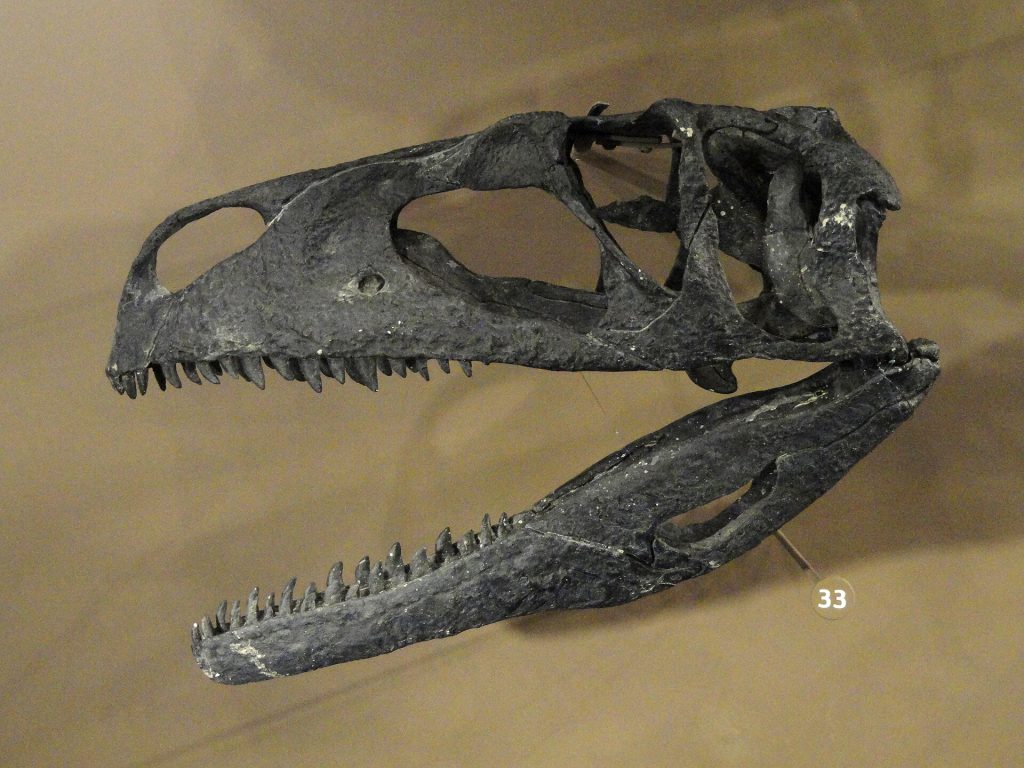
The holotype, TPII 2000-09-29, belongs to Thanksgiving Point Institute in Lehi, Utah. The 2005 paper reports it on display at the North American Museum of Ancient Life, with a cast in Denver. Skull pieces include the premaxilla (front tip of the upper jaw), bones around the eye socket, parts of the jaw joint, and three teeth. The rest adds vertebrae, ribs, both arms and hands, and the lower half of the pubes (paired lower hip bones). Both thighs and shins survive, along with a complete right foot. Unfortunately, nothing of the skull roof or braincase has turned up.
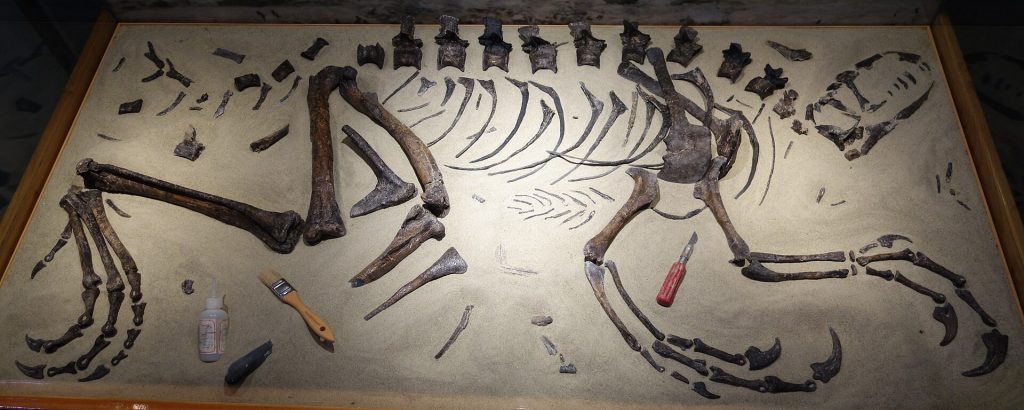

Carpenter’s team also named two paratypes—extra specimens designated alongside the holotype. One is AMNH 587, a partial hand from Bone Cabin Quarry once referred to Ornitholestes. It lay about 980 feet (300 meters) east of the holotype, at approximately the same level. The authors could not rule out Ornitholestes, but they provisionally treated the hand as Tanycolagreus. The second is a premaxilla from Utah’s Cleveland-Lloyd Quarry, previously referred to Stokesosaurus.
In addition, the team referred a Colorado pubis from Felch Quarry 1, which Gilmore had assigned to Coelurus in 1920. Together, these specimens stretch the species across Wyoming, Utah, and Colorado. In 2020, Foster and colleagues added a tentative record from the Black Hills of Wyoming. Their foot bone, labeled “Tanycolagreus?,” may be the first record of the genus north of Bone Cabin Quarry.
Tanycolagreus Size and Description
Even without its braincase, the skeleton shows an animal with long limbs and elongated tail vertebrae.
Short description of Tanycolagreus
The premaxilla was very deep and very short from front to back, with four tooth sockets. A narial foramen—a small hole—pierced the base of its nasal process, a placement the describers called unusual among theropods. Yet their tentative reconstruction still gives a long, low skull, typical of small to medium theropods. According to the describers, the lachrymal—a bone in front of the eye socket—had no horn. In 2019, however, Hartman and colleagues wrote that the small theropod Hesperornithoides differs from Tanycolagreus in lacking “a dorsally projecting horn,” citing a figure in that same paper. One tooth crown, figured by Lei and colleagues in 2023, stands about 0.8 inches (20 millimeters) tall.
The back vertebrae lacked pleurocoels (side openings linked to air sacs) and showed only a shallow side hollow. Farther back, the rear tail vertebrae grew long, about 140 percent longer than the front ones. The shoulder blade was long and strap-like, while the humerus (upper arm bone) was straight.
As the name suggests, its hind limbs were long, with a straight tibia (shin bone) and a long, slender fibula. Likewise, the metatarsals (upper foot bones) were elongate, the third reaching about 60 percent of femur (thigh bone) length.

Size and Weight of Type Species
Carpenter and colleagues estimated the holotype at about 10.8 feet (3.3 meters) long. Its front back vertebrae had unfused neural arches (the bony arches atop each vertebra), so they judged it submature. The Utah premaxilla suggests a larger animal of about 13.1 feet (4 meters), though its maturity remains unknown.
Published descriptions give no hip height for Tanycolagreus. For scale, the holotype’s femur measures about 14.0 inches (356 millimeters), and its tibia about 15.0 inches (382 millimeters).
In 2014, Benson and colleagues estimated that the holotype weighed about 113 pounds (51 kilograms). It is an indirect figure—scaled from the thigh-bone shaft’s circumference of about 3.6 inches (92 millimeters), which their dataset took from the 2005 description.
The Dinosaur in Detail
What sets this dinosaur apart, according to its 2005 diagnosis, starts with its short, deep premaxilla. The diagnosis also lists a T-shaped quadratojugal, a cheek bone near the jaw joint. However, the bone’s own description calls it L-shaped, an inconsistency within the paper. Its interdental plates—the bony walls between tooth roots—fuse to one another. In 2022, Naish and Cau noted that such plates are typically unfused in tyrannosauroids, though Tanycolagreus appears to be an exception.
Compared with Coelurus, the original authors found Tanycolagreus more primitive in several points, such as its straight humerus. Its metatarsals also roughly match the humerus in length, whereas those of Coelurus are about 1.75 times as long. Unlike Ornitholestes, it had a straight-fronted premaxilla and a slender, bowed radius.
The hand carried three clawed fingers, the second longest and the first bearing the biggest claw—trenchant (blade-like) and rather deep. Carpenter’s team also described a semilunate carpal, a half-moon-shaped wrist bone. Hartman’s team, however, argued that this bone is really the radiale, a different wrist bone. They also described the fused wrist block as very flat.
Its place on the family tree is still open. Naish and Cau report that Senter, Brusatte’s team, and Zanno’s team recovered it among early tyrannosauroids, though Zanno’s 2019 tree simply grafted it there following Brusatte. Naish and Cau’s own analysis weakly grouped it with Coelurus on an early tyrannosauroid branch. By contrast, Brusatte and Carr wrote in 2016 that the link lacked convincing support. A 2015 review by Hendrickx and colleagues listed it as possibly at the very base of Coelurosauria. Cau noted in 2024 that analyses code Tanycolagreus only from immature specimens—and suggested it might prove to be the same animal as Stokesosaurus. Most recently, Delcourt and colleagues’ preferred 2025 analysis put it outside Tyrannosauroidea, among early maniraptoromorphs.
Interesting Points about Tanycolagreus
- According to the original description, its first metacarpal, the hand bone of the first finger, is only 41 percent as long as its humerus.
- In 2023, Lei and colleagues ruled it out as the maker of deep tooth marks on Morrison sauropod bones, since its crowns were not larger than 30 millimeters.
- Hartman and colleagues reported in 2019 that the humerus of the small Morrison theropod Hesperornithoides is only 17 percent as long as the Tanycolagreus holotype’s.
- In 2020, Dececchi and colleagues ranked Tanycolagreus 12th in hindlimb elongation relative to thigh-bone girth, citing it among basal tyrannosauroids with long hindlimbs.
- The partial hand AMNH 587 may belong to either Tanycolagreus or Ornitholestes, as Barta and colleagues noted in 2018, citing an earlier study by Brusatte.
Dinosaurs from the Same Formation
Also known from the Morrison Formation (exact level relative to Tanycolagreus not known): Gargoyleosaurus, Stegosaurus, Camptosaurus, Ornitholestes, Allosaurus, and Coelurus. In 2013, Carpenter and colleagues listed the ankylosaur Gargoyleosaurus and a very small juvenile cf. Stegosaurus stenops from Bone Cabin Quarry West. A subadult Camptosaurus came from the same company’s dig in the Bone Cabin Quarry area. Osborn named Ornitholestes in 1903 for a skeleton from nearby Bone Cabin Quarry. Maidment and Muxworthy’s 2019 conclusions date the formation to about 156 to 147 million years ago, so these animals may not all have lived at the same time.
Tanycolagreus in its Natural Habitat
The world Tanycolagreus roamed was one of rivers, floodplains, and lakes. The formation’s rocks crop out from Montana in the north to New Mexico in the south—laid down when the climate was significantly warmer than today. According to the Paleobiology Database, the bones at Bone Cabin Quarry West came from poorly consolidated, fine-grained sandstone with mudstone. The same database lists crocodyliform remains there, along with the pterosaur Harpactognathus gentryii—a flying reptile with an estimated wingspan of 8.2 feet (2.5 meters).
The original description does not state a diet, but later studies treat Tanycolagreus as a meat-eater. In 2023, Lei and colleagues listed it among the Morrison’s terrestrial carnivores. Similarly, Tanaka and colleagues counted it among the formation’s small tyrannosauroid predators in 2021. Its describers noted hyperextensible knuckle joints at the base of the fingers—able to bend back farther than usual. Even so, they stated no hunting behavior for Tanycolagreus itself.
While there is no direct evidence of how Tanycolagreus lived day to day, its skeleton still matters. Isolated small to medium theropod bones occur in most Morrison collections, and its describers read them as a sign of diversity not yet recognized. When it was named in 2005, the describers noted that it was one of only three small to medium Morrison theropods known from partial skeletons, alongside Coelurus and Ornitholestes.
Frequently Asked Questions
It means “long-limbed hunter,” from Greek roots, and the species name honors retired Marine George “Top” Wilson.
It lived in the Kimmeridgian to Tithonian stages of the Late Jurassic, in a formation spanning roughly 156 to 147 million years ago.
The immature holotype was about 10.8 feet long and weighed an estimated 113 pounds. A larger individual may have reached about 13.1 feet.
It was a carnivore, listed by later researchers among the Morrison Formation’s small meat-eating theropods.
Its holotype came from Bone Cabin Quarry West in the Morrison Formation of Albany County, Wyoming, in 1995.
It was a theropod first placed in Coeluridae, and later studies variously treat it as an early tyrannosauroid, a basal coelurosaur, or an early maniraptoromorph.
Sources
The information in this article is based on various sources, drawing on scientific research, fossil evidence, and expert analysis. The aim is to provide a comprehensive and accurate overview of Tanycolagreus. However, please be aware that our understanding of dinosaurs and their world is constantly evolving as new discoveries are made.
- http://web.archive.org/web/20090325023630/https://scientists.dmns.org/sites/kencarpenter/PDFs%20of%20publications/Tanycolagreus.pdf
- https://archive.org/details/osteologyofcarni00gilm
- https://pmc.ncbi.nlm.nih.gov/articles/PMC4011683/
- https://pmc.ncbi.nlm.nih.gov/articles/PMC9271276/
- https://pmc.ncbi.nlm.nih.gov/articles/PMC4735739/
- https://pmc.ncbi.nlm.nih.gov/articles/PMC6385174/
- https://pmc.ncbi.nlm.nih.gov/articles/PMC13549251/
- https://docentes.fct.unl.pt/omateus/files/hendrickx_etal_2015_non_avian_theropods_pjvp12_11.pdf
- https://www.paleoitalia.it/wp-content/uploads/2024/05/01_Cau_2024_BSPI_631.pdf
- https://pmc.ncbi.nlm.nih.gov/articles/PMC6626525/
- https://pmc.ncbi.nlm.nih.gov/articles/PMC7220109/
- https://pmc.ncbi.nlm.nih.gov/articles/PMC10655710/
- https://pmc.ncbi.nlm.nih.gov/articles/PMC5735062/
- https://pmc.ncbi.nlm.nih.gov/articles/PMC8424376/
- https://giw.utahgeology.org/index.php/GIW/article/view/69
- https://pmc.ncbi.nlm.nih.gov/articles/PMC3828194/
- https://giw.utahgeology.org/index.php/GIW/article/view/30
- https://spiral.imperial.ac.uk/handle/10044/1/73346
- https://doi.org/10.7717/peerj.3368
- https://doi.org/10.1144/gsl.sp.2003.217.01.04
- https://paleobiodb.org/classic/basicCollectionSearch?collection_no=49577
This article was last fact checked: TheDinosaurs Team, 17-11-2026
Featured Image Credit: PaleoNeolitic, CC BY 4.0, via Wikimedia Commons
