
Along Alberta’s Red Deer River, the river and shoreline deposits of the Dinosaur Park Formation hold a famously tangled theropod story. Its central figure is Chirostenotes pergracilis, a caenagnathid—one of a family of toothless, beaked oviraptorosaurs—from Late Cretaceous rocks roughly 76.5 to 74.4 million years old. For most of a century, however, paleontologists argued over which jaws and feet belonged with its hands.
G. F. Sternberg found the first specimen in 1914, and it consisted of two slender, articulated hands. The late L. M. Lambe had prepared brief notes on the material, and paleontologist Charles W. Gilmore published the description in 1924. Since then, new skeletons have turned those hands into a long-legged, beaked animal of about 143 pounds (65 kilograms). Its story shows how slowly a scattered skeleton can be matched to its rightful owner.
Chirostenotes Key Facts
| Keyword | Fact |
|---|---|
| Pronunciation | KIE-roh-sten-OH-teez (per the American Museum of Natural History) |
| Meaning of name | Narrow Hand (per museum sources, not given in the 1924 description) |
| Group | Theropoda (Oviraptorosauria, Caenagnathidae) |
| Type Species | Chirostenotes pergracilis |
| Diet | Uncertain (called carnivorous in 1924, proposed as omnivorous with leaves and small prey in a 2014 jaw study, with later work leaning toward more meat-eating) |
| When it Lived | Within the Dinosaur Park Formation’s span of about 76.5 to 74.4 MYA (dated specimens from its lower part) |
| Period | Cretaceous |
| Epoch | Late Cretaceous (Campanian stage) |
| Length | Not specified |
| Height | Not specified |
| Weight | About 143 pounds (65 kilograms), 2020 estimate |
| Mobility | Not specified (hindlimbs exceptionally elongate) |
| First Discovery | 1914 by G. F. Sternberg |
| Described by | 1924 by C.W. Gilmore |
| Holotype | CMN 2367 (originally No. 2367, Geological Survey of Canada) |
| Location of first find | Two miles northeast of the mouth of Little Sandhill Creek, Red Deer River, Alberta, Canada (Dinosaur Park Formation, part of Gilmore’s “Belly River formation”, now the Belly River Group) |
Chirostenotes Origins, Taxonomy and Timeline
Gilmore’s 1924 paper never explains the name Chirostenotes. Museum guides fill that gap—the American Museum of Natural History offers “narrow hand,” and London’s Natural History Museum “narrow-handed.” Neither reading appears in peer-reviewed sources we consulted, though it suits the slender fingers. As for pergracilis, Gilmore said only that the species name came from Lambe’s notes. Together, the name keeps a choice made by a colleague who did not live to see it in print.
Gilmore placed his new animal with “the light-limbed, slender-jawed Coelurid group.” He compared its hand with those of Ornitholestes and Struthiomimus, finding it intermediate in some features and smaller than Struthiomimus. He also proposed moving Coelurus gracilis, a single claw from the Arundel Formation of Maryland, into the new genus. Today, Chirostenotes sits within Theropoda, Maniraptora, Oviraptorosauria, and the family Caenagnathidae. Along the way, a species and a specimen once placed in the genus have moved to Citipes and Epichirostenotes. Gilmore’s Coelurus gracilis is no longer kept in the genus, while the 1971 jaw species “Caenagnathus” sternbergi is now a synonym of C. pergracilis.
In 2020, paleontologist Gregory Funston placed the species in the Upper Campanian of the Dinosaur Park Formation. Two years later, Ramezani and colleagues dated the formation to between about 76.47 and 74.44 million years ago. By their estimate, it built up over about 2 million years while the Western Interior Seaway pushed inland. Where the holotype sat in that window is unknown. However, confidently referred specimens lie roughly 19 to 27 meters (62 to 89 feet) above the formation’s base. The disputed Macrophalangia foot would extend that to 37 meters (121 feet). In 2025, Demers-Potvin and Larsson showed that the base itself varies by about 12 meters (39 feet) locally, so these elevation-based heights are rough.
Discovery & Fossil Evidence
Gilmore recorded the type locality as “2 miles due northeast of the mouth of Little Sandhill creek, Red Deer river, Alberta.” His “Belly River formation” is now the Belly River Group, and later work places the hands in its uppermost unit, the Dinosaur Park Formation. Funston’s 2020 review gives the discovery year as 1924, but Gilmore’s own text says 1914. Either way, the exact quarry is unknown—Funston notes that among Dinosaur Park caenagnathid holotypes, only the quarry of Caenagnathus collinsi is known with certainty.
The holotype, once Geological Survey of Canada No. 2367, is now CMN 2367 at the Canadian Museum of Nature. Gilmore described “nearly complete articulated digits of both fore feet,” and Funston adds that the right hand is slightly more complete. The phalanges (finger bones) are “extremely long and slender, and highly pneumatic”—thin-walled and hollow, which is why postmortem crushing has flattened them. Without its metacarpal (palm bone), the second finger alone measures 199 millimeters (7.8 inches). Gilmore also provisionally referred a toothed lower jaw, No. 343, while admitting “the association of these specimens is purely arbitrary.” That jaw had sockets for at least eighteen sharp, recurved teeth, and it is no longer counted as Chirostenotes.
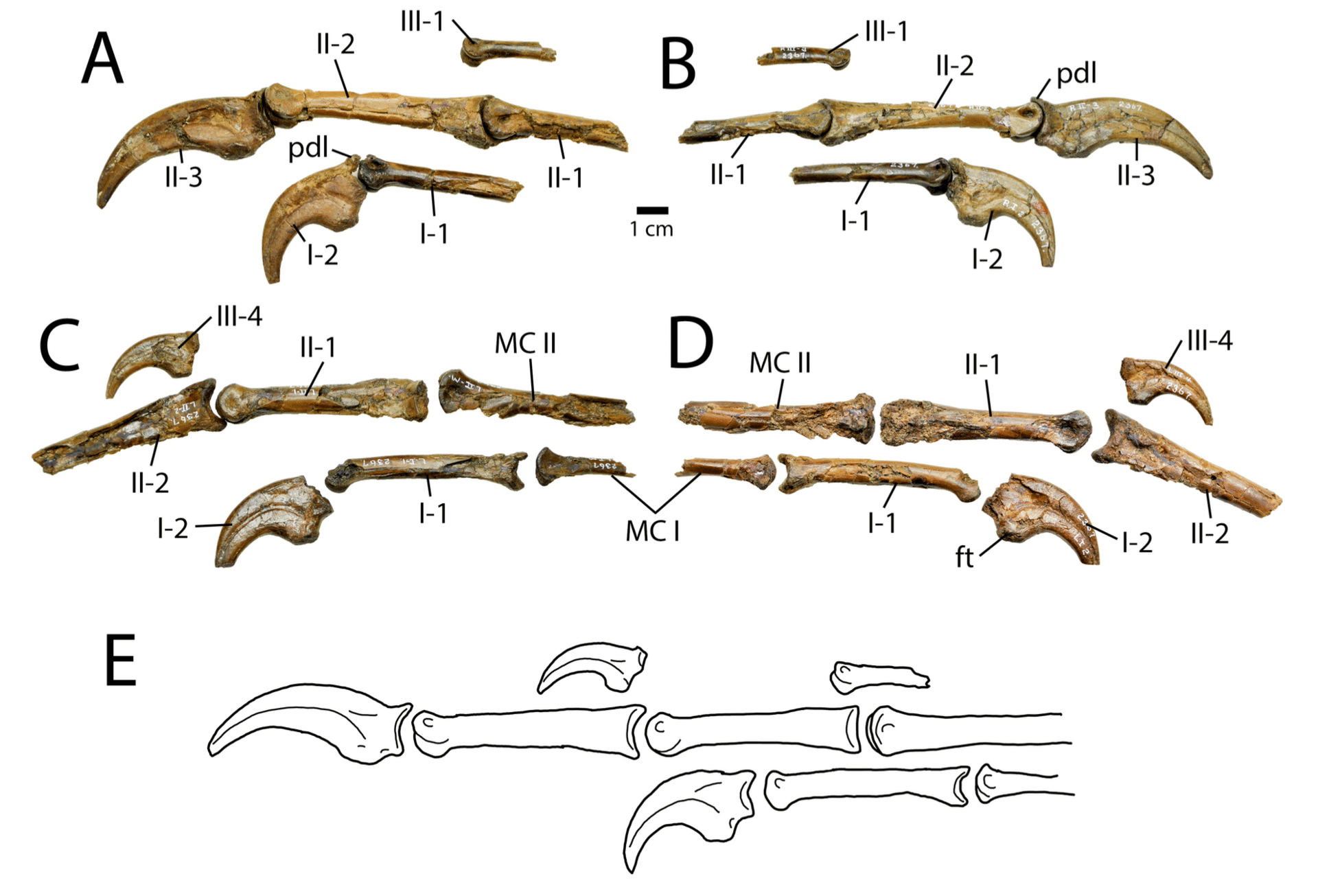

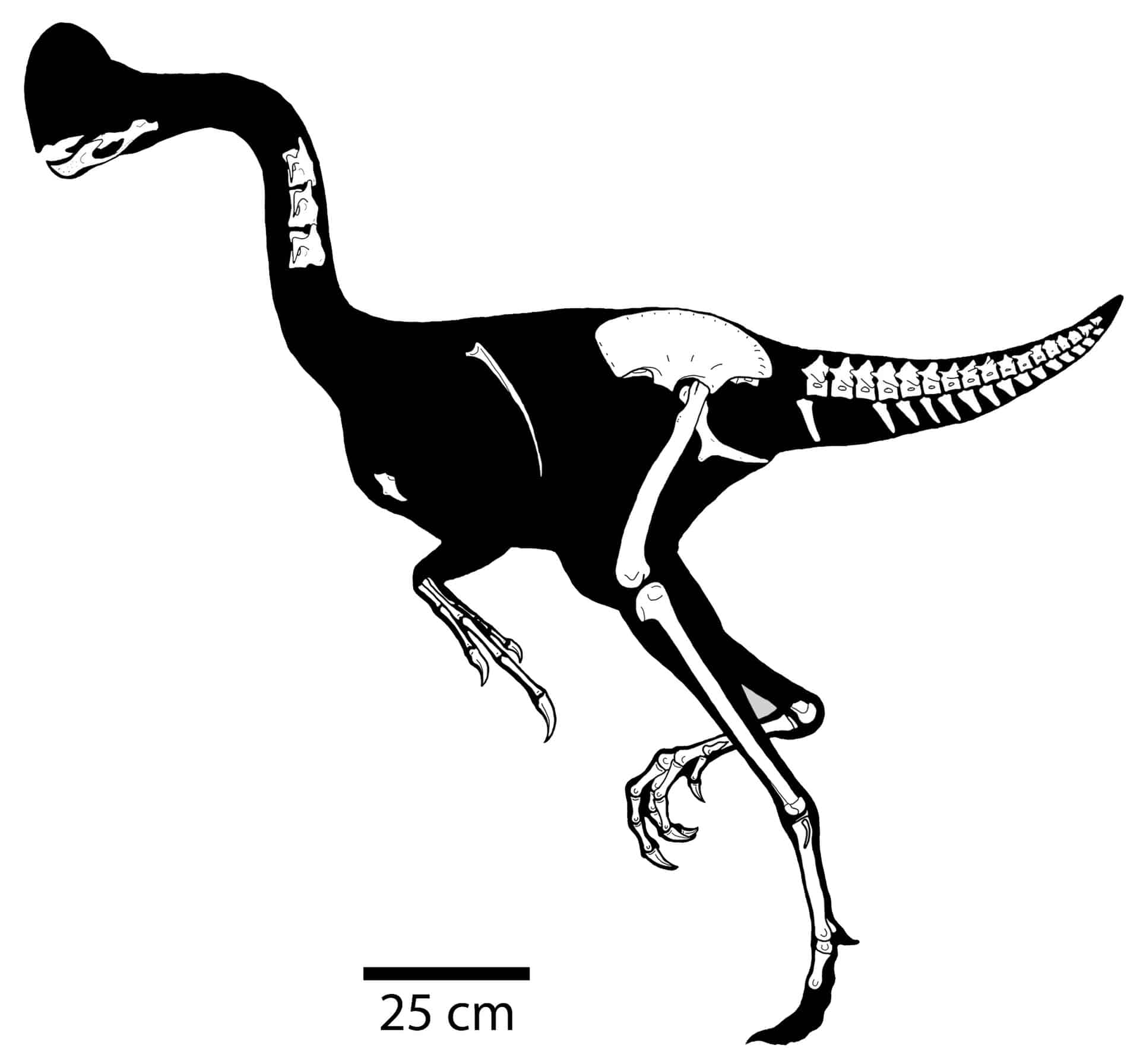
In 1988, Currie and Russell described TMP 1979.020.0001, a partial skeleton collected in 1979 that, Funston says, solidified its caenagnathid identity. Then, in 2016, E. Bamforth found UALVP 59400 in the southeastern part of the park. It preserves a jaw, neck and tail vertebrae, and lower leg and ankle bones. That made it the first Dinosaur Park caenagnathid with jaws and postcrania (bones behind the skull) found together. Most caenagnathid fossils come from the lower formation, a pattern Funston says likely reflects less exposed rock or changes in preservation higher up.
Chirostenotes Size and Description
Assembled from hands, jaws, hips, and feet, Chirostenotes emerges as a gracile, long-legged theropod with a sharply upturned beak.
Short description of Chirostenotes
The lower jaws were toothless and fused, and the 2020 papers describe their tip as a “beak.” That occlusal (biting) tip turned upward at about 45 degrees—an autapomorphy, or trait found in no other species. Farther back, the hips held six sacral vertebrae with pleurocoels (air-sac hollows in the bone). The tail was relatively short, while its rear chevrons—bony spines beneath the tail—were stretched front to back, matching or exceeding their vertebrae in length.
Up front, the slender fingers—the third longer than the first—ended in “compressed strongly curved unguals” (claws), forming what Gilmore called “essentially a raptorial foot.” The ilium (main hip bone) was tall, with a reduced rear blade, and the pelvis was relatively small. By contrast, the hindlimbs were “exceptionally elongate,” and the ankle and upper foot bones stayed unfused even in adults.
Soft tissue is rarely preserved, but filament-like stains near the neck of UALVP 59400 resemble feather impressions. Funston and Currie consider feathers “a plausible explanation,” although whether these were simple filaments or vaned feathers remains ambiguous.
Size and Weight of Type Species
No peer-reviewed study we accessed gives a total length for Chirostenotes. London’s Natural History Museum lists about 5.6 feet (1.7 meters), though it names no author or method. Likewise, no source we found estimates its height at the hips.
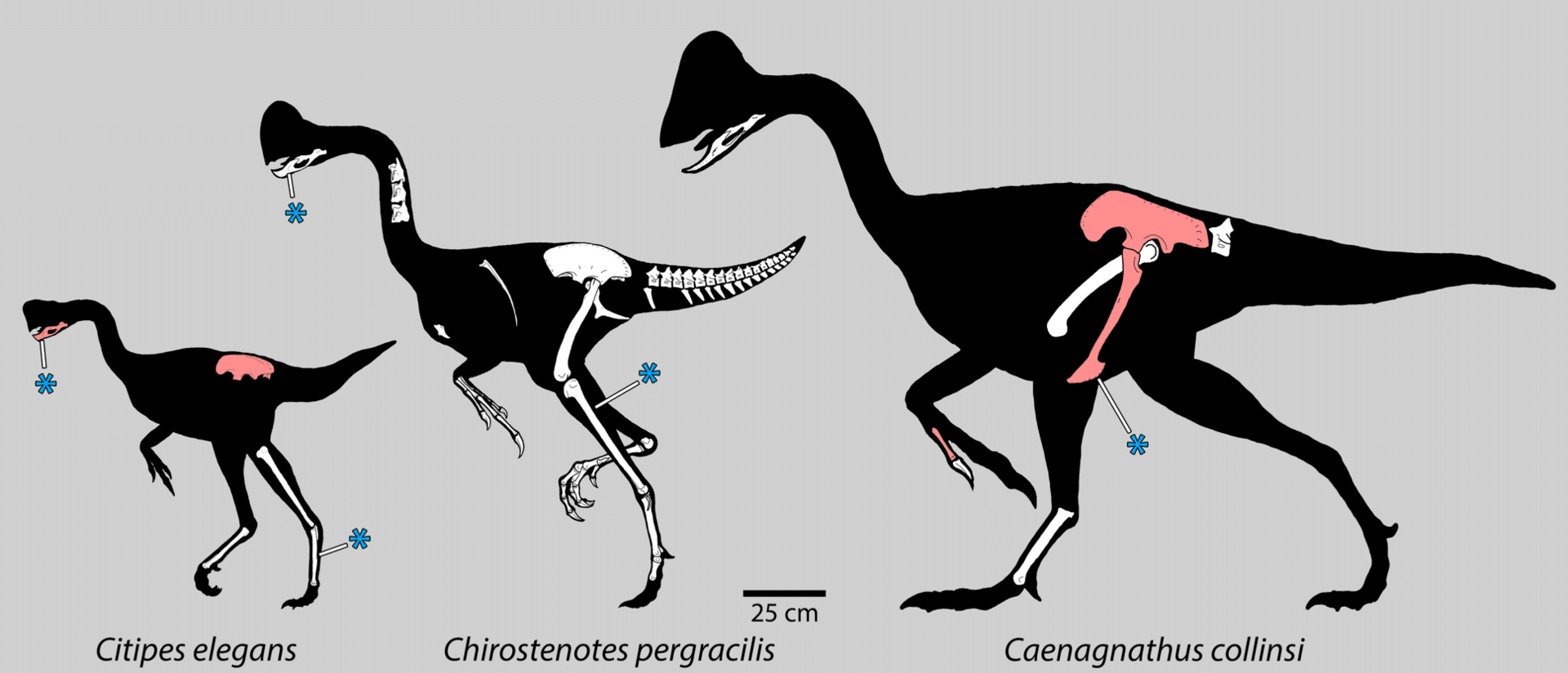

Mass has at least been estimated. In their 2020 revised diagnosis, Funston and Currie call the animal “medium-sized,” at about 143 pounds (65 kilograms). That paper gives no method, although Funston’s companion 2020 study estimated oviraptorosaur masses from thigh-bone circumference.
Among the three Dinosaur Park caenagnathids, Chirostenotes was intermediate—larger than Citipes but smaller than Caenagnathus, which rivaled Anzu in size. UALVP 59400 shows 11 lines of arrested growth, or pauses recorded in bone. Two pairs are doublets counted as single marks, so it was at least nine years old. It was nearing full size, and according to Funston and Currie, its slowing growth may mean it had reached sexual maturity.
The Dinosaur in Detail
What sets this dinosaur apart is its upturned beak, but its deeper interest lies in a long argument over identity. In 1988, Currie and Russell used their partial skeleton to sink Macrophalangia canadensis, a foot named by C. M. Sternberg in 1932, into C. pergracilis. Yet Macrophalangia is still questioned, because its foot, CMN 8538, is larger and differs in its first metatarsal and first toe. Following Longrich and colleagues (2013), Funston notes it may represent Caenagnathus collinsi instead. If so, the name Macrophalangia canadensis would take priority over C. collinsi, although Funston keeps the synonymy for now.
A second debate concerned how many caenagnathids the Dinosaur Park Formation held. In 1997, Sues argued that Caenagnathus collinsi was a junior synonym of C. pergracilis. He also moved Elmisaurus elegans into Chirostenotes as a separate species. Currie, however, had kept three separate genera in 1989, and most later studies follow him. The small elegans took a winding path—from Ornithomimus in 1933 to Macrophalangia, Elmisaurus, Chirostenotes, Leptorhynchos, and finally Funston’s new genus Citipes in 2020. Today, osteohistology—the study of bone microstructure—supports three taxa of different adult size.

Funston’s 2020 analysis recovered C. pergracilis as the sister taxon of Hagryphus, a pairing he found almost certainly North American in origin. He called this “basal position” novel, since earlier studies had nested it deep within the group. However, he also noted that decay indices (a measure of branch support) poorly support the result. In 2024, Atkins-Weltman and colleagues used a closely related Funston matrix and again paired the genus with Hagryphus, but left its wider position unresolved. Taken together, its body is now well defined, but its branch on the family tree is still provisional.
Interesting Points about Chirostenotes
- Gilmore originally thought it was a meat-eating coelurid, and he described its slender hand as “essentially a raptorial foot.”
- The toothed jaw Gilmore provisionally referred to the species in 1924 is no longer considered part of this toothless animal.
- Its larger neighbor Caenagnathus collinsi was first published in 1940 as “a toothless bird from the Cretaceous of Alberta.”
- UALVP 59400 preserves filament-like stains near its neck that may be feather impressions.
Contemporary Dinosaurs
With the holotype’s quarry unknown, any link to other animals runs through referred material. In 2020, Funston reported specimens of each Dinosaur Park caenagnathid from one bonebed, BB 047, about 23 meters (75 feet) above the formation’s base. Much of that material is isolated and provisionally referred.
Largest of the formation’s three caenagnathids was Caenagnathus collinsi, first known from a single mandible (lower jaw), CMN 8776. New hip material shows that it rivaled Anzu wyliei in size. A referred claw, TMP 1993.036.0475, comes from the 23-meter level that Funston places at BB 047. He proposes that the three coexisted by minimizing niche overlap through differences in adult size, jaws, and feet. Still, no fossil records any direct interaction between it and Chirostenotes.
Also known from the Dinosaur Park Formation (exact level relative to Chirostenotes not known): Styracosaurus, Chasmosaurus, Corythosaurus, Lambeosaurus, Parasaurolophus, and Euoplocephalus. The formation spans about 2 million years, so these animals may not all have lived at the same time.
Chirostenotes in its Natural Habitat
The world Chirostenotes roamed was a landscape of rivers and coastal lowlands at the edge of the advancing Western Interior Seaway. River channels rich in bonebeds dominate its lower half, while tidal wetlands and shorelines mark the top, later buried by marine shales of the Bearpaw Formation. Together with the underlying Oldman Formation, these rocks at Dinosaur Provincial Park have yielded more than 140 species of vertebrates. Among the dinosaurs also known from the formation are Centrosaurus, whose remains dominate the park’s classic bonebed BB043, and the small caenagnathid Citipes elegans. Funston lists material provisionally compared with Citipes from BB 047.
Its diet remains uncertain, although Gilmore headed his description “New Carnivorous Dinosaur.” In 2014, Funston and Currie found its jaws adapted for “an efficient shearing mechanism” and proposed an omnivorous diet of leaves and small prey. Likewise, paleontologist Matthew Lamanna and colleagues called caenagnathids “probably ecological generalists” that year, eating plants, small animals, and perhaps eggs. Later, however, Funston described those jaws as “well-adapted for efficient shearing of prey.” Comparisons with raptorial birds also point toward carnivory, though bird beaks reflect much more than diet. Even so, Funston himself calls the share of plants in the caenagnathid diet unclear.
While there is no direct evidence of its behavior, its anatomy offers clues. Funston and Currie argued that the long legs and grasping toes support earlier suggestions of wading rather than fast running. Similarly, Lamanna’s team, working from Hell Creek fossils, proposed that caenagnathids may have favored well-watered floodplains over channel margins. If so, Chirostenotes may have foraged on wet ground.
Frequently Asked Questions
Museum sources translate it as “narrow hand,” although Gilmore’s 1924 description never explains it.
It lived in the late Campanian stage of the Late Cretaceous. Its home, the Dinosaur Park Formation, dates to about 76.5 to 74.4 million years ago.
A 2020 estimate puts it at about 143 pounds (65 kilograms), but no peer-reviewed study gives its length or height.
Its diet is uncertain. Studies have proposed an omnivorous diet of leaves and small prey, a more meat-based diet, or a generalist diet that may have included eggs.
Its first fossils came from the Dinosaur Park Formation along the Red Deer River in Alberta, Canada.
Its toothless lower jaw ends in a tip upturned at about 45 degrees, a trait known in no other species.
Sources
The information in this article is based on various sources, drawing on scientific research, fossil evidence, and expert analysis. The aim is to provide a comprehensive and accurate overview of Chirostenotes. However, please be aware that our understanding of dinosaurs and their world is constantly evolving as new discoveries are made.
- https://download-telecharger.services.geo.ca/pub/nrcan_rncan/publications/STPublications_PublicationsST/297/297678/mb_038.pdf
- https://doi.org/10.18435/vamp29362
- https://journals.library.ualberta.ca/vamp/index.php/VAMP/article/download/29362/21419
- https://doi.org/10.1080/08912963.2020.1726908
- https://www.pure.ed.ac.uk/ws/files/141992407/148._Funston.pdf
- https://doi.org/10.1038/s41598-022-19896-w
- https://doi.org/10.1371/journal.pone.0294901
- https://doi.org/10.1371/journal.pone.0092022
- https://doi.org/10.1139/cjes-2013-0186
- https://palaeo-electronica.org/content/pdfs/1447.pdf
- https://www.amnh.org/explore/ology/ology-cards/001-chirostenotes-pergracilis
- https://www.nhm.ac.uk/discover/dino-directory/chirostenotes.html
This article was last fact checked: TheDinosaurs Team, 16-11-2026
Featured Image Credit: Connor Ashbridge, CC BY 4.0, via Wikimedia Commons
