
On the sea cliffs of Dinosaur Cove in Victoria, Australia, the Eumeralla Formation holds a small dinosaur with an outsized reputation. Leaellynasaura amicagraphica lived in the early Albian stage of the Early Cretaceous—roughly 113 to 110 million years ago. At that time, southeastern Australia lay within the Antarctic Circle, and its animals endured months of twilight each year. Its fame rests on a long tail and large eyes, yet later work questions whether those traits are its own.
In 1987, a volunteer field crew working in tunnels blasted into the cliff uncovered a small piece of skull. Two years later, paleontologists Thomas Rich and Patricia Vickers-Rich named the animal after their daughter, Leaellyn. Their holotype is a juvenile’s left cheek, while more complete bones from the same site were linked to it. That link has since been challenged, so this is a story about which bones belong together.
Leaellynasaura Key Facts
| Keyword | Fact |
|---|---|
| Pronunciation | Not specified |
| Meaning of name | Honors Leaellyn Rich (species name: Friend Writing) |
| Group | Ornithischia (small-bodied ornithopod) |
| Type Species | Leaellynasaura amicagraphica |
| Diet | Herbivore |
| When it Lived | 113 to 110 MYA |
| Period | Cretaceous |
| Epoch | Early Cretaceous (early Albian stage) |
| Length | Not specified in peer-reviewed sources (museum figures range from 3.3 to 6.6 feet, or 1 to 2 meters) |
| Height | Not specified in peer-reviewed sources (one museum gives about 2 feet, or 60 centimeters) |
| Weight | Not specified |
| Mobility | Probably moved on two legs (bipedal), like related small ornithopods |
| First Discovery | 1987 by a volunteer Friends of the National Museum of Victoria field crew |
| Described by | 1989 by T.H. Rich and P.V. Rich (Patricia Vickers-Rich) |
| Holotype | NMV P185991 |
| Location of first find | Slippery Rock site, Dinosaur Cove, Eumeralla Formation, Otway Basin, Victoria, Australia |
Leaellynasaura Origins, Taxonomy and Timeline
The name Leaellynasaura is a family tribute to Leaellyn Rich, daughter of the two paleontologists who described it. The species name amicagraphica means “friend writing.” It honors the National Geographic Society and the Friends of the Museum of Victoria, whose volunteers found the holotype. Together, the name ties a polar dinosaur to a family, a museum community, and a scientific society.
Leaellynasaura belongs to Ornithischia and, more narrowly, to the small-bodied ornithopods, a diverse group of two-legged Australian herbivores. Its describers placed it in the family Hypsilophodontidae, a label some researchers still use informally for these Victorian dinosaurs. In a 2009 conference abstract, however, Herne and Salisbury argued that it belonged inside Iguanodontia. In 2010, by contrast, Agnolin and colleagues recast Australia’s “hypsilophodontids” as basal (early-branching) ornithopods, placing Leaellynasaura below the Argentine Gasparinisaura. Then, in 2019, Herne and colleagues recovered it in Elasmaria alongside Galleonosaurus, although they called that grouping weakly supported. Leaellynasaura amicagraphica is the type and only known species.
The 1989 paper dated the Victorian polar biotas as a whole to the Valanginian through early Albian. Later work placed Dinosaur Cove in the early Albian Crybelosporites striatus Zone, defined by fossil spores and pollen. Its base marks the Aptian–Albian boundary about 113 million years ago, and the Eumeralla vertebrate sites fall within about 3.5 million years of it. In the wider Cretaceous Period, Australia and Antarctica had only begun to pull apart.
Discovery & Fossil Evidence
At Dinosaur Cove on the Otway coast, crews even tunneled into the sea cliff. In 1987, volunteers found the holotype at its Slippery Rock site, inside one of three tunnels blasted with explosives. The host rock, later named the “Tunnel Sandstone,” formed as a point bar—a sandbank on a meandering river’s inner bend.
The holotype, NMV P185991, housed at Museums Victoria in Melbourne, is the partial left cheek of a juvenile’s skull. It includes the maxilla (upper tooth-bearing bone) but lacks a dentary (lower jaw bone). Its maxillary body is just 27.0 millimeters (about 1.1 inches) long and holds 12 alveoli, or tooth sockets.
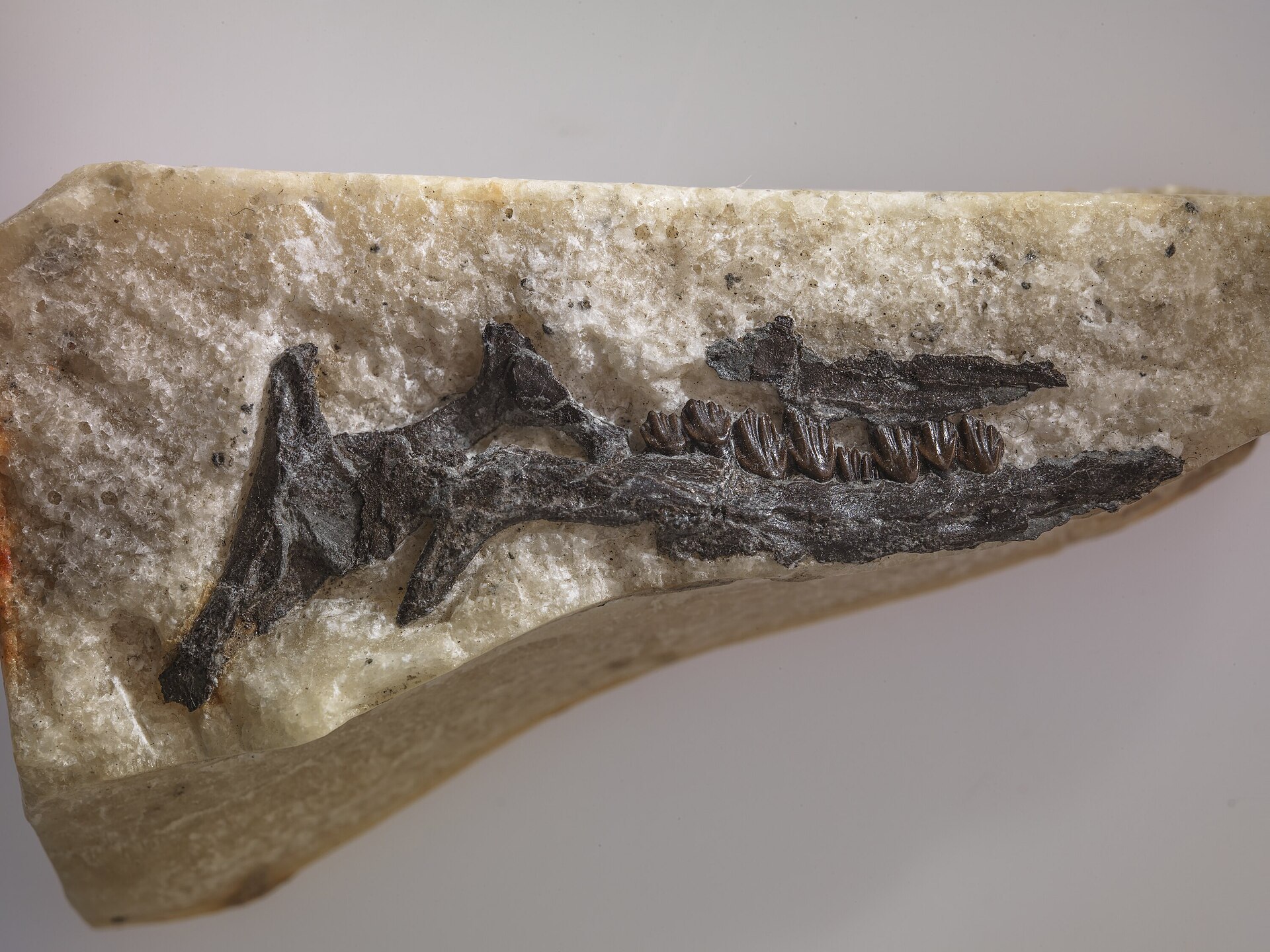

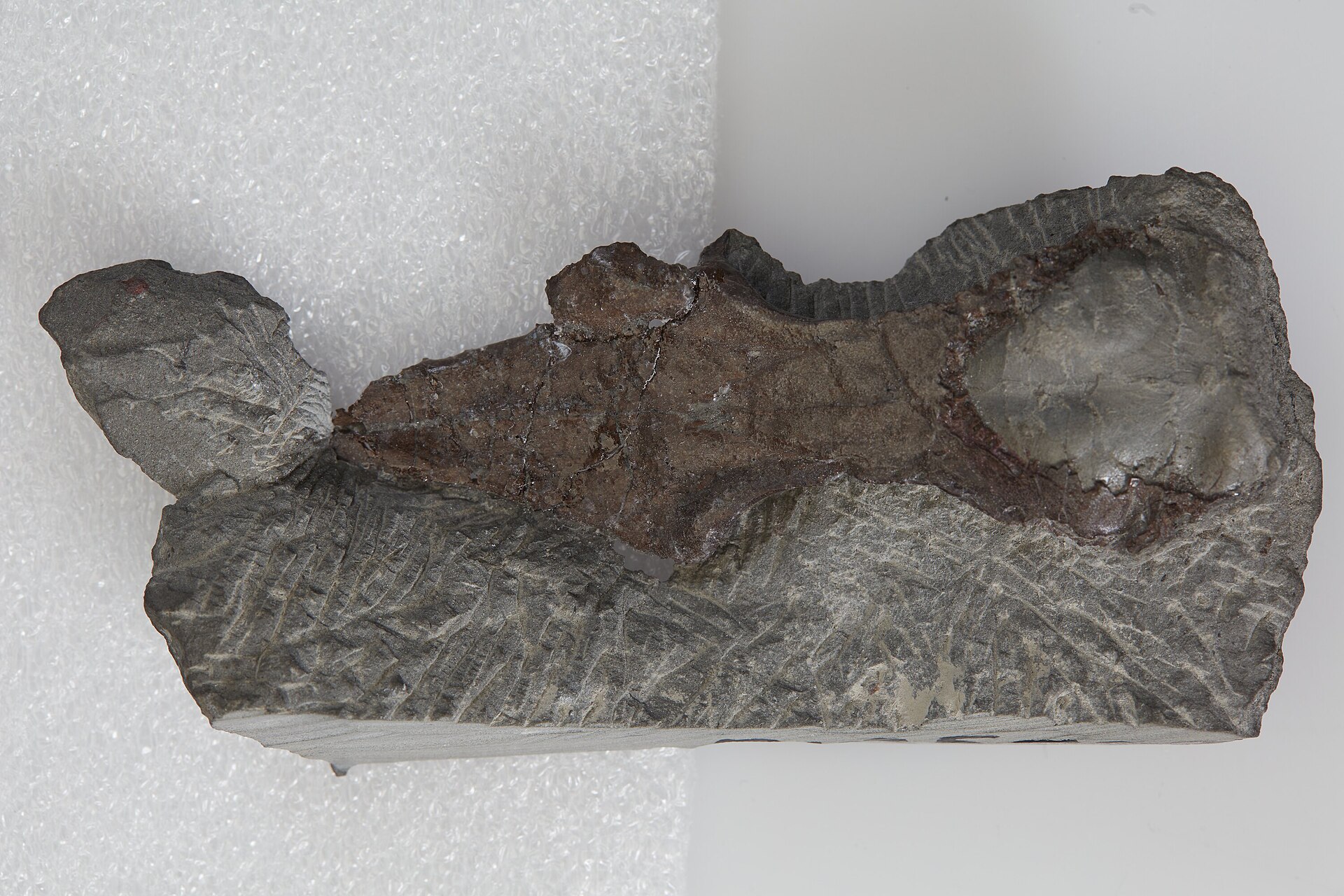
From the same site came a skull roof, NMV P185990, and a partial postcranium—the skeleton behind the skull—cataloged as NMV P185992 and P185993. Rich and Vickers-Rich treated these bones as one individual, assuming a quiet-water deposit such as an oxbow lake or pond. In 2010, Rich, Galton, and Vickers-Rich defended that view, citing the Dryosaurus-like parietal and jugal (cheek bone) and the unique setting.
In 2016, however, Herne, Tait, and Salisbury interpreted the site as an active point bar. Its bones, they argued, had gathered over time from up to four ornithopods, leaving the traditional attribution “inadequately supported.” In 2018, Herne’s team treated the postcranium as an indeterminate ornithopod, while Poropat’s team listed the skull roof and skeleton only with a query, as “?Leaellynasaura.” Meanwhile, two neonate femora (thigh bones) once assigned to the species became an unnamed “Morphotype 3″ in 2019. More recently, in 2021, Duncan and colleagues assigned new upper jaws from Eric the Red West, a site lower in the same formation, to the genus—”evidently adult exemplars, contrasting with the juvenile holotype.”

Leaellynasaura Size and Description
Any portrait of Leaellynasaura depends on which bones one accepts, and its most memorable features come from the disputed ones.
Short description of Leaellynasaura
The holotype shows only part of the face. Unlike Galleonosaurus, it has a straighter tooth row and a shallower buccal emargination—the cheek inset beside the teeth. Its cheek teeth carry a shallow labial furrow (outer groove) at the primary ridge but lack an ectoloph, the raised step at the crown base. Beyond these jaw details, reconstructions draw on the referred skull roof and skeletons.
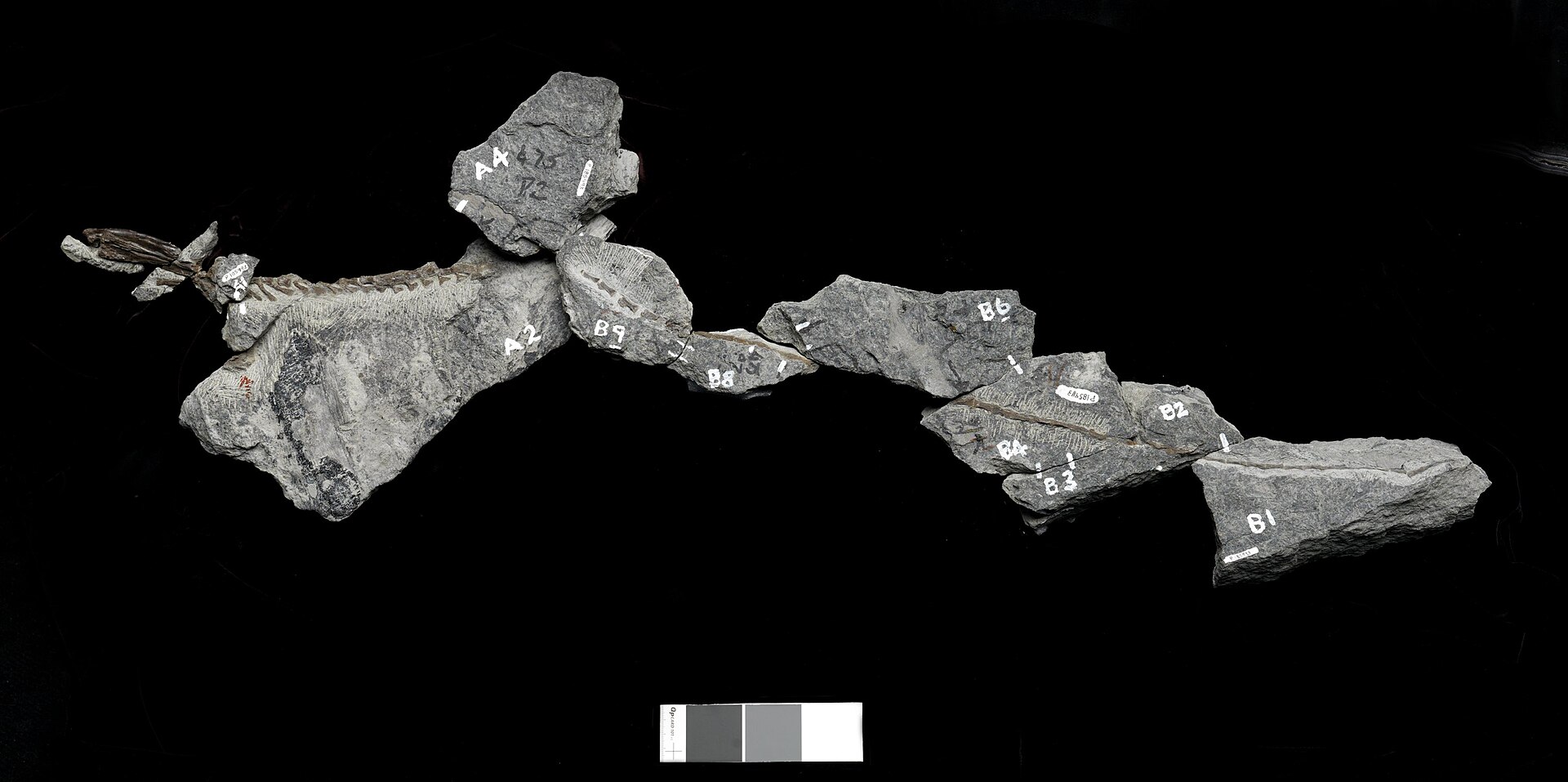
The long-tailed skeleton, NMV P185992–P185993, preserves a partial left hind limb and four precaudal vertebrae. In 2018, Poropat and colleagues listed 74 caudal (tail) vertebrae, while Herne and colleagues cited more than 71. Either way, the tail is remarkably long, but the skeleton’s referral is only traditional. Like the other small ornithopods of the region, Leaellynasaura itself probably moved on two legs.

Size and Weight of Type Species
No peer-reviewed length or weight estimate for Leaellynasaura was found, and museum figures disagree. The Australian Museum gives about 3.3 feet (1 meter), based on the holotype, which may be a juvenile. Museums Victoria’s collection article suggests about 4.9 feet (1.5 meters). Its state fossil page gives about 6.6 feet (2 meters) long and 2 feet (60 centimeters) high—”no higher than a wallaby.”
Bone histology, the study of growth recorded inside bone, offers an indirect clue. In 2018, Woodward and colleagues studied NMV P186047, a larger skeleton from the same deposit. Its growth marks showed skeletal maturity at five years, with a femur just 12.8 centimeters (5 inches) long. Because that skeleton is only questionably referred, however, the result applies to the deposit’s small ornithopods, not this genus specifically.
The same team concluded that the Victorian “hypsilophodontids” they sampled appear to be “diminutive.” Adult jaws described in 2021 confirm that the holotype was not full-grown, but no size estimate based on them was found. Leaellynasaura was evidently small, but its exact size awaits more complete fossils.
The Dinosaur in Detail
In popular accounts, this dinosaur stands out for traits tied to life in polar darkness. Museums Victoria describes large eye sockets that would have let it stay active in low light. The 1989 paper also discussed its brain at length, according to the journal’s index. In 2016, however, Herne and colleagues noted that its “dinosaur of darkness” status rested on referred bones.
Because that referral is contested, so are these conclusions. In 2026, for example, Herne and colleagues set aside the published encephalization quotient of Leaellynasaura—brain size relative to body size. That figure, they explained, relied on cross-species scaling assumptions drawn from referred specimens.
The tail raises the same question. Those 70-plus vertebrae far exceed the roughly 50, at most, estimated for Diluvicursor, a relative from an older level of the same formation. Even so, Herne and colleagues have called that skeleton an indeterminate ornithopod since 2016, though they allow it could still be Leaellynasaura.
Its teeth point to kinship more securely. In 2019, Herne and colleagues found nearly all seven of Galleonosaurus‘s distinctive maxillary crown features in Atlascopcosaurus, Leaellynasaura, and Muttaburrasaurus. Overall, they concluded, the upper jaw, teeth, and palate suggest that Galleonosaurus, Atlascopcosaurus, and Leaellynasaura are closely related. In 2021, Duncan’s team found Leaellynasaura-like jaws at the Diluvicursor site, hinting that Diluvicursor might not be a distinct taxon—though they called the case circumstantial. Taken together, its name rests on secure bone—but its famous body plan remains under debate.
Interesting Points about Leaellynasaura
- The genus honors Leaellyn Rich, daughter of describers Thomas Rich and Patricia Vickers-Rich, who named it in 1989.
- A skeleton long linked to it has 74 tail vertebrae by one count, though its referral to Leaellynasaura is disputed.
- The 1989 paper reported over 150 taxa from these polar biotas but no crocodiles or mammals, both of which later turned up.
- Skeleton NMV P186047, whose link to the genus is uncertain, has a left shinbone with acute osteomyelitis, a bone infection.
Contemporary Dinosaurs
Sharing the very same river deposit was Atlascopcosaurus, a small ornithopod named in 1989 from a partial upper jaw. Herne and colleagues have reported it from the Tunnel Sandstone itself. Agnolin and colleagues called it a nomen dubium, or doubtful name, in 2010, but Herne’s team still treats it as distinct. With no recorded interaction, it is best pictured as a neighbor.
Known from the same cove complex was Timimus, a theropod named from a single thigh bone found at Dinosaur Cove East. Its identity is debated, too—Rich and Vickers-Rich first described it as an ornithomimosaur, and Agnolin’s team later suggested a possible dromaeosaurid. In 2012, however, Benson and colleagues judged its holotype femur likely tyrannosauroid and argued against treating the name as doubtful. Its exact level relative to the Slippery Rock site is unpublished, and no interaction is recorded.
Leaellynasaura in its Natural Habitat
The world Leaellynasaura roamed was a high-latitude rift valley. Rivers filled a graben—a down-dropped block formed as Australia and Antarctica began to separate—with volcanic clays, silts, and sands. Estimates of its latitude differ, however. Rich and Vickers-Rich gave 70 to 85 degrees south in 1989, and Benson’s team 75 to 80 degrees in 2012. More recent plate reconstructions by Herne’s team in 2018 and Kitchener’s in 2019 place the Eumeralla Formation nearer 68 to 70 degrees. The original paper also inferred a cool, humid climate with possible spring meltwater floods. Conifers such as Agathis and Araucaria dominated the forests, with ferns and early flowering plants below.
No published study appears to have examined the diet of Leaellynasaura itself. Museum accounts suggest it used delicate leaf-shaped teeth to snip new growth from soft plants such as ferns and horsetails. Ferns, at least, grew in the understory around it.
Museums Victoria says dinosaurs like it stayed active year-round despite long polar winters. Similarly, Kitchener’s team argued that low body masses would have ruled out long-distance migration for small ornithopods. Current evidence, they added, suggests most high-latitude dinosaurs were year-round residents. While there is no direct evidence of herding, small ornithopods are numerically common in these deposits, so it probably had similar company. Victoria’s Early Cretaceous fossil sites also preserve turtles, mammals such as monotremes, pterosaurs, and non-marine plesiosaurs.
Frequently Asked Questions
It honors Leaellyn Rich, daughter of its describers, while the species name amicagraphica means “friend writing.”
It lived in the early Albian stage of the Early Cretaceous, roughly 113 to 110 million years ago.
No peer-reviewed size estimate was found. Museum figures range from about 3.3 to 6.6 feet long, and all agree it was small.
It was a herbivore, and museums suggest it ate soft plants such as ferns and horsetails.
Its holotype came from the Slippery Rock site at Dinosaur Cove, in the Eumeralla Formation of Victoria, Australia.
Those traits come from bones traditionally referred to it, but some researchers now regard that referral as inadequately supported.
Sources
The information in this article is based on various sources, drawing on scientific research, fossil evidence, and expert analysis. The aim is to provide a comprehensive and accurate overview of Leaellynasaura. However, please be aware that our understanding of dinosaurs and their world is constantly evolving as new discoveries are made.
- https://research.monash.edu/en/publications/polar-dinosaurs-and-biotas-of-the-early-cretaceous-of-southeaster/
- https://archive.org/details/sim_research-exploration_1989_5_contents
- https://archive.org/details/sim_research-exploration_1989_5_index
- https://doi.org/10.1080/03115518.2010.489404
- https://hdl.handle.net/1959.11/63683
- https://doi.org/10.7717/peerj.4113
- https://doi.org/10.1017/jpa.2018.95
- https://doi.org/10.1080/03115518.2018.1453085
- https://doi.org/10.1080/02724634.2021.1946551
- https://figshare.com/articles/journal_contribution/Early_Cretaceous_polar_biotas_of_Victoria_southeastern_Australia_an_overview_of_research_to_date/6234851
- https://doi.org/10.1038/s41598-018-19362-6
- https://doi.org/10.1038/s41598-019-56069-8
- https://doi.org/10.7717/peerj.1523
- https://doi.org/10.7717/peerj.12362
- https://doi.org/10.1371/journal.pone.0037122
- https://doi.org/10.1080/14772011003594870
- https://doi.org/10.7717/peerj.20794
- https://paleobiodb.org/classic/basicTaxonInfo?taxon_no=57101
- https://museumsvictoria.com.au/melbournemuseum/state-fossil-emblem/leaellynasaura/
- https://collections.museumsvictoria.com.au/articles/17152
- https://collections.museumsvictoria.com.au/specimens/1065222
- https://australian.museum/learn/dinosaurs/fact-sheets/leaellynasaura-amicagraphica/
This article was last fact checked: TheDinosaurs Team, 03-11-2026
Featured Image Credit: PaleoEquii, CC BY-SA 4.0, via Wikimedia Commons
