
In Garfield County, Montana, the upper Hell Creek Formation holds some of the last dinosaurs of North America. Among them is Acheroraptor temertyorum, a dromaeosaurid—the family popularly called “raptors”—named in 2013 from a nearly complete upper jaw and a lower jaw. It lived in the latest Maastrichtian, immediately before the end-Cretaceous extinction. Thanks to those jaws, it also became the first Maastrichtian raptor from North America that could be placed in a family tree.
Private collectors found the upper jaw in 2009, and the Royal Ontario Museum (ROM) in Toronto later bought it. Paleontologists David C. Evans, Derek W. Larson, and Philip J. Currie then named the animal in the journal Naturwissenschaften. Its ridged teeth had been known for decades, but only better fossils could place them on the family tree—and even now that answer is debated.
Acheroraptor Key Facts
| Keyword | Fact |
|---|---|
| Pronunciation | ACK-ear-oh-RAP-tor |
| Meaning of name | Acheron Plunderer |
| Group | Theropoda |
| Type Species | Acheroraptor temertyorum |
| Diet | Carnivore |
| When it Lived | 67 to 66 MYA |
| Period | Cretaceous |
| Epoch | Late Cretaceous (Maastrichtian stage) |
| Length | About 9.8 feet (3 meters), museum estimate |
| Height | Not specified |
| Weight | About 88 pounds (40 kilograms), museum estimate |
| Mobility | Moved on two legs (bipedal) |
| First Discovery | Holotype found 2009 by private collectors (teeth known earlier) |
| Described by | 2013 by D.C. Evans, D.W. Larson, and P.J. Currie |
| Holotype | ROM 63777 |
| Location of first find | Hell Creek Formation (reportedly upper part), Garfield County, Montana, USA |
Acheroraptor Origins, Taxonomy and Timeline
According to the ROM’s 2013 announcement, Acheroraptor means “Acheron plunderer.” In Greek myth, the Acheron was the River of Pain in the underworld, while raptor is Latin for “robber” or “plunderer.” The mythical river points to the Hell Creek Formation, which yielded the fossils. Meanwhile, temertyorum honors James and Louise Temerty for their service to the ROM and their support of its paleontology work.
Acheroraptor belongs to Theropoda, the mostly meat-eating dinosaurs, and within it to Dromaeosauridae. In 2013, Evans and colleagues classified it as a velociraptorine, a member of the mostly Asian subfamily Velociraptorinae. They judged it closer to Asian forms such as Tsaagan and Velociraptor than to Saurornitholestes or any other North American raptor. In their raptor-focused analysis, it emerged as the sister of a group containing Velociraptor, Tsaagan, and Adasaurus. However, later work by paleontologist Mark J. Powers and colleagues (2021) recovered it within Saurornitholestinae, the branch that includes Saurornitholestes. Both branches sit within Eudromaeosauria (“true dromaeosaurs”), and Acheroraptor temertyorum is the type and only known species.
The fossils come from the latest part of the Maastrichtian, the final stage of the Late Cretaceous. The ROM’s release dates the animal to roughly 67 to 66 million years ago. In 2026, geologist Eric M. Roberts and colleagues summarized dates tying the formation’s top to the end-Cretaceous impact, about 66.05 million years ago. An ash bed in its upper part gives an age of about 66.29 million years. Acheroraptor thus belongs to the final chapter before the mass extinction—the last act of the age of dinosaurs.
Discovery & Fossil Evidence
On August 28, 2009, private collectors recovered the holotype maxilla about 28 miles (45 kilometers) southwest of Jordan. They supplied GPS data and photographs of the specimen in the ground on the day they found it. The ROM then purchased it and keeps the detailed locality data on file. Years later, one of the same collectors found a dentary in that mixed faunal bonebed—a deposit holding bones of many kinds of animals.
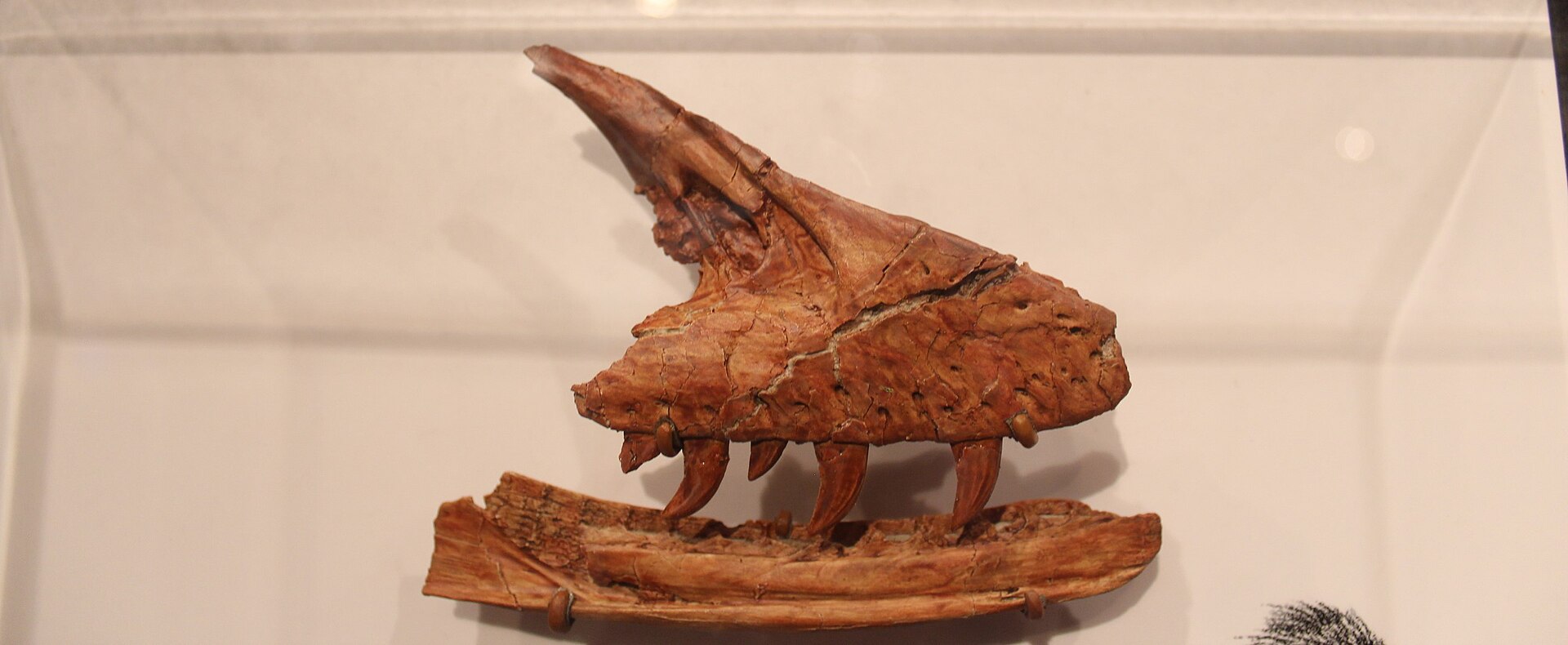
The holotype, ROM 63777, is a nearly complete maxilla (the main upper jaw bone) with teeth. Its companion, ROM 63778, is a dentary (the tooth-bearing bone of the lower jaw). In 2020, paleontologist Steven E. Jasinski and colleagues described the pair as a right maxilla and a “potentially associated” left dentary. While the original abstract calls them “associated,” researcher Chan-Gyu Yun (2024) suggested both probably come from one individual.
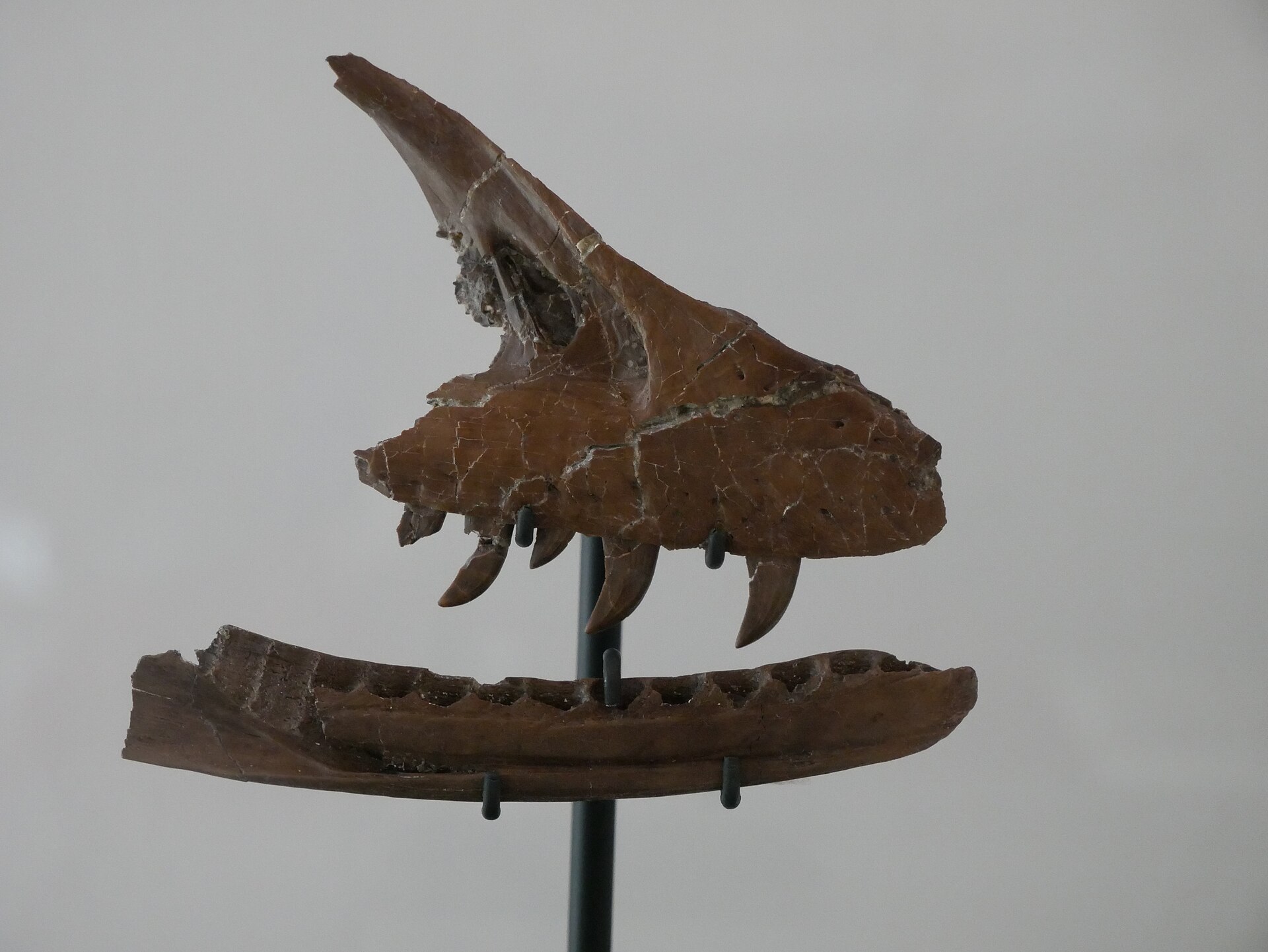

Before 2013, paleontologists usually assigned Maastrichtian raptor teeth to species known from older Campanian rocks. Evans and colleagues then concluded that most isolated dromaeosaurid teeth from the Hell Creek and Lance formations probably belong to Acheroraptor. For example, a 2020 study of a bonebed in Wyoming’s Lance Formation lists 128 Acheroraptor teeth among its fauna. Still, Evans and colleagues themselves noted—as paleontologists Thomas E. Williamson and Stephen L. Brusatte repeated in 2014—that some of these teeth lack ridges. Whether that marks a different animal or individual variation remains uncertain. So far, no confirmed bones from behind the skull belong to Acheroraptor.
Acheroraptor Size and Description
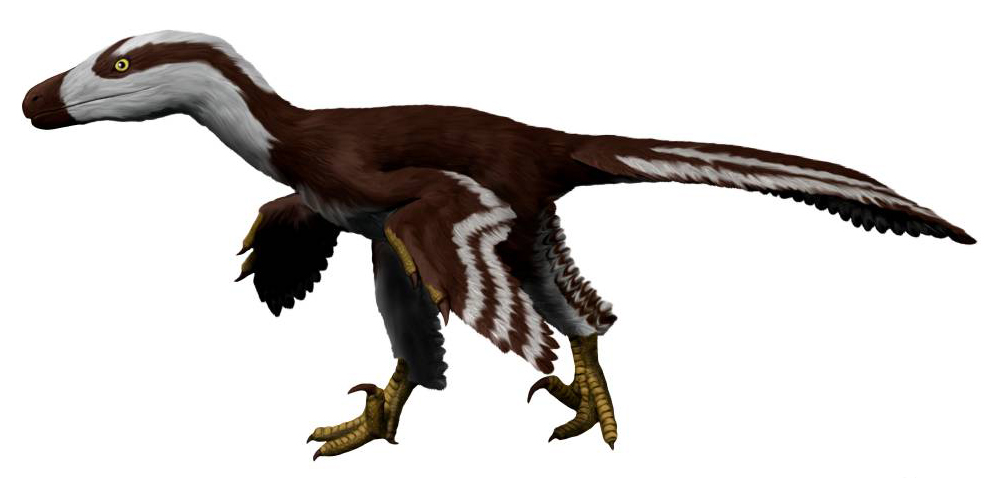
With only two jaw bones known, any picture of the whole animal rests on inference.
Short description of Acheroraptor
The ROM describes Acheroraptor as having “a long-snouted skull and dagger-like ridged teeth.” Its maxilla preserves a promaxillary fenestra and, directly behind it, a maxillary fenestra—two window-like openings in the bone. That second opening sits low within the antorbital fossa, a recess in front of the eye socket. Farther back, an enlarged bony partition called the postantral wall projects into the antorbital fenestra—the large opening in the side of the snout. A supraalveolar ridge also runs along the bone just above the tooth sockets.
The teeth carry marked apicobasal ridges, which run from the base of the crown toward the tip. Even without postcranial bones (those behind the skull), the ROM inferred that it walked on two legs. Because of its close relationship to birds, the museum also judged it likely covered in feathers. However, the fossils preserve no feathers or skin, so any discussion of its outer covering remains speculative.

Size and Weight of Type Species
According to the ROM’s 2013 release, Acheroraptor reached about 9.8 feet (3 meters) in length. The release calls it “relatively large for a ‘raptor'” and gives a weight of about 88 pounds (40 kilograms), but it does not explain either figure.
No source consulted for this article gives a height, and no peer-reviewed study offers a body length or mass. Because the only fossils are jaws, any whole-body figure is an extrapolation—an informed guess rather than a measurement.
By contrast, the jaws offer direct measurements, and the largest complete upper tooth crown stands about 0.52 inches (13.1 millimeters) tall. In 2024, Yun measured a cast of the dentary at about 0.62 inches (1.58 centimeters) deep at mid-length. From a reconstruction, he also estimated a full lower jaw length of about 8.1 inches (20.5 centimeters).
The Dinosaur in Detail
What sets this dinosaur apart are three features its describers highlighted in 2013. First comes the enlarged postantral wall jutting back into the antorbital fenestra. Next, the maxillary fenestra sits “very low in the antorbital fossa compared to other dromaeosaurids,” in the words of the supplementary text. Finally, its teeth bear the marked apicobasal ridges that make isolated crowns so recognizable.
The teeth hold finer clues, too. Along the front edge, the serrations, or denticles, number 6.6 to 7.8 per millimeter, while the back edge carries a coarser 4.4 to 5.0. Its rear denticles are rounded and only slightly angled toward the tip, unlike the strongly hooked ones of Saurornitholestes.

Its placement remains the biggest open question. The 2013 analysis found it closest to Asian velociraptorines, and Jasinski and colleagues (2020) at first agreed, placing it near the base of Velociraptorinae with Dineobellator from New Mexico. In contrast, Powers and colleagues (2021)—a team that included Evans himself—used CT scans to recover Acheroraptor and Atrociraptor as derived saurornitholestines. They argued that its Asian-looking snout traits reflect convergence—similar features evolving independently. Yun (2024) likewise called it probably a saurornitholestine, and he counted the Jasinski team’s 2023 reassessment, which moved Dineobellator outside every named dromaeosaurid group, among the studies on that side. Earlier, a 2019 analysis by paleontologist Scott Hartman and colleagues even placed it among the microraptorians, though a single extra step moved it back into Eudromaeosauria.
The debate carries a geographic twist. Evans and colleagues read its relationships as a sign of complex, two-way exchanges between Asian and North American faunas. Powers and colleagues argued that their results challenge that idea, while Jasinski’s team (2020) still inferred movement between the continents. Yet none of these studies questions that Acheroraptor is a valid species—the dispute is only about its exact branch.
Interesting Points about Acheroraptor
- Its name means “Acheron plunderer,” after the underworld river of Greek myth, a choice that acknowledges the Hell Creek Formation that yielded its fossils.
- When named in 2013, it was described as the latest-occurring dromaeosaurid known. Dakotaraptor (2015), from no more than 66 feet (20 meters) below the Cretaceous–Paleogene boundary in South Dakota, comes from a similarly late level. However, parts of its skeleton have since proved to belong to other animals.
- Speaking of the long-known Hell Creek raptor teeth, co-author Derek Larson said, “We now know that those teeth all belong to the same animal.”
- After buying the holotype from private collectors, the Royal Ontario Museum put the fossils on display over the 2013 holiday season.
- An analysis of its teeth suggested that raptor diversity in North America declined just before the extinction, although later studies question that picture.
Contemporary Dinosaurs
Towering above the floodplain was Tyrannosaurus, which the ROM called “the famous mega-predator.” Paleontologist John R. Horner and colleagues counted five of its skeletons in the upper third of the Hell Creek Formation in northeastern Montana. The 2013 paper places Acheroraptor in this same Tyrannosaurus–Triceratops fauna of the latest Maastrichtian, although no fossil records any encounter between the two.
Far more common was Triceratops, the three-horned plant-eater. In that Montana census, it accounts for 22 skeletons—69 percent of the dinosaur skeletons in the formation’s upper third. Nothing links it to Acheroraptor beyond a shared landscape.
Adding further diversity was Edmontosaurus, a hadrosaurid (duck-billed) herbivore whose five skeletons from the same upper unit matched Tyrannosaurus in Horner’s count. Again, no evidence connects it directly to Acheroraptor.
Also part of this fauna was Thescelosaurus, which a 2009 revision called a basal neornithischian—an early-branching member of the bird-hipped dinosaurs. Its isolated bones turn up in the Doldrum’s Lag, a deposit at the base of the Apex sandstone in the same upper third. Across the whole formation, Horner’s census puts it at about 8 percent of the dinosaurs counted, but no fossil ties it to Acheroraptor.
Acheroraptor in its Natural Habitat
The world Acheroraptor roamed was an extensive floodplain crossed by meandering rivers, with short-lived backwater deposits. In central Montana, pollen and spores from older, lower Hell Creek beds are all land or freshwater types, linked to rivers, swamps, and lakes.
Acheroraptor was a carnivore, but its exact prey is unknown. In 2024, Yun modeled its lower jaw and suggested that it was mainly adapted for rapid, slashing bites. The study found the jaw weaker than that of Saurornitholestes and comparable to Asian velociraptorines. From this, he suggested it may have preyed on smaller animals than other saurornitholestines did, although he cautioned that the result rests mainly on a reconstruction. He also floated the maned wolf as a model—a long-snouted hunter of small vertebrates.
While there is no direct evidence of how it hunted, Yun speculated that it may have pinned prey with an enlarged second-toe claw, even though its foot remains unknown. In addition, he suggested it might have divided resources with similar-sized carnivores, such as juvenile tyrannosaurids, troodontids, and Richardoestesia. Indeed, Horner’s team noted that small troodontids and dromaeosaurids are known there mainly from teeth at microfossil sites, with no skeletons in their census. With Richardoestesia and Paronychodon also known from the formation, Acheroraptor was one of several small hunters here.
Frequently Asked Questions
It means “Acheron plunderer,” after the underworld river of Greek myth, and the species name honors James and Louise Temerty.
It lived in the latest Maastrichtian stage of the Late Cretaceous, about 67 to 66 million years ago.
The Royal Ontario Museum estimated about 9.8 feet long and about 88 pounds, but only its jaws are known.
It was a carnivore. A 2024 jaw study suggested rapid, slashing bites, possibly aimed at fairly small prey.
Its jaw fossils come from Garfield County, Montana, USA, reportedly from the upper Hell Creek Formation. Teeth referred to it are known more widely from Montana and Wyoming.
It was a dromaeosaurid, or “raptor,” first placed with Velociraptor but later linked by most recent studies to Saurornitholestes.
Sources
The information in this article is based on various sources, drawing on scientific research, fossil evidence, and expert analysis. The aim is to provide a comprehensive and accurate overview of Acheroraptor. However, please be aware that our understanding of dinosaurs and their world is constantly evolving as new discoveries are made.
- https://doi.org/10.1007/s00114-013-1107-5
- https://static-content.springer.com/esm/art%3A10.1007%2Fs00114-013-1107-5/MediaObjects/114_2013_1107_MOESM1_ESM.docx
- https://www.rom.on.ca/news-releases/scientists-reveal-new-raptor-dinosaur-north-america
- https://mapress.com/mz/article/view/mesozoic.1.4.3
- https://doi.org/10.1080/02724634.2021.2010087
- https://pmc.ncbi.nlm.nih.gov/articles/PMC7099077/
- https://pmc.ncbi.nlm.nih.gov/articles/PMC6626525/
- https://pmc.ncbi.nlm.nih.gov/articles/PMC3977837/
- https://pmc.ncbi.nlm.nih.gov/articles/PMC7241792/
- https://pmc.ncbi.nlm.nih.gov/articles/PMC13372169/
- https://pmc.ncbi.nlm.nih.gov/articles/PMC12922588/
- https://journals.ku.edu/paleocontributions/article/view/20303
- https://pmc.ncbi.nlm.nih.gov/articles/PMC3036655/
- https://pmc.ncbi.nlm.nih.gov/articles/PMC13189327/
- https://doi.org/10.1671/039.029.0328
- https://paleobiodb.org/classic/basicTaxonInfo?taxon_no=283585
- https://doi.org/10.1002/ar.25103
This article was last fact checked: TheDinosaurs Team, 03-11-2026
Featured Image Credit: Emily Willoughby, CC BY 3.0, via Wikimedia Commons
