
On La Anita farm near El Calafate, in Argentina’s Santa Cruz Province, lie the river-laid rocks of the Chorrillo Formation. They hold a theropod that southern Patagonia had long been missing. Named Kank australis in 2026, it is an unenlagiid—one of a group of paravian theropods known so far only from Gondwana, the old southern landmasses. Its describers rank that group as a family, although many analyses treat it as a dromaeosaurid subfamily instead. Kank lived during the Maastrichtian stage of the Late Cretaceous, which its describing institution rounds to about 70 million years ago. At least seven unenlagiid species have turned up in northern Patagonia, but the far south had offered only scraps.
According to Argentina’s Museo Argentino de Ciencias Naturales (MACN), its field teams and the Fundación Félix de Azara have worked these beds since 2018. The first published field report, by Fernando E. Novas and colleagues, dates its expeditions to 2019. Japan’s National Museum of Nature and Science also joined the effort. The decisive find came in 2024—a neck vertebra recovered just before a snowstorm drove the team off the site. Two years later, paleontologist Matías J. Motta and eleven colleagues named the animal in the Journal of Vertebrate Paleontology. In the team’s view, Kank helps fill a geographic gap for the family between northern Patagonia and Antarctica.
Kank Key Facts
| Keyword | Fact |
|---|---|
| Pronunciation | Not specified |
| Meaning of name | Elder Rhea (from Aonikenk mythology) from the South |
| Group | Theropoda |
| Type Species | Kank australis |
| Diet | Possibly mainly fish, with other small prey such as frogs or small mammals, according to the describing team’s press materials |
| When it Lived | Around 70 MYA |
| Period | Cretaceous |
| Epoch | Late Cretaceous (Maastrichtian stage) |
| Length | Not specified in the paper (“medium-sized”), but team press figures give about 6.6 to 9.8 feet (2 to 3 meters) |
| Height | Not specified |
| Weight | Not specified in the paper, whose diagnosis compares its toe bones to those of Neuquenraptor (about 60 pounds, or 27 kilograms). National Geographic reported about 50 pounds (23 kilograms) |
| Mobility | Not specified |
| First Discovery | 2018 (2019 in some reports) at La Anita farm, with the key neck vertebra found in 2024 by Gonzalo Muñoz |
| Described by | 2026 by M.J. Motta, A.M. Aranciaga Rolando, S. Rozadilla, F.L. Agnolín, F. Brissón Egli, G.P. Álvarez Herrera, N.R. Chimento, G. Lo Coco, T. Tsuihiji, M. Manabe, D. Pol, and F.E. Novas |
| Holotype | Catalogued in the collection of the Museo Padre Molina, Río Gallegos, where it is to be permanently deposited |
| Location of first find | La Anita farm, Chorrillo Formation, near El Calafate, Santa Cruz Province, Argentina |
Kank Origins, Taxonomy and Timeline
The name Kank comes from the mythology of the Aonikenk people. In their stories, Kank is the “elder Rhea” who created the constellation Choiols, known in English as the Southern Cross. The species name australis means “from south” in Latin, a reference to the southern latitude of the find. Together, the name ties a story from the southern sky to a fossil from the far south.
In the describers’ scheme, Kank sits within Dinosauria, Saurischia, and Theropoda. More narrowly, it belongs to Paraves—birds and their closest relatives—and to Unenlagiidae, a family so far confined to Gondwanan landmasses. In 2025, Motta and colleagues also placed the Antarctic paravian Imperobator within that family. One toe bone of Kank, however, recalls a different paravian branch, the troodontids. Kank australis is the type and only known species.
The describers date the fossils to the Maastrichtian stage of the Late Cretaceous, about 72.2 to 66.0 million years ago. Studies of the Chorrillo Formation differ on whether it falls in the early or the late part of that stage. During that interval, the Austral-Magallanes Basin was in a continental phase, before the shallow sea of the overlying Calafate Formation spread across it. This was the final chapter of the Cretaceous, and southern Patagonia was still a land of rivers and floodplains.
Discovery & Fossil Evidence
The fossils of Kank come from La Anita farm, about 19 miles (30 kilometers) southwest of El Calafate. The publisher’s release says the first remains turned up in 2018 but were too fragmentary to identify. National Geographic and the Everything Dinosaur blog instead begin in 2019, the year National Geographic links to a second-toe claw fragment. The breakthrough came in 2024, when MACN technician Gonzalo Muñoz spotted a vertebra from the base of the neck while hunting tiny fossils. When days of snow forced the team out, an Argentine Army helicopter meant for a titanosaur fossil carried the raptor bone away instead. As coauthor Diego Pol put it, “It’s painful to leave a fossil in the field.”
The holotype—the name-bearing specimen—is catalogued in the collection of the Museo Padre Molina in Río Gallegos, where it is to be permanently deposited. Its highly pneumatized, or air-filled, cervical vertebra carries a well-developed parapophysis, the attachment point for a rib, along with carotid processes on its underside. According to MACN, rock still encased the vertebra at first, and the team was unsure which reptile it came from. Motta, however, told National Geographic that he recognized a raptor at once. Altogether, Kank is known from vertebrae, isolated pedal phalanges (toe bones), and shed teeth.
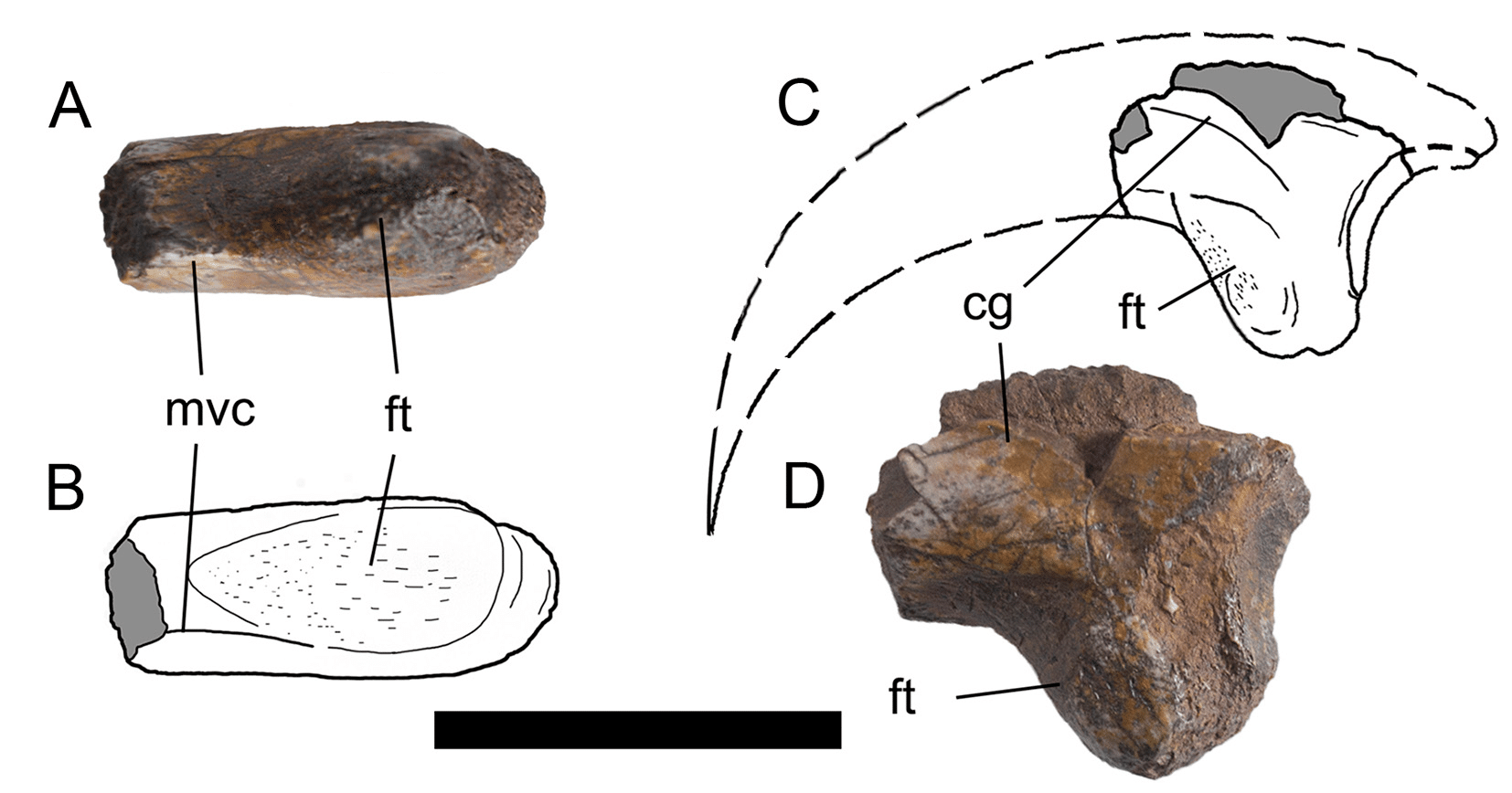
Hints of it may have surfaced earlier. In that 2019 report, Novas and colleagues described unenlagiid remains from the formation’s Puma Cave site. The material, part of a second-toe ungual (claw) and a toe bone, matched the northern unenlagiid Neuquenraptor in size and shape. They called it the southernmost unenlagiid record for South America. In 2022, Aranciaga Rolando and colleagues added that a small back vertebra, first listed as a megaraptorid, might instead be unenlagiid. The Paleobiology Database now lists some of these earlier fragments under Kank.

Kank Size and Description
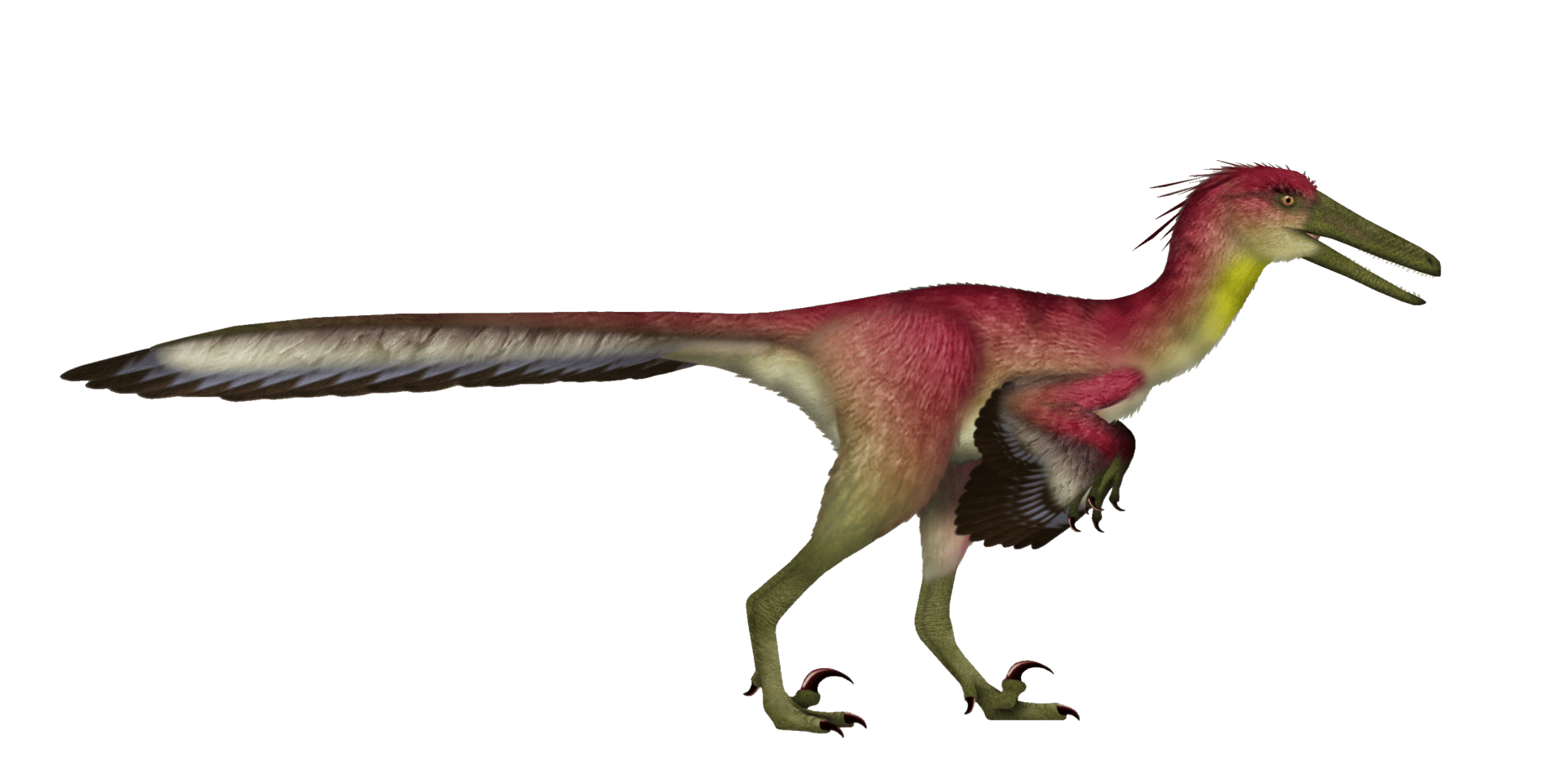
Known only from teeth, vertebrae, and toe bones, Kank has to be pictured largely through comparison with its relatives.
Short description of Kank
Its teeth carried what the publisher’s press release calls “sharp and pronounced longitudinal ridges,” and the upper teeth were flattened from side to side. Its neck vertebrae, meanwhile, were notably air-chambered. In the team’s reading, these bones anchored neck muscles and shielded blood vessels—as in herons and other birds with complex neck movement.
Farther down the body, the press materials describe an enlarged raptorial claw on the second toe. No skull, arm, or hip bones appear among its listed remains, however, so its bones cannot yet reveal its posture or proportions. Skin impressions or feathers are not preserved, so any discussion of its outer covering is speculative.

Size and Weight of Type Species
The describers call Kank a “medium-sized unenlagiid” but give no length for it in their diagnosis. Even the team’s own press materials disagree. The publisher’s release estimates an adult length of 8.2 to 9.8 feet (2.5 to 3 meters), based on Neuquenraptor. MACN, by contrast, gives about 6.6 feet (2 meters)—comparable to a rhea, the large flightless bird of South America.
The paper gives no mass, but its diagnosis likens the toe bones in size to those of Neuquenraptor argentinus. Motta estimated that animal in 2023 at about 60 pounds (27 kilograms). Separately, National Geographic called Kank a “50-pound predator,” or about 23 kilograms.
A famous relative offers a sense of scale. According to the publisher’s press release, Kank was smaller and more gracile than Austroraptor cabazai, a northern Patagonian giant that reached about 16 feet (5 meters). Its real interest, however, lies in the details of its bones.
The Dinosaur in Detail
What sets this dinosaur apart sits at the base of its neck. The cervicodorsal vertebra—the transitional bone between neck and back—bears two autapomorphies, or traits unique to the species. Its underside carries three pneumatic foramina, the openings through which air sacs invaded the bone. In addition, it has an epipophyseal fossa, a hollow on the bony prong where neck muscles attach.
The teeth combine traits seen in different relatives. Like those of Austroraptor, the dentary (lower-jaw) teeth have mesial carinae—front cutting edges—restricted to the top third of the crown. These edges are also crenulate, or finely wrinkled. The maxillary teeth of the upper jaw, meanwhile, are labiolingually compressed, with an “8”-shaped cross-section shared with Buitreraptor.
The toes tell a different story. Phalanx II-2, from the second toe, has reduced distal condyles, the rounded knuckles at the bone’s far end. Its collateral pits, where ligaments attached, sit very close to the upper front corner of those knuckles. In this, it resembles troodontids and differs from every other known unenlagiid.
The publisher’s press release uses the subfamily label, calling Kank an unenlagiine, but the paper’s classification heading names only the family. Its describers concluded that Kank was probably distinct from its kin and that it supports the view of Unenlagiidae as morphologically disparate—varied in body form. Taken together, its teeth and toes share traits with three different paravians, from Austroraptor and Buitreraptor to the troodontids.
Interesting Points about Kank
- Its genus name honors the “elder Rhea” of Aonikenk mythology, the figure credited with creating the constellation Choiols, or Southern Cross.
- The key neck vertebra left the field aboard an Argentine Army helicopter that had been meant to lift a titanosaur fossil, which stayed behind.
- One of its toe bones looks more like those of troodontids than those of any other known unenlagiid.
- Its describers say Kank supports the view that unenlagiids were a morphologically disparate family rather than a uniform group.
- Before Kank, the unenlagiid record of southern Patagonia consisted of only a few isolated remains of indeterminate taxa from Argentina and Chile.
Kank in its Natural Habitat
Kank roamed a low, wet floodplain. Some 1,640 feet (500 meters) of mostly fine-grained floodplain sediment built up there under a low-gradient river system. Channel sands and crevasse splays—sand fans spilled when rivers broke their banks—cut through it. These fine beds show soil development and waterlogging, and one level preserves a swampy, low-energy patch far out on the floodplain. The team describes meandering streams and seasonal ponds with water lilies, in a humid climate with seasonal rain. In 2025, Raigemborn and colleagues used fossil-soil chemistry to class that climate as temperate to subtropical. Insects included midges, mayflies, and moths or butterflies.
No direct evidence shows what Kank ate, but its describers have offered an idea. MACN says teeth with small ridges like these grip slippery prey such as fish. In that view, its heron-like neck marks an active fisher, not the agile hunter often pictured for Velociraptor. The publisher’s release adds that the team found fish fossils alongside its remains. Motta has also noted that long snouts, numerous teeth, and long, flexible necks suggest fishing adaptations across unenlagiids. Pol, speaking to National Geographic, cast the net wider—Kank was “probably eating small prey that may have included small mammals, frogs, or fish.”
MACN reports other dinosaurs from the same site, among them the megaraptorid Maip and the long-necked titanosaur Nullotitan. Published work, however, has not yet tied them to the level that yielded Kank. Maip reached about 30 to 33 feet (9 to 10 meters) by its describers’ estimate, and the Nullotitan holotype probably surpassed 66 feet (20 meters). The elasmarian Isasicursor, an early iguanodontian ornithopod known from several individuals, comes from the upper third, where titanosaurs vanish. Partially equivalent beds continue south into Chile as the Dorotea Formation, whose upper section has yielded the small early Maastrichtian hadrosauroid Gonkoken nanoi.
Life on the Chorrillo Floodplain
Beyond the non-avian dinosaurs, the formation preserves the bird Kookne and enantiornithines, an extinct branch of early birds. Gondwanatherians and monotremes (egg-laying mammals) lived there too, including the monotreme Patagorhynchus from the Puma Cave site. Turtles, frogs, snakes, and fishes round out the fauna, while mosasaur teeth in the upper beds signal marine influence. Unlike faunas farther north, this one lacks abelisaurids and two titanosaur groups, the saltasaurines and aeolosaurines. Novas and colleagues linked that absence to greater age or, “more probably, different environmental conditions.”
Whether Kank lived alone or in groups remains unknown, as its scattered remains say nothing of its social life. If the fishing idea holds, it may have worked the water’s edge on these floodplains—a heron-like hunter among the dinosaurs.
Frequently Asked Questions
Kank is the “elder Rhea” of Aonikenk mythology, who created the Southern Cross, and australis means “from south” in Latin.
It lived during the Maastrichtian stage of the Late Cretaceous, around 70 million years ago.
Its describers call it medium-sized without giving a length. Team press materials give about 6.6 to 9.8 feet, and National Geographic reported about 50 pounds.
Its formal diagnosis states no diet. In press materials, its describing team proposes that it mainly ate fish, perhaps with other small prey such as frogs or small mammals.
Its fossils come from the Chorrillo Formation on La Anita farm, near El Calafate in Santa Cruz Province, Argentina.
Its cervicodorsal vertebra has three air openings on its underside and an epipophyseal fossa, traits its describers consider unique to the species.
Sources
The information in this article is based on various sources, drawing on scientific research, fossil evidence, and expert analysis. The aim is to provide a comprehensive and accurate overview of Kank. However, please be aware that our understanding of dinosaurs and their world is constantly evolving as new discoveries are made.
- https://doi.org/10.1080/02724634.2026.2656456
- https://doi.org/10.22179/revmacn.21.655
- https://doi.org/10.1038/s41598-022-09272-z
- https://doi.org/10.1038/s42003-023-05596-2
- https://doi.org/10.1038/s42003-023-04498-7
- https://doi.org/10.1126/sciadv.adg2456
- https://doi.org/10.5710/AMGH.13.11.2024.3604
- https://doi.org/10.1016/j.cretres.2025.106144
- https://www.macnconicet.gob.ar/kank-australis-el-nuevo-raptor-descubierto-en-la-patagonia-argentina
- https://newsroom.taylorandfrancisgroup.com/heron-like-fish-eating-dinosaur-from-70-million-years-ago-discovered-in-argentina/
- https://www.eurekalert.org/news-releases/1129844
- https://www.nationalgeographic.com/newsletters/article/stones-bones-raptor-in-snow-helicopter-escape
- https://blog.everythingdinosaur.com/blog/_archives/2026/06/02
- https://nautil.us/nightmarish-heron-like-dinosaur-unearthed-in-patagonia-1281530
- https://paleobiodb.org/data1.2/occs/single.json?id=2065165&show=ident,ref,rem
- https://stratigraphy.org/ICSchart/ChronostratChart2024-12.pdf
This article was last fact checked: TheDinosaurs Team, 13-11-2026
Featured Image Credit: Connor Ashbridge, CC BY 4.0, via Wikimedia Commons
