In northeastern Garfield County, Montana, a sandstone concretion in the Hell Creek Formation held a small theropod skeleton with its skull still in place. Named Infernogallus jamesi in 2026, it was a diminutive caenagnathid oviraptorosaur—a small, beaked theropod with a bird-like build. It lived during the late Maastrichtian, the closing stage of the Cretaceous. Its skull is also the first intact cranium known for the entire caenagnathid family. That skull led its describers to a bold hypothesis—that this little dinosaur fed largely on soft, fleshy fruit.
The holotype’s story began in July 2011, when collector C. Phipps recovered the skeleton on private land. The Royal Ontario Museum (ROM) in Toronto then acquired it in April 2012. Separately, a second research group found more material elsewhere in the formation, and the two teams later joined forces. In October 2026, paleontologist Gregory F. Funston and seven colleagues named the animal in Nature Communications. Because the skull survived nearly complete, their study shows how a caenagnathid head was actually built.
Infernogallus Key Facts
| Keyword | Fact |
|---|---|
| Pronunciation | Not specified |
| Meaning of name | Hell Chicken |
| Group | Theropoda |
| Type Species | Infernogallus jamesi |
| Diet | Possibly largely fruit (per its describers) |
| When it Lived | About 66 MYA (holotype 15.5 m below the K–Pg boundary, in a formation spanning about 67.1 to 66.0 MYA in central Montana per Roberts et al. 2026) |
| Period | Cretaceous |
| Epoch | Late Cretaceous (Maastrichtian stage) |
| Length | Not specified |
| Height | Not specified |
| Weight | About 26 pounds (12 kilograms), estimated from the femur |
| Mobility | Not specified |
| First Discovery | Holotype found 2011 by C. Phipps |
| Described by | 2026 by G.F. Funston, T.W. Dudgeon, D.J. Simon, D.M. Dufault, C. Boyd, D. Fowler, P.J. Currie, and D.C. Evans |
| Holotype | ROM VP 65050 |
| Location of first find | Hell Creek Formation, northeastern Garfield County, Montana, USA |
Infernogallus Origins, Taxonomy and Timeline
The name Infernogallus combines “inferno,” meaning “hell,” with the Latin “gallus,” meaning “chicken.” The describers call “inferno” Latin, but the classical Latin word is infernus—inferno is the Italian form. It refers both to the Hell Creek Formation and to the animal’s small, bird-like appearance. The species name jamesi honors James William Boyd, the paternal grandfather of co-author Clint Boyd, who sparked his grandson’s interest in paleontology. According to the paper’s acknowledgments, C. Woodruff suggested the generic name.
Infernogallus belongs to Theropoda and, within it, to Oviraptorosauria. More precisely, it sits in Caenagnathidae—a mostly North American family of oviraptorosaurs with long, low, toothless lower jaws. It also belongs to a new subgroup named in the same paper, which Funston and colleagues called Eucaenagnathinae (“true caenagnathids”). They defined it as the largest group that includes Anzu and Elmisaurus but not Anomalipes. Its members share fused lower jaws with ridges along the biting surface. Infernogallus jamesi is the type and only known species.
All five known specimens come from the late Maastrichtian Hell Creek Formation. However, the describers give no age in millions of years. In 2026, Roberts and colleagues dated the base of the formation in central Montana to about 67.1 million years ago, or older. Its top is tied to the end-Cretaceous impact, roughly 66 million years ago. The holotype lay only about 51 feet below that top. Infernogallus thus lived near the very end of this interval—shortly before 66 million years ago.
Discovery & Fossil Evidence
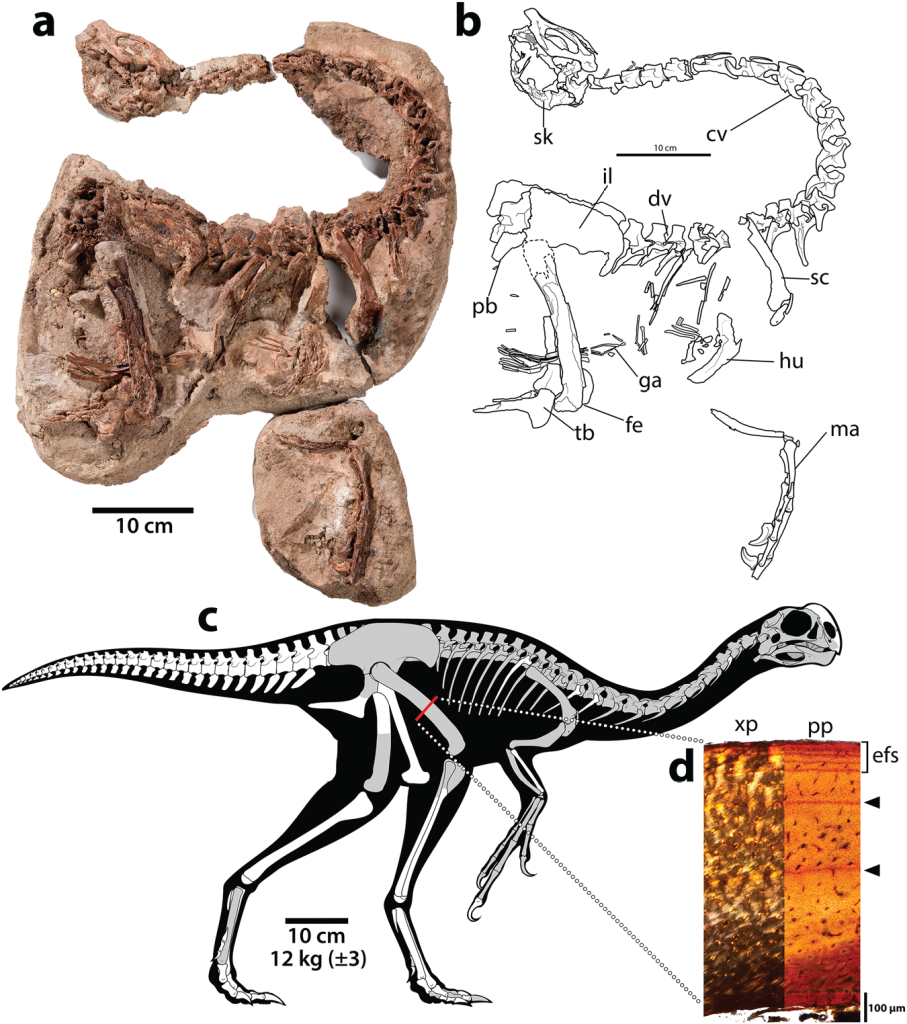
The holotype came from about 51 feet (15.5 meters) below the Cretaceous–Paleogene boundary—the rock layer that marks the mass extinction. It lay inside a concretion, a hard mineral nodule, within a sandstone bed about 12 feet (3.75 meters) thick. CK Preparations in Montana did the first stage of preparation, with “no reconstructive work.” ROM staff then finished the job. CT scans also confirm that the specimen, including the skull, is authentic.
Cataloged as ROM VP 65050, the holotype is an articulated partial skeleton. It preserves the skull, the cervical (neck) and dorsal (back) vertebrae, and the right shoulder girdle and forelimb. Part of the pelvis and right hind limb survive too. However, the main block was split into four pieces, losing part of the shoulder blade and the elbow region. The lower jaw was also crushed from side to side.

Four paratypes—additional specimens named alongside the holotype—add jaw and palate bones. Two are a pair of dentaries (lower jaw bones) and a hinge complex from the back of a lower jaw. Both came from south-central Garfield County, and the authors interpret them as one individual. A pair of pterygoids (palate bones) came from near Faith, South Dakota, and reached the ROM in 2015. In 2019, co-author Denver Fowler collected another set of dentaries in southwestern Bowman County, North Dakota, during a symposium field trip. They lay about 32 feet (9.85 meters) below the extinction boundary. A more detailed description of the second team’s material is still to come. No further specimens had been reported as of late 2026.
Infernogallus Size and Description
Infernogallus was small even by caenagnathid standards, yet its skeleton shows a fully grown animal with an unusual head.
Short description of Infernogallus
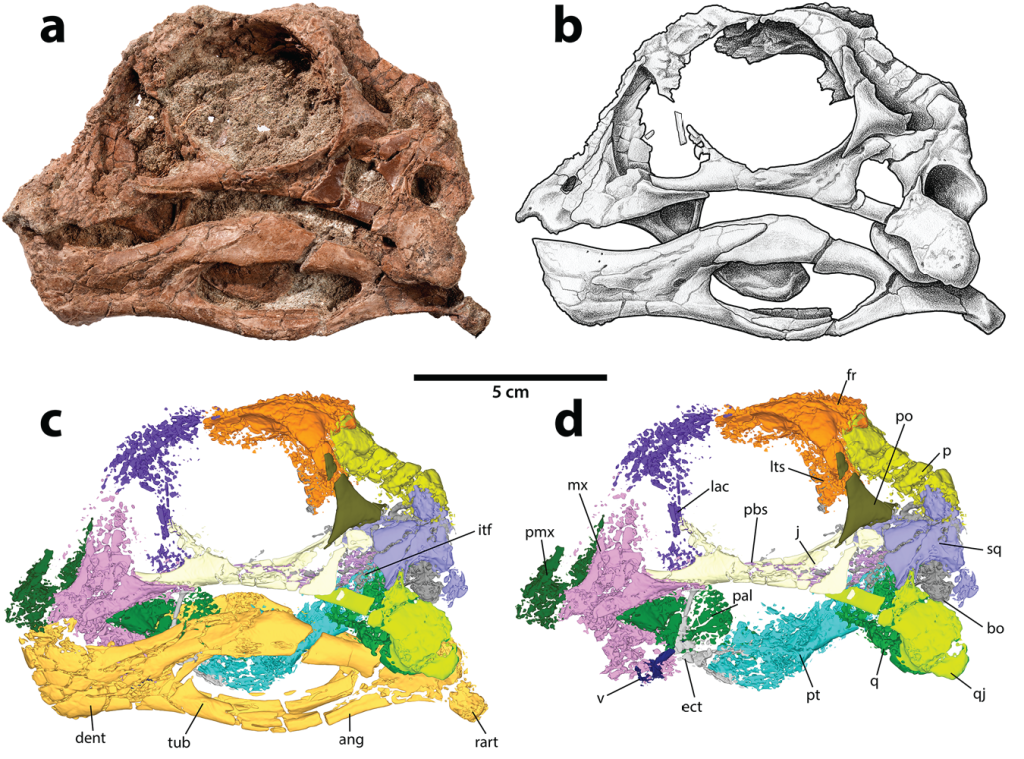
The skull measured just 4.1 inches (104 millimeters) from snout to the back of the head. A large, circular orbit (eye socket) took up nearly 40 percent of that length. Behind it, the infratemporal fenestra—an opening in the cheek region—shrank to about a quarter of the orbit’s diameter. At the front, the fused lower jaws turned steeply upward into a toothless beak, similar to those of modern birds and turtles.

The neck was long, with 14 vertebrae measuring about 19 inches (485 millimeters) in total. By comparison, the trunk from shoulder to hip was only about 9.4 inches (240 millimeters) long. Air spaces extensively hollowed out the neck and back vertebrae, while the shoulders carried a slender, boomerang-shaped furcula (wishbone). In the hand, the second metacarpal was the longest, and two of the claws bore pronounced lips near their bases. Its preserved toe claw was curved, with a large tubercle for the flexor tendon. Feathers are not preserved, so any plumage is inferred from its relatives. According to its describers, oviraptorosaurs as a group had the most complex feathers outside birds.
Size and Weight of Type Species
No total length or hip height appears in the original description. Instead, Funston and colleagues estimated body mass from the circumference of the femur, or thigh bone. Their result was about 26 pounds (12 kilograms), with a range of 20 to 33 pounds (9 to 15 kilograms). Science News put it at “about the size of a turkey.”
That small size belonged to an adult—growth lines in the femur, fibula, and a foot bone record an animal at least six and likely seven years old. An outer bone layer called the external fundamental system also shows that it had stopped growing. In other words, its small size was not a sign of youth.
In life, the femur would have been about 7.3 inches (185 millimeters) long. By contrast, the femur of Anzu reached about 20 inches (500 to 525 millimeters). Its describers also estimate that it reached only about 21 percent (9.4 to 26 percent) of the adult mass of Eoneophron, another Hell Creek caenagnathid. Separately, the 2024 description put the Eoneophron holotype at about 172 pounds (78 kilograms), within a range of 130 to 216 pounds (58.9 to 98.1 kilograms).
The Dinosaur in Detail
What sets this dinosaur apart is the inside of its mouth. There, a greatly enlarged bar of two palate bones, the ectopterygoid and pterygoid, arched downward and filled most of the oral cavity. A rough buttress on each pterygoid looks superficially like the one in crocodylians. In addition, the jaw joint had a ridge-and-saddle shape that allowed extensive fore-and-aft movement. In a virtual model of the joint, the lower jaw could slide up to 0.6 inches (15 millimeters)—about 14 percent of skull length. However, soft tissues probably limited this movement in life.
The cheek opening was just as unusual. It spanned only 11 percent of skull length and 12.5 percent of skull height. In the oviraptorid Citipati, by contrast, the same figures are 29 and 48 percent. Funston’s team called this “a unique condition among non-avian theropods.” Its rounded “chin,” meanwhile, more closely resembles jaws referred to Chirostenotes pergracilis, another caenagnathid, than those of Leptorhynchos or Elmisaurus. The authors also found that the skull “differs radically” from the one earlier proposed for Anzu, its larger Hell Creek relative.
Funston’s team then tested the family tree with three methods, using a matrix of 42 taxa and 271 anatomical characters—trimmed to 29 taxa for the dated analysis. In the parsimony analysis, Infernogallus joined a “deep-beaked” group with Chirostenotes, Elmisaurus, Eoneophron, and others. The preferred tip-dated tree, which also estimates timing, recovered it as the sister of Elmisaurus. However, the authors found “little evidence” for consistent subgroups within Eucaenagnathinae and cautioned against naming them. Their dated model places the origin of the family in the Aptian to Albian stages of the Early Cretaceous. Eucaenagnathinae followed between about 84 and 77 million years ago.
Interesting Points about Infernogallus
- Science News headlined Infernogallus as the “hell chicken” dinosaur, a nickname that echoes the literal meaning of its Latin name.
- Its describers found that the ridged palate and jaws match an arrangement in the living green sea turtle, which they called “directly equivalent.”
- No potential gastroliths (stomach stones) turned up during preparation, even though the holotype preserves a complete gastral basket, or set of belly ribs.
- One peer reviewer noted that the ecological conclusions were qualitative and lacked statistical tests, so the authors added exploratory analyses to the supplement.
- Its describers called caenagnathids “one of the strongest candidates” for dinosaur diets adapted to flowering plants, which began producing fleshy fruits shortly before the family arose.
Contemporary Dinosaurs
Sharing a river-channel complex with part of the Infernogallus material was Acheroraptor, which its describers in 2013 called “the latest occurring dromaeosaurid.” Their analysis suggested it was closer to Asian relatives such as Velociraptor than to any other North American taxon. Two Infernogallus paratypes, a dentary pair and a jaw-hinge complex, come “from the same channel complex that produced the holotype of Acheroraptor temertyorum.” That tie links the jaws, not the Infernogallus holotype skeleton, which came from a different site in northeastern Garfield County. Other dromaeosaurids have since turned up. In 2015, DePalma and colleagues described Dakotaraptor from the upper Hell Creek Formation of South Dakota, no more than 66 feet (20 meters) below the extinction boundary. Still, no fossil records any encounter between Acheroraptor and Infernogallus.
Also known from the Hell Creek Formation (exact level relative to Infernogallus not known): Tyrannosaurus, Triceratops, Edmontosaurus, Thescelosaurus, Anzu and Eoneophron. In a 2011 census of skeletons near Fort Peck Reservoir, Horner and colleagues found Triceratops “by far the most common dinosaur at 40%.” In central Montana, the formation spans about 1.1 million years, according to Roberts and colleagues. As a result, these animals may not all have lived at the same time.
Infernogallus in its Natural Habitat
Geologists describe the world Infernogallus knew as “an extensive floodplain with meandering river systems and ephemeral backwater deposits.” In central Montana, fossil pollen and spores point to rivers, swamps, and lakes across this landscape. The Hell Creek rocks built up as the Western Interior Seaway retreated, while channels and floodplains supported a rich flora. The North Dakota paratype came from a floodplain mudstone, whereas the holotype lay in an organic-rich sandstone.
In 2026, Funston and colleagues proposed that Infernogallus processed soft foods with its ridged jaws, in a motion “similar to a mortar and pestle.” A powerful tongue may have positioned each mouthful. In their view, the closest living analog is Pesquet’s parrot, a fruit specialist that eats the pulp and discards the seed. The authors hypothesized a similar defleshing habit and noted that caenagnathids “lacked adaptations for processing fibrous or durable vegetation.” Still, they added that caenagnathids probably ate many plant parts, and animal foods as well. Statistical tests in the supplement were inconclusive. Three of four approaches classed it as most likely an omnivore, and only an exploratory version favored soft food—barely, at 40.6 to 40.3 percent. The authors kept these tests out of the main paper.
Several earlier studies, the authors note, saw a preference for wetter environments in the caenagnathid fossil record. Before Infernogallus was named, a 2024 study had already argued that two or three kinds of caenagnathid coexisted in the Hell Creek Formation. Funston’s team also suggested that a reliance on seasonal fruit flesh, rather than long-lasting seeds, may help explain its extinction. Its small size and plant diet overlap with traits thought to have helped birds survive—but in the authors’ view, those traits alone were not enough.
Frequently Asked Questions
It means “hell chicken,” referring to the Hell Creek Formation and its bird-like look, while jamesi honors James William Boyd.
It lived near the end of the Maastrichtian stage of the Late Cretaceous, shortly before 66 million years ago.
It weighed about 26 pounds (12 kilograms), estimated from its femur. Its total length has not been published.
Its describers proposed a diet largely of soft, fleshy fruit, probably along with other plant parts and some animal foods.
It was found in the Hell Creek Formation of Garfield County, Montana, which also yielded two paratypes. Others came from South Dakota and North Dakota.
It has the first intact caenagnathid skull, with a palate that fills the mouth and a sliding jaw joint.
Sources
The information in this article is based on various sources, drawing on scientific research, fossil evidence, and expert analysis. The aim is to provide a comprehensive and accurate overview of Infernogallus. However, please be aware that our understanding of dinosaurs and their world is constantly evolving as new discoveries are made.
- https://www.nature.com/articles/s41467-026-78343-w
- https://static-content.springer.com/esm/art%3A10.1038%2Fs41467-026-78343-w/MediaObjects/41467_2026_78343_MOESM1_ESM.pdf
- https://static-content.springer.com/esm/art%3A10.1038%2Fs41467-026-78343-w/MediaObjects/41467_2026_78343_MOESM5_ESM.pdf
- https://doi.org/10.1371/journal.pone.0294901
- https://doi.org/10.1371/journal.pone.0092022
- https://link.springer.com/article/10.1007/s00114-013-1107-5
- https://pmc.ncbi.nlm.nih.gov/articles/PMC3036655/
- https://pmc.ncbi.nlm.nih.gov/articles/PMC3049066/
- https://pmc.ncbi.nlm.nih.gov/articles/PMC13189327/
- https://escholarship.org/uc/item/1m04m6bz
- https://www.sciencenews.org/article/hell-chicken-dinosaur-terror-fruit-eat
- https://journals.ku.edu/paleocontributions/article/view/20303
This article was last fact checked: TheDinosaurs Team, 18-11-2026
Featured Image Credit: TotalDino, CC BY 4.0, via Wikimedia Commons
