
In the Ténéré Desert of Niger, the river-laid sandstones of the Elrhaz Formation hold one of the strangest sauropods yet described. Named Nigersaurus taqueti in 1999, this herbivore lived during the Aptian and Albian stages of the Early Cretaceous—roughly 115 to 105 million years ago. Many of its skull bones are thin enough to let a strong beam of light pass through. Its tooth rows ran straight across a broad muzzle—an arrangement its describers knew from no other sauropod.
French paleontologist Philippe Taquet reported sauropod remains from these beds in 1976. The type skull turned up in 1997, when Didier Dutheil of paleontologist Paul Sereno’s team spotted it. Two years later, Sereno and ten colleagues named the genus in Science. A detailed restudy in 2007 then shortened its estimated length, recounted its teeth, and proposed a new head posture. Its story is a reminder that a species’ portrait keeps shifting as new methods reach old bones.
Nigersaurus Key Facts
| Keyword | Fact |
|---|---|
| Pronunciation | nee-zhayr-sore-us |
| Meaning of name | Niger Reptile |
| Group | Sauropoda |
| Type Species | Nigersaurus taqueti |
| Diet | Herbivore |
| When it Lived | 115 to 105 MYA |
| Period | Cretaceous |
| Epoch | Early Cretaceous (Aptian to Albian stages) |
| Length | About 49 feet (15 meters) in 1999, revised to about 30 feet (9 meters) in 2007 |
| Height | Not specified |
| Weight | About 8,800 pounds (4 metric tons), 2007 estimate |
| Mobility | Moved on all four legs (quadrupedal) |
| First Discovery | 1965 to 1972 by Philippe Taquet’s expeditions (reported 1976); type skull found 1997 by Didier Dutheil |
| Described by | 1999 by P.C. Sereno, A.L. Beck, D.B. Dutheil, H.C.E. Larsson, G.H. Lyon, B. Moussa, R.W. Sadleir, C.A. Sidor, D.J. Varricchio, G.P. Wilson, and J.A. Wilson |
| Holotype | MNN GAD512 (also printed MNN GDF512) |
| Location of first find | Niveau des Innocents (upper Elrhaz to lower Echkar level), Gadoufaoua region, Agadez region, Niger |
Nigersaurus Origins, Taxonomy and Timeline
The name Nigersaurus is refreshingly direct. “Niger” refers to the Republique du Niger, while “sauros” is Greek for “reptile.” The species name taqueti honors Taquet, whose expeditions between 1965 and 1972 began large-scale paleontological exploration in Niger. Together, the name ties the animal to its country and to the scientist who first opened its fossil beds to large-scale study.
In 1999, Sereno and colleagues classified Nigersaurus as a basal diplodocoid within the family Rebbachisauridae. Diplodocoidea also includes the Dicraeosauridae and the more familiar long-necked Diplodocidae. The describers treated Nigersaurus and a dentary—a lower jaw bone—once attributed to the titanosaur Antarctosaurus as the earliest and latest known rebbachisaurids. Older rebbachisaurid finds from the earliest Cretaceous have since overtaken that view. A 2007 restudy later found its closest relative in a Spanish rebbachisaurid—a link between Africa and Europe across the Tethys. Nigersaurus taqueti is the type and only known species.
The 1999 paper placed the bone-bearing horizons of the Tegama Group in the Aptian and Albian stages, roughly 115 to 105 million years ago. The 1999 abstract and the 2007 study rounded this to about 110 million years. A 2008 study used about 112, while the Paleobiology Database allows a wider window of 121.4 to 100.5 million years ago. Every estimate falls in what the 2007 authors call the mid Cretaceous—a time when, in the 1999 paper’s words, Africa was drifting into geographic isolation.
Discovery & Fossil Evidence
Known as “niveau des Innocents,” the type locality lies in the Gadoufaoua region. It sits in a level matching the upper Elrhaz and lower Echkar formations. Although Taquet had interpreted the Gadoufaoua sauropod as a dicraeosaurid allied with titanosaurs, the 1999 team recast it as a rebbachisaurid. Sereno and Wilson later judged, in 2005, that his 1976 report very likely pertains to the same species.
The holotype, MNN GAD512, resides at the Musée National du Niger in Niamey. As first described, the specimen included a partial skull, neck, scapula (shoulder blade), forelimbs, and hind limbs. One 1999 figure caption, however, printed the number as MNN GDF512, and the 2005 restudy used that form throughout. In 2005, Sereno and Wilson restricted the holotype to a partial skull and neck found within a single square meter of outcrop. The scapula and limbs, they noted, lay some distance away and cannot be reliably tied to it, though they still belong to the species.
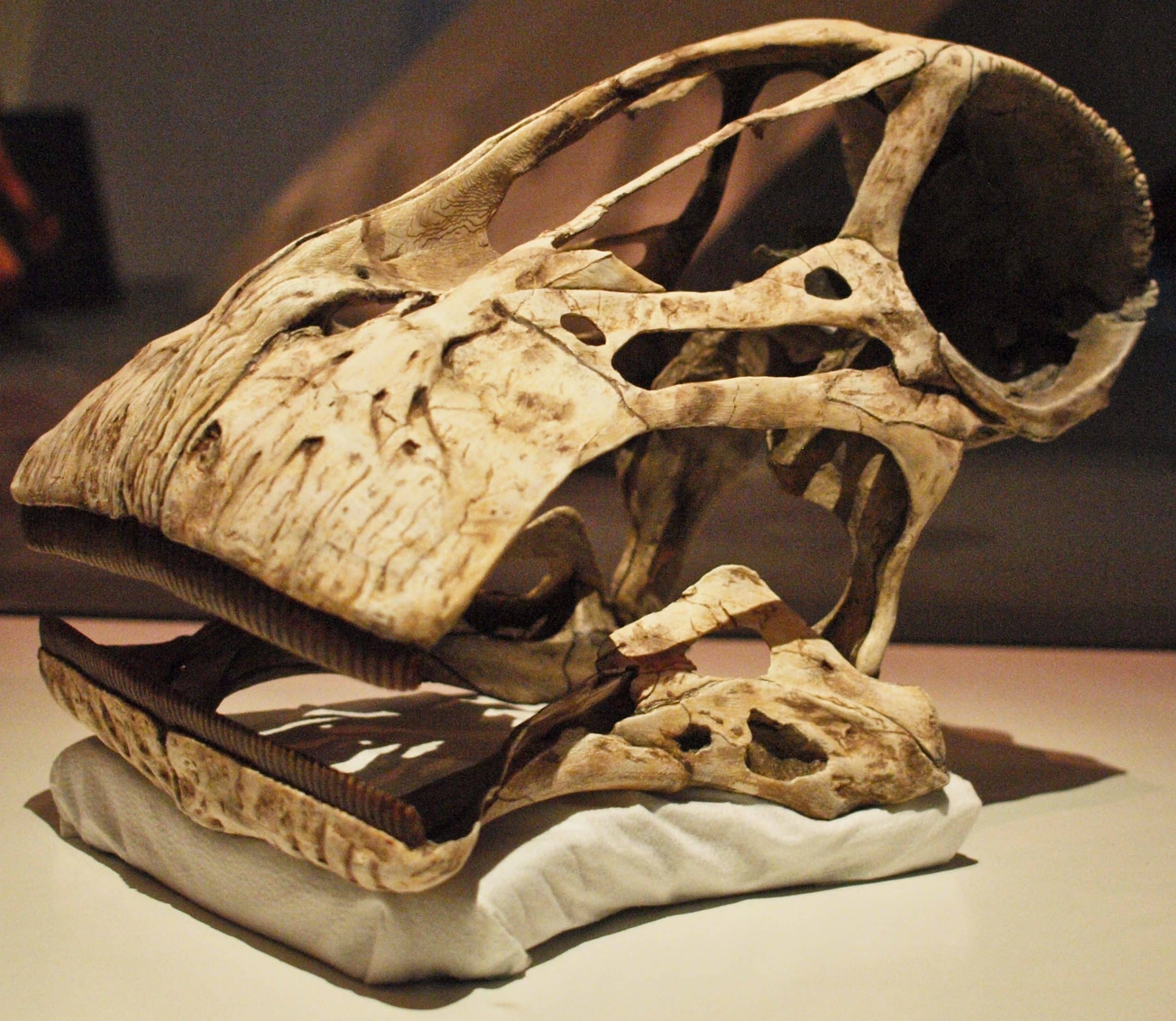

The 1999 paper also reported several partial skeletons and isolated bones. It called Nigersaurus one of the most common vertebrates at Gadoufaoua. Thirteen limb bones from the material Taquet reported in 1976, now referred to Nigersaurus, are held at the National Museum of Natural History in Paris. All of the specimens described in these studies come from Gadoufaoua.
Nigersaurus Size and Description
Nigersaurus departs from the familiar sauropod plan in several ways, from its short neck to a skull built more like a lattice than a box.
Short description of Nigersaurus
The skull was remarkably delicate, with connecting struts that rarely exceed 2 millimeters in thickness. As Sereno and Wilson described in 2005, five extra openings, or fenestrae, pierced its sides. Meanwhile, the supratemporal opening on the skull roof appears to have been closed, or nearly so. The muzzle was slightly wider than the entire lower jaw was long. Grooves at the jaw tips are suggestive of a keratinized sheath—a horny, beak-like covering—although no such tissue is preserved.
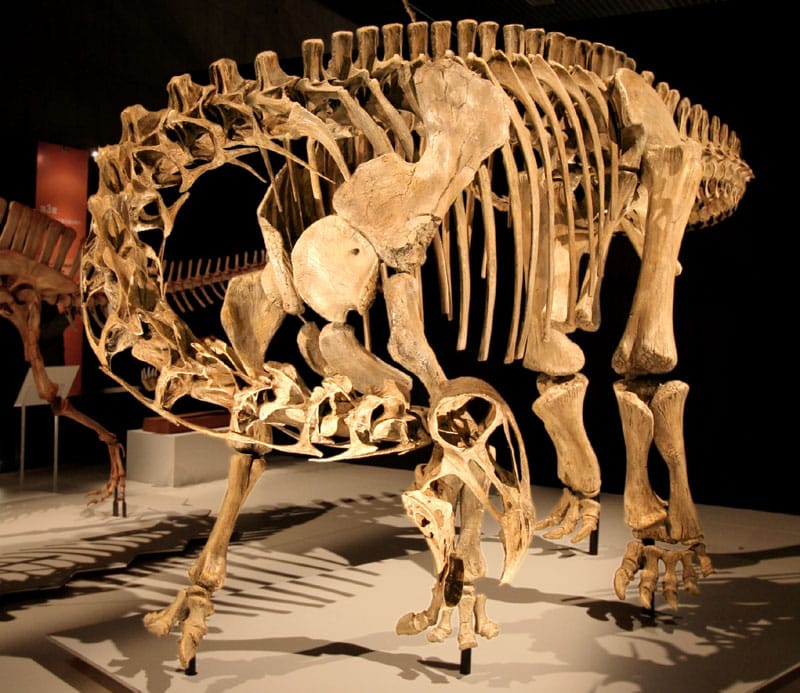
According to the 2007 reconstruction, the neck held just 13 cervical (neck) vertebrae. The same reconstruction makes it only 130 percent as long as the series of back vertebrae. Farther back, the vertebrae in front of the hips were hollow shells, with more air-sac space than bone by volume. Only the tail had solid vertebral bodies. Thin sheets of bone just several millimeters thick made up much of the shoulder and hip girdles.
Its forelimb was only 66 percent the length of the hind limb, and the reconstruction stands the animal on all four legs. In 2023, Lefebvre and colleagues found its limb bones filled with spongy bone inside a rather thin outer wall. They suggested that columnar limbs and air-filled bones, rather than dense limb-bone interiors, carried the load—or that sauropods were lighter than expected for their size.

Size and Weight of Type Species
Sereno and colleagues originally gave Nigersaurus a maximum length of about 49 feet (15 meters). Even that made it one of the smallest sauropods on record. In 2007, Sereno’s team combined and size-adjusted several partial skeletons, and the result was an adult length of only about 30 feet (9 meters).
No body mass appears in the 1999 paper. Sereno’s team then estimated about 8,800 pounds (4 metric tons)—similar to an average elephant. They reached that figure by scaling down one for the slightly larger Dicraeosaurus. We found no published hip-height estimate, so the closest proxy is a thigh bone, or femur, about 3.3 feet (1 meter) long.
Using mass estimates published by Frank Seebacher in 2001, the 2007 team measured Nigersaurus against two famous relatives. Diplodocus and Apatosaurus, they noted, grew to twice its length and four times its estimated mass. Its real oddities, however, lie in the skull and spine.
The Dinosaur in Detail
What sets this dinosaur apart is its tooth battery—columns of active teeth stacked with replacements waiting beneath. The 1999 paper counted 34 teeth in the dentary and at least 20 in the maxilla, the main upper tooth-bearing bone, three times the count in Diplodocus. Its authors estimated more than 600 in all. A 2007 recount revised that to more than 500 active and replacement teeth, with up to 10 per column.
Replacement was fast. Sereno’s team counted fewer than 30 daily growth lines between successive crowns, estimating about a month per tooth. In 2013, D’Emic and colleagues calibrated an indirect method on Diplodocus teeth. They estimated replacement as often as every 14 days—by their reckoning the highest rate known for any dinosaur. The older figure, they suggested, reflected cross-sections exposing too few growth lines. Crown wear records an up-and-down jaw stroke, and the 2007 authors inferred a weaker bite than other sauropods’.
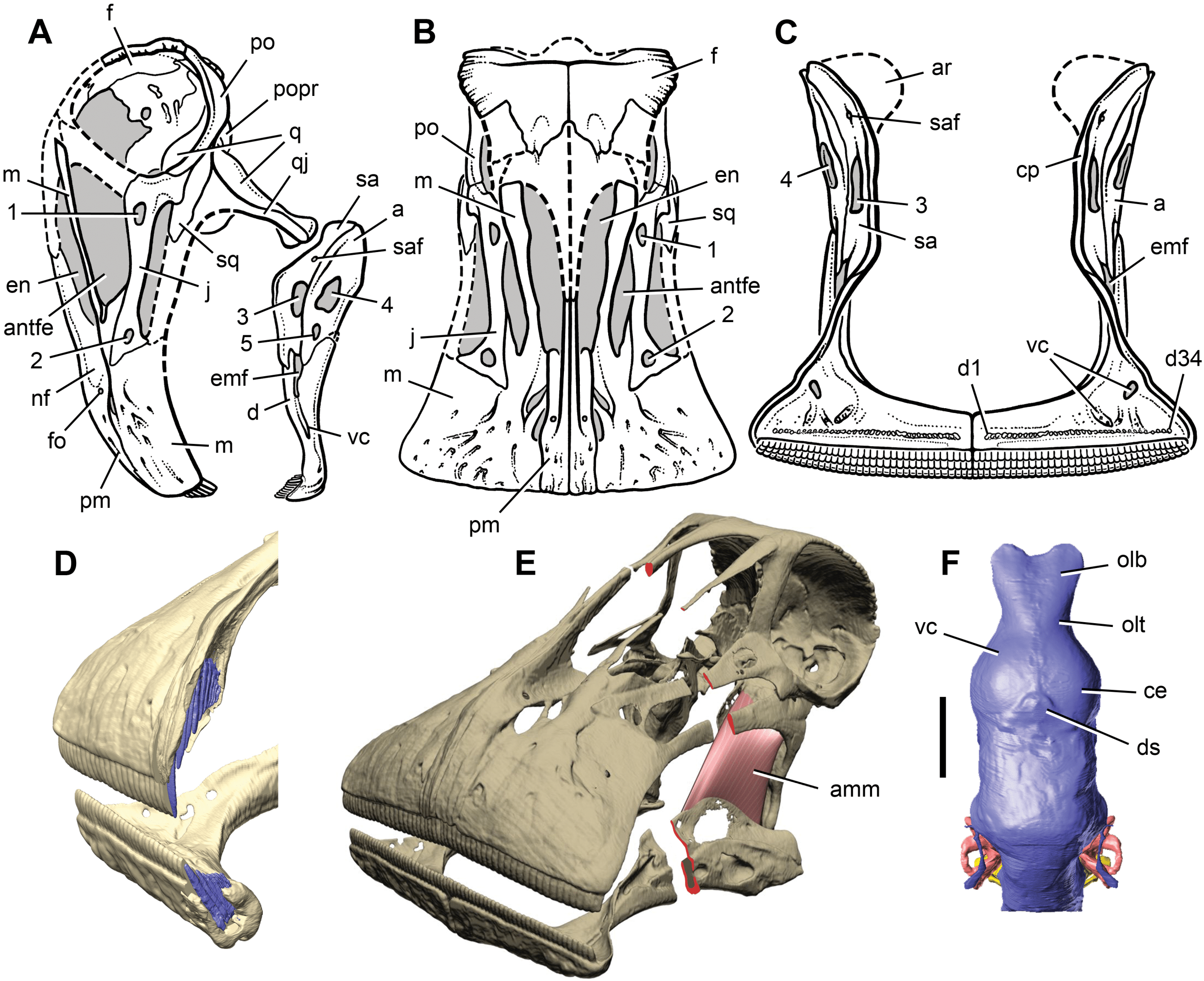

Head posture, unaddressed in the 1999 paper, is among the most debated questions. Using the inner ear’s lateral semicircular canal, Sereno and colleagues proposed in 2007 that the muzzle habitually pointed directly downward—some 70 degrees from the usual depiction. Taylor, Wedel, and Naish accepted in 2009 that it could feed that way. However, they argued this was not its normal posture when not feeding. Marugán-Lobón and colleagues countered in 2013 that the canal is an inconsistent baseline and the skull geometry comparable to other sauropods’.
Its family tree has shifted too. In 2011, Whitlock recovered a rebbachisaurid subgroup including Nigersaurus. Fanti and colleagues credit him with the name Nigersaurinae. Fanti’s team treated it in 2015 as a junior synonym of Rebbachisaurinae because Rebbachisaurus falls closer to Nigersaurus than to Limaysaurus. Taken together, these studies describe a lightly built herbivore organized around its mouth—its angle still debated.
Interesting Points about Nigersaurus
- The 2007 press release, paraphrasing Sereno, likened Nigersaurus to a “Mesozoic cow,” a label that does not appear in the scientific paper itself.
- Quoted by ScienceDaily in 2007, Sereno said that among dinosaurs, Nigersaurus “sets the Guinness record for tooth replacement.”
- Its skull was rebuilt from 3D-printed prototypes of individual bones made from CT scans, which the 2007 authors believed was a first for any dinosaur skull.
- The 2007 study also gave the first reasonably complete view of a sauropod brain, with the cerebrum making up about 30 percent of brain volume.
Contemporary Dinosaurs
Sharing the floodplain in even greater numbers was Lurdusaurus, a robust iguanodontian ornithopod related to Iguanodon. Judging from specimen counts, it is the only large herbivore whose bones outnumber those of Nigersaurus. The 2007 authors named the pair the most common megaherbivores—very large plant-eaters—of their day. No direct interaction is recorded, but those authors reasoned that whatever plants Nigersaurus ate must have been fairly widespread.
Adding further diversity was Ouranosaurus, a large ornithischian herbivore already listed with Nigersaurus in the 1999 paper. The 2007 supporting text places both, with Lurdusaurus and an unnamed titanosaur, in a shared riverside habitat—one of the few known megaherbivore communities balanced between sauropods and large ornithopods. Any contact between the two goes unrecorded.
Prowling the same landscape was Suchomimus, a long-snouted spinosaurid and the most common large theropod in the Elrhaz fauna. The 2007 supporting text lists it among the predators Nigersaurus would have faced. No bite marks or other direct evidence link the two, so the threat is inferred from their shared setting.
Among the lesser-known members of the fauna was Elrhazosaurus, a small dryosaurid ornithopod. It bore the name Valdosaurus nigeriensis from 1982 and received its own genus in 2009. The 2008 faunal list for the Elrhaz Formation includes it under the older name. With no recorded interaction, it is best pictured simply as a neighbor.
Nigersaurus in its Natural Habitat
The world Nigersaurus roamed was one of inland floodplains crossed by high-energy rivers. Its rocks are almost entirely cross-bedded river sandstones, and the aquatic fauna recovered is entirely freshwater. Crocodylomorphs such as the giant Sarcosuchus imperator lived alongside pterosaurs, turtles, bony fish, and a hybodont shark.
In 2007, Sereno and colleagues proposed that Nigersaurus was a ground-level browser. In their view, it cropped plants within about 3.3 feet (1 meter) of the soil. Its weak bite, they argued, favored soft understory vegetation such as immature ferns or horsetails, though they called the plant identity speculative. Whitlock’s 2011 study of snout shape and tooth scratches pointed to nonselective browsing at ground height. D’Emic’s team later suggested that its rapid tooth replacement was linked to the grit that low browsing brings in.
While there is no direct evidence of whether Nigersaurus lived alone or in groups, its fossils rank among the most common vertebrate remains at Gadoufaoua. The 2007 supporting text names Sarcosuchus and Suchomimus among its probable predators. Sereno’s team also argued that the low-browsing strategy Nigersaurus carried to an extreme may have had a significant impact on ground-level vegetation during the Cretaceous.
Frequently Asked Questions
It means “Niger reptile,” and the species name taqueti honors French paleontologist Philippe Taquet.
It lived in the Aptian to Albian stages of the Early Cretaceous, roughly 115 to 105 million years ago.
Its 1999 describers estimated a length of about 49 feet. A 2007 revision cut that to about 30 feet, with an estimated weight of about 8,800 pounds.
It was a herbivore, and researchers have proposed that it cropped soft plants within about 3.3 feet of the ground.
Its fossils come from the Elrhaz Formation in the Gadoufaoua region of Niger’s Ténéré Desert.
Its broad, square muzzle held more than 500 teeth by a 2007 count. Estimates of how often each tooth was replaced range from about 14 to 30 days.
Sources
The information in this article is based on various sources, drawing on scientific research, fossil evidence, and expert analysis. The aim is to provide a comprehensive and accurate overview of Nigersaurus. However, please be aware that our understanding of dinosaurs and their world is constantly evolving as new discoveries are made.
- https://doi.org/10.1126/science.286.5443.1342
- https://pubmed.ncbi.nlm.nih.gov/10558986/
- https://public.websites.umich.edu/~wilsonja/JAW/Publications_files/Sereno&Wilson2005.pdf
- https://doi.org/10.1371/journal.pone.0001230
- https://doi.org/10.1371/journal.pone.0001230.g003
- https://sites.ohio.edu/witmerl/Downloads/2007_Sereno_Wilson_Witmer_et-al_Nigersaurus_Supporting%20Information.pdf
- https://doi.org/10.1371/journal.pone.0018304
- https://doi.org/10.1111/j.1096-3642.2010.00665.x
- https://doi.org/10.1371/journal.pone.0069235
- https://doi.org/10.1371/journal.pone.0123475
- https://www.app.pan.pl/archive/published/app54/app54-213.pdf
- https://doi.org/10.7717/peerj.124
- https://www.app.pan.pl/archive/published/app53/app53-015.pdf
- https://doi.org/10.1111/pala.12670
- https://paleobiodb.org/classic/checkTaxonInfo?taxon_no=57366
- https://www.nhm.ac.uk/discover/dino-directory/nigersaurus.html
- https://paulsereno.uchicago.edu/discoveries/nigersaurus
- https://www.npr.org/2007/11/16/16334081/mesozoic-cow-rises-from-the-sahara-desert
- https://www.sciencedaily.com/releases/2007/11/071115113252.htm
This article was last fact checked: TheDinosaurs Team, 27-10-2026
Featured Image Credit: TotalDino, CC BY 4.0, via Wikimedia Commons
