
Low patches of purplish rock break through the dune fields of the Ténéré desert in Niger. Here the gritty wind works “like sandpaper,” in the words of paleontologist Philippe Taquet, freeing fossil bones bit by bit. This is Gadoufaoua, source of Ouranosaurus, Suchomimus, Nigersaurus and the giant crocodyliform Sarcosuchus, all from a river world of the mid-Cretaceous. In 1970, Taquet ranked it among the most important dinosaur localities in Africa, with only Tendaguru in Tanzania comparable on the continent.
What makes the story unusual is who found it. A French geologist mapping the region noticed the bones in 1954, and prospectors searching for uranium later traced the beds. Then the French Atomic Energy Commission paid to send out a 24-year-old paleontologist in 1965 to tell the prospectors what they had. Six decades later, the beds are still yielding skeletons—and arguments about their age and several of their animals.
Where Gadoufaoua Lies
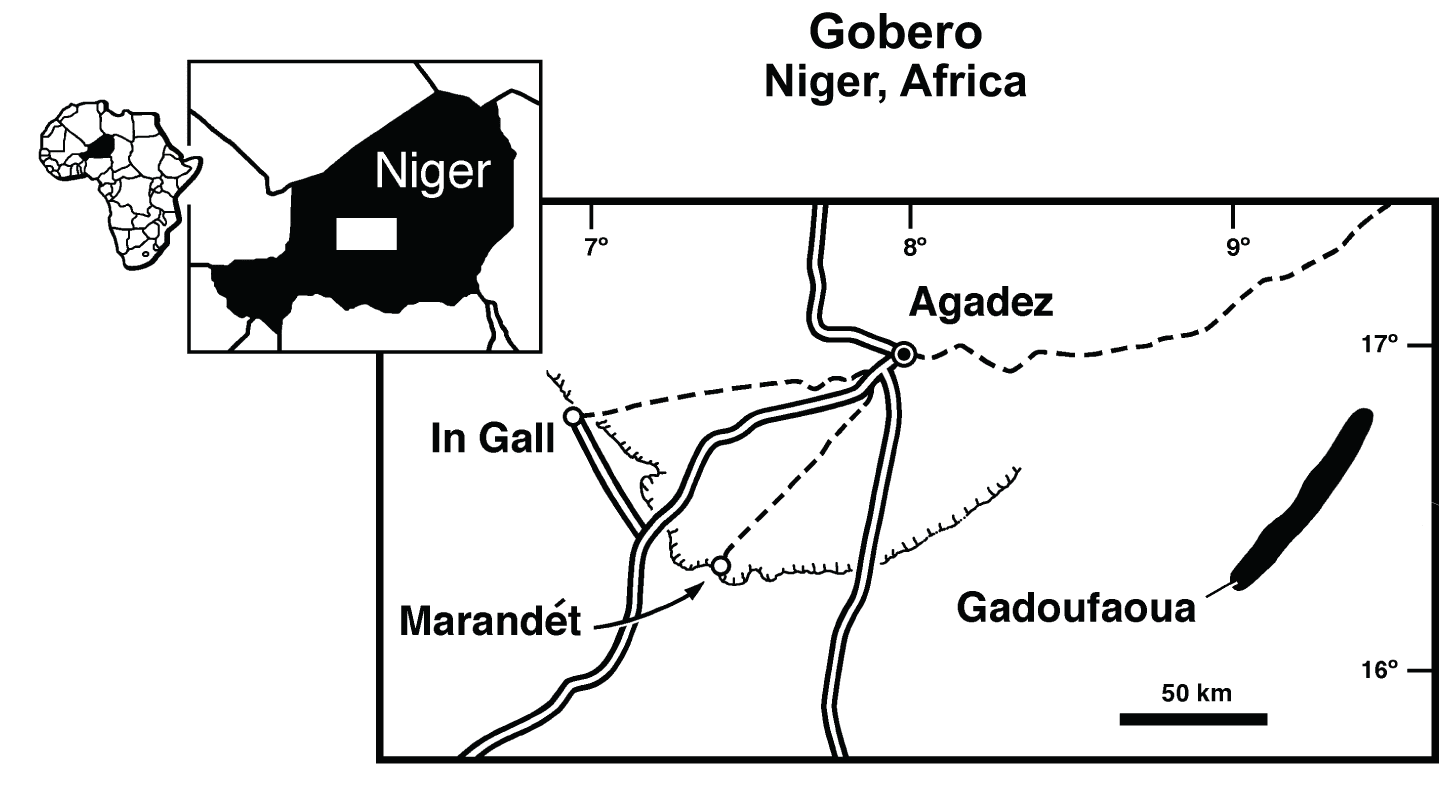
Gadoufaoua sits in the Agadez Region of Niger, about 170 kilometers (106 miles) east of Agadez. Taquet’s 1970 note described it as lying in the south of the Ténéré. Paleontologist Paul Sereno and his colleagues, however, put it along the desert’s western edge, southeast of the Aïr Mountains.
The fossil-bearing rock forms a long, narrow band. Taquet’s 1970 report measured it at 175 kilometers (109 miles) long and 500 meters to 1 kilometer wide. His later memoir, however, gives about 150 by 2 kilometers, spread over some 300 square kilometers. Migrating dunes hide parts of the beds, especially to the north, according to Taquet.
The name comes with its own small puzzle. Taquet translated it from Tamachek, the language of the Tuareg, as the place where dromedaries are “afraid to descend among the bumpy rocks.” Sereno’s site, by contrast, gives a shorter version from what it calls nomad legend—”the place where camels fear to go”—along with a pronunciation, “Ga-doo-fawa.”

Uranium Hunters and a Young Paleontologist
Dinosaur bones were not new to Niger. According to Taquet, R. Chudeau found the country’s first dinosaur remains in 1907, and later finds came mostly from the northwest, west and south of the Aïr. The turn came in 1954, when H. Faure, a French geologist (later of the BRGM, France’s geological and mining bureau) who was mapping eastern Niger, noted abundant reptile bones southeast of the El Rhaz well. He sent fragments to the geologist Albert-Félix de Lapparent, and expeditions of the French Atomic Energy Commission (CEA) later worked out how far the bone beds extended.
Those expeditions were hunting uranium. The CEA had been searching for it south and west of the Aïr since 1958 because France, as Taquet put it, “wanted to become a great nuclear power.” When its geologists turned up fossil bones, they wanted a paleontologist to identify them and, if possible, date the beds. In December 1964, Professor Jean-Paul Lehman of the National Museum of Natural History in Paris (MNHN) offered the job to Taquet, then 24.
Taquet’s First Expeditions
The reconnaissance began in January 1965 with a 10-hour drive by Land Rover and four-wheel-drive Renault truck. The vehicles bogged down five or six times, Taquet’s memoir recalls, and the team navigated by camel droppings. By then, the geologists had already christened the first skeleton site they showed him the “Cemetery of the Innocents.”
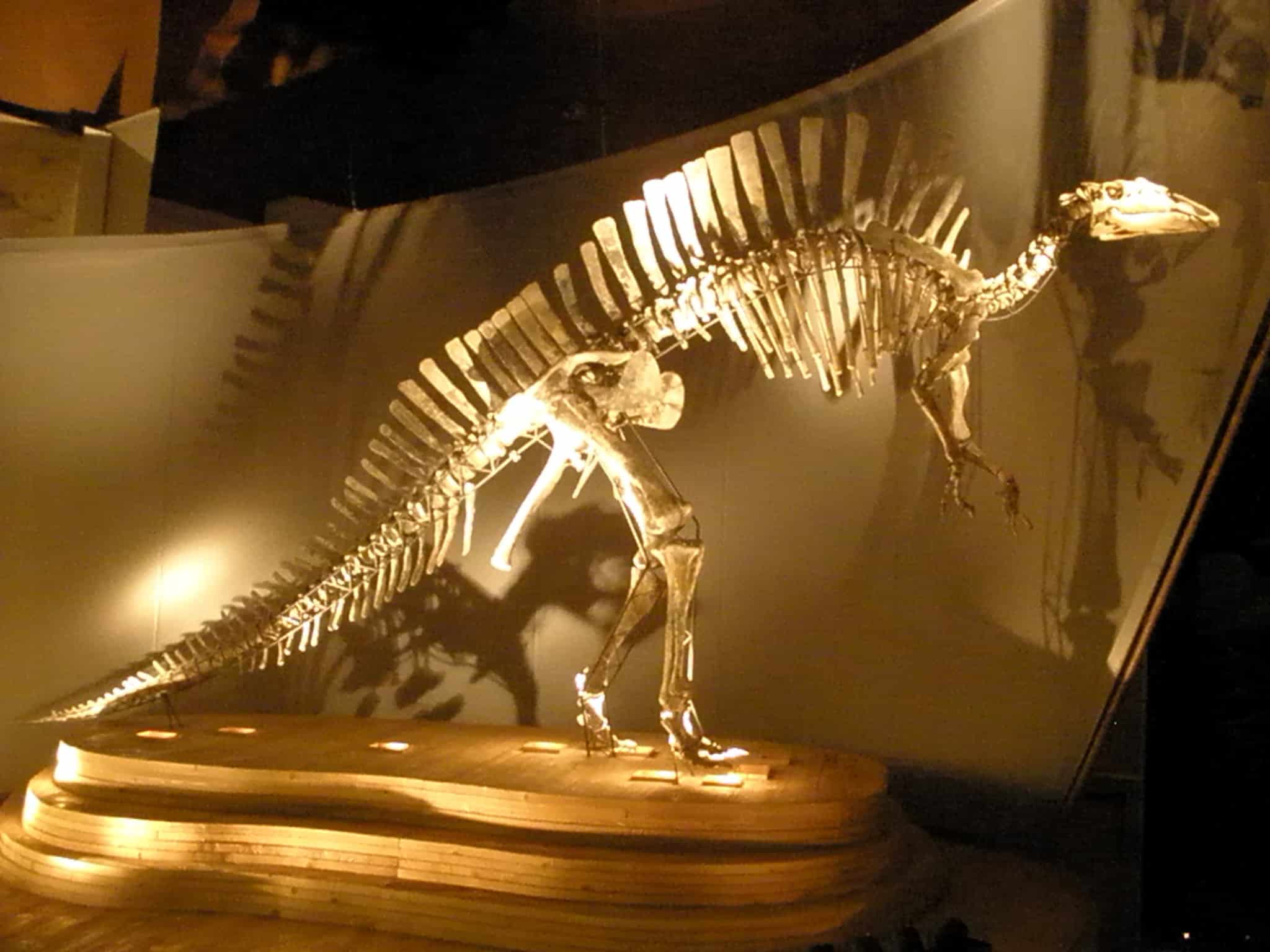
That January, Taquet found a skeleton 7 kilometers southeast of the Elrhaz wells and 400 meters from a spot called the “camp of the Two Trees.” This became the holotype—the specimen on which a species name rests—of Ouranosaurus nigeriensis. Collecting it took ten days in 1966, during the first major expedition run by the MNHN and France’s national research center. The work, Taquet wrote in his 1970 report, had let a French mission recover “for the first time a complete dinosaur skeleton.”
A second Ouranosaurus, nearly complete but lacking its skull, turned up in 1970 beside a small airstrip the CEA had laid out in 1964. In 2017, Bertozzo and colleagues reported that it was excavated in 1972. The skeleton mounted in Venice in 1975, they also concluded, contains this paratype—a second reference specimen named alongside the holotype.

The Rocks and Their Age
The bones lie in the Tégama Group, a sequence of sediments up to about 680 meters (2,230 feet) thick in the southeast. Geologists divide it into three formations—the Tazolé, the Elrhaz and the Echkar—and a 1965 CEA report by E. Molinas split it into eight levels labeled GAD, short for Gadoufaoua. According to Taquet, the fossil level, GAD 5, lies in the upper Elrhaz Formation and is 60 meters thick. Sereno’s team, however, says it appears to extend into the lower Echkar Formation.
The two main research teams describe the same rocks with different emphasis. Taquet reported clay at the base of GAD 5 and a thick sandstone in the middle. Toward the top, he reported small sandstone channels alternating with clays. He called the local sedimentation “more argillaceous” (clay-rich) than usual for the Tégama. Sereno’s teams instead describe almost entirely cross-bedded fluvial sandstones—layers laid down at an angle by flowing water—”almost devoid of finer-grained horizons.” They read the setting as inland floodplains with high-energy rivers.
Sereno’s 2007 team also noted that the aquatic animals are entirely freshwater. In places, Taquet wrote, freshwater mussels strew the ground, some still grouped in life position and others scattered among the skeletons. Most vertebrate remains, however, are disarticulated bones and teeth, as Sereno’s team reported in 1998. They lie in channel lags—the coarse debris at the base of a river channel.
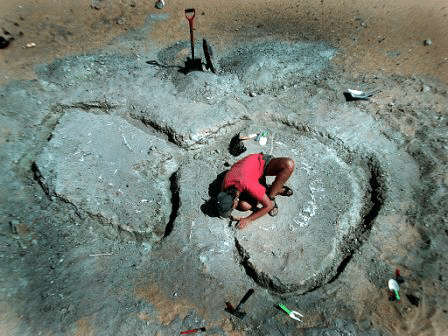
The wind that frees the skeletons also wears them down. Taquet saw dinosaurs lying on the surface east of the Eméchédoui well, uncovered by the sandy wind. He noted that its intense erosion had worn some of the bones. Similarly, wind-blown sand had planed flat a Nigersaurus skeleton found on the 2000 expedition.

Dating the Beds
Dating the beds has proved harder. At first Taquet wavered between the Aptian and Albian stages, but by 1976 he had settled on the Aptian. Sereno’s team gave an Aptian–Albian age of about 115–105 million years in 1999. The team later gave about 110 million years in 2007 and about 112 million in 2008.
Le Loeuff and colleagues have argued that the beds could be as old as the Barremian, the stage before the Aptian. Niger’s stratigraphic lexicon notes that Taquet’s Aptian case relied on a Tunisian ornithopod tooth now thought more likely Albian. Even so, it keeps the Aptian provisionally because no consensus exists. None of these studies reports a radiometric date. Most place the beds in the Aptian–Albian of the Early Cretaceous, stages spanning roughly 121–100 million years ago. Within that span, Sereno’s teams settle on about 110–112 million years, though an older age remains possible.
The Dinosaurs of Gadoufaoua
Sereno and Brusatte listed nine dinosaurs from the Elrhaz Formation in 2008—four theropods, two sauropods and three ornithopods. Two of them remained undescribed.
Ornithopods
Taquet’s 1976 description presented Ouranosaurus nigeriensis as a bipedal animal about 7 meters (23 feet) long. In 2026, however, Gônet, Allain and Houssaye judged from its limb bones that it was likely an obligate quadruped, always walking on all fours. Its long skull, 670 millimeters (26 inches) in the holotype, ends in a “duck-bill.” Along its back run very long neural spines—the bony blades that rise from each vertebra. The name joins “Ourane,” the Tuareg name for the sand monitor lizard, with the Greek sauros, “lizard.”
Bertozzo and colleagues concluded in 2017 that the sail these spines form sets Ouranosaurus apart among ornithopods. In their view, it most probably served for display, and Taquet had reconstructed the holotype’s back vertebrae wrongly.
Taquet and Russell named Lurdusaurus arenatus in 1999, describing a “ponderously constructed” ornithischian resembling the giant ground sloths in body form. Sereno’s team reported that only Lurdusaurus bones outnumber those of Nigersaurus at the site. The same 2026 study concluded that Lurdusaurus always walked on all fours. It also judged the animal graviportal (built to bear great weight), which would make it “the first known graviportal ornithopod.” A third ornithopod, Valdosaurus nigeriensis of the family Dryosauridae, named in 1982, now has its own genus, Elrhazosaurus.
Sauropods
Nigersaurus taqueti, named in 1999 for Niger and for Taquet, is one of the most common vertebrates at Gadoufaoua. At first, its remains were described as a dicraeosaurid allied with titanosaurs. Sereno’s team, however, identified it as a rebbachisaurid, part of the diplodocoid branch of the sauropods. In 1999, estimates of its length ran to a maximum of about 15 meters (49 feet). By 2007, that figure had fallen to about 9 meters (30 feet). The 2007 paper compared its mass to an average elephant’s, about 4 tons.
Its mouth held more than 500 active and replacement teeth, and Sereno’s team estimated that a tooth was replaced in about a month. They argued that it held its muzzle toward the ground and browsed soft plants, possibly young ferns or horsetails. A rare titanosaur, still undescribed, also lived here.
Theropods
Suchomimus tenerensis, named in 1998, takes its name from “crocodile mimic” and the Ténéré. It was a spinosaurid about 11 meters (36 feet) long in reconstruction. According to Sereno and Brusatte, it was also the most common large theropod in the fauna. Months before Suchomimus received its name, Taquet and Russell named another spinosaurid from Gadoufaoua jaw fragments, Cristatusaurus lapparenti. Sereno’s team regarded it as a nomen dubium (a name not tied to diagnostic material), although how it relates to Suchomimus is still debated.
Sereno and Brusatte named two more predators in 2008 from fossils found on the 2000 expedition. The first, Kryptops palaios, was an abelisaurid roughly 6–7 meters (20–23 feet) long. They based it on a single individual with a maxilla (upper jawbone), vertebrae, ribs and pelvis. Sereno and Brusatte classed the second, Eocarcharia dinops, as an early-branching carcharodontosaurid. Its species name, “fierce-eyed,” comes from the heavy, ornamented brow above the eye. Its holotype is a single postorbital—the bone behind the eye—and the rest of its bones turned up in isolation along a 10-kilometer stretch of outcrop.
Carrano and colleagues suggested in 2012 that the Kryptops bones mix more than one kind of predator. Later, in 2025, Cau and Paterna supported that idea and proposed that Eocarcharia is a chimera too. In their reading, the Eocarcharia postorbital belongs to a spinosaurid. For Kryptops, they accept the maxilla as abelisaurid but treat the rest of the skeleton referred to it as allosauroid. The fauna list also includes an undescribed noasaurid. Sereno described Afromimus tenerensis in 2017, from tail vertebrae and hind-limb bones, as an ornithomimosaur. In 2019, however, Cerroni and colleagues reanalyzed it as an abelisauroid, probably related to the noasaurids.
Crocodyliforms, Turtles and Other Neighbors
Taquet found crocodilian remains “very abundant,” led by the giant long-snouted Sarcosuchus imperator, named by Broin and Taquet in 1966. One complete skull measured 1.60 meters (5.2 feet). Sereno and colleagues estimated in 2001 that it reached at least 11–12 meters (36–39 feet). The same team put its weight at about 8 metric tons and its life span at 50–60 years. They read its jaws as suited to a generalized diet of large vertebrates, including fish and dinosaurs. Unlike its closest relatives, they argued, it thrived in river settings. In 2019, however, O’Brien and colleagues estimated a smaller animal from its head width. By their estimate, it was about 7.6–9 meters (25–30 feet) long and weighed 2.6–3.5 metric tons.
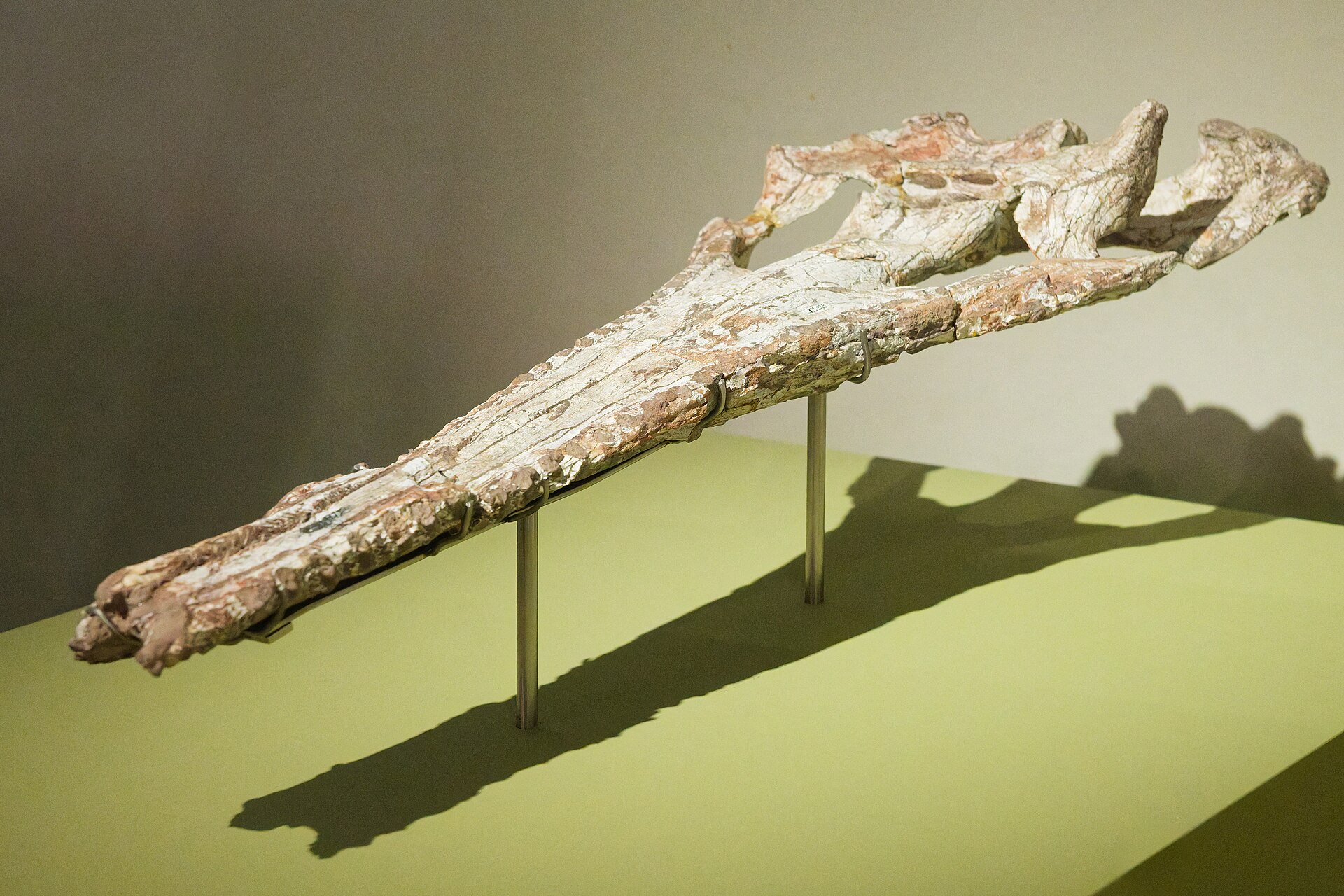

Among the smaller crocodyliforms, Anatosuchus minor was a blunt-snouted animal under 1 meter long, while Stolokrosuchus lapparenti survives as a nearly complete, narrow-snouted skull. One sandstone block holds at least five individuals of Araripesuchus wegeneri, three of them lying side by side. Sereno and Larsson’s 2009 monograph argued that this range of feeding adaptations deepens the picture of African crocodyliform diversity.
Taquet recorded two species of pleurodires (side-necked turtles), and in 1980 Broin named Teneremys lapparenti and Taquetochelys decorata. A 2019 study by Pérez-García calls Gadoufaoua the oldest African locality where several pleurodire species occur together. It also treats Laganemys tenerensis, named in 2013 from an almost complete skeleton, as the same animal as Taquetochelys.
The fish Taquet listed in 1970 include a hybodont shark, Lepidotes, the coelacanth Mawsonia and two species of the lungfish Ceratodus. Pterosaurs are present too, but their fossils remain largely undescribed and even the published identifications disagree—azhdarchid in 1998, ornithocheirid in 2008, and tapejarid and anhanguerid in the stratigraphic lexicon.
Why Gadoufaoua Matters
Sereno and colleagues described Nigersaurus, Lurdusaurus, a titanosaur and Ouranosaurus as one of the few megaherbivore (giant plant-eater) associations with a balance of sauropods and large ornithopods. Predators, by their account, would have included Sarcosuchus, Suchomimus and similar-sized abelisaurid and carcharodontosaurid theropods.
Sereno’s 1998 team found that the closest relative of Suchomimus was the European Baryonyx. They argued that this was evidence of dispersal across the Tethys seaway—the ancient sea between the northern and southern continents—in the Early Cretaceous. A decade later, Sereno and Brusatte drew a similar trans-Tethyan conclusion for carcharodontosaurids. Their evidence was the close relationship between Eocarcharia and the North American Acrocanthosaurus. If Cau and Paterna are right that the Eocarcharia holotype is spinosaurid, however, that particular link would need a new basis.
The same 2008 paper argued that abelisauroids in Africa remove the strongest potential support for the “Africa-first” hypothesis. That is the idea that Africa was isolated first, leaving the other southern continents to share animals it lacked. The authors called Kryptops “the oldest indisputable abelisaurid on any continent.” Even Cau and Paterna still accept its holotype maxilla as abelisaurid. More broadly, Sereno and Brusatte argued that three groups had come to the fore in several mid-Cretaceous African faunas. Abelisaurids, carcharodontosaurids and spinosaurids, in their view, were the main large predators.
Back to the Ténéré
Sereno’s teams worked at Gadoufaoua in 1997 and 2000, and D. Dutheil found the type skull and skeleton of Nigersaurus. According to the University of Chicago, David Varricchio spotted the thumb claw of what became Suchomimus on December 4, 1997. The team worked through heat that reached 120 °F (49 °C) and blowing sand, carrying in all its water.
By his account in National Geographic, Sereno’s 2022 expedition finally left in September after nearly three weeks’ delay in Agadez over an armed escort. The convoy carried nearly 100 people in 15 vehicles, including 64 armed guards and some 20 students and early-career scientists. At Gadoufaoua the team excavated an Ouranosaurus—about two tons of it in three days, partly at night under spotlights. Sereno calls it “the first intact bony dinosaur sail ever discovered,” a claim made in a popular article. However, Taquet’s skeletons had already preserved much of the sail, and the 2017 restudy drew on the paratype’s articulated backbone.
The team also cut a bone-rich patch of rock holding raptors, turtles, fish and more into “10 tons of jacketed slabs.” Altogether, the expedition’s haul from Gadoufaoua and other sites weighed 55 tons. Then, Sereno writes, a military coup toppled Niger’s elected government and put the shipment on hold. In spring 2025 he signed an agreement in Niamey. It provides for bringing the fossils to Chicago and returning them to Niger in stages. The plan includes two new Nigerien museums and a training institute, overseen by NigerHeritage, a foundation Sereno set up in 2016.
Philippe Taquet, who first reached these beds by Land Rover at 24, died on November 16, 2025, at the age of 85. Still, every Nigersaurus taqueti that comes out of Gadoufaoua carries his name.
Frequently Asked Questions
It lies in the Ténéré desert of Niger, about 170 kilometers (106 miles) east of Agadez. Taquet placed it in the south of the desert, while Sereno’s team describes its western edge.
Most studies date them to the Aptian–Albian stages, roughly 121–100 million years ago. Within that range, Sereno’s team favors about 110–112 million years. However, some geologists think they could be as old as the Barremian, and Niger’s stratigraphic lexicon notes that no consensus exists.
Geologist H. Faure noted abundant bones there in 1954, and uranium prospectors from the CEA later worked out the site’s extent. According to Sereno’s team, Philippe Taquet’s expeditions, which began in 1965, started large-scale paleontological exploration in Niger.
They include Ouranosaurus, Lurdusaurus, Elrhazosaurus, Nigersaurus, Suchomimus, Kryptops, Eocarcharia and the disputed Afromimus, plus an undescribed titanosaur and noasaurid. The doubtful spinosaurid Cristatusaurus also comes from here. However, studies since 2012, most recently in 2025, argue that the bones assigned to Kryptops and Eocarcharia each mix more than one kind of predator.
Taquet translated it from Tamachek as the place where dromedaries fear to descend among bumpy rocks. Sereno’s lab site, by comparison, gives “the place where camels fear to go.”
Taquet’s finds sit mainly in two museums, the National Museum of Niger in Niamey and the National Museum of Natural History in Paris. The Niamey museum displayed the Ouranosaurus holotype in 1976. Part of an Ouranosaurus skeleton is mounted in Venice, while Sereno’s specimens are cataloged to Niger’s national museum. According to Sereno, fossils from the 2022 expedition are to go to Chicago and return to Niger in stages.
Sources
The information in this article is based on various sources, drawing on scientific research, fossil evidence, and expert analysis. The aim is to provide a comprehensive and accurate overview of Gadoufaoua. However, please be aware that our understanding of dinosaurs and their world is constantly evolving as new discoveries are made.
- https://naturalhistory.si.edu/sites/default/files/media/translated_publications/Taquet%252070.pdf
- https://naturalhistory.si.edu/sites/default/files/media/translated_publications/Taquet_76.pdf
- https://faculty.washington.edu/gpwilson/Reprints/Sereno_etal_1998.pdf
- https://public.websites.umich.edu/~wilsonja/JAW/Publications_files/Sereno&al1999.pdf
- https://pubmed.ncbi.nlm.nih.gov/11679634/
- https://journals.plos.org/plosone/article?id=10.1371/journal.pone.0001230
- https://journals.plos.org/plosone/article/file?type=supplementary&id=10.1371/journal.pone.0001230.s007
- https://www.app.pan.pl/archive/published/app53/app53-015.pdf
- https://doi.org/10.3897/zookeys.28.325
- https://www.ameghiniana.org.ar/index.php/ameghiniana/article/view/3155
- https://assets.cambridge.org/97805217/79302/excerpt/9780521779302_excerpt.pdf
- https://doi.org/10.1016/S0753-3969(99)80009-3
- https://peerj.com/articles/3403
- https://sciencepress.mnhn.fr/en/periodiques/comptes-rendus-palevol/18/fasc1/identification-lower-cretaceous-pleurodiran-turtle-taquetochelys-decorata-only-african-araripemydid-species
- https://www.italianjournalofgeosciences.it/297/article-1220/beyond-the-stromer-s-riddle-the-impact-of-lumping-and-splitting-hypotheses-on-the-systematics-of-the-giant-predatory-dinosaurs-from-northern-africa.html
- https://hal.science/hal-04612943
- https://doi.org/10.3897/fr.29.173614
- https://doi.org/10.1016/j.jafrearsci.2019.103572
- https://doi.org/10.1093/iob/obz006
- https://doi.org/10.1080/14772019.2011.630927
- https://nigerlex.geolex.org/formations/Elrhaz%20Fm
- https://nigerlex.geolex.org/formations/T%C3%A9gama%20Gr
- https://paleobiodb.org/data1.2/taxa/single.txt?name=Elrhazosaurus&show=attr,class,ref
- https://chronicle.uchicago.edu/981125/expedition.shtml
- https://paulsereno.uchicago.edu/news/exploring_gadoufaoua
- https://www.nationalgeographic.com/science/article/sahara-desert-dinosaurs-cretaceous-paleontology
- https://www.ocim.fr/actualites/regard-sur-lactu/hommage-a-philippe-taquet
This article was last fact checked: TheDinosaurs Team, 28-10-2026
Featured Image Credit: Holger Reineccius, CC BY-SA 3.0, via Wikimedia Commons
