
In Garden Park, just north of Cañon City, Colorado, the upper Morrison Formation holds the story of a dinosaur no one can now examine. Here, one enormous piece of backbone left a mudstone bonebed for Philadelphia in 1878. Today we call it Maraapunisaurus fragillimus, a sauropod that lived in the Late Jurassic, probably during the late Kimmeridgian or early Tithonian stage. Cope called it “the largest saurian I have yet seen.” Yet the bone later vanished—so every estimate, modest or monstrous, depends on Cope’s words and drawing.
Edward Drinker Cope first placed the species in Amphicoelias, alongside A. altus from a nearby Garden Park quarry. From 1921 onward, most scientists treated it as a diplodocid, a member of the family of Diplodocus. In 2018, however, paleontologist Kenneth Carpenter reread Cope’s drawing and identified a basal rebbachisaurid instead. He gave the animal a new genus name and, by his own estimate, a far smaller body. Its story shows how much one lost bone can still teach—and how much it cannot.
Maraapunisaurus Key Facts
| Keyword | Fact |
|---|---|
| Pronunciation | Not specified |
| Meaning of name | Huge Reptile |
| Group | Sauropoda |
| Type Species | Maraapunisaurus fragillimus |
| Diet | Not specified |
| When it Lived | Younger than about 152 MYA (not directly dated) |
| Period | Jurassic |
| Epoch | Late Jurassic (late Kimmeridgian or early Tithonian stage) |
| Length | About 99 to 105 feet (30.3 to 32 meters), 2018 estimate from one lost bone |
| Height | About 26 feet (7.95 meters) at the hips, 2018 estimate |
| Weight | Not specified |
| Mobility | Not specified |
| First Discovery | Year not specified, by Oramel W. Lucas, who shipped the vertebra to Cope in 1878 |
| Described by | 1878 by E.D. Cope (as Amphicoelias fragillimus), with the new genus named in 2018 by K. Carpenter |
| Holotype | AMNH FR 5777 (missing) |
| Location of first find | Near Cope’s Nipple, Garden Park, north of Cañon City, Fremont County, Colorado, USA (Morrison Formation) |
Maraapunisaurus Origins, Taxonomy and Timeline
The name Maraapunisaurus joins maraapuni, Southern Ute for “huge,” with saurus, Greek for “reptile.” Carpenter gives the pronunciation of the Ute root as “mah-rah-poo-nee.” The Southern Ute Cultural Department in Ignacio, Colorado, recommended the name, since Garden Park was traditionally Ute territory. The species name fragillimus survives from Cope’s original 1878 description. Together, the name honors both the animal’s scale and the people whose land yielded it.
Maraapunisaurus belongs to Sauropoda and, within it, to Diplodocoidea. Carpenter placed it in Rebbachisauridae as a basal, or early-branching, member of that family. By contrast, most recent analyses place A. altus as an early-branching diplodocoid, although a spot within Diplodocidae cannot yet be ruled out. In 2021, Philip Mannion and colleagues tentatively agreed that Maraapunisaurus might be a rebbachisaurid. With only a drawing to go on, however, the placement stays provisional. The Paleobiology Database follows Carpenter, and M. fragillimus is the type and only known species.
Although the bone came from high in the Morrison Formation, no radiometric date exists for its quarry. Carpenter’s 2018 map labels the genus Kimmeridgian–Tithonian, while his 2019 study suggested an early Tithonian age for the fauna. A dated layer near the base of the formation in Garden Park gives about 152.3 million years, so the animal is younger. Either way, it lived in the Late Jurassic, when the Morrison built up mainly on floodplains, in river channels, and in small lakes.
Discovery & Fossil Evidence
School teacher Oramel W. Lucas found the bone at Garden Park, where he and his brother Ira dug from 1877 to 1884. In 1878, he shipped it to Cope, who credited his “indefatigable friend” in print that August. Cope gave its source as the “Dakota formation,” but geologists have since identified these rocks as Morrison Formation.
The holotype—the name-bearing specimen—received the number AMNH FR 5777 at the American Museum of Natural History, though it never turned up. It was a partial neural arch, the bony upper part of a vertebra, from the rear of the back. The fossil preserved the neural spine without its tip, the bases of the transverse processes (side projections), and both postzygapophyses—the rear joints linking it to the next vertebra. Cope measured the preserved arch at 1,500 millimeters (4.9 feet) tall and judged the complete vertebra “not less than six feet, and probably more.” He also warned that the bone was so thin that “much care was requisite to secure its preservation.”
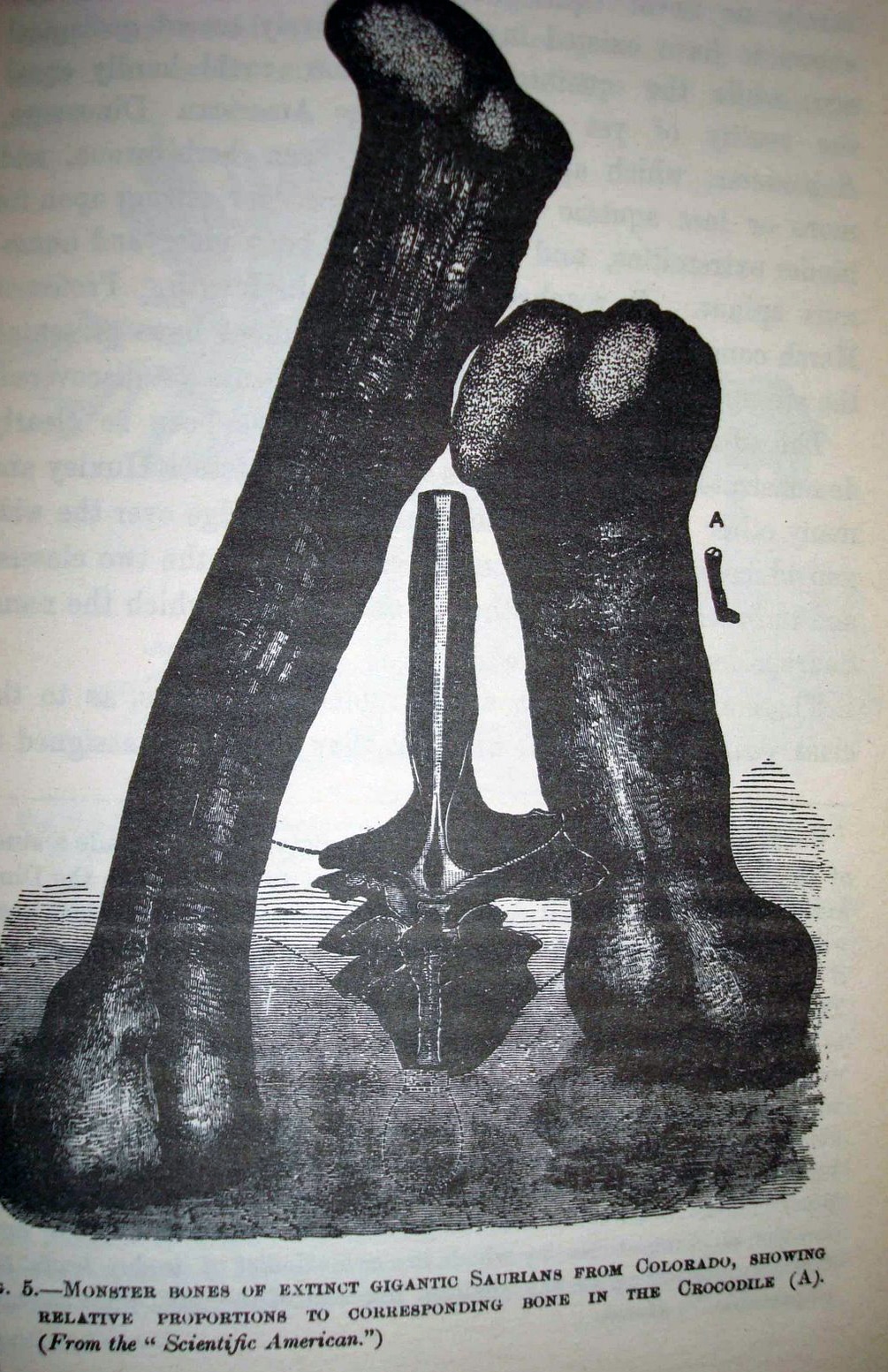

Sadly, the bone went missing. Carpenter places the loss before 1902, when Cope’s reptile collection went to the American Museum, but Mannion and colleagues call the timing unclear. Carpenter suspects that it crumbled and Cope discarded it, or that rough handling destroyed it during an 8-kilometer (5-mile) move to storage in Philadelphia. Ultimately, as he admits, “we will never know what happened.” Digs by the Carnegie Museum in 1901 and the Denver Museum of Natural History in 1991–1996 recovered no more of it. Carpenter also rejects a distal femur that paleontologists D. C. Woodruff and J. R. Foster included in the type, since it could belong to another sauropod. Nobody has confirmed any additional specimens of Maraapunisaurus.
Maraapunisaurus Size and Description
Short description of Maraapunisaurus
Because the description covers a single back vertebra, the skull, neck, limbs, and tail remain unknown. Below the postzygapophyses, the neural arch was extremely tall, making up about a third of the preserved height. Above it rose a simple, unforked spine that was T-shaped in cross-section. Paired openings pierced the spine on either side of a ridge running down its back, while pneumatic camerae (air-filled chambers) hollowed the arch. The arch also carried a small, rectangular hyposphene—an extra locking joint between vertebrae.
Carpenter suggests that the transverse process angled upward by as much as 30 degrees. Cope drew it nearly horizontal, which Carpenter blames on the influence of A. altus. Since Henry Osborn and Charles Mook of the American Museum matched other Cope figures to real bones, Carpenter trusts this drawing and its measurements. Beyond this one bone, any picture of the body, including its skin, is speculative.
Size and Weight of Type Species
Cope estimated a femur (thigh bone) of “twelve feet” (3.66 meters), though he called this “not a necessary consequence.” Gregory S. Paul in 1994 suggested, as Carpenter reports, 131 to 197 feet (40 to 60 meters). In 2006, Carpenter used Diplodocus proportions to reach 190 feet (58 meters) and a mass of 122,400 kilograms (about 135 short tons).
In 2014, Woodruff and Foster rebuilt the full vertebra at 9.2 feet (2.8 meters) around a Supersaurus-style centrum, which gave a femur of 15.6 feet (4.76 meters). They also proposed—while calling it speculative—that Cope’s “1500” was a typo for 1,050 millimeters (3.4 feet), shrinking the complete vertebra to about 6 feet (1.83 meters). Overall, they judged the reported size “most likely an extreme over-estimation.” Their case cited proposed land-animal mass limits of roughly 75,000 to 90,700 kilograms (about 83 to 100 short tons).
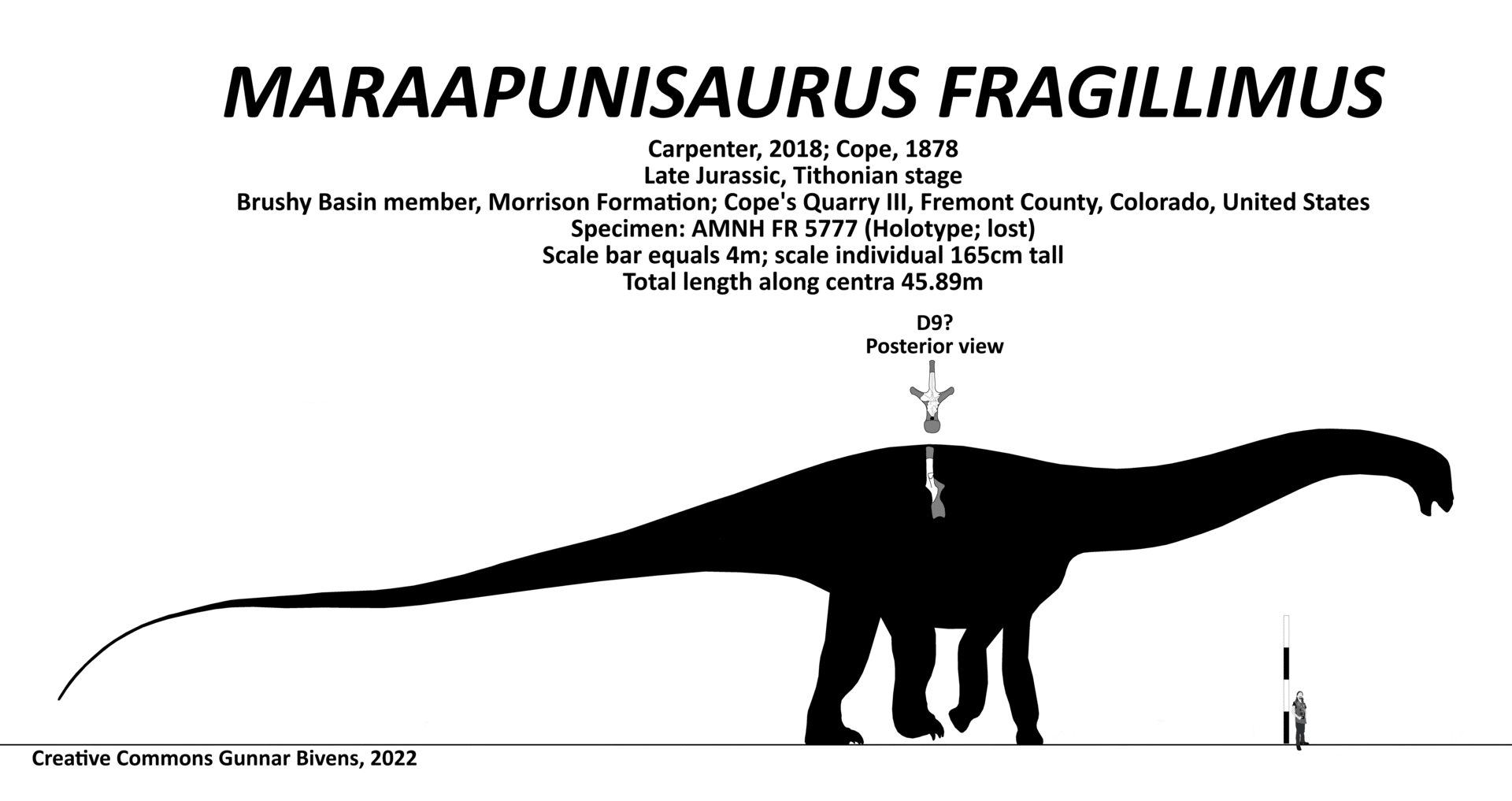
In 2018, Carpenter rejected the typo idea. In Cope’s day, he noted, “m” meant both meter and millimeter, and an 1878 Lucas letter backs a six-foot bone. Restored as a rebbachisaurid, the vertebra stood about 7.9 feet (2.4 meters) tall. The animal, in turn, shrank to about 99 feet (30.3 meters), possibly 105 feet (32 meters), with hips 26 feet (7.95 meters) high. The longer figure, he wrote, falls within estimates for Supersaurus and Diplodocus hallorum.
His revised 9.5-foot (2.9-meter) femur would still beat any sauropod thighbone yet found. By comparison, the longest measured femora, from Patagotitan, reach 7.8 feet (2.38 meters). An incomplete Argentinosaurus femur is estimated at 8.2 feet (2.5 meters). He also argued that sauropod tracks from Broome, Australia, 4.4 to 4.6 feet (1.35 to 1.40 meters) long, contradict claims that such giants were impossible. Cope wrote that its dimensions “much exceed those of any known land animal”—and the debate over its size remains open.

The Dinosaur in Detail
What sets this dinosaur apart is a feature that made sense only after later sauropod finds. Carpenter singled out a festooned spinodiapophyseal lamina—a scalloped sheet of bone between the spine and the side process—as “unambiguously rebbachisaurid.” Together with the pneumatic spine and arch, it convinced him the bone did not belong in Amphicoelias. He also argued that zoology’s naming rules allow a lost specimen to carry a new genus name.
Cope had seen things differently. In his view, a hyposphene, a spine aligned front to back, and a raised diapophysis (the rib-bearing side process) marked it as Amphicoelias. He separated the species from A. altus by its taller, slimmer spine, its more sheet-like buttresses, and its T-shaped section. In 1921, Osborn and Mook provisionally referred the specimen to A. altus. Later, Woodruff and Foster (2014) suggested it might be a growth stage of A. altus, which they in turn merged into Diplodocus.
Carpenter’s “basal” label rests on the hyposphene, which Maraapunisaurus shares with Histriasaurus, Comahuesaurus, and Demandasaurus. Even so, some of its features look more derived than in Histriasaurus. Importantly, he ran no formal cladistic analysis—the placement rests on comparing characters with Cope’s drawing.
Carpenter called it the oldest rebbachisaurid and the first from North America, which he floated as a possible birthplace for the family. He proposed that the group spread to Europe and then, via Africa, to South America—the reverse of earlier ideas. Taken together, a single drawing now anchors a debate about where an entire sauropod family began.
Interesting Points about Maraapunisaurus
- The name Maraapunisaurus means “huge reptile,” built on a Southern Ute word that the tribe’s own Cultural Department recommended.
- According to Carpenter, its holotype received a museum catalog number even though the bone was already missing, in case it ever turned up.
- In a memoir for the 50th reunion of his Oberlin class, finder Oramel Lucas exclaimed, “What a monster this animal must have been.”
- Cope wrote that the bone’s thin, hollow construction resembled “nothing so much as” what is seen in deep-sea fishes.
- Wilson and Allain (2015) had estimated a 20-million-year rebbachisaurid ghost lineage (a gap in the fossil record), which Xenoposeidon has since cut to about 10 million years.
Contemporary Dinosaurs
Sharing the same bonebed was Camarasaurus, represented by several partial skeletons of C. supremus from the Nipple quarries. Cope himself noted that his giant vertebra came from “the same bed” as Camarasaurus. Like Maraapunisaurus, it was a sauropod, though no record links the two directly.
Prowling the same ground was Allosaurus, known here from Cope’s Laelaps trihedrodon and from an abraded tooth fragment found at the base of Cope’s Nipple in 1991. An 1878 report of theropod teeth mixed with Camarasaurus bones hints at scavenging—but nothing links Allosaurus to Maraapunisaurus directly.
Adding further diversity was Apatosaurus, a diplodocid sauropod. Carpenter lists it among the Nipple-quarry taxa, based on material that Cope called Morosaurus laticollis. With no recorded interaction, it is best pictured as a neighbor in the same landscape.
Maraapunisaurus in its Natural Habitat
The world Maraapunisaurus roamed was a floodplain, and its bonebed formed in silty mudstone far from the main river channel. Over time, soil formation altered the mud into a yellow-green rock with fossil root casts. Floods from a nearby river likely carried in some of the abraded bones, while others came from animals that died on the spot. In this upper part of the unnamed member, purple and red mudstones dominate, and aquatic animals grow scarcer than in the lower beds. However, clay minerals and fossil distribution lead to contradictory conclusions about the climate.
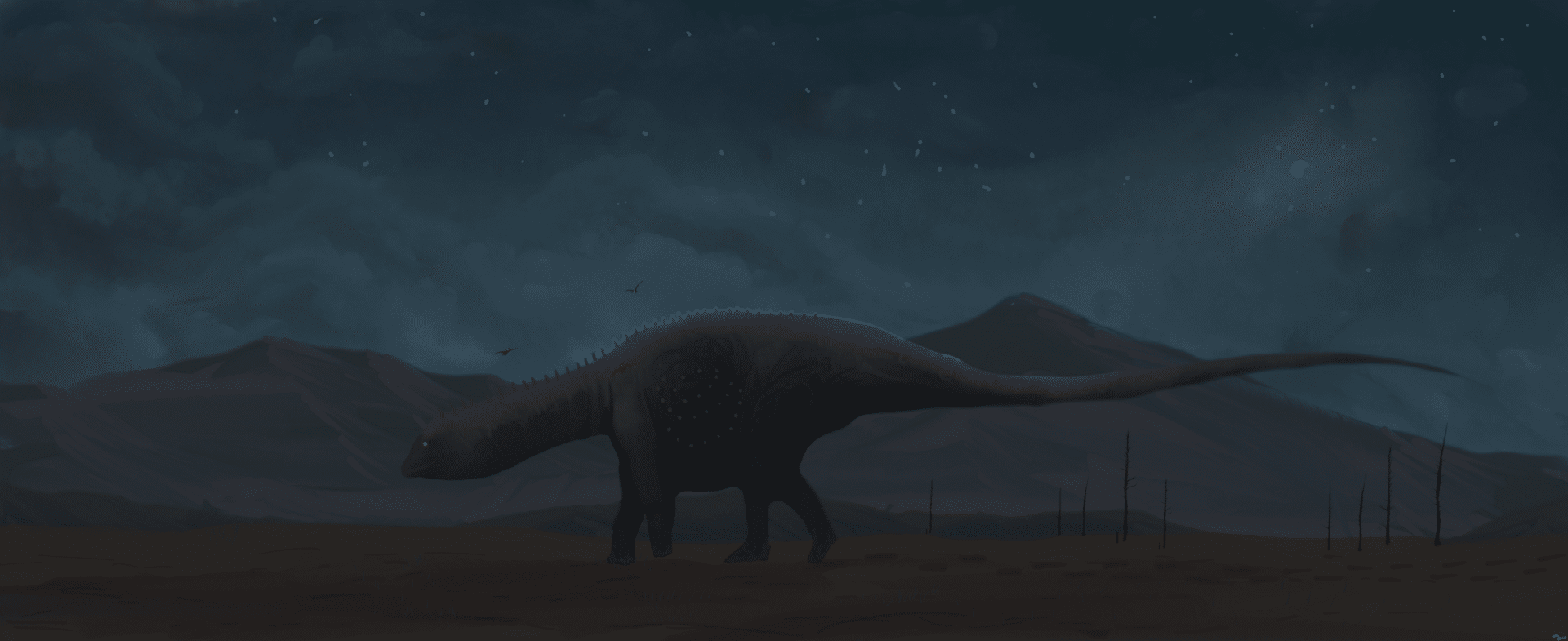

No study has examined what Maraapunisaurus ate. In 1878, Cope proposed that such hollow-boned beasts “may have walked in deep water and browsed on precipitous shores”—an idea now long outdated.
While there is no direct evidence of how Maraapunisaurus lived, grew, or behaved, its bonebed neighbors offer a rare glimpse of its world. Until a second specimen surfaces, the rest of its life remains a riddle locked in stone.
Frequently Asked Questions
It means “huge reptile,” from the Southern Ute word maraapuni and the Greek saurus.
It lived in the Late Jurassic, probably the late Kimmeridgian or early Tithonian, less than about 152 million years ago.
Carpenter’s 2018 estimate is about 99 to 105 feet (30.3 to 32 meters) long. Older estimates reached 190 feet, which Woodruff and Foster called an extreme overestimate.
It was a sauropod that Carpenter identified in 2018 as a basal rebbachisaurid, not a diplodocid as long believed. In 2021, Mannion and colleagues accepted this only tentatively.
Oramel Lucas found it near Cope’s Nipple in Garden Park, north of Cañon City, Colorado, in the Morrison Formation.
Everything we know comes from Cope’s 1878 description and drawing of one vertebra, which was later lost.
Sources
The information in this article is based on various sources, drawing on scientific research, fossil evidence, and expert analysis. The aim is to provide a comprehensive and accurate overview of Maraapunisaurus. However, please be aware that our understanding of dinosaurs and their world is constantly evolving as new discoveries are made.
- https://archive.org/details/sim_american-naturalist_1878-08_12_8
- https://giw.utahgeology.org/index.php/GIW/article/view/32
- https://giw.utahgeology.org/index.php/GIW/article/view/38
- https://giw.utahgeology.org/index.php/GIW/article/view/37
- https://vjs.pgi.gov.pl/article/download/26620/18330/40026
- https://peerj.com/preprints/838
- https://giw.utahgeology.org/index.php/GIW/article/view/6
- https://paleobiodb.org/data1.2/occs/list.json?coll_id=48129&show=ident,ref
- https://paleobiodb.org/data1.2/taxa/single.json?name=Maraapunisaurus
- https://doi.org/10.1098/rsos.210377
- https://svpow.com/2021/11/01/the-femur-of-argyrosaurus-maybe/
This article was last fact checked: TheDinosaurs Team, 01-11-2026
Featured Image Credit: E. D. Cope, Public domain, via Wikimedia Commons
