
On the north side of the Milk River, near the town of Havre in Montana, badlands expose the Coal Ridge Member of the Judith River Formation. There, in 2014, a loader clearing rock struck something unexpected—the knob of an armored dinosaur’s tail club. That animal is now Zuul crurivastator, a herbivore from the Campanian stage of the Late Cretaceous—between about 76.3 and 75.2 million years ago. In fact, its describers call it the most complete ankylosaurid ever found in North America.
In 2017, paleontologists Victoria M. Arbour and David C. Evans named the new genus and species. Theirs was the first ankylosaurin skeleton known with both a complete skull and a tail club. Beyond the bones, the holotype also carries skin impressions and what may be the original horny sheaths on its tail spikes. As a result, these remains offer a rare glimpse of an ankylosaur’s armor still lying where it grew.
Zuul Key Facts
| Keyword | Fact |
|---|---|
| Pronunciation | Zool CRUR-uh-vass-TATE-or |
| Meaning of name | Zuul (Ghostbusters Monster), Destroyer of Shins |
| Group | Ankylosauria |
| Type Species | Zuul crurivastator |
| Diet | Herbivore |
| When it Lived | About 76.3 to 75.2 MYA |
| Period | Cretaceous |
| Epoch | Late Cretaceous (Campanian stage) |
| Length | About 20 feet (6 meters), Royal Ontario Museum estimate |
| Height | Not specified |
| Weight | About 5,500 pounds (2,500 kilograms), Royal Ontario Museum estimate |
| Mobility | Not specified |
| First Discovery | 2014 by a private commercial fossil company |
| Described by | 2017 by Victoria M. Arbour and David C. Evans |
| Holotype | ROM 75860 |
| Location of first find | Coal Ridge Member, Judith River Formation, Milk River badlands near Havre, Hill County, Montana, USA |
Zuul Origins, Taxonomy and Timeline
The genus name refers to Zuul the Gatekeeper of Gozer, a fictional monster from the 1984 film Ghostbusters. Meanwhile, the species name joins two Latin words—crus, meaning “shin” or “shank,” and vastator, meaning “destroyer.” Its describers chose it in reference to the sledgehammer-like tail club, and the Royal Ontario Museum glosses the species name as “destroyer of shins.” Together, the name is a nod to popular culture and to the weapon at the end of the tail.
Zuul belongs to Ankylosauria, the armored dinosaurs, within Ornithischia and Thyreophora. More narrowly, it sits in Ankylosauridae, Ankylosaurinae, and finally Ankylosaurini. To test its relationships, Arbour and Evans ran a parsimony analysis across 58 taxa and 177 characters—a method that favors the family tree needing the fewest evolutionary changes. It placed Zuul in a clade with Dyoplosaurus and Scolosaurus, while Euoplocephalus was more distantly related. Zuul crurivastator is the type and only known species.
The host rock lies in the middle part of the Coal Ridge Member, within the Campanian stage. In 2022, Ramezani and colleagues dated that member to roughly 76.3 to 75.2 million years ago—slightly refining the old dates. According to its describers, ankylosaurines were evolving rapidly at the time. In their view, Zuul probably fills a gap in the record after Euoplocephalus tutus and Dyoplosaurus acutosquameus. They also judged it older than the ankylosaurines of Montana’s Two Medicine Formation. Even so, they noted that the dates for these rocks were under major revision.
Discovery & Fossil Evidence
The skeleton came to light by accident on May 16, 2014. At the time, a private commercial fossil company was removing overburden—the rock above a fossil—to reach a tyrannosaurid skeleton. During that work, a skid-steer loader hit the tail club knob. The bones lay about 10 meters (33 feet) from the edge of the exposure, under more than 12 meters (39 feet) of rock. As a result, modern erosion had never touched them. Evans later checked the quarry in person, in 2014 and again in 2016.
In June 2016, the Royal Ontario Museum in Toronto acquired the skeleton and cataloged it as ROM 75860. Upside-down in the rock, the animal kept its tail, pelvis, and dorsal (back) vertebrae articulated. Although its skull, jaws, and neck vertebrae had come apart, they stayed close together. It came out in two large blocks, and the torso block alone weighs more than 15,000 kilograms (33,000 pounds). The 2017 description covered a nearly complete cranium, both lower jaws, and a partially articulated postcranium (the skeleton behind the head).
The same quarry also yielded turtles, crocodyliforms, theropods, hadrosaurids, invertebrates, and plants, which the authors planned to describe later. For now, the 2017 study lists ROM 75860 as the only specimen of Zuul. It also stands as the first diagnostic ankylosaurid skeleton from the Judith River Formation.
Zuul Size and Description
When Zuul was named in 2017, the skull and jaws were fully prepared, while the tail block was only partly prepared.
Short description of Zuul
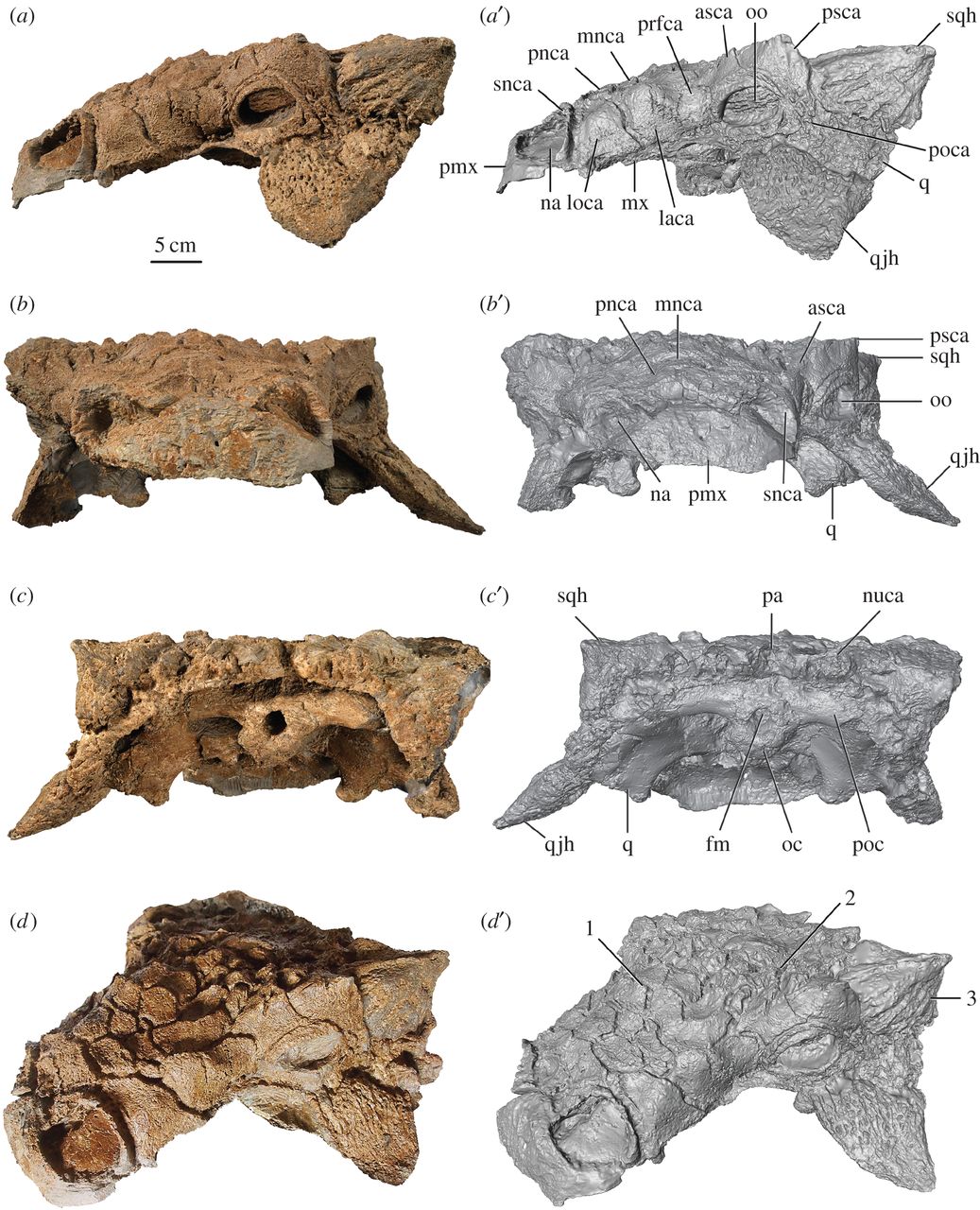
From above, the skull has a trapezoidal outline with a squared-off premaxillary beak (the bony front of the upper jaw). Crushing has flattened it from top to bottom, leaving the eye sockets as flattened ovals. Long, backswept squamosal horns—spikes at the rear corners of the skull—carry a sharp upper keel and furrows along their sides. A single osteoderm, or bony skin plate, sat inside each eyelid. Meanwhile, the leaf-shaped teeth at the front of the lower jaw bear 12 to 14 small cusps, and small gular ossicles (throat bones) survive too.
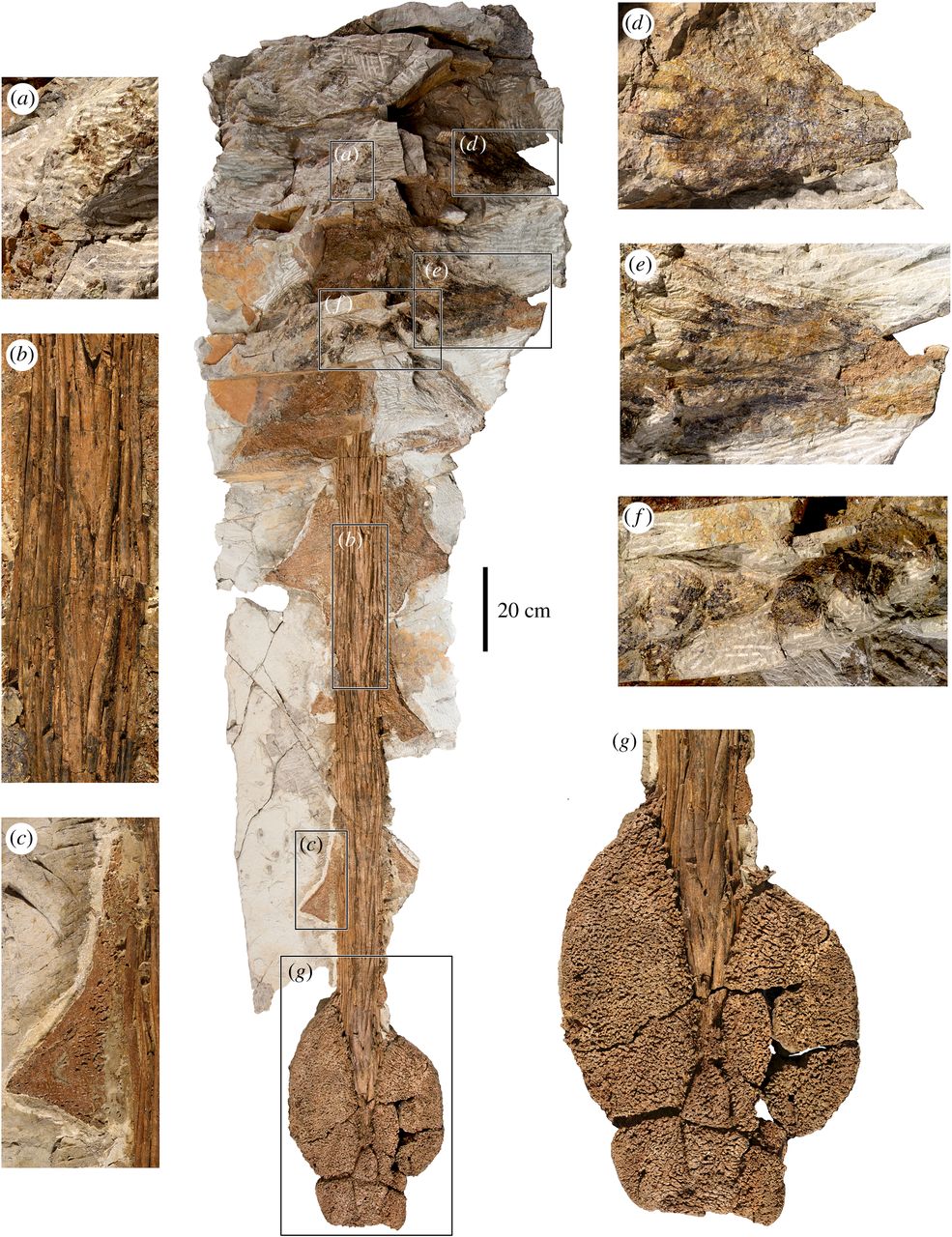
Farther back, osteoderms ran the whole length of the tail, including five pairs along the club handle. Near the front of the tail, the spikes measure 180 to 190 millimeters (7 to 7.5 inches) from front to back. Even with broken tips, they run over 250 millimeters (10 inches) from base to tip. A black film on the first three pairs appears to be the original horny sheath. Biochemical tests, however, are still needed to confirm keratin. No limb bones had yet been identified and prepared, so the 2017 paper says nothing about its limbs.

Size and Weight of Type Species
The 2017 paper gives no total body length or mass. Instead, it measures the skull directly at 501 millimeters (19.7 inches) from beak to nuchal shelf. Apart from three Ankylosaurus skulls, no larger ankylosaurine skull is known from Laramidia, the western landmass of North America.
The Royal Ontario Museum estimates a length of about 20 feet (6 meters) and a weight of around 5,500 pounds (2,500 kilograms)—about the size of a white rhinoceros. However, the museum gives no method, and the figures have not been peer-reviewed. We found no published height estimate.
Measured across the supraorbitals (bones above the eyes), the skull of Zuul is 1.3 percent wider than the Euoplocephalus skull ROM 1930. It also exceeds Scolosaurus MOR 433 by 11 percent and Dyoplosaurus ROM 784 by 10.7 percent. According to the authors, this size strongly suggests a skeletally mature animal.
The Dinosaur in Detail
What sets this dinosaur apart is its tail. The club measures about 210 centimeters (6.9 feet) from handle to knob, though its front edge was still hidden. The knob is also unusually flat, at 525 millimeters (20.7 inches) long but only 80 millimeters (3.1 inches) high. That gives a height-to-length ratio of 0.15, whereas most other knobs fall between 0.3 and 0.5. It is lopsided as well, because the left major osteoderm is longer than the right.
Interlocking vertebrae turned the handle into a rigid rod. On each side, up to eight ossified tendons are stacked together, and many exceed 50 centimeters (20 inches). The tail spikes still sit in place along the handle—the first such occurrence in a North American ankylosaurine. Mongolian ankylosaurines, Arbour and Evans noted, were buried in place without flowing water. In their view, such burials likely gave those animals a better chance of keeping osteoderms in place than their Laramidian relatives.

The diagnosis of Zuul lists peaked, overlapping caputegulae—small bony tiles on the skull roof—and prominent furrows on each squamosal horn. As in Scolosaurus, those horns extend well past the nuchal shelf. Ossicles also line the tail to the club knob. This led the authors to suggest that a pavement of ossicles covered the whole body.
In nine of ten most parsimonious trees, Zuul emerged as the sister of Dyoplosaurus, but in the tenth it paired with Anodontosaurus. The strict consensus, meanwhile, collapses Zuul, Ankylosaurus, Anodontosaurus, Dyoplosaurus, and Scolosaurus into a polytomy, an unresolved branching. Its describers also raised the idea that Zuul may be part of an anagenetic Dyoplosaurus lineage—one species gradually becoming the next—but called for more specimens to test it.
Interesting Points about Zuul
- The genus honors Zuul the Gatekeeper of Gozer from the 1984 film Ghostbusters, while the species name translates roughly as “destroyer of shins.”
- A skid-steer loader uncovered the skeleton by striking its tail club knob while workers cleared rock above a tyrannosaurid skeleton.
- The torso block weighs more than 15,000 kilograms (33,000 pounds) and was still being prepared when the species was named in 2017.
- Zuul is the first ankylosaurid known to preserve gular ossicles, the small bones set in the skin of its throat.
- Its holotype preserves skin impressions, plus a row of large tail scales without bony cores that no other specimen shows.
Contemporary Dinosaurs
Among the plant-eaters of this landscape was Corythosaurus, a crested, duck-billed hadrosaurid also known from the Coal Ridge Member. In a study published in 2022, Takasaki and colleagues described the first definitive Corythosaurus specimens from the Judith River Formation. They described the member as roughly time-equivalent to Alberta’s Dinosaur Park Formation, as did Arbour and Evans. However, the study’s published summary does not give the fossils’ exact level within the member. No interaction with Zuul is recorded either.
Zuul in its Natural Habitat
The world Zuul roamed was a humid coastal plain. The Judith River Formation built up on land over about 4 million years, as the Western Interior Seaway rose and fell. Its Coal Ridge Member formed as the Bearpaw Sea advanced, and near Havre, coal appears within the top 20 meters (66 feet) of the formation. Zuul itself came to rest at the base of a river channel sandstone about 3 meters (10 feet) thick, surrounded by mudstone-rich river deposits. Elsewhere in the member, microfossil sites hold tyrannosaurids, troodontids, ankylosaurs, ceratopsids, and hadrosaurids.
As a herbivore, Zuul processed plants with small, leaf-shaped teeth. In 2023, Ballell, Mai, and Benton compared ankylosaur jaws using mechanical advantage—a measure of how efficiently jaw muscles turn force into bite. They found that Zuul, Euoplocephalus, and Ankylosaurus evolved toward the lowest extremes of that measure. Still, these results are indirect, since they come from jaw shape alone.
In 2022, Arbour, Zanno, and Evans reported that injured osteoderms on the holotype cluster on the flanks near the hips. Such damage, they wrote, is consistent with lateral tail-swinging and ritualized combat. On that basis, they argued that sexual selection, rather than predation, drove the evolution of tail clubs. Nevertheless, they accepted that a club could serve in defense when needed. Earlier, the museum’s 2017 release had left both roles open—striking at the legs of predators or battling rivals. The original paper, by contrast, took no position on club use. Arbour and Evans also proposed that closely related ankylosaurins may have preferred different habitats.
Frequently Asked Questions
The genus refers to Zuul, a monster from the 1984 film Ghostbusters, and crurivastator means “destroyer of shins.”
It lived during the Campanian stage of the Late Cretaceous, between about 76.3 and 75.2 million years ago.
The Royal Ontario Museum estimates about 20 feet long and around 5,500 pounds, though no peer-reviewed estimate exists.
It was a herbivore, and a 2023 study found its jaws at the low extreme of mechanical advantage among the ankylosaurs studied.
Its skeleton came from the Coal Ridge Member of the Judith River Formation, near Havre in Hill County, Montana.
It is the most complete ankylosaurid ever found in North America, with a complete skull, a tail club, and skin impressions.
Sources
The information in this article is based on various sources, drawing on scientific research, fossil evidence, and expert analysis. The aim is to provide a comprehensive and accurate overview of Zuul. However, please be aware that our understanding of dinosaurs and their world is constantly evolving as new discoveries are made.
- https://doi.org/10.1098/rsos.161086
- https://pmc.ncbi.nlm.nih.gov/articles/PMC5451805/
- https://doi.org/10.6084/m9.figshare.4924556.v1
- https://doi.org/10.6084/m9.figshare.4924574.v1
- https://doi.org/10.1098/rsbl.2022.0404
- https://pmc.ncbi.nlm.nih.gov/articles/PMC9727678/
- https://pmc.ncbi.nlm.nih.gov/articles/PMC10600113/
- https://pmc.ncbi.nlm.nih.gov/articles/PMC4871577/
- https://doi.org/10.1002/ar.25097
- https://www.rom.on.ca/news-releases/royal-ontario-museum-identifies-spectacular-new-species-armoured-dinosaur
- https://paleobiodb.org/classic/basicCollectionSearch?collection_no=190394
- https://doi.org/10.1038/s41598-022-19896-w
This article was last fact checked: TheDinosaurs Team, 01-11-2026
Featured Image Credit: TotalDino, CC0, via Wikimedia Commons
