
Along the Omakizawa River near Yubari, on the Japanese island of Hokkaido, lie the marine mudstones of the Hikagenosawa Formation. Although these rocks formed under the sea, they hold an unexpected guest from the land. There, a partial skull sealed inside a concretion—a hard nodule of cemented sediment—preserved the head of a long-unnamed dinosaur. Described in 2026 as Nipponopelta yezoensis—the print issue is dated 2027—it belongs to Nodosauridae, one of the families of ankylosaurs. It lived during the late Cenomanian stage of the Late Cretaceous, about 96 to 94 million years ago. Its describers call it the first ankylosaur formally named from Japan.
The fossil’s road to a name took about three decades. Eijiro Goto found it—in 1995, according to Live Science—and later donated it to the Mikasa City Museum. In 2005, Hiroshi Hayakawa, who prepared the specimen, and his colleagues described it as an unnamed nodosaurid. Their paper appeared after Hayakawa’s death. Then, in 2026, paleontologist Shumpei Oyabu and four colleagues revisited it with CT scans and a 3D digital model. Their analyses placed it among nodosaurids from North America and Europe. In turn, the team uses that result to trace how these armored dinosaurs dispersed between regions.
Nipponopelta Key Facts
| Keyword | Fact |
|---|---|
| Pronunciation | Not specified |
| Meaning of name | Japan Shield |
| Group | Ankylosauria (Nodosauridae) |
| Type Species | Nipponopelta yezoensis |
| Diet | Not specified |
| When it Lived | 96 to 94 MYA |
| Period | Cretaceous |
| Epoch | Late Cretaceous (Cenomanian stage) |
| Length | Not specified |
| Height | Not specified |
| Weight | Not specified |
| Mobility | Not specified |
| First Discovery | 1995 by Eijiro Goto |
| Described by | 2026 (online, print issue dated 2027) by S. Oyabu, Y. Kobayashi, D.K. Zelenitsky, A.R. Fiorillo, and M. Kano |
| Holotype | MCM A522 |
| Location of first find | Omakizawa River, Yubari, Hokkaido, Japan (upper Hikagenosawa Formation, Yezo Group) |
Nipponopelta Origins, Taxonomy and Timeline
The name Nipponopelta joins a country to a piece of armor. According to news reports of the study, “Nippon” refers to Japan, while the Greek pelta means “shield.” Similarly, the species name yezoensis points to Yezo, or Ezo—the historical name for Hokkaido. Together, the name ties the animal to its nation and to the island where it came to light.
Oyabu and colleagues placed Nipponopelta within Nodosauridae, part of Ankylosauria among the ornithischian (“bird-hipped”) dinosaurs. Their computer analyses nested it deeply among derived—more specialized—nodosaurids from North America and Europe. However, it did not group with other Asian nodosaurids, which come mainly from mid-Cretaceous deposits in China and Japan. Its named relatives include Pawpawsaurus, Panoplosaurus, Edmontonia, Denversaurus, Nodosaurus, and Borealopelta from North America, along with the European Dracopelta. For now, Nipponopelta yezoensis remains the type and only known species.
The fossil comes from the upper part of the Hikagenosawa Formation, which the describers place in the upper Cenomanian. Some news coverage, such as Sci.News, converts that into roughly 96 to 94 million years ago. In contrast, Live Science gives a broader span of 93 to 100 million years. Either way, that puts Nipponopelta early in the Late Cretaceous, when Japan lay at the eastern edge of the Asian continent. Although the article appeared online in August 2026, the journal issue that carries it bears a February 2027 date. For its part, the Paleobiology Database credits the name to “Oyabu et al. 2027.”
Discovery & Fossil Evidence
Goto’s find came from the Omakizawa River, a tributary of the Shuparo River in Yubari, Hokkaido. The site lies in the upper Hikagenosawa Formation, part of the wider Yezo Group. While Live Science dates the discovery to 1995, the Hokkaido Shimbun put it 31 years before its 2026 report. Afterward, Hayakawa prepared the specimen at the Mikasa City Museum and led its first study.
The holotype—the specimen that anchors the name—is MCM A522, permanently housed at the Mikasa City Museum. A contemporary summary of the 2005 description lists a partial skull and 11 loose teeth preserved in the rock filling it. It also lists the atlas (first neck vertebra), with neck armor still attached. The 2026 paper’s brief recap names only the skull, atlas, and teeth. In contrast, Live Science’s coverage of the new study adds “bony plates.” The specimen’s surface is somewhat eroded, yet the surrounding concretion kept deformation and cracking to a minimum. However, the bone was hard to separate from the rock, so it had to be prepared with acid. As a result, the 2026 authors note, anatomical detail was hard to obtain and its exact position remained unclear.
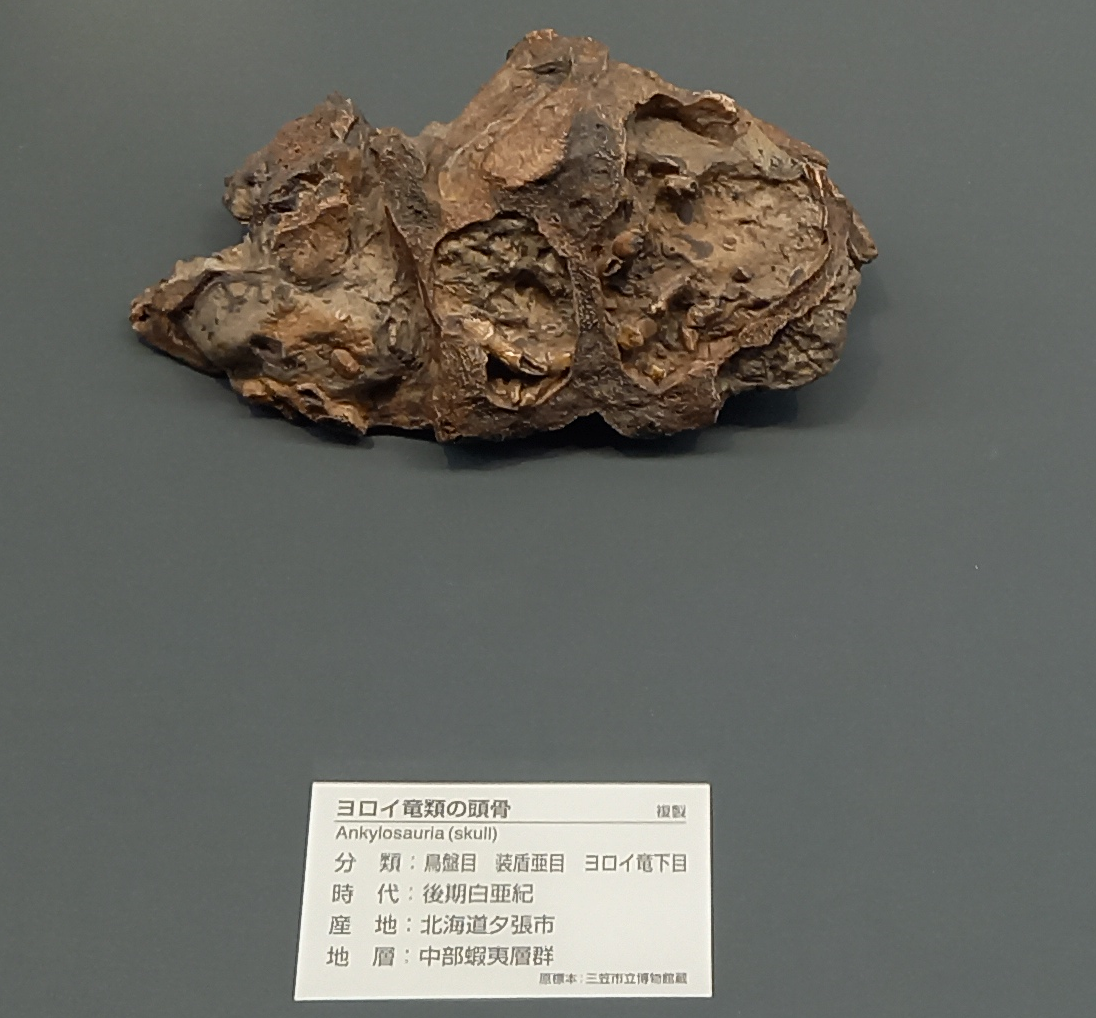

To see past those limits, Oyabu’s team built a 3D digital model from CT data. According to Sci.News, the scans revealed part of the lower jaw, two complete teeth, and the left inner ear. Today the real fossil is on display at the Mikasa City Museum. All of the material described so far belongs to this single specimen—no additional individuals have been confirmed.
Nipponopelta Size and Description
Nipponopelta is known only from its head, teeth, first neck vertebra, and some neck armor, so its portrait starts and ends near the skull.
Short description of Nipponopelta
The surviving skull preserves the occipital region (the back of the skull), and that region carries the features that define the genus. News coverage describes the combination of traits there as one not seen in other known nodosaurids. Alongside the skull, the 2005 study listed the atlas, armor attached to the front of the neck, and 11 loose teeth. Later, CT scans revealed part of the lower jaw, two complete teeth, and the left inner ear.
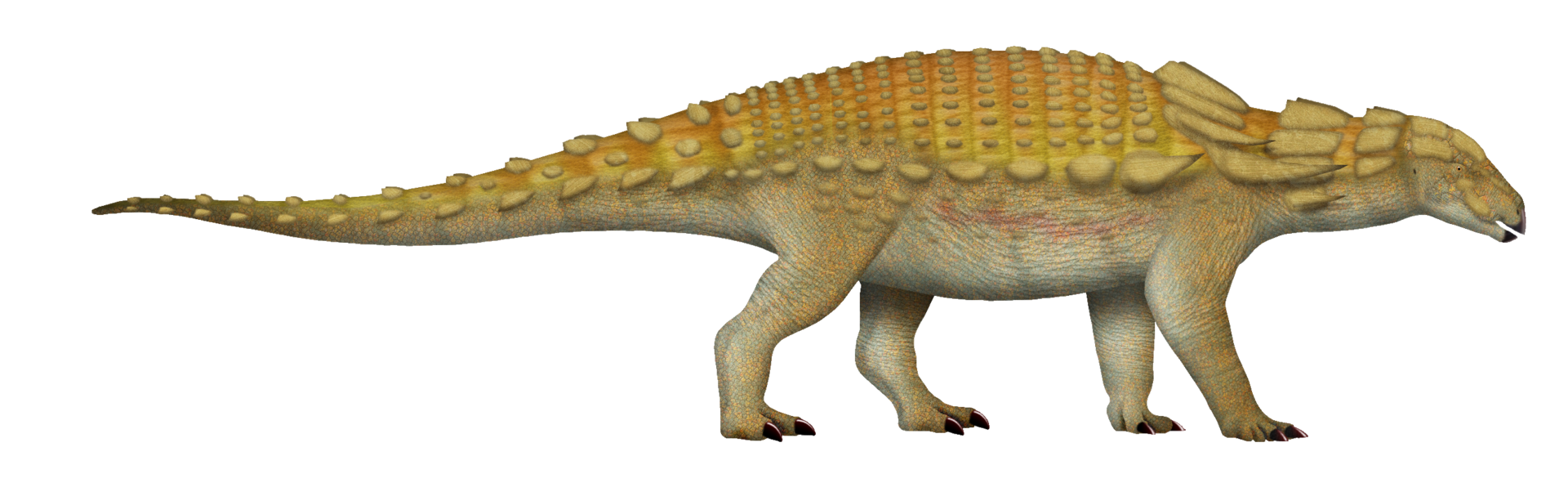
Notably, the only armor described so far sits at the front of the neck. As summarized at the time, the 2005 description reports osteoderms (bony armor plates) attached to the atlas. News reports of the 2026 study mention bony plates too. Beyond the neck, however, any armor shown in life restorations is modeled on relatives rather than drawn from this fossil. Likewise, the material says nothing directly about the limbs or posture. Because skin and other soft tissues are not part of the described material, any discussion of its outer covering is speculative.
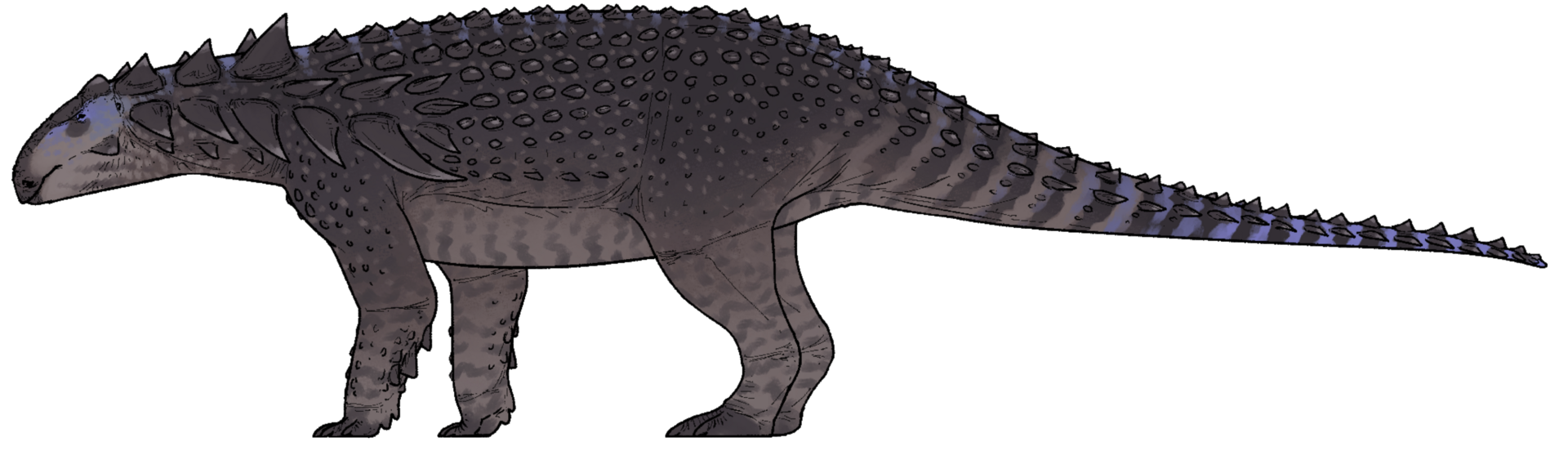

Size and Weight of Type Species
No length, height, or weight estimate appears in the openly available parts of the 2026 description, so our Key Facts table lists all three as not specified.
Without a skeleton behind the skull, any body size would have to come from comparisons with better-known relatives. For instance, Edmontonia and Panoplosaurus, two North American nodosaurids grouped with it, could serve as reference points. Even so, a skull alone is a thin basis for scaling a whole animal.
Some popular sources quote a body length, but we found no peer-reviewed basis for it, so we leave the figure out. Until more of the skeleton turns up, its size remains an open question.
The Dinosaur in Detail
One of the most distinctive things about Nipponopelta is where it sits on the family tree. Asian nodosaurids come mainly from mid-Cretaceous deposits in China and Japan. Yet the new analysis placed Nipponopelta deep among derived nodosaurids from North America and Europe, closer to them than to its Asian neighbors. That clade—an ancestor and all of its descendants—rests on 13 synapomorphies, or shared derived features.

This placement refines earlier work rather than overturning it. In 2005, Hayakawa and colleagues had assigned the specimen to Nodosauridae based on its teeth and features at the back of the skull. Oyabu’s team reports that their phylogeny—an evolutionary tree built from anatomical characters—is consistent with that assignment. What the 2026 study adds is a precise position and, at last, a name. As of late 2026, we found no published work disputing the new genus.
The team also used computer models to reconstruct where the lineage arose. Their results point to a wide ancestral area spanning Laramidia, Appalachia (the western and eastern landmasses of a divided North America), and Asia. In contrast, Live Science offered a more specific reading of the study. In its coverage, ancestors may have reached Asia from North America over a Bering land connection around 100 to 110 million years ago. The abstract itself, however, states only the wide ancestral area.
Taken together, these results place Nipponopelta within a widespread lineage. Moreover, the authors suggest that coastal environments played a role in spreading nodosaurids between regions. Its skull is modest evidence for so large a story—yet it gave Japan its first formally named ankylosaur.
Interesting Points about Nipponopelta
- Nipponopelta yezoensis is the first ankylosaur formally named from Japan, according to the highlights of its 2026 description.
- The Hokkaido Shimbun reported that it is only the third new dinosaur genus and species named from Hokkaido, not counting birds.
- Live Science dates the find to 1995, which means roughly three decades passed before its 2026 description gave the fossil a name.
- Although it was found in Japan, its closest relatives were North American and European nodosaurids rather than other Asian species.
- According to Sci.News, CT scans revealed hidden parts of the specimen, including two complete teeth and the left inner ear.
Nipponopelta in its Natural Habitat
The world Nipponopelta knew lay along the eastern edge of the Asian continent. Its skull came to rest in the Hikagenosawa Formation of the Yezo Group, whose mudstones and sandstones built up offshore in shallow to deep marine settings. The brown or dark grayish mudstone filling the skull also holds black plant fragments. Even so, Oyabu and colleagues reconstruct Nipponopelta as an animal that preferred marine-influenced environments—likely coastal or estuarine areas. As news accounts stress, it lived on land near the sea, not in the sea itself.
The openly available summaries of the 2026 study do not address what Nipponopelta ate. Its teeth may one day help answer that question. In 2005, 11 teeth were visible through the adductor fossa (the opening for the jaw muscles), and CT scans later revealed two complete teeth. Whether those two are among the 11 is unclear. For now, its diet stays Not specified in our Key Facts table.
While there is no direct evidence of how Nipponopelta lived from day to day, its describers see a broader pattern in its setting. Nodosaurids seem to have ranged more widely than ankylosaurids, and their fossils turn up more often in marine deposits. In addition, the authors note that several studies suggest nodosaurids were more adapted to coastal and estuarine environments. Coastal settings, they add, may have played a role in spreading these ankylosaurs between regions.
The Yezo Group has also produced two other named dinosaurs. One is the hadrosaurid (duck-billed dinosaur) Kamuysaurus japonicus, and the other is the therizinosaurid Paralitherizinosaurus japonicus. However, both come from much younger rocks. Kamuysaurus is from the early Maastrichtian Hakobuchi Formation, while Paralitherizinosaurus is from the early Campanian Osoushinai Formation. Neither shared Nipponopelta‘s world, and no other named dinosaur is known from the Hikagenosawa Formation in the current fossil record.
Frequently Asked Questions
According to news reports, it combines “Nippon” (Japan) with the Greek pelta, “shield,” while yezoensis refers to Yezo, Hokkaido’s historical name.
It lived in the late Cenomanian stage of the Late Cretaceous, about 96 to 94 million years ago.
No size estimate is openly available, since the animal is known only from a partial skull, an atlas with some neck armor, and teeth.
It was a nodosaurid ankylosaur, more closely related to North American and European nodosaurids than to Asian ones.
Its partial skull was found along the Omakizawa River in Yubari, Hokkaido, in the Hikagenosawa Formation of the Yezo Group.
It is the first ankylosaur formally named from Japan, and unique features at the back of its skull define the genus.
Sources
The information in this article is based on various sources, drawing on scientific research, fossil evidence, and expert analysis. The aim is to provide a comprehensive and accurate overview of Nipponopelta. However, please be aware that our understanding of dinosaurs and their world is constantly evolving as new discoveries are made.
- https://doi.org/10.1671/0272-4634(2005)025[0240:NAFTCO]2.0.CO;2
- https://dml.reptilis.net/2005Apr/msg00153.html
- https://doi.org/10.1016/j.cretres.2026.106477
- https://www.sciencedirect.com/science/article/abs/pii/S0195667126001667
- https://api.crossref.org/works/10.1016/j.cretres.2026.106477
- https://paleobiodb.org/data1.2/taxa/list.txt?name=Nipponopelta&show=attr,app
- https://paleobiodb.org/data1.2/occs/list.txt?base_name=Dinosauria&formation=Hikagenosawa
- https://doi.org/10.1038/s41598-019-48607-1
- https://doi.org/10.1038/s41598-022-11063-5
- https://www.livescience.com/animals/dinosaurs/rare-armored-dinosaur-found-in-japan-may-have-ancestors-that-migrated-across-a-land-bridge-100-million-years-ago
- https://sci.news/paleontology/nipponopelta-yezoensis-15014.html
- https://nazology.kusuguru.co.jp/archives/199032
- https://blog.everythingdinosaur.com/?p=69837
- https://www.hokkaido-np.co.jp/article/1384695/
This article was last fact checked: TheDinosaurs Team, 05-11-2026
Featured Image Credit: TotalDino, CC BY 4.0, via Wikimedia Commons
