
On the southern bank of the Amur River near Jiayin, in northeastern China, cliffs called Belyie Kruchi expose the Yuliangze (also spelled Yuliangzi) Formation. Here, bonebeds stretch over several tens of square meters, and lambeosaurines make up more than 90 percent of the fauna. The site’s describers referred all that lambeosaurine material to a single species, Charonosaurus jiayinensis. It was a hadrosaurid—a duck-billed dinosaur—from the Maastrichtian, the final stage of the Late Cretaceous. Their analysis made the North American Parasaurolophus its closest relative—a kinship that hints at faunal exchanges between Asia and North America.
In 1902, Gurov, a professor at Blagoveschensk, found fossil bones near Jiayin. Geologist W.P. Renngarten later collected bones at roughly the same spot, in the winter of 1915–1916. Russian crews then dug at the site in 1916 and 1917. In 2000, paleontologist Pascal Godefroit and colleagues Zan Shuqin and Jin Liyong named the genus. The same team published a full description in 2001, which this profile follows.
Charonosaurus Key Facts
| Keyword | Fact |
|---|---|
| Pronunciation | Not specified |
| Meaning of name | Charon’s Reptile (after the ferryman of the Styx) |
| Group | Ornithopoda |
| Type Species | Charonosaurus jiayinensis |
| Diet | Herbivore |
| When it Lived | 72.2 to 66.0 MYA |
| Period | Cretaceous |
| Epoch | Late Cretaceous (Maastrichtian stage) |
| Length | About 32.8 feet (popular estimate by Holtz) |
| Height | Not specified |
| Weight | Not specified |
| Mobility | Mostly moved on two legs (bipedal), possibly on all four at times |
| First Discovery | 1902 by A.I. Gurov (approximate spot), Belyie Kruchi bones 1915 to 1916 by W.P. Renngarten |
| Described by | 2000 by P. Godefroit, S. Zan, and L. Jin |
| Holotype | CUST J-V1251-57 |
| Location of first find | Belyie Kruchi, Yuliangze Formation, near Jiayin, Heilongjiang Province, China |
Charonosaurus Origins, Taxonomy and Timeline
The genus name reaches back to Greek myth, and paleontologist Thomas Holtz Jr.’s popular genus list renders it “Charon’s reptile.” In 2000, George Olshevsky reported on the new paper. He wrote that its describers named the genus after Charon, the “boatswain of the Styx River in Greek and Roman mythology,” without saying why. The species name jiayinensis most likely refers to Jiayin, the village near the type locality.
Charonosaurus belongs to Ornithopoda, the beaked plant-eating dinosaurs, and to Hadrosauridae, the duckbills. Within that family it sits in Lambeosaurinae, the branch whose members carried long nasal passages inside hollow crests. Later studies placed it in the tribe Parasaurolophini, alongside Parasaurolophus. Charonosaurus jiayinensis is the type and only known species.
No radiometric date exists for the Jiayin bonebeds themselves, so their age rests mainly on fossil pollen. The describers noted that Jiayin shares a pollen zone with Blagoveschensk, Kundur, and Sakhalin—”therefore Maastrichtian in age, maybe late Maastrichtian.” However, palynologists (pollen specialists) Markevich and Bugdaeva considered that zone early to “middle” Maastrichtian. In 2022, Xing and colleagues treated the formation’s upper member as middle Maastrichtian. Meanwhile, a 2026 study tentatively keeps an early Maastrichtian age for the lower member, which it credits to Sun and colleagues. Whichever view prevails, the Maastrichtian spanned roughly 72.2 to 66.0 million years ago—the last chapter of the Cretaceous period.
Discovery & Fossil Evidence
In 2001, the describers called the type locality, Belyie Kruchi—”White Cliffs”—the only exposure of the Yuliangze Formation in Jiayin County. A 2011 review calls these cliffs the Longgushan section. After the Russian digs of 1916 and 1917, led by preparator N.P. Stepanov, the Heilongjiang Provincial Museum excavated near Jiayin from 1975 to 1979. Changchun Geological College followed in 1989, and the Geological Museum of Heilongjiang in Harbin began digging in 1992. Two older names, Trachodon amurense of 1925 and Mandschurosaurus amurensis of 1930, may belong to the same animal. However, the describers treat both as nomina dubia—names too poorly founded to use.
The holotype, CUST J-V1251-57, is a partial skull in the Museum of Natural History of Jilin University in Changchun. The describers referred far more material, including Changchun collections and 15 listed specimens in the Harbin museum. Among them are the maxilla (upper jaw), dentary (lower jaw), humerus (upper arm), ilium (hip bone), and femur (thigh bone). Both juveniles and adults appear in the sample.
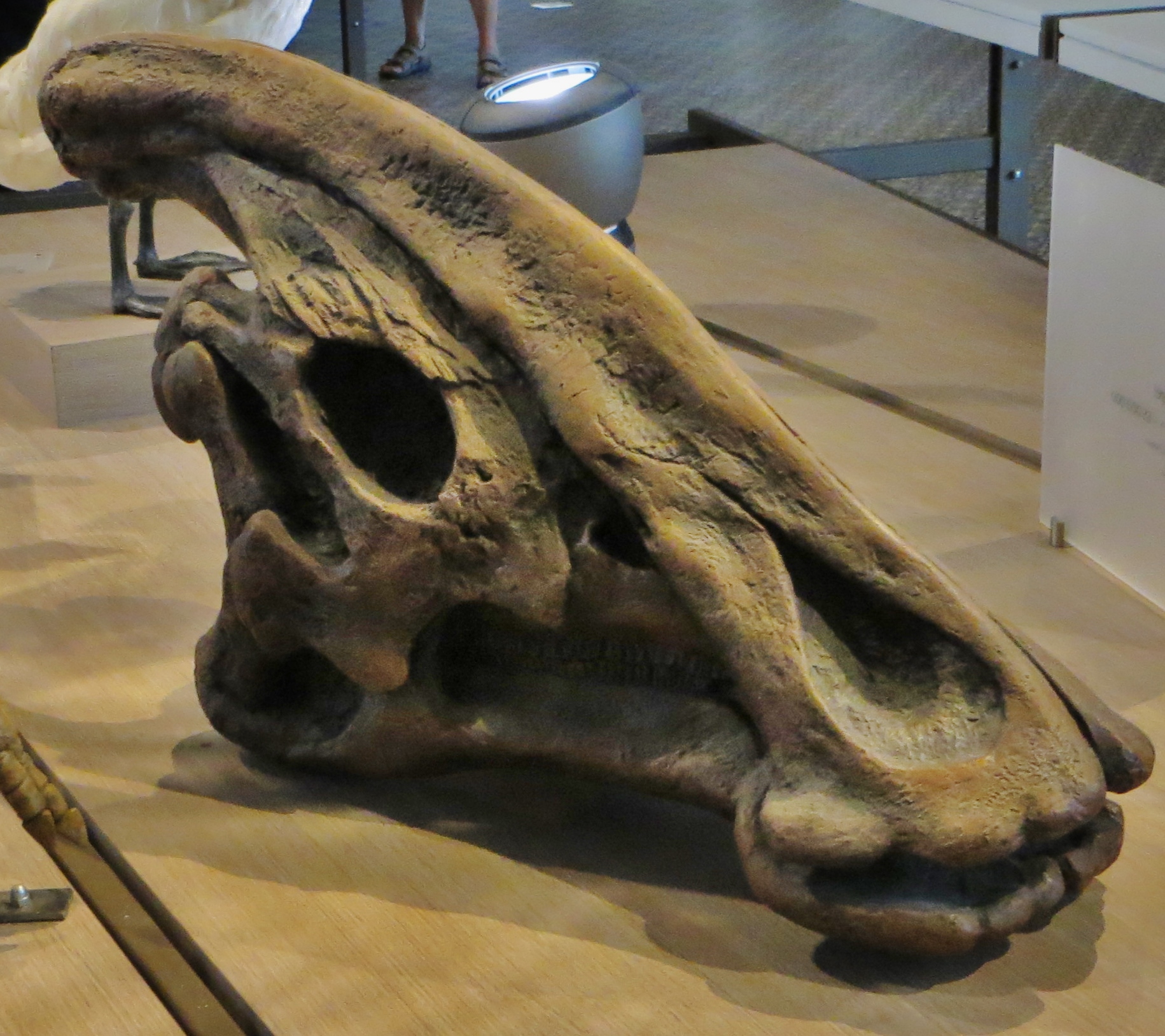

Most bones lie disarticulated and mixed from several individuals. Transport snapped off many spines and processes, so the backbone remains poorly understood. Because the old excavations lacked precise maps, museum skeletons may be composites, and the describers called its proportions “very conjectural.” A fire later destroyed one mounted skeleton, and no additional specimens have been confirmed outside the Jiayin locality.
Charonosaurus Size and Description
No single skeleton exists, so scientists must assemble its portrait from a jumble of bones.
Short description of Charonosaurus
The parietal, at the back of the skull roof, was short and broad. Its smoothly rounded top never developed a sagittal (midline) crest, even in large adults. The frontal formed a wide, hollowed platform that, with the postorbital, probably supported the base of a broad crest. No specimen preserves that crest, so any tube on a museum skull or in artwork is a reconstruction. The describers inferred a crest reaching farther back than in helmet-crested forms, but not as far as in Parasaurolophus tubicen.
The jaws held dental batteries—packed columns of teeth—with up to 44 rows in the maxilla and more than 40 in the dentary. Its sacrum (hip region) had nine fused vertebrae. The forearm was long and slender, and the straight metacarpals (hand bones) lacked the weight-bearing adaptations of Iguanodon. By contrast, its femur was long, stout, and straight.
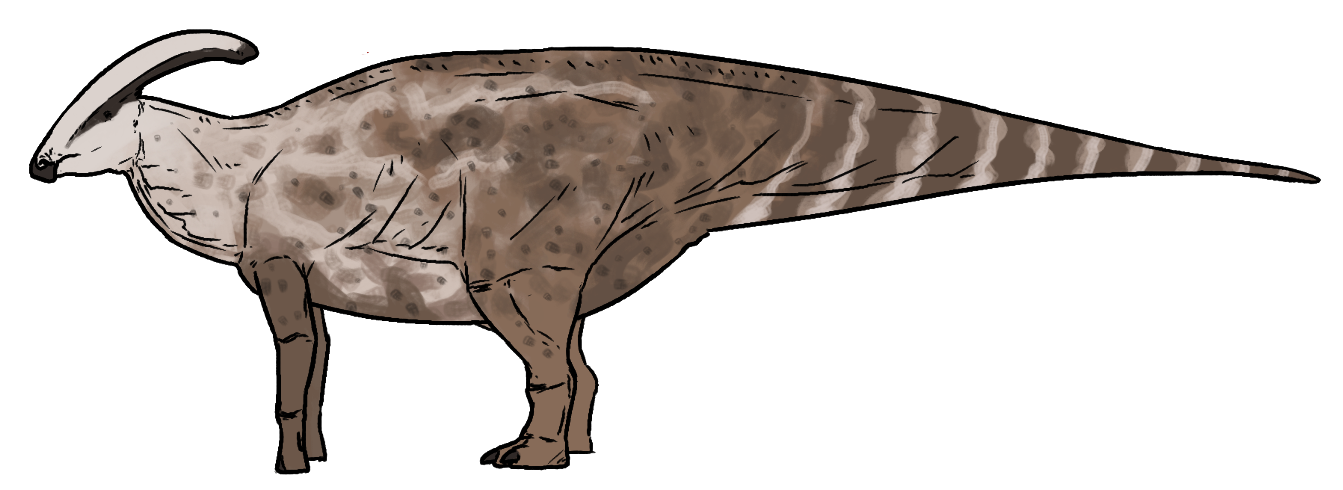
Godefroit and colleagues concluded that Charonosaurus, like other hadrosaurids, was primarily bipedal, with particularly powerful hindlimb muscles. Even so, they drew it both walking on all fours and running on two legs.

Size and Weight of Type Species
Body size is the weakest part of the record—the 2001 description gives no length, height, or weight, as its proportions remain uncertain.
Instead, the most widely repeated length comes from a popular book, Holtz’s genus list, which gives about 32.8 feet (10 meters). That is a little shorter than a city bus, but with no stated method, it offers only a rough guide.
The firmest size clue, however, is its thigh bone. In 2011, Godefroit and colleagues reported femora up to 135 centimeters (4.4 feet) long—longer than in any other known hadrosaurid except Shantungosaurus. No verified source gives its height or weight.
The Dinosaur in Detail
Some of its most distinctive features lie at the back of the skull. Its paroccipital processes (bony struts behind the skull) reach only halfway down the foramen magnum—the spinal cord opening. The postorbital nearly covers the squamosal’s side, and a wing of bone on the braincase, the alar process, is very prominent. Its humerus also bears a strong rear crest, which the describers say no one had reported in other hadrosauriforms, though only old adults show it well.
The 2000 analysis of 33 characters found that it “may be closer to Parasaurolophus than any other known Lambeosaurinae.” A year later, a 34-character analysis made it the sister taxon of Parasaurolophus. The two share a club-shaped lower end of the fibula and a parietal excluded from the back of the skull. A shared frontal platform over a skull opening also implies “probably a similar kind of supracranial hollow crest.” That tree placed China’s Tsintaosaurus outside the clade uniting Charonosaurus with North American lambeosaurines.
Later work trimmed the original diagnosis. In 2012, Godefroit, Bolotsky, and Bolotsky noted that a very long front blade on the ilium also appears in Sahaliyania and Olorotitan. As a result, it no longer counts as an autapomorphy—a feature unique to one species.
Later analyses, including a 2013 study, recovered it as the sister of Parasaurolophus. In contrast, a 2017 tree by Xing, Mallon, and Currie placed “Charonosaurus,” in quotation marks, inside Parasaurolophus, beside P. tubicen. That study did not discuss the result, and no study consulted here formally merges the two genera. Taken together, these studies tie it closely to Parasaurolophus—how closely remains an open question.
Interesting Points about Charonosaurus
- Its describers say the first dinosaur discovery mentioned from China came from the Amur’s banks in 1902, when Colonel Manakin obtained bones from fishermen.
- Its largest lower-jaw tooth crowns stand 50 millimeters (2.0 inches) tall, more than four times as high as they are long.
- In 2004, Godefroit and colleagues compared 22 characters and found that 14 differ between Charonosaurus and its Russian relative Amurosaurus.
- Its describers suggested that a broad “foot” on the ischium anchored a belly muscle, perhaps helping it breathe in through its long nasal passages.
Contemporary Dinosaurs
Sharing the Yuliangze Formation was Wulagasaurus dongi, a hadrosaurine known from isolated bones at the Wulaga quarry. In 2008, Godefroit and colleagues called it “the most basal hadrosaurine known to date,” and a 2017 analysis placed it in Brachylophosaurini. A 2022 study placed Wulaga in the upper member. However, the Jiayin cliffs belong to the lower member, so the two may not be exactly the same age.
Far more abundant at Wulaga was Sahaliyania elunchunorum, a lambeosaurine making up more than 80 percent of the bones in that bonebed. Godefroit’s team named it in 2008, but in 2022 Xing and colleagues treated it as a junior synonym of Amurosaurus riabinini. Under either name, it shared the formation, though not a known site, with Charonosaurus.
From a neighboring region comes Olorotitan, a hollow-crested lambeosaurine known from a nearly complete skeleton. It comes from the Udurchukan Formation at Kundur, across the Amur in Russia, not from the Yuliangze Formation. In 2004 and 2008, Godefroit and colleagues treated the two formations as roughly synchronous, since both fall in one pollen zone. Xing and colleagues later argued that they formed at the same time in one basin.
Also from that region is Kerberosaurus manakini, a hadrosaurine named in 2004 from skull material. It comes from the Udurchukan Formation at Blagoveschensk, Russia, about 300 kilometers northwest of the Jiayin cliffs. A 2017 analysis placed it within Edmontosaurini, close to Edmontosaurus and Shantungosaurus. Like Olorotitan, it is known only from the Russian side of the basin.
Charonosaurus in its Natural Habitat
The world Charonosaurus roamed lay in the southern Zeya–Bureya Basin, which began as Late Jurassic rift valleys. At Jiayin, grayish-green sandstones, purple mudstones, and pale conglomerates record that setting. In 2001, the describers concluded that the carcasses gathered in a river with relatively strong currents—the skeletons lie mixed and broken, with long bones aligned. However, a 2011 review noted that most bones lie in diamict layers, beds of mixed coarse and fine sediment. Green floodplain deposits there also hold reddish-purple fossil soils. Citing palynologists Markevich and Bugdaeva, the review describes the region’s dinosaurs living along lakes and rivers under a warm-temperate, relatively dry climate.
Like other hadrosaurids, Charonosaurus chewed with a dental battery. Its upper and lower teeth met along a chewing surface angled at about 45 degrees. While there is no direct evidence of which plants it ate, its battery let it grind plant food.
Although the evidence is indirect, the region’s bonebeds hint at social behavior. Every dinosaur locality known from the region by 2008 was a lambeosaurine-dominated bonebed. According to Godefroit and colleagues, such bonebeds usually reflect some degree of herding. Crocodile and turtle bones also turn up at Jiayin.
Predators are known mostly from shed teeth. A 2026 study lists tyrannosaurids and troodontids as the only theropods definitively identified from the formation. Two troodontid teeth come from Longgushan, the lower-member cliff section that yielded Charonosaurus, though not from a bed tied to its bones. The study classed them as “Troodon-morphotype” teeth, meaning they resemble those of North America’s Troodon, without assigning them to that genus. Earlier, the 2001 describers judged older theropod teeth from Jiayin indeterminate but tied them to predators or scavengers.
Frequently Asked Questions
It honors Charon, ferryman of the River Styx in Greek myth, and Holtz’s popular genus list renders it “Charon’s reptile.”
It lived in the Maastrichtian stage of the Late Cretaceous, roughly 72.2 to 66.0 million years ago, though researchers debate which part.
The 2001 description gives no overall size, but a 2011 review reported thigh bones up to 135 centimeters (4.4 feet) long. Holtz’s popular list gives about 32.8 feet, and no verified source gives its height or weight.
It was a herbivore whose dental batteries held up to 44 tooth rows in each maxilla (upper jaw bone).
Its bones come from Belyie Kruchi in the Yuliangze Formation, on the Amur River near Jiayin, Heilongjiang Province, China.
It is one of the closest known relatives of Parasaurolophus, although no specimen preserves its crest.
Sources
The information in this article is based on various sources, drawing on scientific research, fossil evidence, and expert analysis. The aim is to provide a comprehensive and accurate overview of Charonosaurus. However, please be aware that our understanding of dinosaurs and their world is constantly evolving as new discoveries are made.
- https://doi.org/10.1016/S1251-8050(00)00214-7
- https://ui.adsabs.harvard.edu/abs/2000CRASE.330..875G/abstract
- https://biblio.naturalsciences.be/rbins-publications/bulletin-of-the-royal-belgian-institute-of-natural-sciences-earth-sciences/71-2001/bulletin71-article4.pdf
- https://app.pan.pl/archive/published/app53/app53-047.pdf
- http://app.pan.pl/acta49/app49-585.pdf
- https://www.app.pan.pl/archive/published/app57/app20110051.pdf
- https://pmc.ncbi.nlm.nih.gov/articles/PMC3724916/
- https://pmc.ncbi.nlm.nih.gov/articles/PMC5383305/
- https://doi.org/10.1080/02724634.2021.2085111
- https://sjp.pensoft.net/article/195625/
- https://www.sciopen.com/article/10.3969/j.issn.1673-9736.2022.03.01
- https://www.vliz.be/imisdocs/publications/ocrd/279577.pdf
- https://stratigraphy.org/ICSchart/ChronostratChart2024-12.pdf
- https://paleobiodb.org/classic/basicTaxonInfo?taxon_no=64258
- https://biblio.naturalsciences.be/library-1/rbins-staff-publications/pdfs/Godefroit%20et%20al.-%202011%20-%20Recent%20advances%20on%20study%20of%20hadrosaurids.pdf
- http://dml.reptilis.net/2000Sep/msg00141.html
This article was last fact checked: TheDinosaurs Team, 05-11-2026
Featured Image Credit: Fernando Losada Rodríguez, CC BY-SA 4.0, via Wikimedia Commons
