
In the Aix-en-Provence Basin of southern France, the Begudian sandstones at La Boucharde have yielded the scattered bones of a puzzling predator. Named Pyroraptor olympius in 2000, it was described as a dromaeosaurid—a member of the raptor family of theropod dinosaurs. It lived in the Campanian stage of the Late Cretaceous, although estimates for its rocks range from the middle Campanian to, in older accounts, the early Maastrichtian. Before the discovery of Balaur, it was the best-represented dromaeosaurid in Europe.
According to London’s Natural History Museum, its remains first turned up after a destructive forest fire in Provence. Paleontologists Ronan Allain and Philippe Taquet described the animal in the Journal of Vertebrate Paleontology. In 2012, a review by Alan Turner, Peter Makovicky and Mark Norell quoted their diagnosis word for word. Since then, researchers have questioned what makes these bones distinctive and where Pyroraptor sits on the family tree. Its story shows how much—and how little—a handful of foot bones can reveal.
Pyroraptor Key Facts
| Keyword | Fact |
|---|---|
| Pronunciation | PIE-ro-rap-tor (per the Natural History Museum, London) |
| Meaning of name | Fire Thief |
| Group | Theropoda (Dromaeosauridae) |
| Type Species | Pyroraptor olympius |
| Diet | Carnivore |
| When it Lived | 83.6 to 72.2 MYA (Paleobiology Database range) |
| Period | Cretaceous |
| Epoch | Late Cretaceous (Campanian stage) |
| Length | Not specified |
| Height | Not specified |
| Weight | Not specified |
| Mobility | Moved on two legs (bipedal) |
| First Discovery | Year not specified |
| Described by | 2000 by R. Allain and P. Taquet |
| Holotype | MNHN BO001 |
| Location of first find | Begudian sandstones at La Boucharde, near Trets, Aix-en-Provence Basin, Bouches-du-Rhône, Provence, France |
Pyroraptor Origins, Taxonomy and Timeline
The name Pyroraptor means “fire thief”. According to the Natural History Museum, it recalls the forest fire that preceded the first finds. The species name, olympius, completes the binomial—the two-part scientific name—that Allain and Taquet published in 2000. Only the genus name, though, refers to the fire.
Allain and Taquet placed Pyroraptor within Dromaeosauridae, as the title of their paper announces. Turner and colleagues later agreed, writing that “it is clear that Pyroraptor olympius is a dromaeosaurid”. Pyroraptor olympius is the type and only known species. However, its relationship to a second French dromaeosaurid, Variraptor mechinorum, has proved harder to settle. Allain and Taquet regarded Variraptor as a nomen dubium—a name too poorly founded to use—and Turner’s team agreed in 2012. In 2003, Allain and Xabier Pereda Suberbiola called it “probably a chimera,” meaning a mix of bones from different animals. In contrast, Phornphen Chanthasit and Eric Buffetaut argued in 2009 that both species may be valid. A 2015 review of Europe’s island faunas added that it is also “conceivable” that the two represent the same taxon.
Dating is no simpler. Allain and Pereda Suberbiola gave a late Campanian age for La Boucharde. Turner’s team described the beds as Upper Campanian to Lower Maastrichtian. In 2022, however, Erik Isasmendi and colleagues followed earlier stratigraphic work in treating the Begudian deposits as middle Campanian. Part of the problem is that these Provence rocks allow no radiometric dating. The Paleobiology Database gives the site a broad range of 83.6 to 72.2 million years ago, and the museum gives 84 to 71 million.
Discovery & Fossil Evidence
La Boucharde lies about 1.2 miles (2 kilometers) southeast of Trets, at the foot of Mont Olympe in the Bouches-du-Rhône department. No account available to us names the finder, and the database’s collecting dates of 1995 to 1996 need not mark the first find.
The holotype, MNHN BO001, is an ungual phalanx of pedal digit II—the enlarged claw of the second toe. Paris’s Muséum National d’Histoire Naturelle houses it. The paratype, a supporting specimen, includes a right phalanx II-2 (the second bone of the second toe), MNHN BO 002. Allain and Taquet also referred five more toe bones, MNHN BO 006 to 010. One is another right phalanx II-2 about 20 to 25 percent larger, so at least two individuals are present.
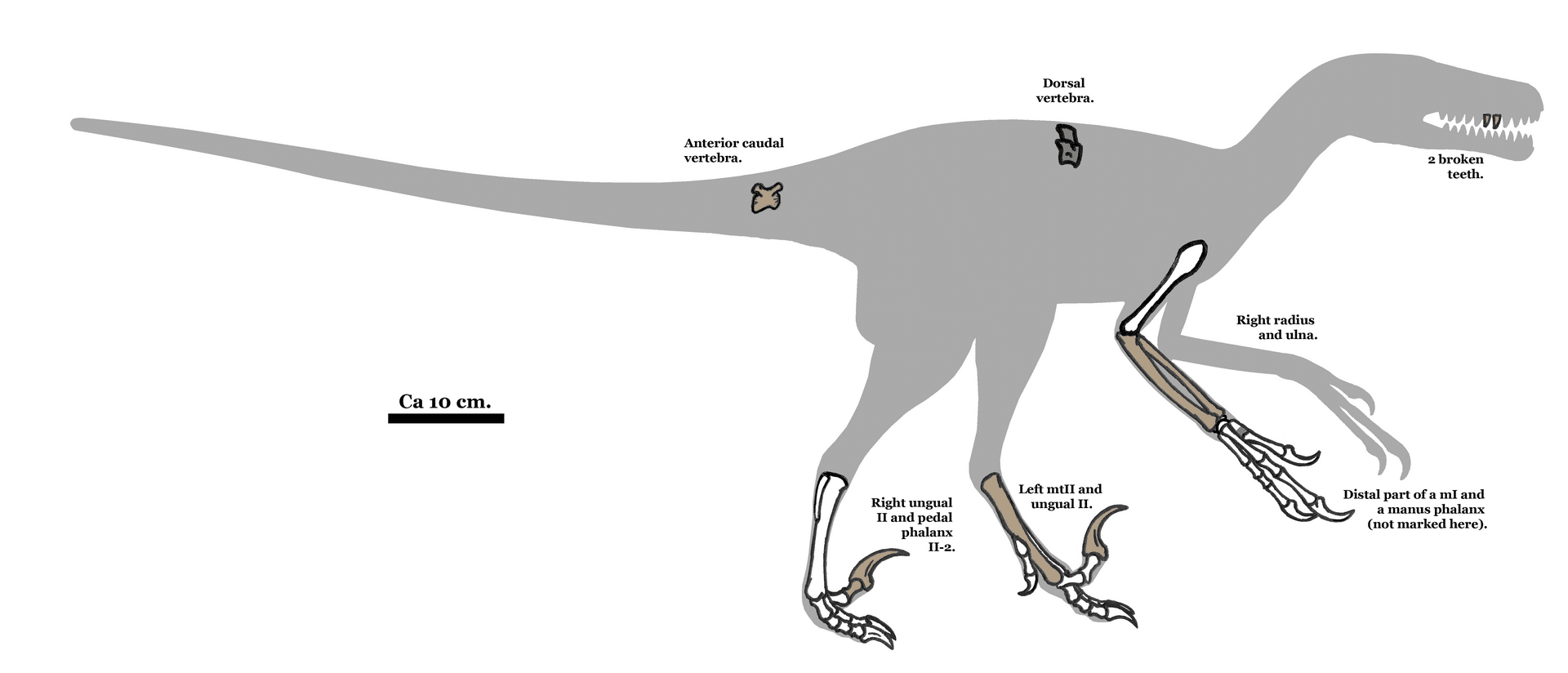

Turner’s team summed up the material as “a few pedal phalanges, a metatarsal II, a radius and ulna, and a vertebra”. Their figures add a manual (hand) phalanx, another second-toe claw and a tooth. The dorsal (back) vertebra, MNHN BO 017, is incomplete and poorly preserved. They also listed a distal right metatarsal III as undescribed. A bone cataloged as a partial metacarpal I (MNHN BO 012), they suggested, is in fact a nearly complete metatarsal I.
Only two badly preserved teeth are known, and only one seems complete. In southern Europe, Late Cretaceous theropod teeth usually turn up alone. Pyroraptor is an exception, since two of its teeth were found with its bones. In 2015, Angelica Torices and colleagues referred isolated teeth from Laño and Montrebei in Spain to “?Pyroraptor olympius“. In 2022, however, Isasmendi’s team moved the Laño teeth to Dromaeosauridae indet. and ruled out the Montrebei tooth, along with two Chera teeth referred to cf. Pyroraptor in 2009. Today, no confirmed Pyroraptor fossil comes from outside La Boucharde.
Pyroraptor Size and Description
Any portrait of Pyroraptor rests on feet, forearms and teeth, so much of its body remains unknown.
Short description of Pyroraptor
The best-known part of the animal is its foot, which carried an enlarged, curved claw on the second toe. Its metatarsal II, the long bone leading to that toe, had a concave rear margin that Turner’s team called “characteristic of Pyroraptor“. At its lower end, that bone formed a ginglymoid joint—a hinge-like surface shared with all dromaeosaurids. In addition, the metatarsal was roughly equal in length to the ulna, one of the two forearm bones.
The single preserved back vertebra departs a little from the dromaeosaurid norm. Its neural spine is less squared off than in Velociraptor, and its prezygapophyses (the forward joints between vertebrae) slant more strongly. The teeth were laterally compressed, tapered and curved backwards. According to Isasmendi’s team, the original description counted 8 to 9 front denticles—tiny saw-teeth—per millimeter, against 6 on the rear edge. On the front edge, preserved denticles cover only the basal half, although the upper ones may have worn away.
With no skull, tail or hip bones known, its head and posture remain guesses based on relatives. No skin impressions survive either, so any discussion of its body covering is speculative.
Size and Weight of Type Species
No technical study has published a length, height or weight for Pyroraptor. Instead, Turner and colleagues described it simply as “a medium-sized dromaeosaurid” in their revised diagnosis. By contrast, the Natural History Museum calls it a small theropod and adds that its full size is very hard to work out.
The museum gives its curved toe claw as almost 7 centimeters (about 2.8 inches) along the outer edge. It adds that Pyroraptor might have been around the same size as Velociraptor, or smaller—an informal comparison, not a measured estimate.
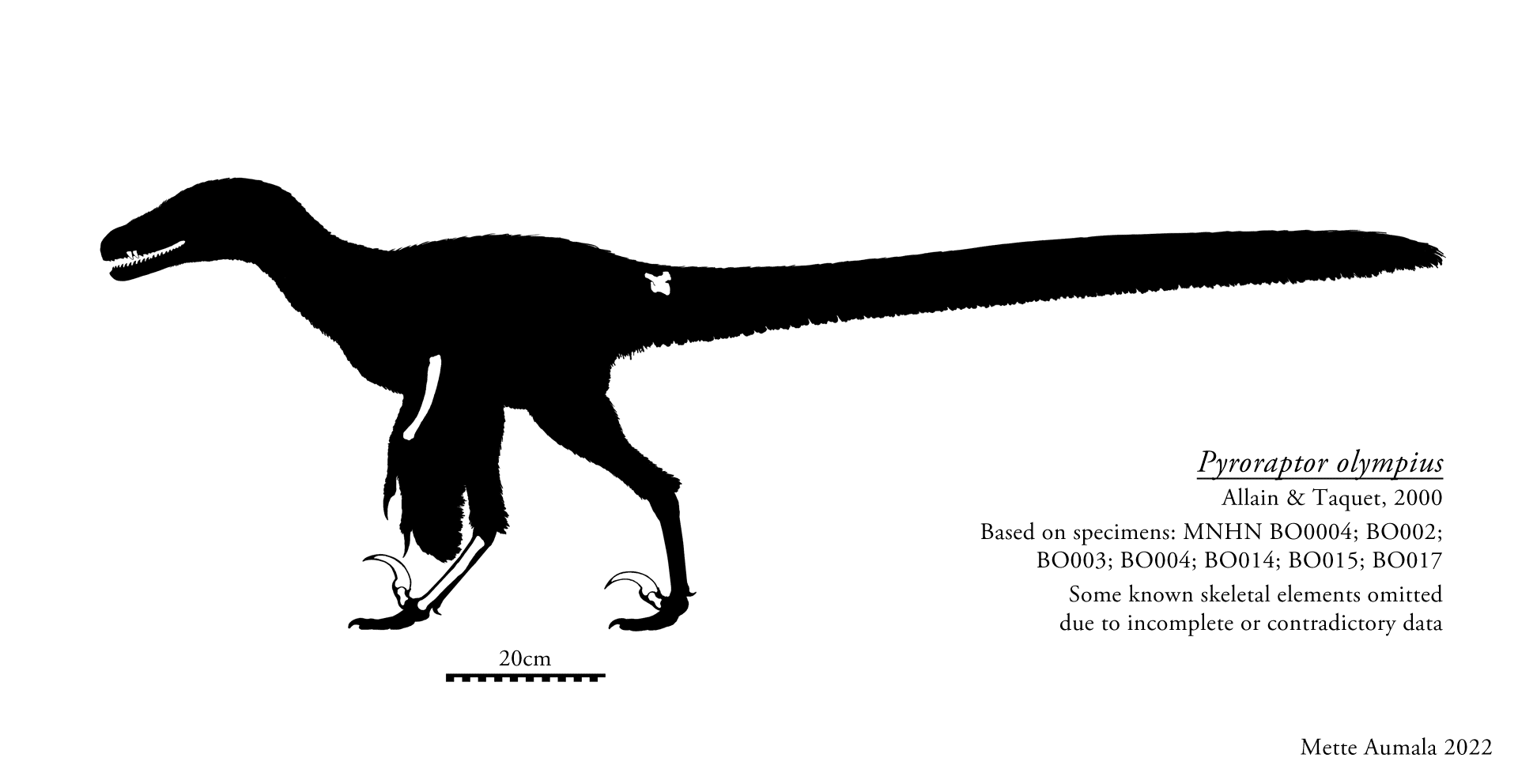

Full-body reconstructions, the museum notes, are largely guesswork. Until new bones turn up, any figure beyond those cautious labels would be speculation.
The Dinosaur in Detail
What sets this dinosaur apart is less a single feature than a debate over whether it has one. Allain and Taquet’s original diagnosis listed four traits—a deep pit on the ulna, a grooved, asymmetrical metatarsal II that was concave below, restricted front serrations on the teeth, and an ulna about as long as metatarsal II.
Turner’s team later pared that list down. The ulna pit, they found, is “a preservational artifact”. The grooved metatarsal is typical of dromaeosaurids. Likewise, the serration pattern is widespread—exceptions include Dromaeosaurus, with serrations on both edges, and Buitreraptor, with none. Even so, their revised diagnosis keeps those serrations, pairing them with a ventrally concave metatarsal II roughly as long as the ulna. Only the metatarsal features were flagged as possible unique traits.
Overall, Turner’s team admitted that “at present it is hard to adequately diagnose this taxon based on clear apomorphies,” meaning uniquely derived traits. By contrast, Allain and Pereda Suberbiola had written that it seemed the only recently described French theropod based on diagnostic material.
Its family tree is just as unsettled. In Turner’s 2012 analysis, it could occupy at least 23 positions among dromaeosaurids because of missing data. In 2019, however, Scott Hartman and colleagues recovered it as an unenlagiine. Their trees paired unenlagiines with halszkaraptorines as sister to a clade of dromaeosaurids and troodontids. That, they argued, would fit other Gondwanan (southern-continent) groups in Cretaceous Europe, such as spinosaurids and abelisaurs. If it is an unenlagiine, Isasmendi’s team noted, then not all unenlagiines had unserrated, fluted teeth. In 2024, Juan Porfiri and colleagues again placed it near or within the unenlagiines, though it proved unstable. In 2025, Rui Qiu and colleagues pruned it from their consensus tree as a “rogue.” Taken together, these studies leave its branch open for lack of bones.
Interesting Points about Pyroraptor
- The name Pyroraptor means “fire thief,” after the Provence forest fire that preceded the first finds.
- The holotype of Pyroraptor is a single toe claw, cataloged as MNHN BO001 and housed in Paris.
- So much of its skeleton is missing that one 2012 analysis found at least 23 possible positions for it.
- After Pyroraptor dove underwater in Jurassic World: Dominion, the Natural History Museum noted that experts assume dinosaurs could at least paddle. Nobody knows, though, if it could really dive and swim for long periods.
- According to the same museum, it probably was no longer around at the time of the impact 66 million years ago.
Contemporary Dinosaurs
Sharing the very same site was Rhabdodon priscus, a rhabdodontid ornithopod—a plant-eating dinosaur. Allain and Pereda Suberbiola figured its jaws and thigh bones from La Boucharde, including a juvenile femur. However, Łukasz Czepiński and Daniel Madzia suggested in 2025 that one of those jaws may belong to Obelignathus septimanicus. No fossil records any encounter between Rhabdodon and Pyroraptor, but they shared the landscape.
Elsewhere in the same basin lived Matheronodon provincialis, another rhabdodontid with startlingly enlarged teeth up to 5 centimeters (about 2 inches) wide. Its fossils come from Begudian sandstones at Velaux-La Bastide Neuve. Both sites belong to this local stage, but Isasmendi’s team dated La Boucharde to the middle Campanian and Velaux to the late Campanian. As a result, the two animals may not have been contemporaries.
Rounding out the plant-eaters was Atsinganosaurus velauciensis, a titanosaur sauropod from the same Velaux-La Bastide Neuve site. Its describers distinguished it from Lirainosaurus, Ampelosaurus and Magyarosaurus. As with Matheronodon, the link with Pyroraptor is the basin rather than a shared quarry, and the Velaux beds appear to be younger.
La Boucharde also produced unnamed titanosaur bones, a neoceratosaur tibia resembling those of abelisauroids, and nodosaurid remains.
Pyroraptor in its Natural Habitat
Pyroraptor roamed a land of rivers and lakes in the central Ibero-Armorican Island, part of the Late Cretaceous European archipelago. At La Boucharde, its bones lie in sandstone from a fluvial-lacustrine setting—a mix of river and lake environments. Turtles such as Dortoka, Solemys and Polysternon shared the site.
The museum lists Pyroraptor as a carnivore that fed on other animals. While there is no direct evidence of what it hunted, its backward-curved, serrated teeth seem consistent with that diet. At this time, rhabdodontids and titanosaurs were the most common dinosaurs in southern France.
La Boucharde preserves at least two individuals, but vertebrate remains in this region usually traveled some distance before burial. As a result, the find cannot show whether they lived together. Meanwhile, dromaeosaurids were relatively common in these faunas alongside ankylosaurs and abelisaurids. Pyroraptor may have been one of the mid-sized predators on its island—an animal still glimpsed mainly through its feet.
Frequently Asked Questions
It means “fire thief,” a name the Natural History Museum links to the forest fire that came before the first finds.
It lived during the Campanian stage of the Late Cretaceous—roughly 83.6 to 72.2 million years ago, according to the Paleobiology Database.
No length or weight has been estimated in the technical literature. Turner and colleagues call it a medium-sized dromaeosaurid, and its second-toe claw is almost 7 centimeters long.
It was described as a dromaeosaurid theropod, although a 2019 study placed it among the unenlagiines instead.
Its fossils come from the Begudian sandstones at La Boucharde, near Trets in Provence, southern France.
Most Late Cretaceous theropod teeth from southern Europe turn up alone, but two Pyroraptor teeth were found with its bones. Its holotype, meanwhile, is a single toe claw.
Sources
The information in this article is based on various sources, drawing on scientific research, fossil evidence, and expert analysis. The aim is to provide a comprehensive and accurate overview of Pyroraptor. However, please be aware that our understanding of dinosaurs and their world is constantly evolving as new discoveries are made.
- https://doi.org/10.1671/0272-4634(2000)020[0404:ANGODD]2.0.CO;2
- https://doi.org/10.1206/748.1
- https://zenodo.org/records/5399588
- https://doi.org/10.1016/S1631-0683(03)00002-2
- https://doi.org/10.2113/gssgfbull.180.2.145
- https://doi.org/10.3897/zookeys.469.8439
- https://doi.org/10.4202/app.2012.0121
- https://doi.org/10.7717/peerj.7247
- https://doi.org/10.1002/spp2.1419
- https://doi.org/10.1038/s41598-017-13160-2
- https://doi.org/10.2113/gssgfbull.181.3.269
- https://doi.org/10.1038/s41598-025-98083-z
- https://doi.org/10.1186/s12862-024-02247-w
- https://doi.org/10.1093/nsr/nwaf068
- https://paleobiodb.org/data1.2/colls/single.json?id=48849&show=strat,loc,ref,time,lith,geo,methods
- https://paleobiodb.org/data1.2/occs/list.json?base_name=Pyroraptor&show=coll,strat,loc,ref,time
- https://www.nhm.ac.uk/discover/dino-directory/pyroraptor.html
This article was last fact checked: TheDinosaurs Team, 30-10-2026
Featured Image Credit: Mette Aumala, CC BY-SA 4.0, via Wikimedia Commons
