
On bluffs above Alaska’s Colville River, the Prince Creek Formation preserves what researchers call the northernmost Late Cretaceous land ecosystem. Among its fossils are skull fragments of Nanuqsaurus hoglundi, a tyrannosaurid—or tyrant dinosaur—named in 2014 by paleontologists Anthony R. Fiorillo and Ronald S. Tykoski. They dated it to roughly 70 to 69 million years ago. However, a 2025 study dates the formation’s fauna to about 73 million years ago. Its describers saw it as a small, advanced tyrannosaurid—a predator perhaps scaled down by the hardships of a polar home.
In 2006, crews from the Dallas museum now called the Perot Museum of Nature and Science collected the bones at the Kikak-Tegoseak Quarry. Since then, new fossils, a 2021 peer-reviewed study and a 2023 thesis have challenged its small size. The thesis also questioned the features that define it. Even so, Nanuqsaurus puts a tyrannosaur at the northern edge of its continent, in a land of long polar nights.
Nanuqsaurus Key Facts
| Keyword | Fact |
|---|---|
| Pronunciation | Not specified |
| Meaning of name | Polar Bear Lizard |
| Group | Theropoda (Tyrannosauridae, Tyrannosaurinae) |
| Type Species | Nanuqsaurus hoglundi |
| Diet | Carnivore |
| When it Lived | 70 to 69 MYA as originally described. A 2025 study dates the formation’s fauna to around 73 MYA |
| Period | Cretaceous |
| Epoch | Late Cretaceous (Maastrichtian stage as originally described, late Campanian stage per a 2025 study) |
| Length | About 26 feet (8 meters), estimate from a 2023 thesis that is not peer-reviewed. The 2014 description gives no numerical length, though its size chart shows a much smaller animal than Tyrannosaurus |
| Height | Not specified |
| Weight | About 3,560 to 4,190 pounds (1,615 to 1,900 kilograms) per a 2023 thesis that is not peer-reviewed. About 4,200 pounds (1,904 kilograms) from a 900 mm skull, as reported in a 2024 peer-reviewed supplement |
| Mobility | Not specified |
| First Discovery | 2006 by field crews of the Dallas museum now named the Perot Museum of Nature and Science |
| Described by | 2014 by A.R. Fiorillo and R.S. Tykoski |
| Holotype | DMNH 21461 |
| Location of first find | Kikak-Tegoseak Quarry, Prince Creek Formation, Colville River, North Slope Borough, Alaska, USA |
Nanuqsaurus Origins, Taxonomy and Timeline
The name Nanuqsaurus draws on two very different languages. The first part, nanuq, is the Iñupiaq word for “polar bear,” while sauros is Greek for “lizard.” Its species name, hoglundi, honors Forrest Hoglund for his career in earth sciences and his philanthropic efforts.
Fiorillo and Tykoski placed Nanuqsaurus in Tyrannosauridae, the family of big-headed predatory theropods, and within its subgroup Tyrannosaurinae. Their main analysis recovered it as the sister taxon—closest relative—of the pair formed by Tarbosaurus and Tyrannosaurus. In contrast, moving it onto the albertosaurine branch cost at least six extra evolutionary steps. In 2016, Brusatte and Carr grouped it near Utah’s Teratophoneus in one analysis, but another left it poorly resolved. Then in 2024, Zheng and colleagues paired it with China’s Asiatyrannus—but only because both were scored as small-bodied. Nanuqsaurus hoglundi is the type and only known species.
As first described, Nanuqsaurus came from the earliest Late Maastrichtian, roughly 70 to 69 million years ago. Volcanic ash beds in this part of the formation give dates of 68 to 71 million years, averaging about 69.1 million. However, a 2025 study of the formation’s fishes by Brinkman and colleagues sets its fauna in the late Campanian, about 73 million years ago. Similarly, Perry’s 2023 thesis gave about 72.8 million years, and a 2021 study mapped the region as it stood 72 million years ago. This article therefore gives both figures.
Discovery & Fossil Evidence
The museum’s crews worked at the quarry, in Alaska’s North Slope Borough, under a Bureau of Land Management permit. At first, researchers referred the bones to the albertosaurine Gorgosaurus libratus, then to Albertosaurus sarcophagus. Closer comparison and more material revealed tyrannosaurine affinities instead.
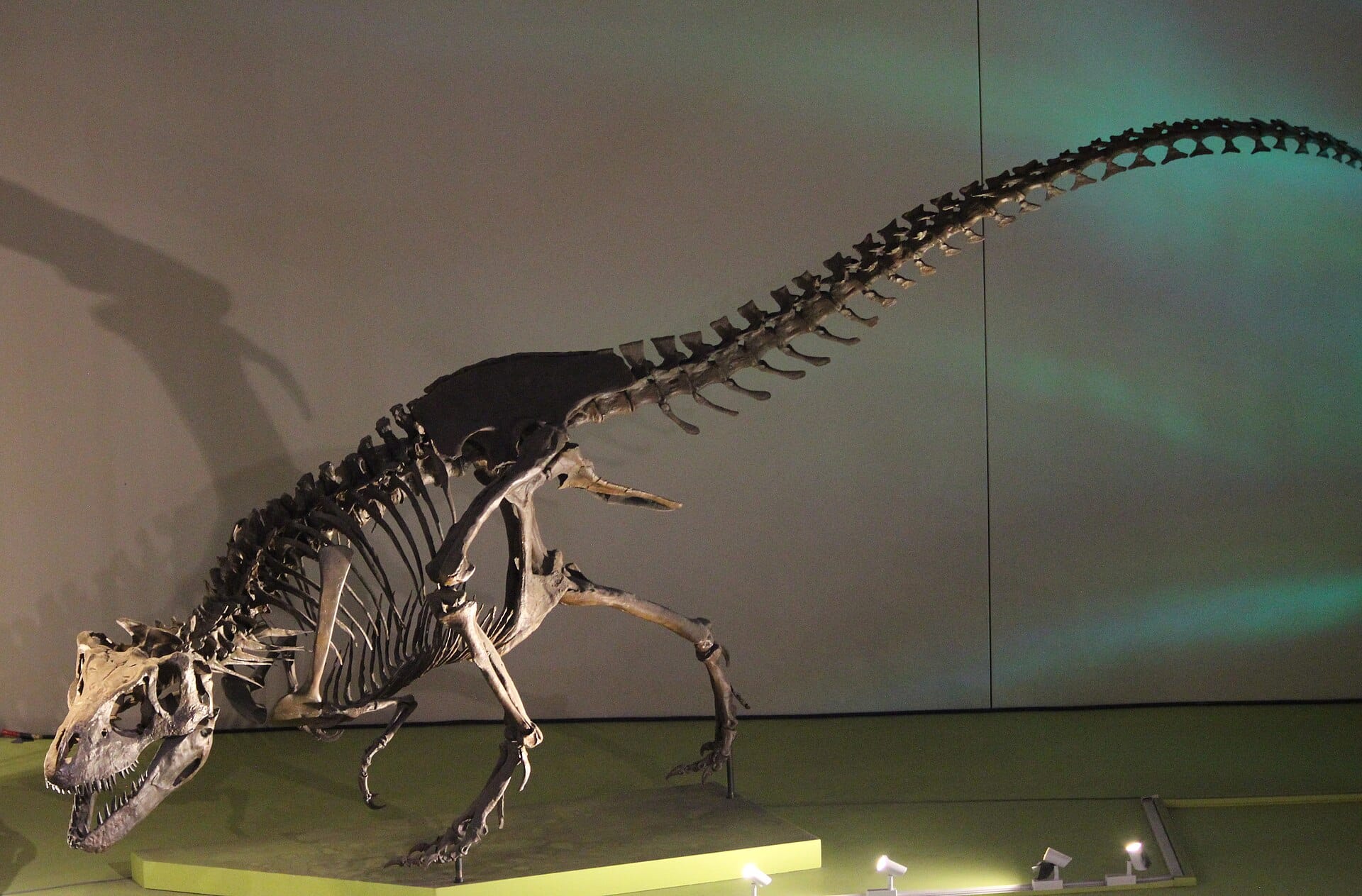
The holotype, DMNH 21461, is housed at the Perot Museum in Dallas, Texas. It consists of part of the right maxilla (the main upper tooth-bearing bone) and a partial skull roof. It also includes the left dentary (the tooth-bearing lower jaw bone) from its tip back to the unerupted tenth tooth. The skull roof preserves parts of both frontals and the parietals, plus the right laterosphenoid—a braincase wall bone.
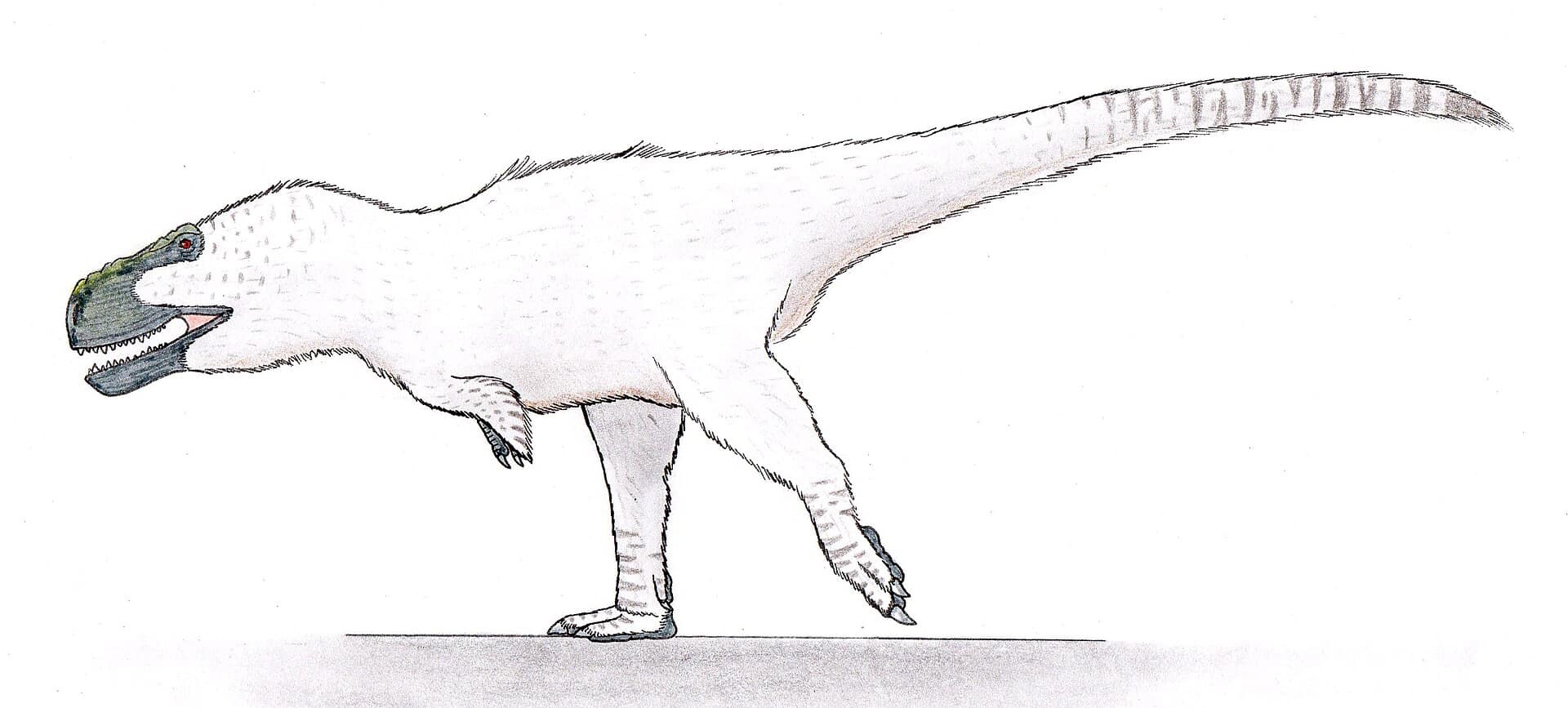

Today, the University of Alaska Museum of the North holds newer skull and body fossils. They include the proximal (upper) end of a metatarsal (foot bone) and a complete dorsal (back) rib. A 2023 University of Alaska Fairbanks thesis by Z.R. Perry attributes them to Nanuqsaurus.
Nanuqsaurus Size and Description
Because the holotype preserves only pieces of the head, any picture of the whole animal leans on its relatives.
Short description of Nanuqsaurus
Its skull roof bore a sagittal crest (a midline ridge on top of the skull). This crest was pinched on the parietal but broad and double-ridged over the frontals. Along the lower jaw, three rows of small openings for nerves and blood vessels converged toward the tip, where three large openings sat just below the teeth.
Its third lower tooth crown was nearly round in cross-section, whereas the seventh was narrower. All the teeth bore serrated cutting edges. Beyond the skull, the 2014 description covers no bones, so the holotype says nothing about posture or limb proportions. No skin impressions survive, so any discussion of its body covering is speculative.

Size and Weight of Type Species
Fiorillo and Tykoski gave no numerical body length or weight in 2014, though their size chart showed a much smaller animal than Tyrannosaurus. Instead, they estimated a skull length of about 24 to 28 inches (600 to 700 millimeters) in mature individuals. By their reading, that indirect estimate made Nanuqsaurus smaller than related tyrannosaurids from lower latitudes.
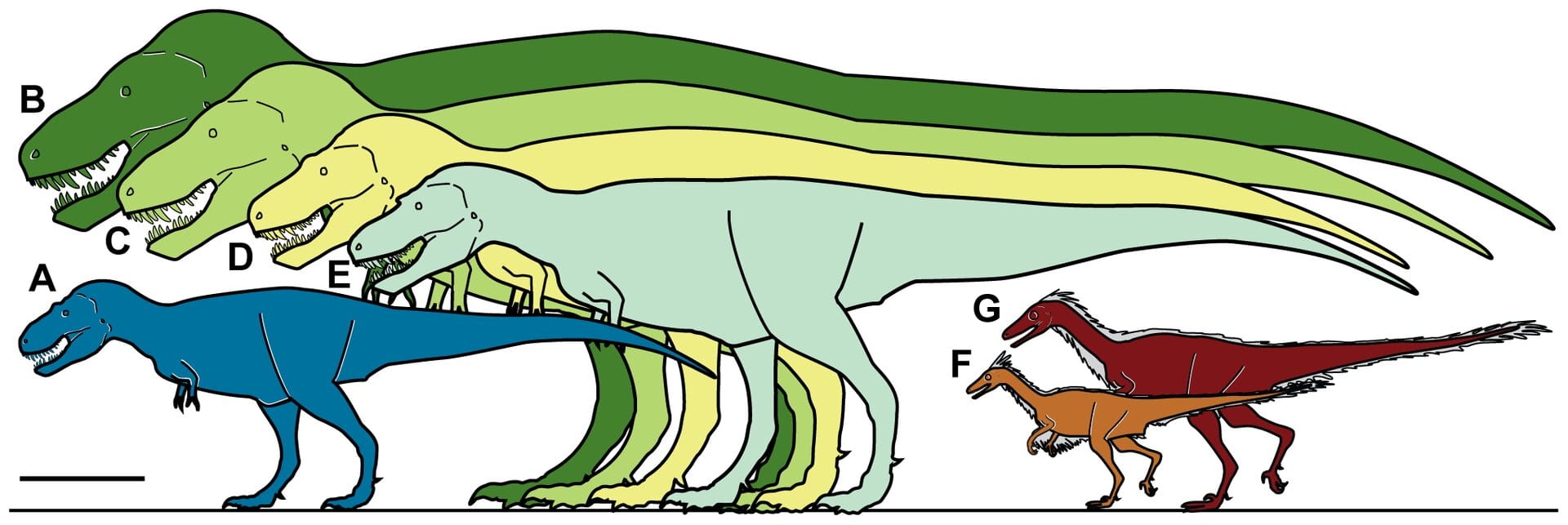
Later work pointed to a much larger animal. In 2021, Druckenmiller and colleagues wrote that adult-sized teeth and bones in their collection do not support a diminutive tyrannosaur. Instead, they suggested a size closer to Albertosaurus. Perry’s 2023 thesis, which has not been peer-reviewed, then applied theropod regression equations to the new fossils. They gave a length of about 26 feet (8 meters) and a weight of roughly 3,560 to 4,190 pounds (1,615 to 1,900 kilograms). Direct scaling suggested a size comparable to Albertosaurus, Gorgosaurus, and Daspletosaurus—all 30 to 33 feet (9 to 10 meters) long.
Wilson and colleagues, Perry among them, summarized this work in the supplement to a peer-reviewed 2024 Nature Communications paper. There, Perry’s skull estimates fall mostly between 860 and 900 millimeters (34 to 35 inches). From a 900-millimeter skull, Perry calculated a mass of about 4,200 pounds (1,904 kilograms). However, the supplement gives no body length or weight range, so those thesis figures stand alone. In the main text, the authors placed adult sizes within the range of relatives such as Daspletosaurus. Because every figure here comes from partial remains, its true size remains uncertain.
The Dinosaur in Detail
What sets this dinosaur apart, its describers argued, are three features of the skull and jaw. First, a thin, forked spur of the fused parietals pushed forward between the frontals, forming a “Y” shape within the crest when seen from above. Second, a long, pointed prong separated the frontal’s joints with the prefrontal and lacrimal bones, much as in Teratophoneus.
Third, its first two dentary sockets measured just 5.6 and 7.5 millimeters long, while the third and fourth reached 16.5 and 23.2 millimeters. In the authors’ view, no other tyrannosaurid had two such reduced front teeth as an adult. Fiorillo and Tykoski also argued that the holotype was mature, citing a deep peg-in-socket joint between the nasal and maxilla. Elsewhere, that joint appears only in mature advanced tyrannosaurines. Later, Perry used histology—the study of bone microstructure—on the new metatarsal and rib. Both specimens came from individuals at least 14 years old, and growth had likely not yet stopped.
These features are now contested. Perry’s thesis concluded that the name is a nomen dubium, or “doubtful name,” lacking reliable defining features. In 2025, paleontologist P.S. Druckenmiller, director of the University of Alaska Museum of the North, offered a split verdict. His team, he told Alaska Public Media, believes the species is valid but its original diagnostic features are not. He said the work was under review, but as of late 2026 we have found no peer-reviewed redescription.
Its family tree carries a caveat, too, since 95.1 percent of its anatomical data were missing in the original analysis. In that first analysis, only one unambiguous trait supported its link to Tarbosaurus and Tyrannosaurus—a tall, paired crest on the frontal. Taken together, these studies point to an Arctic tyrannosaur that clearly existed, even as its size and name remain under debate.
Interesting Points about Nanuqsaurus
- Its name combines nanuq, the Iñupiaq word for polar bear, with the Greek sauros, giving roughly “polar bear lizard.”
- According to National Geographic, Fiorillo’s team nearly overlooked the bones while working on horned dinosaurs, and he recalled that they “put it aside.”
- CT scans confirmed that two tiny openings at the front of its lower jaw were genuine tooth sockets, each holding an unerupted replacement tooth.
- Its describers suggested the ancestral Brooks Range partly isolated northern Laramidia, making it “effectively, an island” for evolving new species.
Contemporary Dinosaurs
Sharing the very same quarry was Pachyrhinosaurus perotorum, a horned dinosaur named by Fiorillo and Tykoski in 2012. All the specimens in its 2012 description, including the holotype DMNH 21200, came from Kikak-Tegoseak. Still, no bite marks or other direct evidence link the two.
Adding further diversity was Edmontosaurus, a hadrosaurine, or duck-billed dinosaur. A 2020 re-examination moved Prince Creek material once named Ugrunaaluk kuukpikensis into Edmontosaurus, with the species left open. A hadrosaur also appears in the 2012 faunal list for Kikak-Tegoseak itself.
Also present was a large troodontid, known here mostly from teeth referred to Troodon. Those teeth are exceptionally large—about twice the average size of teeth from Alberta and Montana. Fiorillo and Tykoski proposed that the two predators kept separate niches by relying on different senses to find food. In their view, Arctic pressures drove Nanuqsaurus smaller while the troodontid grew larger. Later work challenges both halves. The new tyrannosaur fossils are not small, and a 2024 study found the troodontid similar in size to Alberta’s Latenivenatrix.
Dromaeosaurids—small sickle-clawed theropods—left mostly isolated teeth, some of which researchers tentatively referred to Dromaeosaurus and Saurornitholestes. Ostrich-like ornithomimosaurs lived here too, appearing in the 2012 quarry list and a 2013 study by Watanabe and colleagues.
Nanuqsaurus in its Natural Habitat
The world Nanuqsaurus roamed lay on the northernmost edge of Laramidia, a long, narrow landmass stretching from central Mexico to the Arctic Ocean. Later studies place the formation’s deposits at roughly 80 to 85 degrees north. Winters brought up to about 120 days of continuous darkness and occasional snowfall. Cold-month temperatures averaged about 28 °F (−2 °C), yet open conifer woodland with ferns, flowering plants, and abundant horsetails covered the low coastal plain.
Fiorillo and Tykoski called Nanuqsaurus the apex predator of this ecosystem. They suggested that scarce resources in the seasonal Arctic may have favored a smaller body, as in modern island carnivores. Perry, however, argued that the larger new estimates warrant a fresh look at that idea.
While there is no direct evidence of whether Nanuqsaurus lived alone or in groups, the formation offers wider clues. In 2021, Druckenmiller and colleagues reported newborn and very young dinosaurs from the formation. Among them was UAMES 17610, a tiny tyrannosaurid tooth tentatively compared with Nanuqsaurus, found at Kikak-Tegoseak. Its size points to an animal in its first year, so this predator likely bred in the Arctic. Overall, the team concluded that most, if not all, Prince Creek dinosaurs were year-round residents. In addition, cold-blooded animals such as crocodile relatives are absent, suggesting the winters were too harsh for them.
Frequently Asked Questions
It means “polar bear lizard,” from the Iñupiaq nanuq and Greek sauros.
Its describers dated it to 70 to 69 million years ago, but a 2025 study dates the formation’s fauna to about 73 million years ago.
The describers estimated only its skull, at 24 to 28 inches. Peer-reviewed studies in 2021 and 2024 found adults closer in size to Albertosaurus and Daspletosaurus.
It was a carnivore, and its describers considered it the apex predator of its Arctic ecosystem.
Its holotype comes from the Kikak-Tegoseak Quarry in the Prince Creek Formation, along Alaska’s Colville River, and later referred finds come from the same formation.
That is debated. A 2023 thesis called it a dubious name, while Druckenmiller told a 2025 news report that his team considers the species valid.
Sources
The information in this article is based on various sources, drawing on scientific research, fossil evidence, and expert analysis. The aim is to provide a comprehensive and accurate overview of Nanuqsaurus. However, please be aware that our understanding of dinosaurs and their world is constantly evolving as new discoveries are made.
- https://doi.org/10.1371/journal.pone.0091287
- https://doi.org/10.4202/app.2011.0033
- https://doi.org/10.1038/srep20252
- https://doi.org/10.1371/journal.pone.0235078
- https://doi.org/10.1371/journal.pone.0232410
- https://doi.org/10.1016/j.cub.2021.05.041
- https://doi.org/10.1038/s41467-024-46843-2
- https://doi.org/10.1002/spp2.70014
- https://doi.org/10.1098/rsos.261403
- https://doi.org/10.1126/science.adt5189
- https://doi.org/10.2110/palo.2007.p07-036r
- https://par.nsf.gov/biblio/10291425
- https://doi.org/10.1038/s41598-024-66278-5
- https://doi.org/10.1080/02724634.2013.770750
- https://scholarworks.alaska.edu/uaf_grad_geosci/306
- https://www.nationalgeographic.com/animals/article/140313-new-species-dinosaurs-tyrannosaurus-rex-animals-science
- https://www.rcinet.ca/eye-on-the-arctic/2025/02/13/alaska-needs-a-state-dinosaur-lawmaker-says-but-top-dino-scientist-not-sure-on-pick/
This article was last fact checked: TheDinosaurs Team, 30-10-2026
Featured Image Credit: Connor Ashbridge, CC BY 4.0, via Wikimedia Commons
