
In the Ruhuhu Basin of southern Tanzania lie the reddened floodplain mudrocks of the Lifua Member of the Manda Beds. These rocks yielded Nyasasaurus parringtoni, a reptile described in 2013 from a single humerus (upper arm bone) and eleven vertebrae—six with the holotype and five with a second specimen. Its describers identified it as either the earliest known dinosaur or the dinosaurs’ closest relative—a question that remains open. They also dated it to the late Anisian stage of the Middle Triassic, although later work suggests it may be younger.
Paleontologist Francis Rex Parrington collected the type specimen in the 1930s, when Tanzania was the British territory of Tanganyika. Later, Alan Charig described much of Parrington’s material in an unpublished Cambridge thesis in the 1950s. Even so, the animal waited decades for a formal name. Finally, paleontologist Sterling Nesbitt and colleagues named it, with the late Charig as coauthor. Few fossils show so clearly how much can ride on a handful of bones.
Nyasasaurus Key Facts
| Keyword | Fact |
|---|---|
| Pronunciation | Not specified |
| Meaning of name | Lake Nyasa Lizard |
| Group | Dinosauriformes (possibly Dinosauria, debated) |
| Type Species | Nyasasaurus parringtoni |
| Diet | Not specified |
| When it Lived | 247 to 241 MYA as originally dated (Anisian stage range), possibly younger |
| Period | Triassic |
| Epoch | Middle or Late Triassic (Anisian stage as originally described, possibly Ladinian to Carnian) |
| Length | 6.6 to 9.8 feet (2 to 3 meters), estimated from vertebrae |
| Height | Up to 3 feet (1 meter) at the hip, per a 2012 press release |
| Weight | 45 to 135 pounds (20 to 60 kilograms), per a 2012 press release |
| Mobility | Not specified |
| First Discovery | 1930s, holotype collected by Francis Rex Parrington (a referred specimen collected by G. M. Stockley was described in 1932) |
| Described by | 2013 by S.J. Nesbitt, P.M. Barrett, S. Werning, C.A. Sidor, and A.J. Charig |
| Holotype | NHMUK R6856 |
| Location of first find | Locality B36, Lifua Member of the Manda Beds, Ruhuhu Basin, southern Tanzania |
Nyasasaurus Origins, Taxonomy and Timeline
The name Nyasasaurus is a nod to geography. “Nyasa” refers to Lake Nyasa, which lies near the type locality, while sauros is Greek for “lizard.” The species name parringtoni honors Francis Rex Parrington, who collected the holotype. Together, the name ties the animal to its landscape and to the collector who found it.
Classification is trickier. Nesbitt and colleagues titled their paper around a dinosauriform—a member of the wider group holding dinosaurs and their closest kin—yet placed it under Dinosauria in a formal heading. Their abstract called it “either the earliest known member of, or the sister–taxon to, Dinosauria”—that is, the group’s nearest relative just outside it. In 2017, however, Baron, Norman, and Barrett treated it as a potential sauropodomorph, an early relative of the long-necked sauropods. Nyasasaurus parringtoni is the type and only known species.
As originally described, Nyasasaurus came from late Anisian rocks, within a stage spanning roughly 247 to 241 million years ago. However, the describers set that age indirectly, by matching the Manda fauna with South Africa’s Cynognathus Assemblage Zone. In 2016, Marsicano and colleagues said their early Carnian date for Argentina’s Chañares Formation made the Manda age less certain. By 2022, Butler and colleagues noted a hypothesis placing the Manda Beds in the Carnian, which began roughly 237 million years ago.
Then, in 2026, George and colleagues argued that the mid-to-upper Lifua Member is late Ladinian to Carnian in age. Their abstract says this part of the member includes possibly the oldest dinosaur records. A University of Bristol press release went further—naming Nyasasaurus and Asilisaurus, it said Tanzania’s Triassic rocks “can no longer be regarded as preserving the oldest potential dinosaur fossils.” If so, Nyasasaurus may be no older than South America’s earliest dinosaurs.
Discovery & Fossil Evidence
Parrington collected the holotype at a single site, his locality B36, in the Lifua Member. He and Gordon Murray Stockley of the Tanganyika Geological Survey made the first reported archosaur collections in these beds. Archosaurs include living birds and crocodilians, along with the extinct pterosaurs and non-avian dinosaurs. Charig, a student of Parrington, described the material but never published that work in his lifetime. As Nesbitt told the University of Washington, “Found in the ’30s, first described in the 1950s but never published, then its name pops up but is never validated.”
The Natural History Museum in London houses the holotype, NHMUK R6856. It consists of a right humerus, three partial presacral vertebrae (backbones ahead of the hips), and three sacral vertebrae (the hip vertebrae).

A second specimen, SAM-PK-K10654, belongs to the Iziko South African Museum in Cape Town. It preserves three cervical (neck) vertebrae and two posterior presacral vertebrae. In fact, these were the first Nyasasaurus bones to be described. Stockley collected them at locality B27 near Gingama, and in 1932 geologist Sidney Haughton named them Thecodontosaurus alophos. Nesbitt and colleagues scored the two specimens separately and then together. No further specimens have been described.
Nyasasaurus Size and Description
Short description of Nyasasaurus
The humerus carries the most telling feature—a deltopectoral crest (the ridge where chest and shoulder muscles attached). It runs down more than 30 percent of the bone’s estimated total length. In addition, its apex bends outward, a trait the describers found only in dinosaurs. The hips held at least three sacral vertebrae with tall sacral ribs. A facet on the first sacral rib indicates that the ilium (the upper hip bone) stood nearly vertical, as in all early dinosaurs. The backbones ahead of the hips also locked together through extra joints called hyposphene–hypantrum articulations.
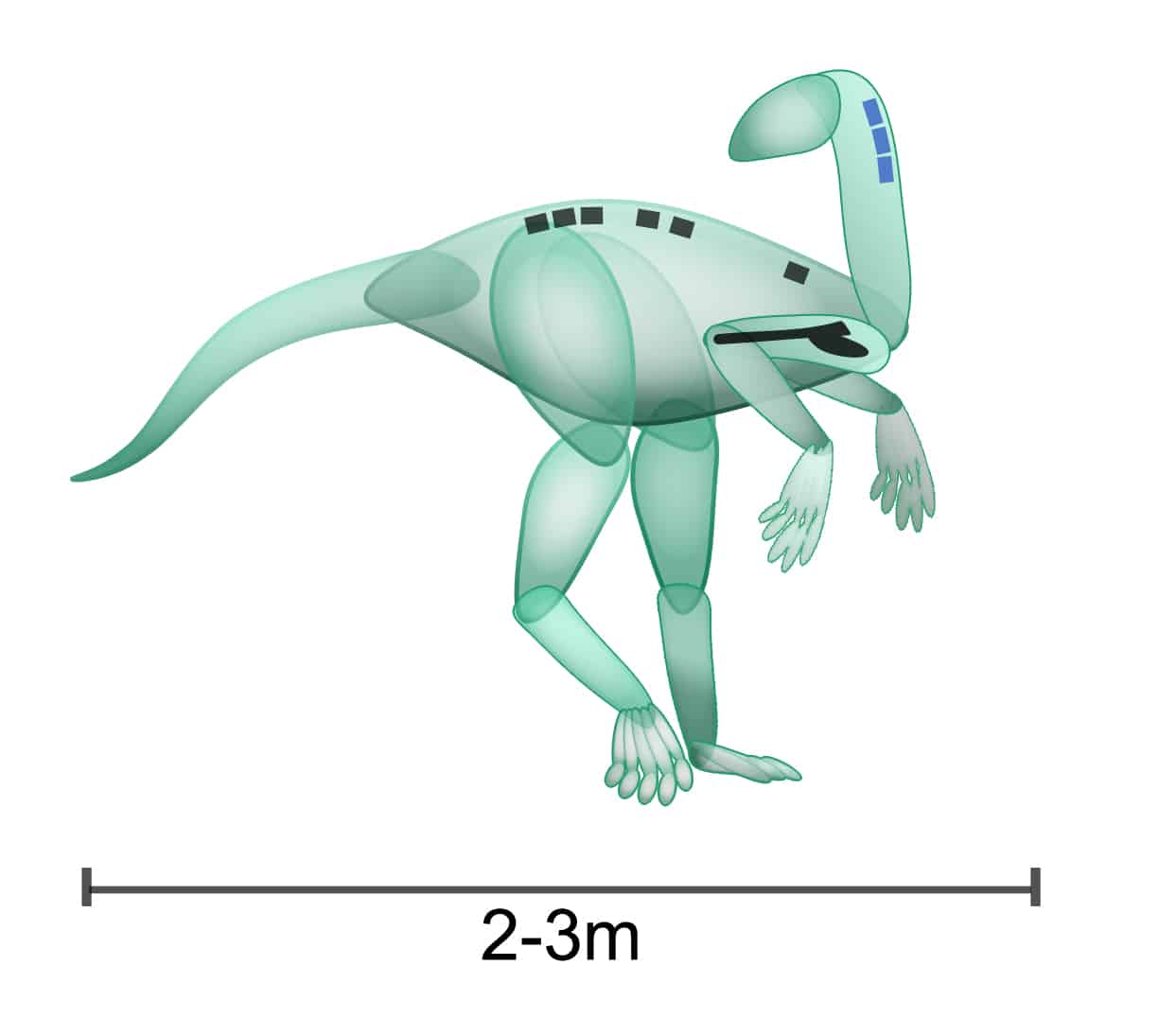
The referred neck vertebrae are elongated. Deep fossae, or pockets, sit beside the neural canal, and the same pockets occur in Silesaurus. Earlier studies suggested they may match features that clearly housed air sacs in theropods. Because no skull, teeth, hind limbs, or tail bones survive, its posture remains unknown. Skin and other soft tissue are missing too, so any depiction of its body covering is speculative.
Size and Weight of Type Species
Nesbitt and colleagues estimated Nyasasaurus at 6.6 to 9.8 feet (2 to 3 meters) long. They based that figure on its vertebrae, not a measured skeleton.
Other figures come only from press coverage. The University of Washington’s 2012 press release said it stood as tall as 3 feet (1 meter) at the hip. It also gave a weight of 45 to 135 pounds (20 to 60 kilograms), which Science News attributed to Nesbitt and colleagues. Neither outlet explained the method.
According to Science News, Nesbitt said the animal would have been slightly larger than a golden retriever. He also mentioned a very long tail, although no tail bones survive. Without hind limbs or a skull, all of these numbers are rough approximations.
The Dinosaur in Detail
What sets Nyasasaurus apart is the dinosaur signal in one arm bone. Its describers found two traits considered unique to dinosaurs—the elongated deltopectoral crest and its sideways-bent apex. They found that deflection only in dinosaurs such as Tawa, Saturnalia, and Heterodontosaurus. Yet the humerus shared no exclusive feature with any other Triassic archosaur group. Likewise, its hyposphene–hypantrum joints occur in dinosaurs such as Dilophosaurus but also in the crocodile-line Batrachotomus and in Silesaurus.
Bone tissue adds a clue. Thin humerus sections revealed highly woven bone, complex blood-vessel networks, and no lines of arrested growth—rings that record growth pauses. The describers inferred sustained, elevated growth like that of Megapnosaurus and Herrerasaurus. However, they tentatively identified an annulus, a band marking a brief slowdown, in the outermost bone. In contrast, Silesaurus—usually treated as one of the dinosaurs’ closest relatives—shows low levels of vascular connectivity.
The family-tree results were mixed. Alone, the holotype fell either just outside or within Dinosauria, while the referred specimen came out as a theropod. Combined, the two again landed just outside or within the group. However, the authors cautioned that positions within Dinosauria did not robustly portray the evidence. Paleontologist Stephen Brusatte, who was not involved, told Science News, “there’s just not enough evidence to decide which of these two family trees it is.”
If Nyasasaurus belongs to the dinosaur lineage, they argued, a 10–15 million-year ghost lineage—a gap the family tree predicts but fossils had not filled—would be “immediately eliminated.” They also proposed that the dinosaur radiation began possibly 15 million years earlier than thought. Its African home, they added, supports a southern Pangaean origin. Both claims hinge on its placement and age, and the 2026 revision weakens the first. Taken together, Nyasasaurus stands near the threshold—a possible dinosaur, or one of its closest relatives.
Interesting Points about Nyasasaurus
- The genus name honors Lake Nyasa, which lies near the site where Francis Rex Parrington collected the holotype in the 1930s.
- Coauthor Alan Charig died in 1997, so his name appeared on the 2013 description posthumously.
- Before it was referred to Nyasasaurus, the specimen in Cape Town had been known as Thecodontosaurus alophos.
- In 2017, Baron, Norman, and Barrett included it in an extra analysis that predicted an Early Triassic origin for dinosaurs.
- One phylogenetic analysis recovered its referred specimen as a theropod, but the describers did not consider that result robust.
Nyasasaurus in its Natural Habitat
The world Nyasasaurus inhabited was a river floodplain under a warm, seasonally wet climate. Rivers flowed from the Ruhuhu rift scarps into subsiding basins, building up reddened mudrocks. Higher in the Lifua Member, floodplain ponds and sheetwash deposits preserve partly articulated archosaurs, coprolites (fossil dung), and nonmarine bivalves. In 2018, Smith and colleagues suggested that rising temperature and rainfall created vegetated, semipermanent water bodies in floodplain hollows.
Without a skull or teeth, its diet is unknown. According to Smith’s team, those wet hollows supported herbivorous dicynodonts (beaked mammal relatives), cynodonts, and early archosaurs.
While there is no direct evidence of how Nyasasaurus lived, its scarce remains hint at its standing. Its describers argued that dinosaurs or “near-dinosaurs” made up only a small part of Middle Triassic vertebrate assemblages. Seen that way, dinosaur-like animals were, in the 2013 paper’s words, “just another component of an extensive archosauriform radiation” after the end-Permian extinction.
Frequently Asked Questions
It means “Lake Nyasa lizard,” and parringtoni honors collector Francis Rex Parrington.
It was originally dated to the Anisian stage, 247 to 241 million years ago. A 2026 study suggests it may be younger, possibly Ladinian to Carnian.
Its describers estimated 6.6 to 9.8 feet long. A 2012 press release added up to 3 feet at the hip and 45 to 135 pounds.
Its describers called it either the earliest dinosaur or the dinosaurs’ closest relative. The question remains open.
No source specifies its diet, and no skull or teeth have been found.
It was found in the Lifua Member of the Manda Beds, in the Ruhuhu Basin of southern Tanzania.
Sources
The information in this article is based on various sources, drawing on scientific research, fossil evidence, and expert analysis. The aim is to provide a comprehensive and accurate overview of Nyasasaurus. However, please be aware that our understanding of dinosaurs and their world is constantly evolving as new discoveries are made.
- https://doi.org/10.1098/rsbl.2012.0949
- https://pmc.ncbi.nlm.nih.gov/articles/PMC3565515/
- https://pmc.ncbi.nlm.nih.gov/articles/PMC8826131/
- https://pmc.ncbi.nlm.nih.gov/articles/PMC4725541/
- https://www.nature.com/articles/nature21700
- https://doi.org/10.1080/02724634.2026.2692542
- https://doi.org/10.1080/02724634.2017.1415915
- https://doi.org/10.1038/nature08718
- https://www.nature.com/articles/nature22037
- https://doi.org/10.1080/02724634.2017.1396539
- https://pmc.ncbi.nlm.nih.gov/articles/PMC5470689/
- https://doi.org/10.1098/rsbl.2020.0417
- https://doi.org/10.1144/gsl.jgs.1932.088.01-04.22
- https://www.bristol.ac.uk/news/2026/september/new-species-of-240-million-year-old-prehistoric-animal-from-tanzania-discovered.html
- https://stratigraphy.org/ICSchart/ChronostratChart2024-12.pdf
- https://paleobiodb.org/data1.2/occs/list.txt?base_name=Nyasasaurus&show=strat,loc,ref
- https://www.washington.edu/news/2012/12/04/scientists-find-oldest-dinosaur-or-closest-relative-yet/
- https://www.sciencenews.org/?p=9203
This article was last fact checked: TheDinosaurs Team, 30-10-2026
Featured Image Credit: TotalDino, CC BY 4.0, via Wikimedia Commons
