
At Dashanpu, about 6 miles (10 kilometers) northeast of Zigong in China’s Sichuan Province, lie the rocks of the Lower Shaximiao Formation. This unit, mainly purplish-red mudstones with yellowish-gray or grayish-green sandstones, has yielded one of the region’s most puzzling theropods. Named Gasosaurus constructus in 1985, it is usually placed in the Middle Jurassic—though its exact age is still argued over. The Natural History Museum in London puts it between 170 and 160 million years ago. In 2010, paleontologists Brusatte, Benson, and Xu noted that most Chinese Middle Jurassic theropods have not been described in detail since their original publication. As a result, their affinities remain uncertain, and Gasosaurus still lacks a settled family.
Paleontologists Dong and Tang described the animal in the journal Vertebrata PalAsiatica. This profile could not obtain their paper, so it draws on later studies that report its contents. Those studies describe a partial backbone, hip bones, and hind-limb bones, with the vertebrae incomplete and heavily restored in plaster. Since then, researchers have called Gasosaurus a coelurosaur, suggested it might be a primitive carnosaur, drawn it into a megalosaurid family tree, and left it unplaced. Its story shows how one little-studied skeleton can unsettle the early history of a whole lineage.
Gasosaurus Key Facts
| Keyword | Fact |
|---|---|
| Pronunciation | gas-oh-SORE-us |
| Meaning of name | Gas Lizard |
| Group | Theropoda |
| Type Species | Gasosaurus constructus |
| Diet | Carnivore |
| When it Lived | 170 to 160 MYA (museum estimate, debated) |
| Period | Jurassic |
| Epoch | Middle Jurassic (Bajocian to Callovian stages) |
| Length | About 13.1 feet (4 meters) |
| Height | Not specified |
| Weight | About 460 pounds (210 kilograms), estimated from femur length |
| Mobility | Not specified |
| First Discovery | Not specified |
| Described by | 1985 by Z.-M. Dong and Z.-L. Tang |
| Holotype | Not specified (material reportedly at the IVPP, Beijing, and the Zigong Dinosaur Museum, per PBDB) |
| Location of first find | Dashanpu, Zigong, Sichuan Province, China (Lower Shaximiao Formation) |
Gasosaurus Origins, Taxonomy and Timeline
According to the Natural History Museum, the name Gasosaurus means “gas lizard” and is pronounced gas-oh-SORE-us. The museum does not explain the “gas” element, and the 1985 description, where any explanation would likely appear, was not available here. Together, the name hints at a story locked in one journal issue.
Gasosaurus constructus is the type species of this theropod, but its position shifts with nearly every study. In 2000, paleontologist Thomas R. Holtz Jr. recovered it as a basal—early-branching—coelurosaur, part of the theropod branch that includes birds. He called that placement novel and based on “less secure evidence.” He also reported paleontologist Philip Currie’s view that undescribed specimens point instead to a primitive carnosaur—perhaps a sinraptorid.
In 2011, Li and colleagues likewise called it a coelurosaur but placed it in a cladogram (a branching family tree) of Sichuan megalosaurids. Rauhut, Hübner, and Lanser (2016) then listed it as valid but incertae sedis—of uncertain position. In 2020, Dai and colleagues grouped it with other “Chinese Jurassic tetanurans,” the group holding both megalosaurs and coelurosaurs.
Its age is just as unsettled. Rauhut’s team placed Gasosaurus in the Bajocian, and Li’s team dated the lower-member fauna Bajocian to Bathonian. Invertebrate fossils point older, whereas detrital zircons—durable grains eroded from older rocks—point younger. In 2018, Wang and colleagues used zircons from the formation, reportedly not from Dashanpu, to set a maximum depositional age of about 159 million years. They argued for a Late Jurassic (Oxfordian) age, but Dai’s team later called such a late start “not widely accepted.” In 2022, Ren and colleagues dated zircons from the formation’s base near the Dashanpusaurus quarry to about 169.9 million years. They suggested deposition there began by about 170 million years ago, possibly in the earliest Bajocian. That age dates the formation’s start, not the Gasosaurus fossils.
Discovery & Fossil Evidence
The title of the original paper places the find at Dashanpu, Zigong. Later studies assign it to the Xiashaximiao, or Lower Shaximiao, Formation. At the Dashanpu site, this formation is about 590 feet (180 meters) thick. Its dinosaur fossils cluster in the lower part, in a grayish-green sandstone just 10 to 16 feet (3 to 5 meters) thick. The site has produced more than 200 individual animals from 29 species in 26 genera. Even so, none of the sources consulted here says which bed yielded Gasosaurus, or when and by whom it was found.
This article could not verify the holotype number—the catalog code of the name-bearing specimen. The Paleobiology Database lists material at the Institute of Vertebrate Paleontology and Paleoanthropology (IVPP) in Beijing and at the Zigong Dinosaur Museum. A 2020 study by Dai and colleagues also links the material to the IVPP. That study notes that the material includes most of the presacral vertebrae—those in front of the hips. However, these bones are incomplete and so heavily restored with plaster that their original shape is hard to observe. Holtz’s anatomical coding draws on the pubis and ischium, two of the three hip bones. It also uses the femur (thigh bone), the tibia (shin bone), and the fibula, the slimmer bone beside it.
Accounts of its quality differ, and Holtz called the form “admittedly fragmentary.” By contrast, Brusatte and colleagues listed Gasosaurus among Middle Jurassic Asian theropods “known from well-preserved and substantially complete specimens.” None of the studies consulted here describes a skull or teeth, so this profile leaves both out. A full modern redescription of the bones would help settle the question.
Gasosaurus Size and Description
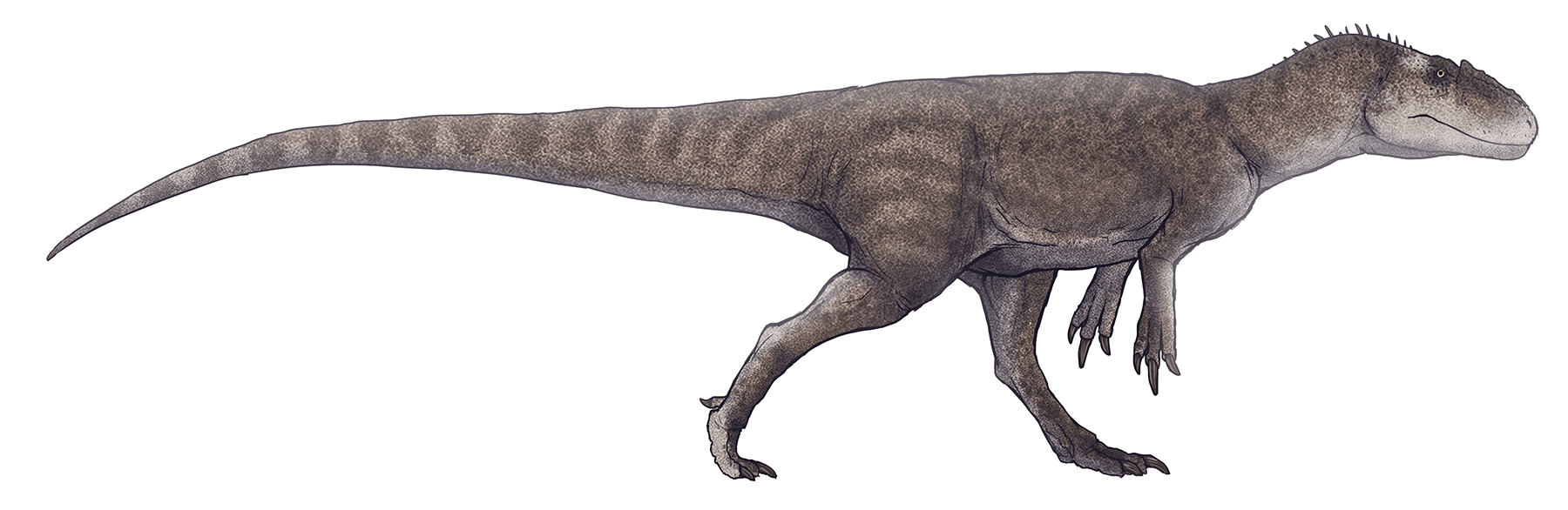
Because so much of the skeleton is incomplete, any portrait of Gasosaurus rests on a few key bones—above all, the femur.
Short description of Gasosaurus
Moving from front to back, the first region with substantial, if heavily restored, material is the backbone ahead of the hips. Its cervical centra—the spool-shaped bodies of the neck vertebrae—lack a rear pneumatic foramen or fossa. That is an opening or pocket linked to air sacs, and Dai and colleagues listed its absence as a trait shared with most tetanurans.
Behind the backbone, the known pelvis includes the pubis and ischium, while the hind limb preserves the femur, tibia, and fibula. Holtz drew on these bones for his analysis, and they carry most of the clues discussed below. Even so, they say little about its overall look. The sources consulted report no skin impressions, so any discussion of its outer covering would be speculative.

Size and Weight of Type Species
The Natural History Museum gives Gasosaurus a length of about 13.1 feet (4 meters). This article found no published hip height, and it could not check the size statement in the 1985 description either.
Weight comes from a different route. In 2010, Brusatte and colleagues took the 470-millimeter (18.5-inch) femur reported by Dong and Tang. They then applied an equation by Christiansen and Fariña (2004) that relates femur length to body mass. The result was about 460 pounds (210 kilograms)—roughly the weight of a large male lion. Their table lists no femur circumference, so they gave no second, circumference-based estimate. The femur length is a direct measurement, while the mass is only an estimate derived from it.
Brusatte’s team used Gasosaurus as their example of a “medium-sized” Chinese Middle Jurassic theropod. In 2020, Dai and colleagues compared it in size with Yunyangosaurus, estimated at about 15.4 feet (4.7 meters), and with Piatnitzkysaurus. That comparison describes general size and is not a new estimate for Gasosaurus.
The Dinosaur in Detail
One of the most distinctive things about Gasosaurus is the mix of features in its hips and legs—a mosaic of primitive and derived traits. In the femur, Holtz identified a head set at more than 90 degrees to the shaft. He also found a lesser trochanter—a small crest for muscle attachment—cleft from the femoral head. In addition, the upper end of the fibula is more than 75 percent as wide as the top of the tibia. Holtz treated all three as coelurosaur characteristics.
In contrast, the pelvis looks more old-fashioned, retaining the obturator foramen, an opening through the pubis. Its obturator process appears to be trapezoidal, a shape Holtz compared with those of carnosaurs and of Afrovenator. Meanwhile, the ischium ends in a large expansion, or “foot.” Holtz regarded all three as primitive features that later coelurosaurs transformed. His tree was also unstable here, as Proceratosaurus could take five different positions relative to Gasosaurus and Dryptosaurus, the other basalmost coelurosaurs.
Holtz also drew a broader conclusion from these bones. Along with Monolophosaurus and Proceratosaurus, he argued, Gasosaurus indicates that carnosaurs and coelurosaurs had split by the Middle Jurassic. Gasosaurus‘s part in that argument depends on the coelurosaur placement, which Rauhut and colleagues (2016) did not adopt. Instead, their table places Gasosaurus in none of the major theropod groups it uses. Taken together, these studies paint a picture of a theropod poised near a major fork in the family tree. Which side it belongs on remains an open question.
Interesting Points about Gasosaurus
- The Natural History Museum translates Gasosaurus as “gas lizard,” but the reasoning behind the name sits in a 1985 paper that this profile could not consult.
- In 2000, Holtz described its inclusion in Coelurosauria as “novel to this study,” placing it among the oldest coelurosaurs on less secure evidence.
- Its estimated weight of about 460 pounds rests on a single measurement—a femur 18.5 inches long.
- One 2011 study called Gasosaurus a coelurosaur in its text yet included it in a cladogram of megalosaurids from the Sichuan Basin.
- Two studies disagree on its fossils, with one calling them fragmentary and another listing them among substantially complete specimens.
Dinosaurs from the Same Formation
Also known from the Lower Shaximiao Formation (exact level relative to Gasosaurus not known): the sauropods Shunosaurus, Omeisaurus, Datousaurus and Dashanpusaurus, the stegosaur Huayangosaurus, and the small plant-eater Agilisaurus. The age of the formation is still debated, and none of the studies consulted gives the exact bed of each find, so these animals may not all have lived at the same time.
Gasosaurus in its Natural Habitat
The world Gasosaurus roamed was one of rivers and lakes. The Shaximiao Formation as a whole consists of continental red beds laid down by rivers and lakes, and its sandstones show conspicuous cross-bedding and often fill old river channels. Deposits of its lower part formed on land, possibly in a shallow lake setting. At Dashanpu, geologists have interpreted the bone-bearing rock of the lower quarry as a calm lake-shore deposit.
The Natural History Museum lists Gasosaurus as carnivorous, although there is no direct evidence of what it ate. The same formation has also produced the small plant-eater Xiaosaurus and the theropod “Szechuanosaurus” zigongensis.
No published study has examined how Gasosaurus hunted or whether it lived alone or in groups. Li and colleagues noted that coelurosaurs are rare in the lower member, and they named Gasosaurus as an example. That rarity stands out against the sheer size of the Dashanpu record, with more than 200 individual animals recovered. For now, Gasosaurus remains an uncommon theropod in a crowded fossil record—its role in that world still waiting to be written.
Frequently Asked Questions
According to the Natural History Museum, it means “gas lizard,” and the name is pronounced gas-oh-SORE-us.
Most sources place it in the Middle Jurassic, about 170 to 160 million years ago by the museum’s estimate, although its exact age is debated.
It was about 13.1 feet long. One indirect estimate based on its femur puts its weight at about 460 pounds.
It was a theropod. Studies have called it a coelurosaur or a possible primitive carnosaur and placed it in a megalosaurid tree, while a 2016 study left it unplaced.
Its fossils come from the Lower Shaximiao Formation at Dashanpu, near Zigong in China’s Sichuan Province.
The Natural History Museum lists it as carnivorous, although no fossil directly records what it ate.
Sources
The information in this article is based on various sources, drawing on scientific research, fossil evidence, and expert analysis. The aim is to provide a comprehensive and accurate overview of Gasosaurus. However, please be aware that our understanding of dinosaurs and their world is constantly evolving as new discoveries are made.
- Dong, Z. & Tang, Z. 1985. A new Mid-Jurassic theropod (Gasosaurus constructus gen. et sp. nov.) from Dashanpu, Zigong, Sichuan Province, China. Vertebrata PalAsiatica 23(1): 77–83 (original description, not available online and cited here through the later studies below)
- https://revistas.ucm.es/index.php/JIGE/article/download/JIGE1010220275A/32716
- https://www.geol.umd.edu/~tholtz/gaiaphyl.pdf
- https://vjs.pgi.gov.pl/article/download/26567/18275
- https://palaeo-electronica.org/content/pdfs/654.pdf
- https://doi.org/10.1038/s41598-019-56959-x
- https://doi.org/10.1098/rsos.220794
- https://www.nhm.ac.uk/discover/dino-directory/gasosaurus.html
- https://paleobiodb.org/classic/basicTaxonInfo?taxon_no=52766
- https://paleobiodb.org/classic/displayCollResults?collection_no=24883
- https://iugs-geoheritage.org/?p=10700
- https://doi.org/10.1130/B31910.1
- https://doi.org/10.1016/j.palaeo.2022.111318
This article was last fact checked: TheDinosaurs Team, 14-11-2026
Featured Image Credit: IJReid, CC BY 4.0, via Wikimedia Commons
