
Near the Shangyou Reservoir dam in Yongchuan—then a county of Sichuan, now a district of Chongqing—lie the dark-red sandy mudstones of the Upper Shaximiao Formation. In 1977, they gave up a large meat-eating dinosaur. Named Yangchuanosaurus shangyouensis in 1978, this theropod lived during the Late Jurassic, according to its describers. Its skeleton lay largely complete, though the forelimbs, most of the shoulder girdle, and much of the tail were gone. The authors called the skull “perfectly preserved” and the skeleton “the first nearly complete dinosaur skeleton found in China.” That was an overstatement, since Lufengosaurus was named in 1941 and a largely complete Mamenchisaurus skeleton surfaced in 1957.
The fossil surfaced in June 1977, during renovation of the Daba Dam. Chen Sinung, leader of the Daba Reconstruction Public Works Corps, made the find. Zhang Yihong of the Chongqing Natural History Museum then collected it. A year later, paleontologist Dong Zhiming and three Chongqing colleagues announced the new genus. Their fuller monograph of 1983 added a museum number, formal diagnoses, and a second species. Since then, the genus has become a focus of debate over the big meat-eaters of Jurassic China.
Yangchuanosaurus Key Facts
| Keyword | Fact |
|---|---|
| Pronunciation | yang-choo-AHN-oh-SORE-us (Natural History Museum, London) |
| Meaning of name | Yangchuan Lizard |
| Group | Theropoda |
| Type Species | Yangchuanosaurus shangyouensis |
| Diet | Carnivore |
| When it Lived | Not specified (we found no direct date for the Upper Shaximiao Formation) |
| Period | Jurassic |
| Epoch | Late Jurassic (stage not specified) |
| Length | About 26.2 feet (8 meters) in 1978, about 23 feet (7 meters) in the 1983 species diagnosis |
| Height | Not specified |
| Weight | Not specified |
| Mobility | Moved on two legs (bipedal) |
| First Discovery | June 1977 by Chen Sinung at the Daba Dam, though the Y. magnus holotype was found in 1973 |
| Described by | 1978 by Dong Zhiming, Zhang Yihong, Li Xuanmin, and Zhou Shiwu |
| Holotype | CV 00215 |
| Location of first find | Shangyou Reservoir dam site, Upper Shaximiao Formation, Yongchuan (now in Chongqing), Sichuan Basin, China |
Yangchuanosaurus Origins, Taxonomy and Timeline
Dong and colleagues named the genus and species “after its type locality.” The genus refers to Yongchuan County, spelled “Yangchuan,” while shangyouensis refers to Shangyou Reservoir. London’s Natural History Museum glosses the name as “Yangchuan lizard.” Together, the name works like a map reference.
In 1978, Dong and colleagues placed it in Saurischia, Theropoda, Carnosauria, and finally Megalosauridae. They admitted that Megalosauridae was known as a “garbage bag”—a catch-all family within Carnosauria. Within it, they found Yangchuanosaurus closest to Megalosaurus. That genus, they noted, had only one pair of antorbital fenestrae (openings in front of the eye socket), though Megalosaurus was then known only from fragments. Later workers variously placed it in Allosauridae and Sinraptoridae. The Paleobiology Database records that Carrano and colleagues assigned it to Metriacanthosauridae in 2012. That family, also called Sinraptoridae, sits within Allosauroidea. Y. shangyouensis remains the type species, although how many other species belong in the genus is disputed.
Dong and colleagues regarded the rocks as Late Jurassic, an age they called “at least correct” for the Upper Shaximiao. By 1983, they had settled on “early Late Jurassic,” even though fishes and bivalves pointed toward the Middle Jurassic. However, we found no published date from the Upper Shaximiao itself. Instead, the dates we found come from the Lower Shaximiao beneath it. A 2018 study found those fossil beds no older than 159 ± 2 million years, while a 2022 study reported about 166 million. Weighing this, Rauhut and colleagues concluded in 2024 that the Shaximiao faunas are “most probably latest Middle to Late Jurassic in age.”
Discovery & Fossil Evidence
The holotype—the name-bearing specimen—lay 350 meters (about 1,150 feet) from the base of the dam at Shangyou Reservoir. Both the 1978 paper and the 1983 monograph date the find to June 1977. Oddly, a footnote in the monograph gives July 1976. The skeleton remained fully articulated, “without any dislocation,” with its head tilted backward and its tail curved upward. According to the 1978 authors, it lay where it died, “without much subaerial exposure or any transportation before burial.”
The 1983 monograph records the holotype, CV 00215, as on display at the Chongqing (Chungking) Museum of Natural History. It lists complete cervical (neck) and dorsal (back) series, but only the first 12 caudal (tail) vertebrae—nearly 30 more are missing. From the hind limb came the femur (thigh bone), tibia, fibula, astragalus, and several toe bones, though parts of the right foot were absent. Of the forelimbs, only a piece of the right shoulder blade and a scrap of upper-arm bone survived.
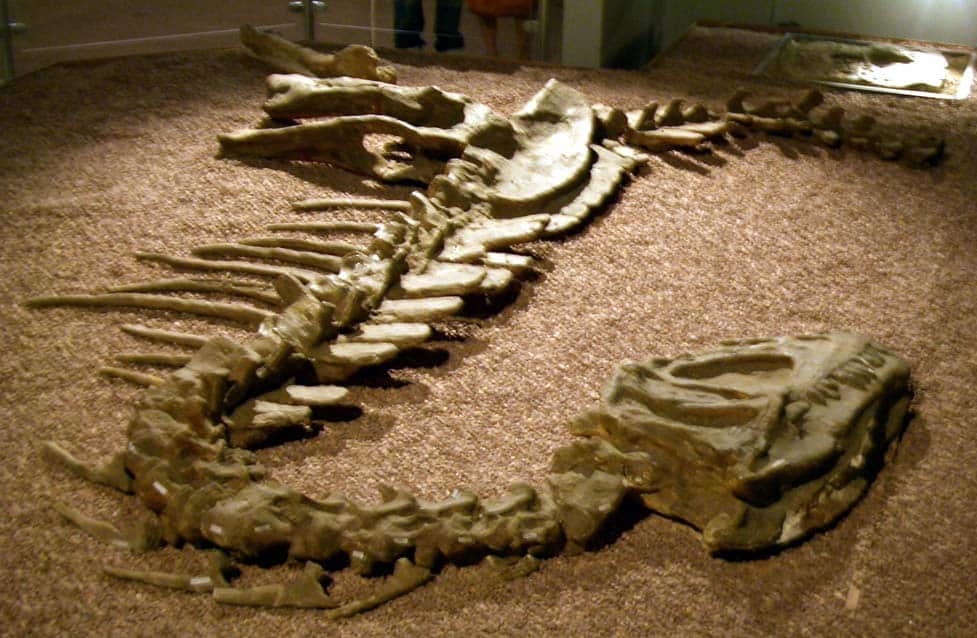

In 1983, Dong, Zhou, and Zhang also named a second species, Y. magnus. Its holotype, CV 00216, turned up in September 1973 during foundation work for the Hongjiang Machine Factory near Yongchuan. They diagnosed it as “an extremely large megalosaur” whose maxilla—the main upper tooth-bearing bone—bears two depressions, one of which perforates the bone. According to the Paleobiology Database, however, Carrano and colleagues judged Y. magnus a subjective synonym of Y. shangyouensis in 2012.
Yangchuanosaurus Size and Description
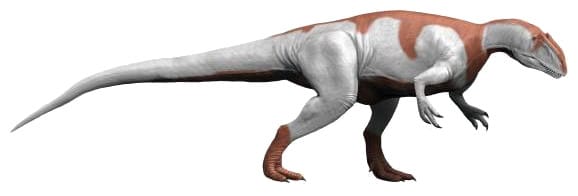
Yangchuanosaurus followed the classic big-theropod plan, with a few skull details all its own.
Short description of Yangchuanosaurus
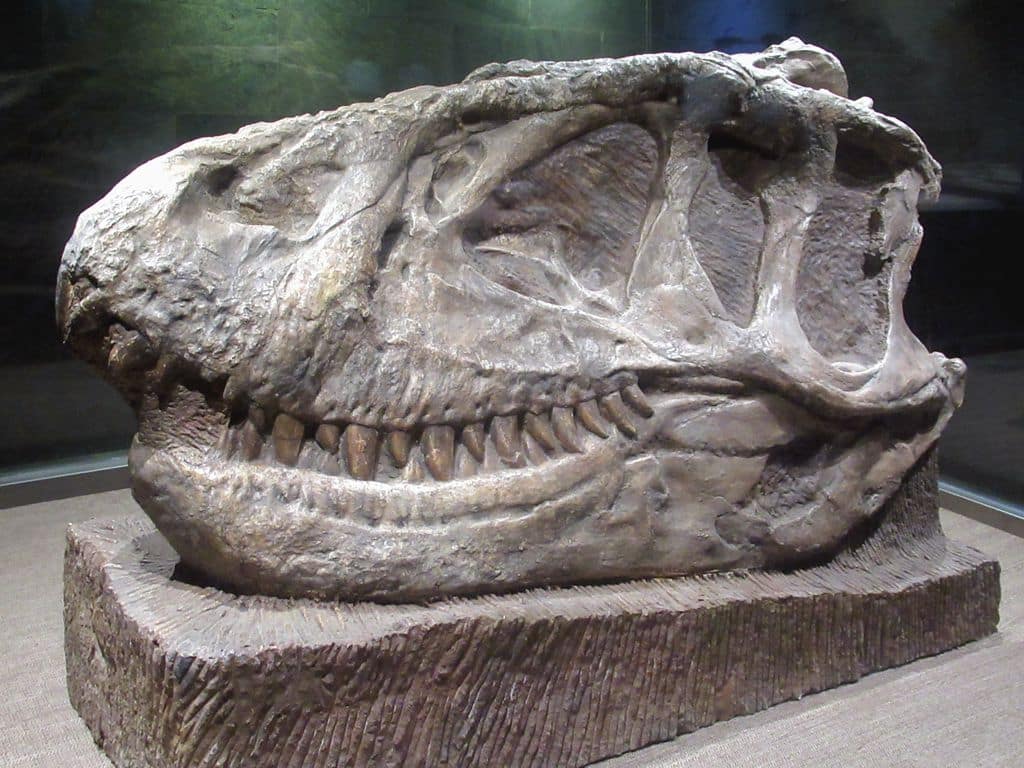
The holotype skull measured 82 centimeters (32.3 inches) long in 1978. The 1983 monograph revised this to 78 centimeters (30.7 inches), with a height of about 50 centimeters (19.7 inches). Six pairs of fenestrae, or skull openings, pierced it, including two pairs of antorbital fenestrae. The first pair was large, like an upside-down triangle, and the second small and triangular. Pitting covered the nasals and maxillae, and rugosities—rough, knobbly patches—gave the face “a distinct robusticity.”
Its teeth were laterally flattened, curved backward, and serrated, with 12 denticles (tiny serrations) per 5 millimeters. Each side held four premaxillary teeth and 14 to 15 in both the maxilla and the dentary (lower jaw bone). The largest maxillary crowns stood 5.6 centimeters (2.2 inches) high. Behind the head came 10 cervical, 13 dorsal, and 5 sacral vertebrae, with all five sacrals fused.
At the hips, the ilium was low and elongated. The left and right pubes fused to each other, as did the two ischia. Likewise, the astragalus and calcaneum—two bones of the ankle—had fused together. Its femur was “a little longer than the tibia,” at 85 versus 75.5 centimeters (33.5 versus 29.7 inches). Like other megalosaurids, as its describers defined them, it walked on two legs.
Size and Weight of Type Species
Dong and colleagues gave the holotype a total length of 26.2 feet (8 meters) in 1978, after only preliminary preparation. Their 1983 diagnosis of Y. shangyouensis instead says “approximately seven meters,” or about 23 feet. Yet the same monograph’s genus diagnosis notes that Yangchuanosaurus “may exceed eight meters.” London’s Natural History Museum lists 32.8 feet (10 meters), though it names no source for that figure.
We found no published estimate of height or weight for this species, so both remain unspecified here. For context, Rauhut and colleagues describe metriacanthosaurids as “medium to large-sized” allosauroids 16.4 to 26.2 feet (5 to 8 meters) long. The 1978 length would place the holotype at the top of that range.
Y. magnus was larger still, with a skull 111 centimeters (43.7 inches) long and a femur of 95 centimeters (37.4 inches). In 1983, its authors called it “the largest carnosaur currently known from the early Late Jurassic.”
The Dinosaur in Detail
One of the most distinctive features of this dinosaur, its describers argued, is a set of pits on the lacrimal and prefrontal bones, in front of and above the eye. The lacrimal pit was, in their words, “unrecorded on any other genus in the megalosaur family.” They also cited a large obturator foramen (an opening in the pubis) and a small pubic boot. In contrast, the second antorbital opening was not unique—their own table showed it in Allosaurus, though not in Ceratosaurus. Yangchuanosaurus differed from both in having four premaxillary teeth, against three in Ceratosaurus and five in Allosaurus.
The genus may also hold more than one species. In 1992, paleontologist Gao Yuhui named Y. hepingensis from a “fairly complete skeleton,” ZDM 0024. Farmers found it in February 1985 at Heping, Zigong, also in the Upper Shaximiao Formation. The Paleobiology Database records several studies that moved it to Sinraptor, from Currie and Zhao in 1994 to Carrano and colleagues in 2012. Others, including Gao in 1999 and Li and colleagues in 2011, kept it in Yangchuanosaurus. In 2024, Rauhut and colleagues again used “Yangchuanosaurus hepingensis” while describing Alpkarakush from Kyrgyzstan. In 2025, however, Zhang and colleagues used Sinraptor hepingensis while describing Yuanmouraptor from Yunnan. For now, both placements have published support.

A third name adds to the puzzle. Gao’s Szechuanosaurus zigongensis of 1993, from the Lower Shaximiao, appears in the Paleobiology Database as Yangchuanosaurus zigongensis, following Carrano and colleagues. Rauhut’s team, however, called it either an early-branching tetanuran (a broad group of advanced theropods) or a metriacanthosaurid. From the Upper Shaximiao, they listed two Yangchuanosaurus species and an unnamed third form, specimen CV 00214, once called Szechuanosaurus campi.
Taken together, Yangchuanosaurus has traveled from a “garbage bag” family to the heart of an unsettled debate.
Interesting Points about Yangchuanosaurus
- Explosives used to expose the holotype damaged the teeth and the jugal, or cheek bone, on its right side.
- For the museum mount, restorers rebuilt the right forelimb and foot from specimen CV 00214, then called Szechuanosaurus but now an unnamed theropod.
- According to the 1983 monograph, the holotype’s hind limb lay “posteriorly extended in a death throe.”
- In 2009, Xing and colleagues described a healed shoulder-blade fracture in the Y. hepingensis skeleton and blamed an external blow rather than disease.
Contemporary Dinosaurs
Towering over the Upper Shaximiao landscape was Mamenchisaurus hochuanensis, a long-necked sauropod with 19 neck vertebrae. Its neck made up “nearly one-half the length of the entire body,” in Dong and colleagues’ words. The 1978 paper lists it in the same mudstone fauna as Yangchuanosaurus. Xing and colleagues even named a blow from what they called its tail club as the likeliest cause of the fracture in Y. hepingensis.
Bristling with an estimated 17 pairs of plates and spines was Tuojiangosaurus multispinus, which the 1983 monograph called “the most heavily armored genus in the subfamily.” Its remains come from Wujiaba, Zigong, at a different level of the Upper Shaximiao. Whether Yangchuanosaurus ever tested that armor is unknown.
Smaller in build was Chungkingosaurus jiangbeiensis, described as “a small stegosaur with a relatively high rostrum,” or snout. It comes from Maoershi in Chongqing, in rocks its describers assigned to the Upper Shaximiao. It shared the formation with Yangchuanosaurus, though not necessarily the same moment.
Rounding out the plated herbivores was Chialingosaurus kuani, “a moderate sized stegosaur with a slim and graceful body.” It was also the first stegosaur recovered from the Sichuan Basin. The 1983 fauna list places it in the Upper Shaximiao, at an unstated level.
Yangchuanosaurus in its Natural Habitat
Rivers and lakes shaped the world Yangchuanosaurus roamed. Dong and colleagues described the Upper Shaximiao as “typical fluviolacustrine sedimentation”—river and lake deposits. Its brown-yellow and purple-red mudstones alternate with gray sandstones, reaching 767 to 2,200 meters (about 2,516 to 7,218 feet) thick. Plesiochelyid turtles and the lungfish Ceratodus are common in the same fauna.

Its describers inferred that the holotype “was probably pursuing prey when it got trapped in the mud by a lake and died.” In 1983, they also reported “a well-developed secondary palate”—a bony roof between mouth and nasal passages. On that basis, they suggested megalosaurs could breathe while eating. Yet the palate itself could not be studied, so this rests on a glimpse of one palate bone.
There is no direct evidence of whether Yangchuanosaurus hunted alone or in groups. Curiously, the 1978 authors also called it a “highland-dwelling animal.” According to Rauhut and colleagues, large theropods of its time “are mainly represented by metriacanthosaurids.” As one of them, it likely ranked among the top predators of its ecosystem.
Frequently Asked Questions
It is named after its type locality in Yongchuan County, and London’s Natural History Museum glosses it as “Yangchuan lizard.”
Its describers placed it in the Late Jurassic, but we found no study that dates its rock layer directly.
The 1978 paper gave about 26.2 feet (8 meters), while the 1983 species diagnosis gave about 23 feet (7 meters).
It was a carnivore, armed with flattened, backward-curving, serrated teeth.
It was found at the Shangyou Reservoir dam site in Yongchuan, now part of Chongqing, China, in the Upper Shaximiao Formation.
Its describers singled out pits on the lacrimal and prefrontal bones, a large obturator foramen, and a small pubic boot.
Sources
The information in this article is based on various sources, drawing on scientific research, fossil evidence, and expert analysis. The aim is to provide a comprehensive and accurate overview of Yangchuanosaurus. However, please be aware that our understanding of dinosaurs and their world is constantly evolving as new discoveries are made.
- Dong et al. 1978, Kexue Tongbao 23(5):302-304 (English translation): https://naturalhistory.si.edu/sites/default/files/media/translated_publications/Dong%26amp%3B%25201975.pdf
- https://naturalhistory.si.edu/sites/default/files/media/translated_publications/Dong%26amp%3B_83.pdf
- https://naturalhistory.si.edu/sites/default/files/media/translated_publications/Gao_92a.pdf
- https://doi.org/10.1080/14772019.2011.630927
- https://academic.oup.com/zoolinnean/article/201/4/zlae090/7731089
- https://doi.org/10.1130/B31910.1
- https://www.cgsjournals.com/article/id/dztb_20091004
- https://paleobiodb.org/classic/basicTaxonInfo?taxon_no=38594
- https://www.nhm.ac.uk/discover/dino-directory/yangchuanosaurus.html
- https://doi.org/10.7717/peerj.19218
This article was last fact checked: TheDinosaurs Team, 29-10-2026
Featured Image Credit: Connor Ashbridge, CC BY 4.0, via Wikimedia Commons
