
At the Grosser Gleichberg near Römhild in Thuringia, Germany, marls from the top of the Arnstadt Formation hold one of Europe’s best-known early theropods. Named Liliensternus liliensterni, this meat-eater lived during the Sevatian, the last part of the Norian stage of the Late Triassic. The Norian ended about 205.7 million years ago. In 2003, paleontologist O.W.M. Rauhut called it “the best represented Triassic theropod from Europe.” Yet its fossils come from young animals tangled together, and they still sit at the center of a lively debate.
Friedrich von Huene named the species in 1934, placing it in the genus Halticosaurus. Half a century later, Samuel P. Welles gave it a genus of its own in his 1984 monograph on Dilophosaurus. Since then, its place on the family tree has shifted more than once, while unpublished bones from Bavaria hint that adults may have grown far larger.
Liliensternus Key Facts
| Keyword | Fact |
|---|---|
| Pronunciation | Not specified |
| Meaning of name | Not specified (the name recalls collector Hugo Rühle von Lilienstern) |
| Group | Theropoda (Neotheropoda) |
| Type Species | Liliensternus liliensterni |
| Diet | Carnivore |
| When it Lived | About 205.7 MYA or earlier (late Norian, Sevatian) |
| Period | Triassic |
| Epoch | Late Triassic (Norian stage) |
| Length | Up to 13.1 feet (4 meters) for the subadult type skeletons |
| Height | Not specified |
| Weight | About 185 pounds (84 kilograms), 2014 estimate |
| Mobility | Moved on two legs (bipedal) |
| First Discovery | Collected 1922–1923 by R. von Lilienstern, per the Paleobiology Database (other accounts may differ) |
| Described by | 1934 by Friedrich von Huene (as Halticosaurus liliensterni), genus named 1984 by Samuel P. Welles |
| Holotype | No single holotype, syntypes MB.R. 2175 |
| Location of first find | Grosser Gleichberg near Römhild, top of the Arnstadt Formation, Thuringia, Germany |
Liliensternus Origins, Taxonomy and Timeline
The genus Liliensternus was built on the species name liliensterni, which Huene coined in 1934. No source consulted here spells out the dedication, but the name clearly recalls the Lilienstern family. The Paleobiology Database lists “R. von Lilienstern” as collector of the type material. Likewise, Lang and Huene’s 1952 book on Thuringia’s fossil reptiles names Hugo Rühle von Lilienstern as their central steward.
The title of Huene’s paper calls the animal a new “Coelurosaurier,” or coelurosaur, in that era’s usage. However, Welles showed that it lacks features tying it to Halticosaurus longotarsus, the poorly known type species of that genus. That species is now a nomen dubium—a name resting on non-diagnostic material. In 2007, a second species from Normandy, France, “Liliensternus” airelensis, received its own genus, Lophostropheus. Today, L. liliensterni is the type and only known species, placed within Neotheropoda (the “new theropods”).
According to paleontologists Hans-Dieter Sues and Rainer R. Schoch, the type horizon dates to the Sevatian, the late Norian. The Sevatian is the uppermost substage of the Norian, a division first defined in the Alpine Triassic. On the international timescale, the Norian closes at about 205.7 million years ago. That places Liliensternus in the final part of the Norian, before that date—a time when large sauropodomorphs abounded in the region.
Discovery & Fossil Evidence
The type material comes from the Grosser Gleichberg, a hill near Römhild southwest of Hildburghausen. There, the bones lay in marl at the top of the Arnstadt Formation. The upper part of that formation is the lateral equivalent of the Trossingen Formation (Knollenmergel) of southern Germany. The Paleobiology Database dates the collecting to 1922–1923, though this article could not confirm the date in Huene’s original paper.
Instead of a single holotype, the species rests on syntypes—specimens that jointly carry the name—catalogued as MB.R. 2175 in Berlin’s Museum für Naturkunde. These are the jumbled remains of at least two individuals whose bones “cannot be readily separated.” Welles chose the larger skeleton as a lectotype (a single name-bearing specimen picked later), but Sues and Schoch call that choice arbitrary. The material includes vertebrae, hip bones, the femur (thigh bone), tibia (shin bone), hand and foot bones, and a few skull pieces.
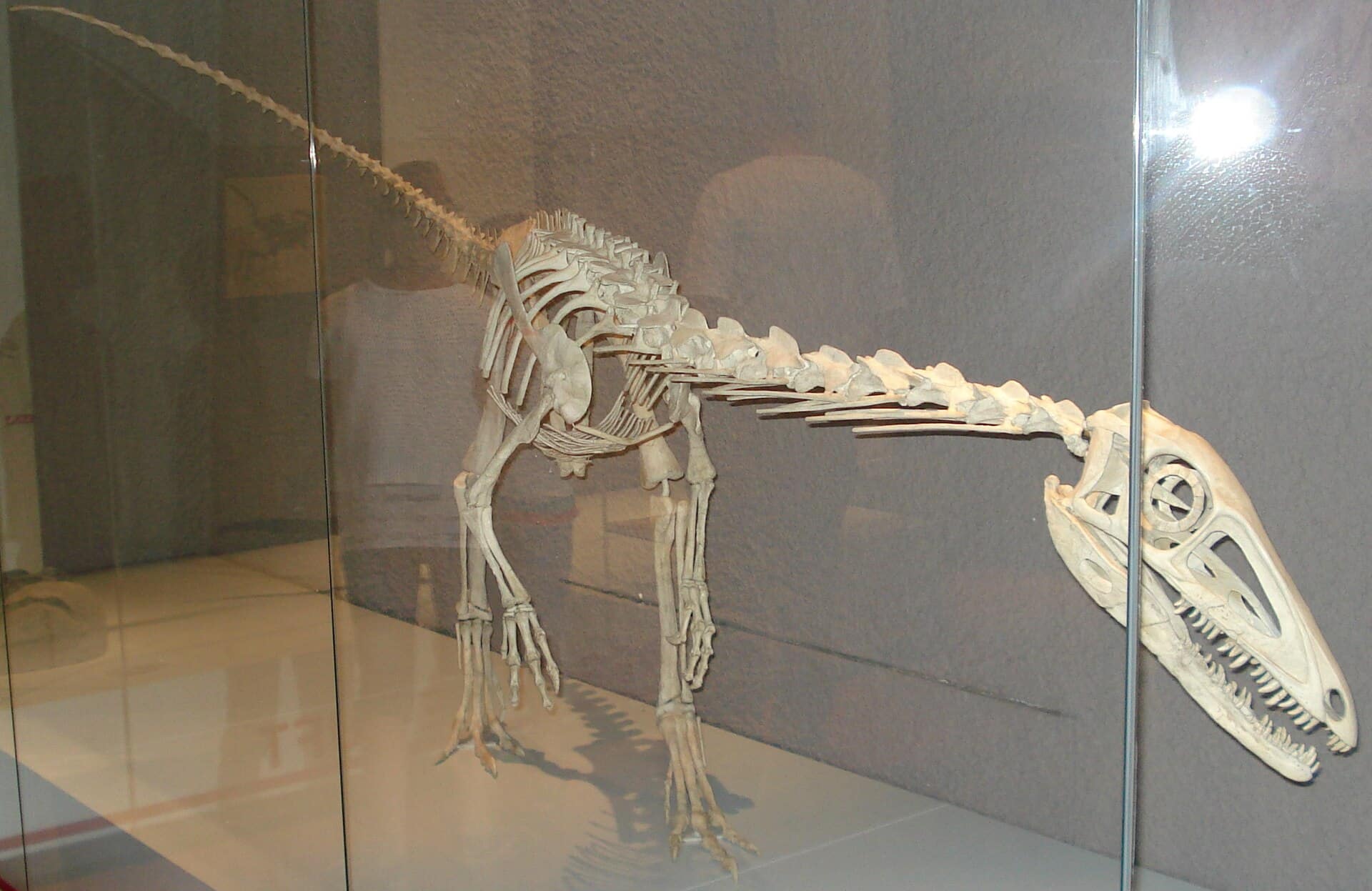

More material has surfaced since. According to a 2024 conference abstract by Kirmse and colleagues, unpublished skull and skeletal remains from the Trossingen Formation at Ellingen, Bavaria, belong to L. liliensterni or a close relative. Back in 2003, Moser’s monograph on Plateosaurus had referred a now-missing metatarsal (foot bone) fragment from Heroldsberg, near Nuremberg, to “cf. Liliensternus.” For now, though, Sues and Schoch list only the Ellingen fossils as referred material.
Liliensternus Size and Description
With so little of the head preserved, any portrait of Liliensternus leans on its neck, trunk, hips, and legs.
Short description of Liliensternus
Only a few incomplete skull bones are known from the type material, yet its upper-jaw teeth bore denticles (tiny serrations) in a pattern the Ellingen fossils share. Along the neck, the vertebrae carried potentially diagnostic ridges and keels, including a broad, rounded ridge behind the diapophysis, the rib-attachment process. Each neck vertebra also had a single pair of pleurocoels—hollow pockets in the sides of the bone.
Farther back, the rear trunk vertebrae were proportionally short. The ilium, or upper hip bone, had a straight or slightly convex upper edge in front of the hip socket. On the femur sat a hook-shaped tuber, a well-developed fourth trochanter (a muscle-attachment flange), and a tall, sharp greater trochanter. Like other theropods, it presumably walked on two legs.
No skin, crest, or other soft tissue has been reported, so any such features in artwork are speculative.
Size and Weight of Type Species
According to Mujal and colleagues in 2025, the syntype skeletons reach up to 13.1 feet (4 meters) long, though their method is not stated. Those individuals were not fully grown—their neurocentral sutures (seams between vertebral body and arch) remain open.
In 2014, Benson and colleagues estimated a mass of about 185 pounds (84 kilograms) from limb-bone shaft circumference, roughly a quarter of their figure for Dilophosaurus. Similarly, Spiekman and colleagues describe Liliensternus and Gojirasaurus as considerably larger than the small Welsh theropod Pendraig.
Adults, though, may have been far bigger. In 2024, Kirmse and colleagues estimated the unpublished Ellingen animals at 23 to at least 29.5 feet (7 to at least 9 meters) long. Their abstract’s title calls it the largest Triassic neotheropod, a claim that still awaits full peer review.
The Dinosaur in Detail
What sets this dinosaur apart is less a single showpiece than a suite of neck details. In 2003, Rauhut diagnosed it by its broad neck ridge and single pair of neck pleurocoels. Compared with “L.” airelensis, it also has a weaker infradiapophyseal fossa—a hollow beneath the rib-attachment process. Still, Sues and Schoch caution that a full diagnosis must await a reassessment of the syntypes and new specimens, which is now in progress.
Comparisons with relatives sharpen the picture. As in Coelophysis and Herrerasaurus, the centra along its back stayed rather constant in length, while its pubic shaft was straight, much like that of Dilophosaurus. Yet Marsh and Rowe found that its supra-acetabular crest, the bony hood over the hip socket, projects downward, unlike in Dilophosaurus.
Its family tree remains contested. Traditionally, it sat within Coelophysoidea (the group named after Coelophysis), as Zahner and Brinkmann still noted in 2019. In 2020, Marsh and Rowe placed it beside Lepidus praecisio, either as basal coelophysoids or in an unresolved split with that group. By contrast, Spiekman and colleagues found it to be an early non-coelophysoid neotheropod in 2021. Meanwhile, Ezcurra’s 2017 analysis and a 2024 conference abstract by Kirmse and colleagues recovered it as a stem-averostran—an early offshoot on the line to Averostra.
Reviewing these results in 2025, Mujal and colleagues concluded only that it might be a non-coelophysid coelophysoid or a stem-averostran. Taken together, the evidence leaves Liliensternus near a major fork in early theropod history—exactly which side remains open.
Interesting Points about Liliensternus
- Samuel P. Welles erected the genus inside his 1984 monograph on Dilophosaurus, an Early Jurassic theropod from Arizona.
- A second species from Normandy once carried the name, until Ezcurra and Cuny moved it to Lophostropheus in 2007.
- A 2014 study by Benson and colleagues cited Liliensternus as an example of the rise of large body size in derived theropods.
- Wellnhofer flagged theropod fossils from Ellingen as cf. Liliensternus in 1994, and Moser mentioned them in 2003, but they were first characterized only in 2024.
- Sues and Schoch’s 2025 synopsis lists it under Neotheropoda rather than Coelophysoidea, reflecting the ongoing debate.
Contemporary Dinosaurs
Sharing the very hill and horizon of Liliensternus was Ruehleia bedheimensis, a Plateosaurus-like sauropodomorph about 16.4 feet (5 meters) long. It was first identified as Plateosaurus plieningeri, but in 2024 Schaeffer recovered it outside Plateosauridae. The Paleobiology Database lists both species in the same collection, though no fossil records any interaction between them.
From the same formation at Halberstadt in Saxony-Anhalt comes Plateosaurus, named there as P. longiceps. Its type horizon is also the top of the Arnstadt Formation, Sevatian in age. Sues and Schoch treat it as a separate species, while Mujal and colleagues include it in P. trossingensis, the type species of the genus. By their count, that species reached 14.8 to 29.5 feet (4.5 to 9 meters) long. Its own type locality lies in a neighboring region, the Trossingen Formation at Trossingen in Baden-Württemberg, which Sues and Schoch also date to the Sevatian. No published Plateosaurus, however, comes from the Thuringian type site.
From another neighboring region comes Notatesseraeraptor frickensis, found in the Klettgau Formation at Frick, Canton Aargau, Switzerland. According to Zahner and Brinkmann, its bed lies in the latest Norian, about 3.3 feet (1 meter) below the Triassic–Jurassic boundary. Sues and Schoch call the Klettgau Formation correlative with the German units, and Mujal and colleagues note similar tetrapod assemblages in both. This immature neotheropod was 8.5 to 9.8 feet (2.6 to 3 meters) long. Its specimen includes a nearly complete skull, both forelimbs, and stomach contents. It is not known from Thuringia, so it is best seen as a regional counterpart rather than a neighbor.
Liliensternus in its Natural Habitat
Imagine a vast alluvial plain under a semi-arid, monsoon-influenced climate—this is how Mujal and colleagues picture the Trossingen Formation. The plain periodically dried out, leaving carbonate nodules in clay-rich soils, while occasional heavy rains spread gravels in places. Broad clayey plains carried at least locally dense vegetation, and root traces abound at Trossingen. Along river channels at Halberstadt, meanwhile, lived phytosaurs and temnospondyls—crocodile-like reptiles and amphibians.
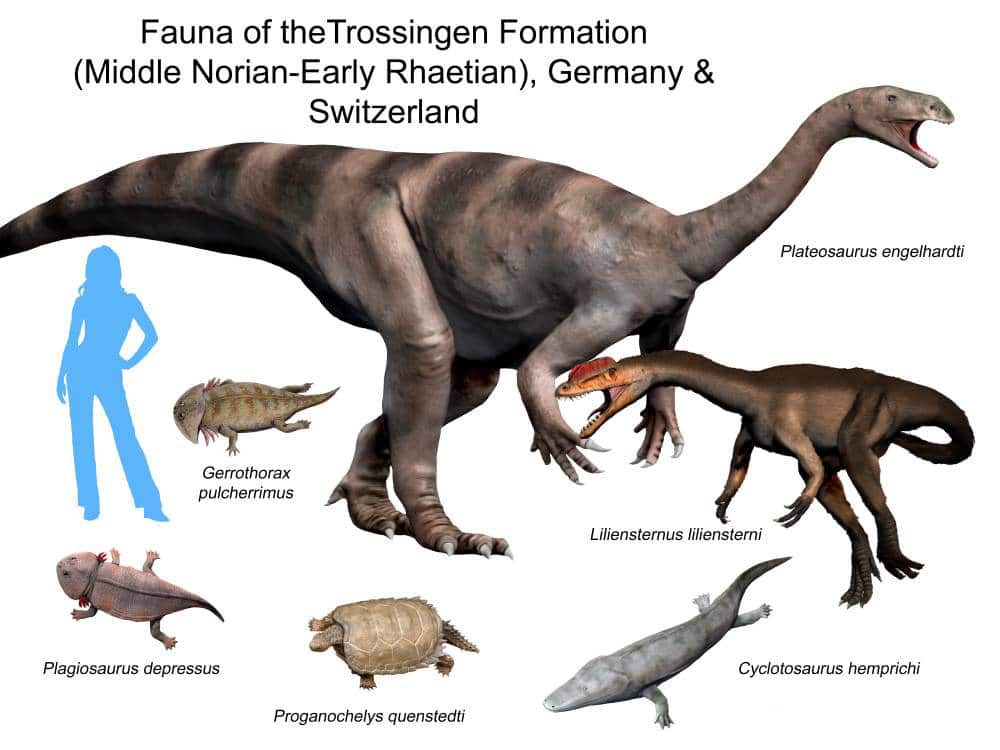

As a theropod—a group whose early members were mostly meat-eaters—Liliensternus was likely a carnivore too. Still, no gut contents or bite marks record its actual prey. Benson and colleagues linked the rise of large theropods such as Liliensternus to a “macropredation” hypothesis. The sauropodomorphs around it were also larger and more common than in earlier Norian settings, pointing to richer vegetation.
No direct evidence shows whether Liliensternus lived alone or in groups. Its type site holds at least two individuals, but whether they died together is unknown. If the Ellingen giants prove to be Liliensternus, it may rank among the largest Triassic theropods yet reported, as Kirmse and colleagues suggest.
Frequently Asked Questions
Its meaning is not spelled out in available sources, but the name recalls Hugo Rühle von Lilienstern, who is linked to the type material.
It lived in the Late Triassic, during the Sevatian, the last part of the Norian stage, which ended about 205.7 million years ago.
The young type skeletons reach up to 13.1 feet long, with an estimated weight of about 185 pounds. Unpublished Ellingen fossils may indicate much larger adults.
It was a carnivore, like other theropods, although no gut contents or bite marks reveal its actual prey.
Its type fossils come from the top of the Arnstadt Formation on the Grosser Gleichberg near Römhild, Thuringia, Germany.
It was an early neotheropod, traditionally called a coelophysoid but recently recovered by some analyses as a stem-averostran.
Sources
The information in this article is based on various sources, drawing on scientific research, fossil evidence, and expert analysis. The aim is to provide a comprehensive and accurate overview of Liliensternus. However, please be aware that our understanding of dinosaurs and their world is constantly evolving as new discoveries are made.
- https://doi.org/10.1007/BF03042684
- https://www.schweizerbart.de/papers/pala/detail/A185/71132/iDilophosaurus_Wetherilli_i_Dinosauria_Theropoda_Osteology_and_comparisons
- https://doi.org/10.3897/fr.28.164405
- https://doi.org/10.1016/j.earscirev.2025.105085
- https://zenodo.org/records/5123139
- https://epub.ub.uni-muenchen.de/12711/1/zitteliana_2003_b24.pdf
- https://doi.org/10.1098/rsos.210915
- https://doi.org/10.1038/s41559-019-0941-z
- https://doi.org/10.1017/jpa.2020.14
- https://pmc.ncbi.nlm.nih.gov/articles/PMC4011683/
- https://pmc.ncbi.nlm.nih.gov/articles/PMC5735062/
- https://doi.org/10.3897/vz.72.e86348
- https://docentes.fct.unl.pt/omateus/files/hendrickx_etal_2015_non_avian_theropods_pjvp12_11.pdf
- https://api.crossref.org/works/10.1671/0272-4634(2007)27%5B73:TCLAGN%5D2.0.CO;2
- https://stratigraphy.org/ICSchart/ChronostratChart2024-12.pdf
- https://paleobiodb.org/data1.2/colls/single.txt?id=48694&show=loc,strat,stratext,lithext,geo,ref,methods&vocab=pbdb
This article was last fact checked: TheDinosaurs Team, 03-11-2026
Featured Image Credit: ABelov2014, CC BY-SA 3.0, via Wikimedia Commons
