
Deep in Mongolia’s Gobi Desert, the pale orange sandstones of Ukhaa Tolgod expose the Djadokhta Formation. These rocks have yielded one of the most widely recognized Cretaceous fossils—an adult crouched over its nest of eggs. That animal belongs to Citipati osmolskae, an oviraptorid named in 2001. Oviraptorids form a family of theropods that also includes the famous Oviraptor. Citipati lived in the Late Cretaceous, most likely during the Campanian stage. Its rocks have not been dated directly, but a tentative magnetic-reversal correlation for the same rock unit at Bayn Dzak points to roughly 75 to 71 million years ago.
A joint American Museum of Natural History–Mongolian Academy of Sciences expedition discovered Ukhaa Tolgod in 1993. That same year, the team recovered both an embryo and the first nesting adult later assigned to Citipati. In 2001, paleontologists James M. Clark, Mark A. Norell, and Rinchen Barsbold named the species, together with the small oviraptorid Khaan mckennai.
Citipati Key Facts
| Keyword | Fact |
|---|---|
| Pronunciation | chit-i-puh-tih |
| Meaning of name | Lord of the Funeral Pyre |
| Group | Theropoda |
| Type Species | Citipati osmolskae |
| Diet | Uncertain, possibly herbivorous or omnivorous (inferred from skull mechanics) |
| When it Lived | About 75 to 71 MYA (tentative, correlated rather than directly dated) |
| Period | Cretaceous |
| Epoch | Late Cretaceous (Campanian stage) |
| Length | Not specified |
| Height | Not specified |
| Weight | About 243 pounds (110 kilograms), indirect estimate for the holotype |
| Mobility | Not specified |
| First Discovery | 1993 by the American Museum of Natural History–Mongolian Academy of Sciences expedition |
| Described by | 2001 by J.M. Clark, M.A. Norell, and R. Barsbold |
| Holotype | IGM 100/978 (now MPC-D 100/978) |
| Location of first find | Ukhaa Tolgod, Djadokhta Formation, Ömnögovi Province, Mongolia, with the holotype from Ankylosaur Flats |
Citipati Origins, Taxonomy and Timeline
According to the Natural History Museum in London, the name Citipati means “lord of the funeral pyre.” The species name osmolskae honors Halszka Osmólska.
Within Theropoda, Citipati belongs to Coelurosauria, then Oviraptorosauria, and finally the family Oviraptoridae. When it was named, that family held just six genera—Oviraptor, Ingenia, Conchoraptor, Nomingia, Citipati, and Khaan. Later, in 2020, Funston and colleagues recovered most oviraptorids in two clades (branches of the family tree), with Khaan in Heyuanninae and Citipati in Citipatiinae. They also inferred that citipatines first arose in southern China. In 2015, Lü and colleagues had already found that a new oviraptorid from China’s Nanxiong Formation was closely related to Citipati. Nevertheless, Citipati osmolskae remains the type and only named species.
Geologists assign the rocks at Ukhaa Tolgod to the Bayn Dzak Member of the Djadokhta Formation by rock type. In 2008, Dingus and colleagues interpreted their fauna as Campanian in age. Meanwhile, magnetostratigraphy—matching rock layers to reversals in Earth’s magnetic field—gave the same member at Bayn Dzak a tentative age of roughly 75 to 71 million years. On today’s timescale, the youngest part of that 1995-based range falls in the Maastrichtian. Dingus and colleagues also reported a fauna-based analysis that ranked Ukhaa Tolgod as younger than Bayn Dzak. Earlier, Clark and colleagues had noted that its vertebrates suggest a late Campanian to early Maastrichtian age.
Discovery & Fossil Evidence
In July 1993, the expedition uncovered an embryo inside an egg at the Xanadu sublocality, in an eroded nest. The same season produced IGM 100/979, a large oviraptorid on a nest that Norell and colleagues reported in Nature in 1995. Because its skull was missing, Clark and colleagues could not name its species in 1999. Even so, in several features it looked closer to Oviraptor than to other oviraptorids.
The species rests on the holotype—the name-bearing specimen—IGM 100/978, a nearly complete skeleton from Ankylosaur Flats. Now catalogued as MPC-D 100/978, it was first identified, preliminarily, as Oviraptor philoceratops. Its skull is complete down to both stapes (tiny middle-ear bones) and the paired hyoids (tongue-supporting bones). In November 1997, researchers CT scanned the skull at the University of Texas, and the DigiMorph archive documents that scan. However, even by 2002 the rest of the skeleton had not been fully prepared—freed from its surrounding rock.
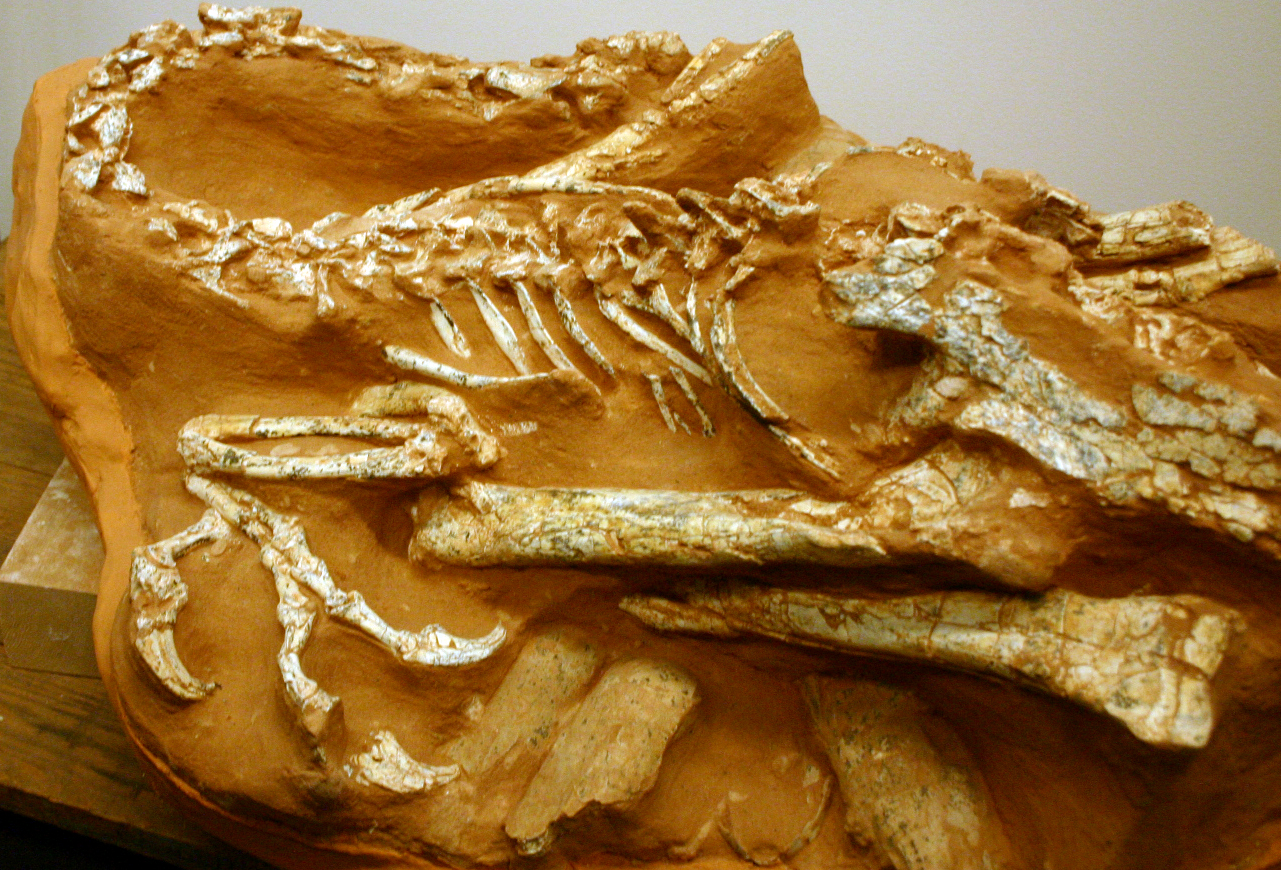

In 2001, Clark and colleagues referred two more specimens to the species, assigning IGM 100/979 mainly on its large size and its differences from Khaan. Similarly, they placed the embryo IGM 100/971 in Citipati because its premaxilla (front upper jaw bone) is nearly vertical. In their own 2001 embryo study, Norell and colleagues referred it only tentatively. Meanwhile, a second nesting adult, IGM 100/1004, had turned up in 1995 at the Death Row sublocality. It lacks the skull, tail, and parts of the hind limbs, which eroded away before discovery. Its preparers deliberately left it partly embedded to keep it on its nest.
Citipati Size and Description
Short description of Citipati
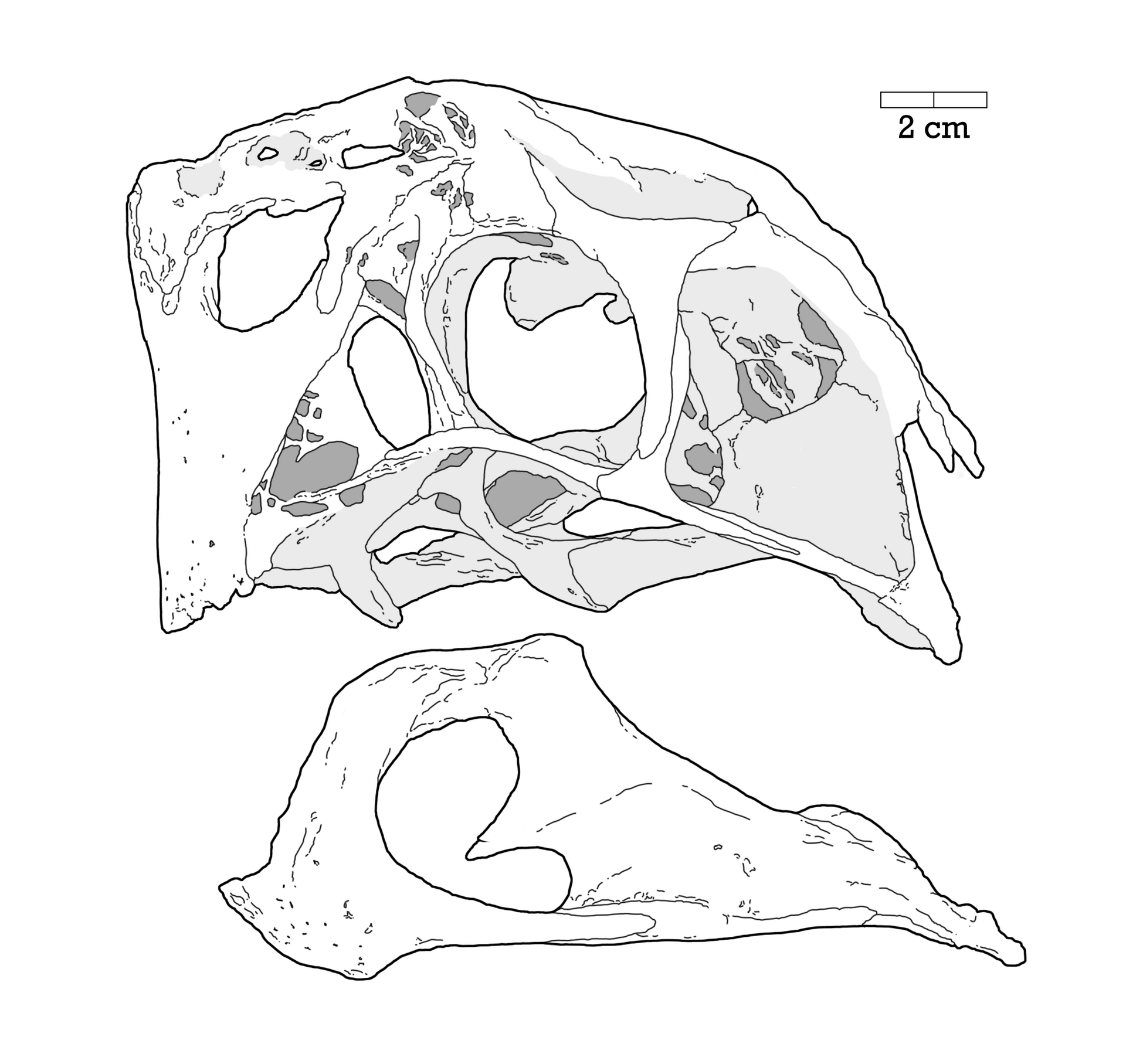
The skull was almost rectangular in side view, with a vertical premaxilla at the front. Its fused, toothless premaxillae ended in a sharp beak edge with five large bony denticles—tooth-like points—on each side. On its underside, the premaxilla widened into a U-shaped triturating (grinding) surface lined with ridges. In 2012, Balanoff and Norell listed Citipati among oviraptorids with a large nasal crest, though crest shapes varied widely.
Behind the head, the neck vertebrae were unusually long for an oviraptorid. Each cervical (neck) vertebra was about twice as long as wide, and the neck ribs outran their vertebral bodies. In addition, the nesting adult IGM 100/979 preserves bony rib struts called uncinate processes. It also shows joints between the ribs and sternum (breastbone), another oviraptorid first.
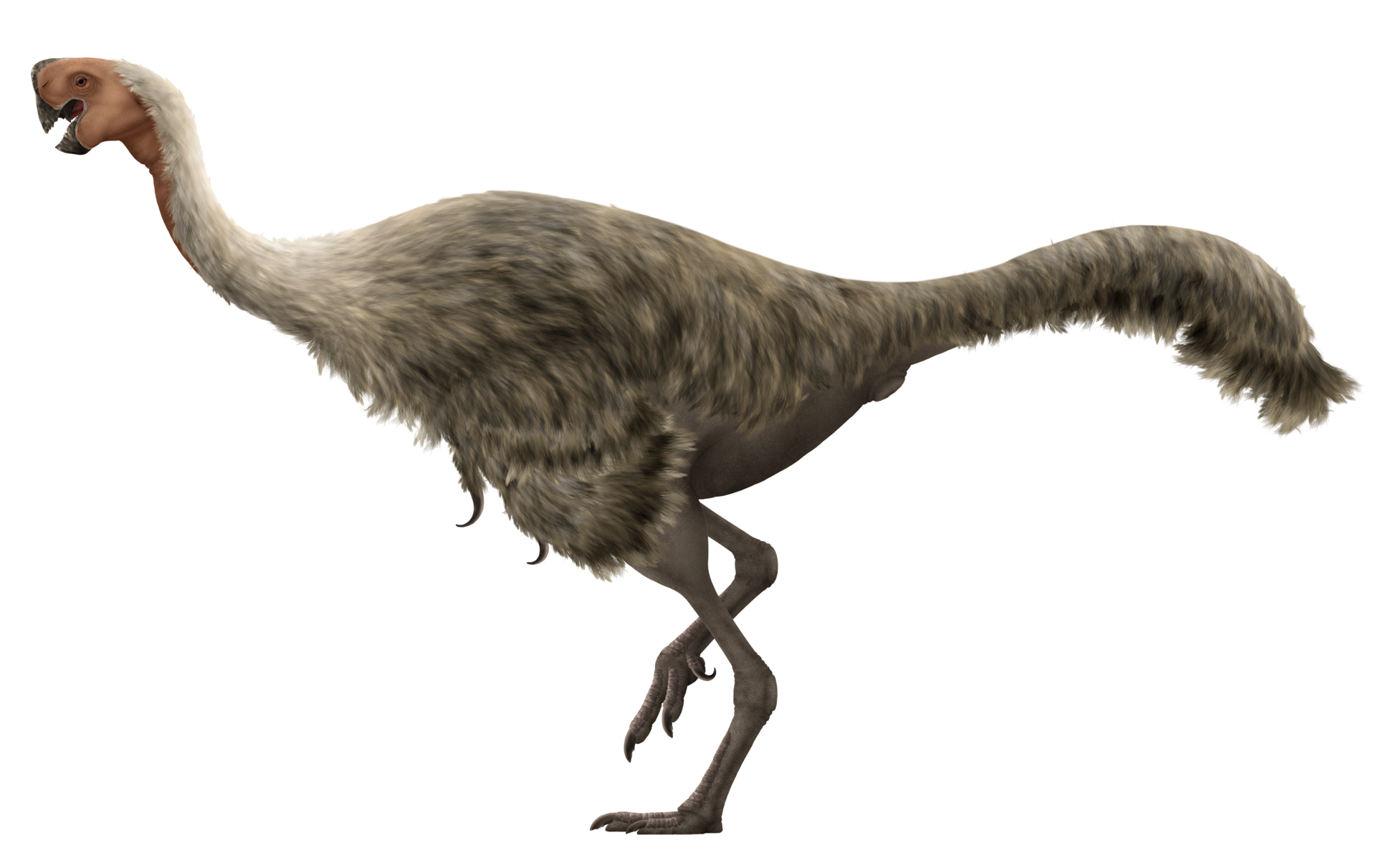
The hand claws of IGM 100/979 were as strongly curved as those of Archaeopteryx, and four still carry remnants of their keratin sheaths. The ulna (forearm bone) of IGM 100/1004 lacks quill knobs (bumps where large feathers anchor), as in other oviraptorids except Apatoraptor. No feather impressions have been reported with these specimens, but its close relatives show that Citipati was almost certainly feathered. Still, the extent and color of its plumage are unknown.

Size and Weight of Type Species
Published descriptions of Citipati do not give a length or hip height.
In 2024, Pintore and colleagues estimated the holotype’s mass at about 243 pounds (110 kilograms). They worked from the girth of its femur (thigh bone), which measures 4.8 inches (121.1 millimeters) around and 13.3 inches (338.1 millimeters) long. Their indirect method carries a prediction error of about 25 percent.
Sources differ on which individual was largest. In 2018, Norell and colleagues judged IGM 100/1004 about 6 percent larger than the holotype, based on its humerus (upper arm bone). That humerus measures 9.1 inches (230.11 millimeters). Pintore’s team, by contrast, called the holotype the largest known individual of the species.
The Dinosaur in Detail
Its describers set it apart mainly by its skull. Unlike any oviraptorid known when it was named, its occiput (back of the skull) and quadrate (jaw-joint bone) slope forward and upward. Its parietal is much longer than its frontal along the midline, and its nostril opening is closer to circular. In addition, its jugal (cheek bone) sends up a process at right angles to the main bar.
In its describers’ words, the holotype skull is “one of the best preserved oviraptorid skulls known.” It was the first oviraptorid skull reported with stapes, epipterygoids, and a slender coronoid bone. In 2002, Clark and colleagues described its epipterygoid—a strut linking the palate to the braincase wall—as the largest then known in any theropod. CT scans also revealed a space, probably air-filled, above the braincase that was larger than the brain cavity itself. In 2018, Balanoff and colleagues found that endocasts (casts of the braincase interior) of Citipati and Khaan confirm an expanded, bird-like cerebrum.

Comparing this skull with Oviraptor in 2002, Clark and colleagues identified the Oviraptor holotype, with its longer snout and lower jaw, as a candidate for the most basal (early-branching) oviraptorid. Earlier, the Ukhaa Tolgod embryo had shown that the eggs found with Oviraptor were oviraptorid, making it a parent rather than a thief.
At Dzamin Khond, a skeleton long called Oviraptor, IGM 100/42, may represent a second species of Citipati. Clark and colleagues placed it in the genus in 2002 but left its species open. Later analyses still treat it separately—Funston’s team, for instance, listed it beside Citipati as a Gobi citipatine.
Interesting Points about Citipati
- Before 1996, 4 of the 17 adult oviraptorid skeletons collected from the Djadokhta Formation’s structureless sandstones in Mongolia and China were found on nests, about 23.5 percent.
- Growth lines suggest that both nesting adults, IGM 100/979 and IGM 100/1004, were about 13 years old when they died.
- In 2007, Erickson and colleagues estimated a lifetime output of about 140 to 180 eggs for one Citipati.
- In 2016, Moyer and colleagues found that the claw-sheath remnants on IGM 100/979 react to beta-keratin antibodies, though more weakly than living birds.
Contemporary Dinosaurs
Sharing the dunes was Pinacosaurus, an ankylosaurid (armored dinosaur) whose Ukhaa Tolgod finds include a juvenile skull of Pinacosaurus grangeri. Its fossils also come from the Camel’s Hump horizon, which preserved the nesting Citipati IGM 100/1004. However, no direct interaction between the two is recorded.
From that same horizon came Shuvuuia deserti, an alvarezsaurid—a small theropod whose hand was dominated by one hugely enlarged first finger. Its holotype also comes from Ukhaa Tolgod.
Closest in kind was Khaan mckennai, a small-bodied, crestless oviraptorid named in the same 2001 paper. Its holotype came from the Mark’s Second Egg locality at Ukhaa Tolgod. In 2022, Meade and Ma linked differences in jaw-muscle strength between co-occurring oviraptorids to possible niche partitioning—dividing up resources. However, no fossil shows how Citipati and Khaan actually shared the dunes.
Also present were protoceratopsids, ceratopsians (horned dinosaurs) related to Protoceratops. At Death Row, where IGM 100/1004 was found, Dingus and colleagues recorded Protoceratops specimens in the same narrow interval as the oviraptorids. Yet in 2020, Prieto-Márquez and colleagues treated the Ukhaa Tolgod animals as a new, undescribed protoceratopsid. No fossil records an interaction with Citipati.
Citipati in its Natural Habitat
The world Citipati roamed was a field of large sand dunes. At Ukhaa Tolgod, about 246 feet (75 meters) of pale orange sandstones, conglomerates, and siltstones record an arid environment. For long periods the dunes stayed stable, with sparse plants traced by rhizoliths (fossil root casts) and short-lived ponds between them. Meanwhile, dinosaur tracks in the cross-bedded sandstone show that dinosaurs walked across active dunes.
While there is no direct evidence of what Citipati ate, its skull points to a powerful bite. In models by Meade and Ma, Citipati, Khaan, and Conchoraptor bit much harder than plant-eating ornithomimosaurs and therizinosaurs, yet opened their jaws far less widely than meat-eating theropods. In their view, this combination may be an adaptation for tough vegetation.
The nesting adults offer the clearest window into its behavior. In 1999, Clark and colleagues interpreted IGM 100/979 as having died in place, in a brooding posture among tetrapods “commonly taken only by birds.” Still, they cautioned that nest-sitting does not prove the adult warmed its eggs—a link they called “an untestable assumption.” In 2008, Varricchio and colleagues favored paternal care—brooding by fathers. However, in 2013, Birchard and colleagues argued that clutch mass cannot reveal which parent incubated, so the sex of these brooding adults remains unknown. Notably, neither nesting adult shows medullary bone, a tissue tied to egg-laying females.
Under IGM 100/979, eggs lie in pairs in a ring, apparently with no eggs in the center at the level of the outer eggs. Similarly, IGM 100/1004 sits over a paired ring. Although nests are common at Ukhaa Tolgod, Norell and colleagues found no closely packed nests, so a nesting colony seems unlikely. Instead, rain-soaked dunes that suddenly slid downslope most likely buried these adults on their nests—a vivid case of how dinosaur fossils form.
Frequently Asked Questions
According to the Natural History Museum in London, it means “lord of the funeral pyre,” and osmolskae honors Halszka Osmólska.
It lived in the Late Cretaceous, most likely during the Campanian stage. Its rocks are not directly dated, but a tentative correlation points to roughly 75 to 71 million years ago.
No peer-reviewed length is available, but the holotype’s weight has been estimated indirectly at about 243 pounds (110 kilograms).
There is no direct evidence, but according to skull studies its strong bite may have suited tough vegetation.
Its fossils come from Ukhaa Tolgod, in the Djadokhta Formation of Mongolia’s Gobi Desert.
It is one of the best-known nesting dinosaurs, with two adults found sitting on their eggs, and its holotype skull is among the best-preserved oviraptorid skulls known.
Sources
The information in this article is based on various sources, drawing on scientific research, fossil evidence, and expert analysis. The aim is to provide a comprehensive and accurate overview of Citipati. However, please be aware that our understanding of dinosaurs and their world is constantly evolving as new discoveries are made.
- https://doi.org/10.1671/0272-4634(2001)021[0209:TNOTOU]2.0.CO;2
- https://archive.org/details/cranialanatomyc3364clar
- https://archive.org/details/oviraptoridskel3265clar
- https://www.nature.com/articles/378774a0
- https://archive.org/details/embryonicovirap3315nore
- https://archive.org/details/secondspecimenc00nore
- https://doi.org/10.1017/pab.2024.6
- https://pmc.ncbi.nlm.nih.gov/articles/PMC2396186/
- https://pubmed.ncbi.nlm.nih.gov/19095938/
- https://pmc.ncbi.nlm.nih.gov/articles/PMC3730617/
- https://pmc.ncbi.nlm.nih.gov/articles/PMC7657903/
- https://pubmed.ncbi.nlm.nih.gov/26133245/
- https://archive.org/details/bulletin-american-museum-natural-history-372-001-077
- https://pubmed.ncbi.nlm.nih.gov/30099460/
- https://pubmed.ncbi.nlm.nih.gov/28120795/
- https://pubmed.ncbi.nlm.nih.gov/35194096/
- https://pubmed.ncbi.nlm.nih.gov/38600295/
- https://archive.org/details/geologyukhaatol00ding
- https://archive.org/details/newstratigraphi00dash
- https://archive.org/details/newspecimenpina3395hill
- https://archive.org/details/biostor-214985
- https://pmc.ncbi.nlm.nih.gov/articles/PMC7381594/
- https://www2.geo.utexas.edu/specimens/Citipati_osmolskae
- https://www.nhm.ac.uk/discover/dino-directory/citipati.html
This article was last fact checked: TheDinosaurs Team, 03-11-2026
Featured Image Credit: Jonathan Chen, CC BY-SA 4.0, via Wikimedia Commons
