
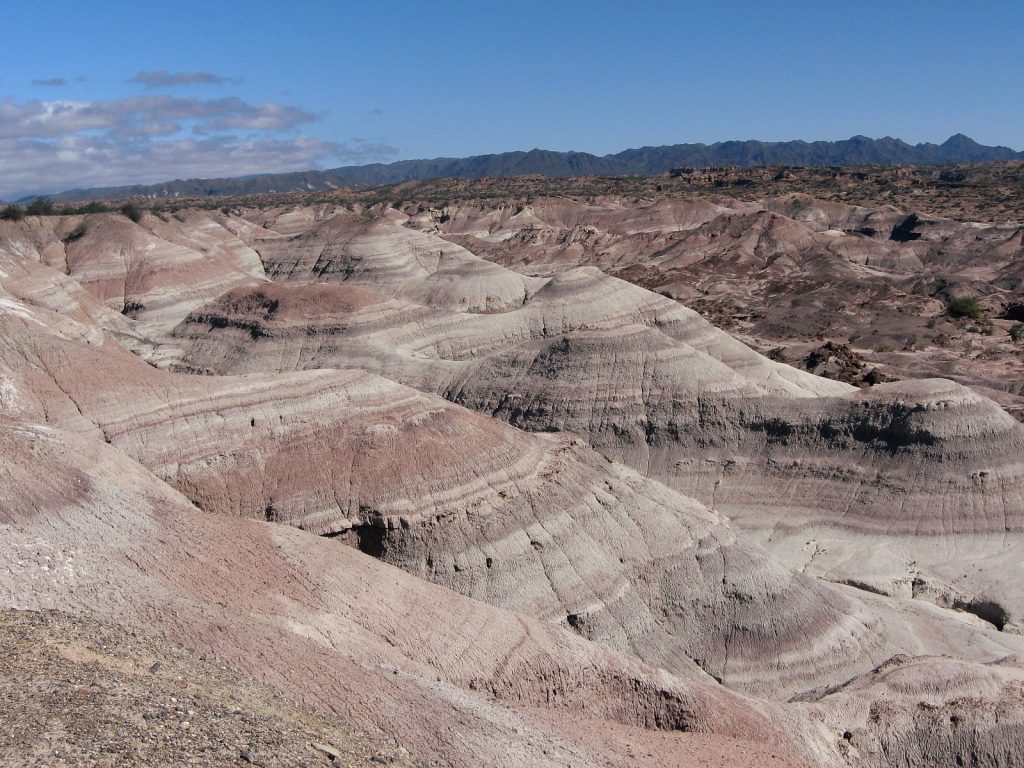
In the badlands of Ischigualasto Provincial Park, in Argentina’s San Juan Province, lie the river-laid rocks of the Ischigualasto Formation. Their lower layers, say the describers of Anteavis, hold more small and medium-sized dinosaurs than scientists had recognized. From these layers comes Anteavis crurilongus, a small theropod named in 2025. It lived in the late Carnian stage of the Late Triassic, more than 228.9 million years ago. Although it falls just outside Neotheropoda—the theropod group that includes Coelophysis—it has features once thought exclusive to that group, several of them in the hips.
Argentine news reports say a Universidad Nacional de San Juan team led by paleontologist Ricardo Martínez found the skeleton in 2014. Eleven years later, Martínez and five colleagues described it in Nature Ecology & Evolution. Its single partial skeleton pairs a shin far longer than its thigh with a mosaic of primitive and derived traits. In this way, it hints that some later theropod hallmarks appeared before Neotheropoda itself.
Anteavis Key Facts
| Keyword | Fact |
|---|---|
| Pronunciation | Not specified |
| Meaning of name | Ancestor of the Birds, Long Leg (according to news reports) |
| Group | Theropoda |
| Type Species | Anteavis crurilongus |
| Diet | Carnivore |
| When it Lived | 231.4 to 228.9 MYA |
| Period | Triassic |
| Epoch | Late Triassic (Carnian stage) |
| Length | Not specified |
| Height | Not specified |
| Weight | Not specified |
| Mobility | Not specified |
| First Discovery | 2014 by a Universidad Nacional de San Juan team led by Ricardo Martínez (according to news reports) |
| Described by | 2025 by R.N. Martínez, C.E. Colombi, M.D. Ezcurra, D.O. Abelín, I. Cerda, and O.A. Alcober |
| Holotype | PVSJ 1085 |
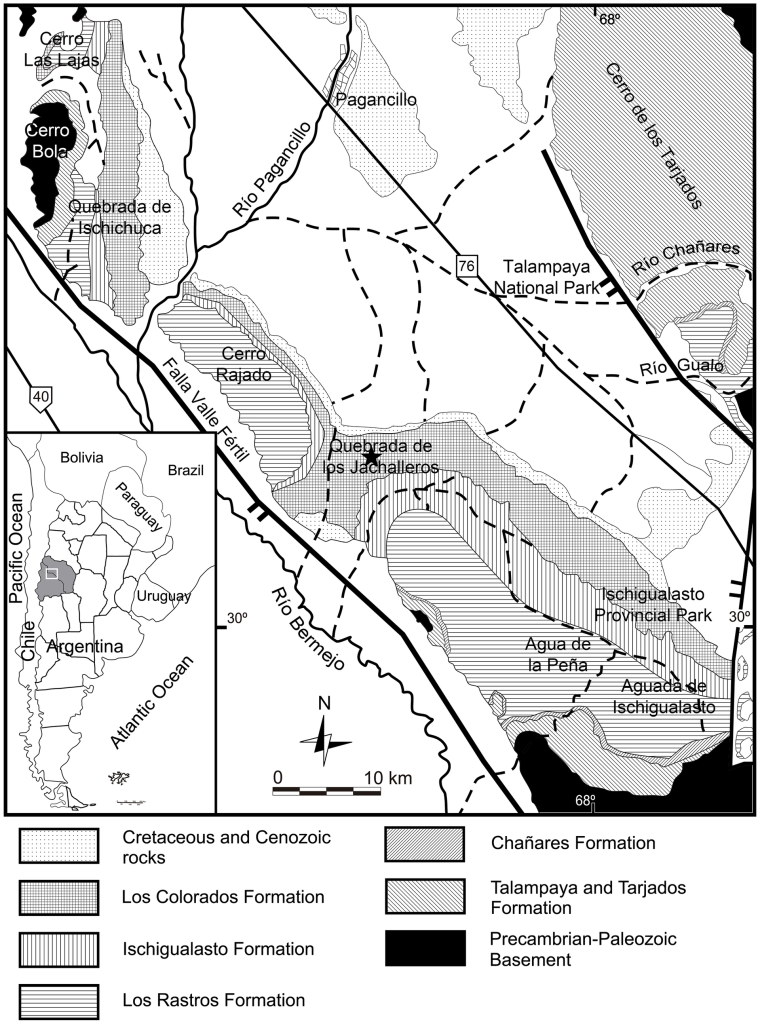
| Location of first find | North of Agua de la Peña locality, lower Cancha de Bochas Member, Ischigualasto Formation, Ischigualasto Provincial Park, San Juan Province, Argentina |
Anteavis Origins, Taxonomy and Timeline
According to Tiempo de San Juan, Anteavis means “ancestor of the birds,” while crurilongus means “long leg.” The species name suits the animal—few early dinosaurs its describers compared come close to its shin-to-thigh ratio. The name thus pairs the bird lineage with its most striking proportion.
Anteavis is an early-diverging (early-branching) theropod that sits outside Neotheropoda. In one parsimony analysis—a method that seeks the tree needing the fewest evolutionary changes—the describers found Eodromaeus, Anteavis, and Lepidus to be successive sister taxa to Neotheropoda. A second data set also placed Anteavis just outside that group. Bayesian analyses of both sets backed a clade of Anteavis plus neotheropods, at 100% and 96% posterior probability. Anteavis crurilongus is the type and only known species.
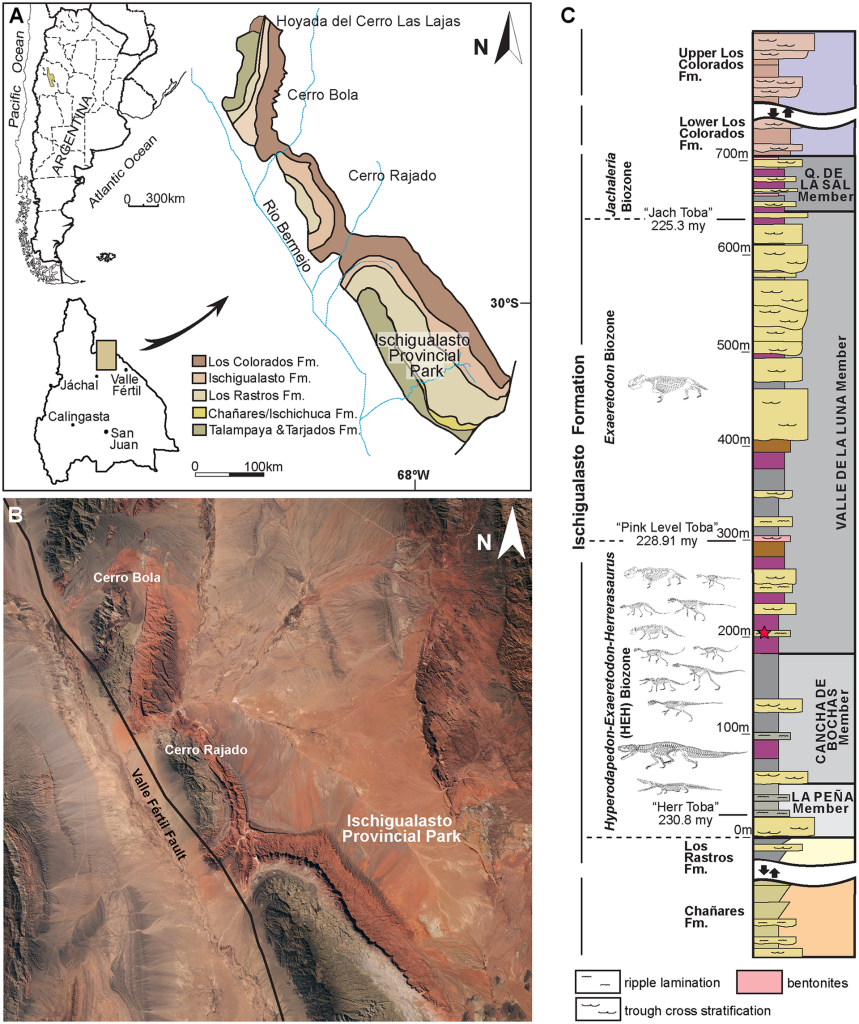
Its fossils come from the lower Cancha de Bochas Member, 105 meters (344 feet) above the base of the Ischigualasto Formation. The whole formation spans roughly 231.4 to 225.9 million years ago. However, the skeleton lies below a volcanic ash layer dated to 228.91 million years, placing it in the late Carnian. On the international timescale, the Carnian stage as a whole ran from about 237 to 227.3 million years ago. At the time, the region was shifting toward semi-arid conditions, and dinosaurs were diversifying—though that early radiation would soon stall.

Discovery & Fossil Evidence
The skeleton was found at a locality called “North of Agua de la Peña,” in the Hoyada de Ischigualasto. News reports place the 2014 find in the Cancha de Bochas area. The bones lay in floodplain deposits with well-developed Calcisols—ancient soils rich in calcium carbonate. According to Diario de Cuyo, the park announced the new species on October 14, 2025, the day the paper appeared online.
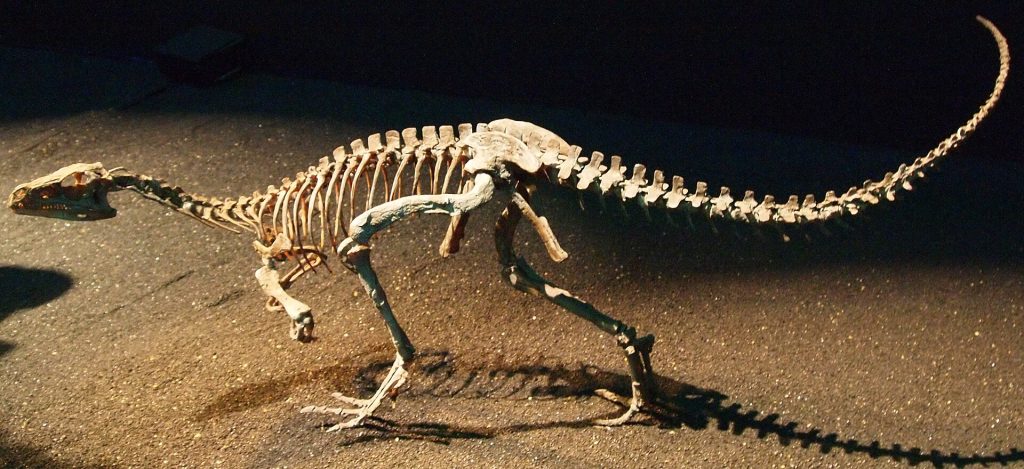
The holotype, PVSJ 1085, belongs to the Instituto y Museo de Ciencias Naturales of the Universidad Nacional de San Juan. Its skull material includes a partial left maxilla (upper jaw bone), most of the right dentary (lower jaw bone), and pieces of the palate. Four neck, ten back, four sacral (hip), and six tail vertebrae preserve much of the spine. The shoulders and arms yield a partial scapulocoracoid (fused shoulder blade and coracoid) and both humeri (upper arm bones). The pelvis is complete. Below the hips lie the left femur (thighbone), the right tibia (shinbone), parts of both fibulae, and an ankle bone (astragalus). A complete left metatarsus (upper foot) and several toe bones finish the set.
According to the describers, the disarticulated skull bones are somewhat distorted and fragmented, yet well preserved given their fragility. PVSJ 1085 remains the only known specimen, and no additional fossils of Anteavis have been confirmed outside this locality.
Anteavis Size and Description
Short description of Anteavis
In the skull, the upward process of the maxilla fanned out from front to back, a feature unique to the genus. The upper jaw held at least 14 tooth positions and the lower jaw at least 22, its crowns strongly recurved. Unlike Eodromaeus and Eoraptor, its pterygoids (palate bones) lacked tiny teeth called denticles.
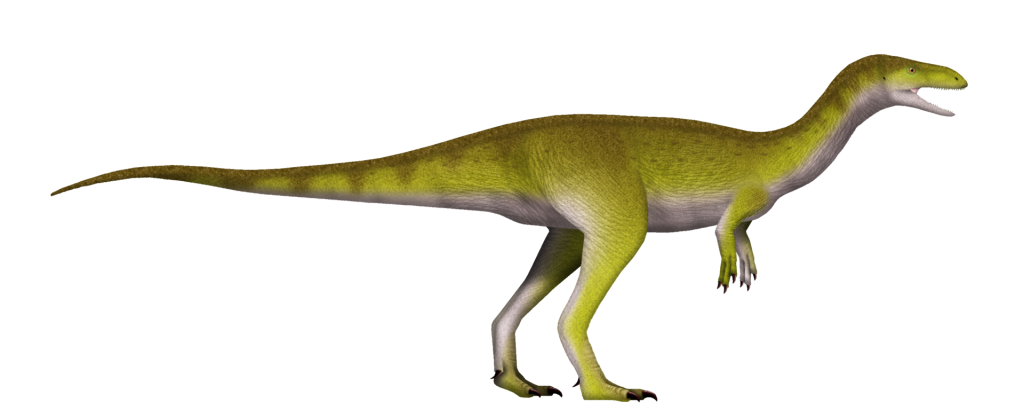
Its neck vertebrae were elongate, and one centrum (vertebral body) is three and a half times longer than tall. News reports describe Anteavis as small, bipedal, and carnivorous, and the describers’ skeletal silhouette shows it on two legs. Its humerus measures about 3.1 inches (79.3 millimeters), well short of the hind-limb bones.
The bones also record its age—fused neural arches, a fused shoulder girdle, and fused hip bones point to skeletal maturity. Rib sections show around 16 lines of arrested growth—yearly pauses in bone growth—though the describers note they cannot be counted with confidence. Even so, they give a minimum age of twelve years. They conclude it was likely mature, or at least a young adult nearing skeletal maturity. Only bones are known, so any body covering shown in restorations is speculative.

Size and Weight of Type Species
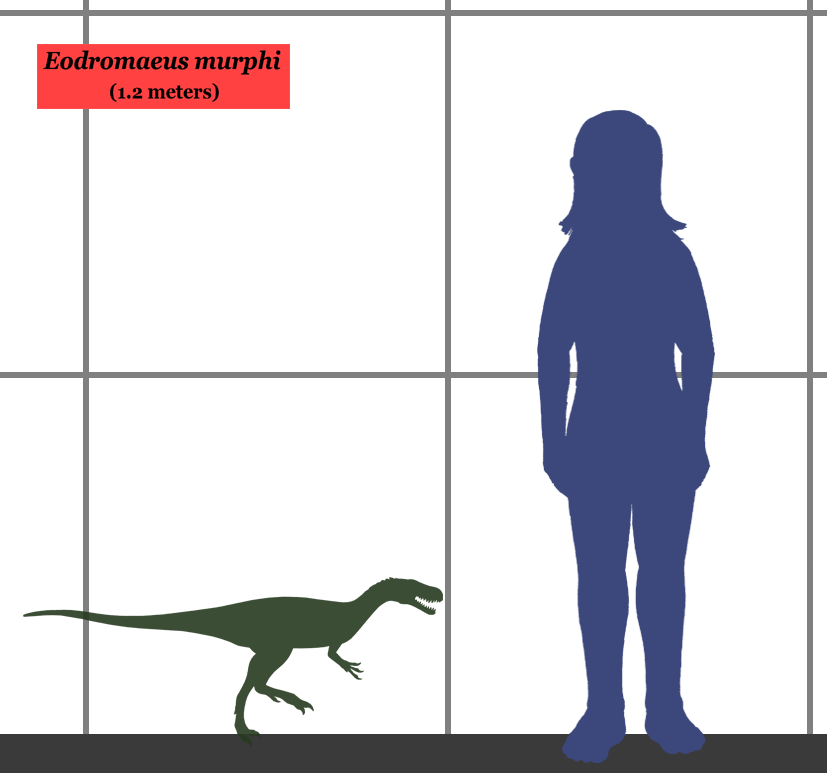
Published lengths come only from press coverage, and no report explains its method. Argentine outlets reported about 5.2 feet (1.6 meters) from head to tail, while Sci.News gave about 4 feet (1.2 meters).
The describers place Anteavis in their under-30-kilogram (66-pound) body-mass category. News reports of the description put it at about 18 to 20 pounds (8 to 9 kilograms). Martínez told reporters it was “the size of a turkey, but with a tail.”
Its thighbone is about 5.5 inches (14 centimeters) long and its shinbone about 6.7 to 6.9 inches (17 to 17.5 centimeters). The describers’ text and tables differ slightly. By contrast, they used a body mass of about 604 pounds (274 kilograms) for Herrerasaurus in their analysis.
The Dinosaur in Detail
What sets this dinosaur apart is the length of its lower leg. Its tibia is 24% longer than its femur, a ratio of about 1.2 that differs markedly from the 1.06 of Eodromaeus. The one early dinosaur the describers single out as an exception is the ornithischian Heterodontosaurus, at 1.30. Its third metatarsal, the longest foot bone, reaches 61% of tibia length. That is close to Megapnosaurus at 62% and well beyond Herrerasaurus at 52% or Tawa at 50%.
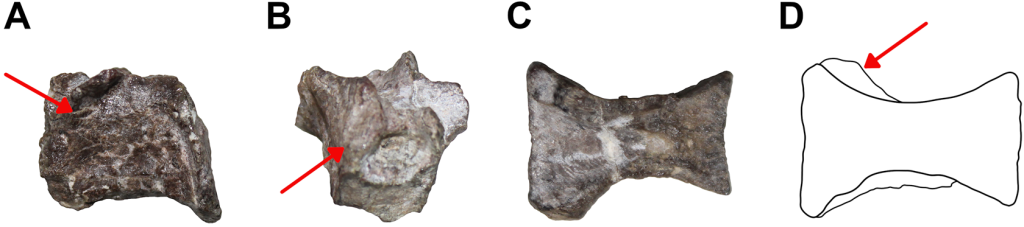
Another autapomorphy—a feature unique to Anteavis—is a large coracoid foramen (opening) on the suture between shoulder blade and coracoid. Its inner opening pierces the shoulder blade. Two similar-sized pubic openings and a blunt bump giving the femoral head’s front-outer edge a squarish outline join the list. Meanwhile, its pelvis shares key features with neotheropods, which the describers illustrate beside Eoraptor and Coelophysis. In contrast to Eodromaeus, its neck vertebrae lack pneumatic openings—pockets linked to air sacs.
The hip region is also where scientists disagree. Martínez and colleagues originally counted four sacral vertebrae, including one added from the back and one from the tail. After studying the fossil firsthand, however, Fonseca and colleagues (2026) accepted the added tail vertebra but not the back one. Even so, they treat Anteavis as confirming that a tail vertebra joined the sacrum before Neotheropoda arose.

Across all their analyses, the describers found “with very high resampling support” that Anteavis is one of the closest sister taxa to Neotheropoda. Overall, Anteavis shows how close to neotheropods a Carnian theropod could already be.
Interesting Points about Anteavis
- Argentine news coverage translates Anteavis crurilongus roughly as “ancestor of the birds with long legs.”
- Growth lines in its ribs suggest the only known individual was at least twelve years old when it died.
- The skeleton was found in 2014, according to news reports, but was not formally named until October 2025.
- Despite its neotheropod-like hip features, every analysis in the original study placed Anteavis just outside Neotheropoda.
Contemporary Dinosaurs
From similar stratigraphic levels comes Herrerasaurus, the herrerasaurid predator that names the local HEH biozone (a rock interval defined by its fossils). The describers count 60 specimens of it and class it among carnivores heavier than 30 kilograms (66 pounds). No fossil evidence links the two directly.
The closest relative of Anteavis in the formation was Eodromaeus, which the describers call the only other known Carnian theropod. They count four specimens of this small carnivore and report it from similar levels in the same formation. A 2024 study, however, placed its sampled specimen higher, at the base of the overlying Valle de la Luna Member.
Also recorded from similar levels is Eoraptor, reassessed in 2011 as a basal sauropodomorph—an early relative of the long-necked plant-eaters. In the describers’ own analysis, it groups with Panphagia, and they class it as a small herbivore or omnivore.
Also known from the Ischigualasto Formation (exact level relative to Anteavis not known unless stated): Chromogisaurus, the herrerasaurid Sanjuansaurus from the Cancha de Bochas Member, and the early sauropodomorph Panphagia. Both Sanjuansaurus and Panphagia have holotypes about 40 meters (131 feet) above the formation’s base, some 65 meters (213 feet) below Anteavis. The formation spans about 5.5 million years, so these animals may not all have lived at the same time.
Anteavis in its Natural Habitat
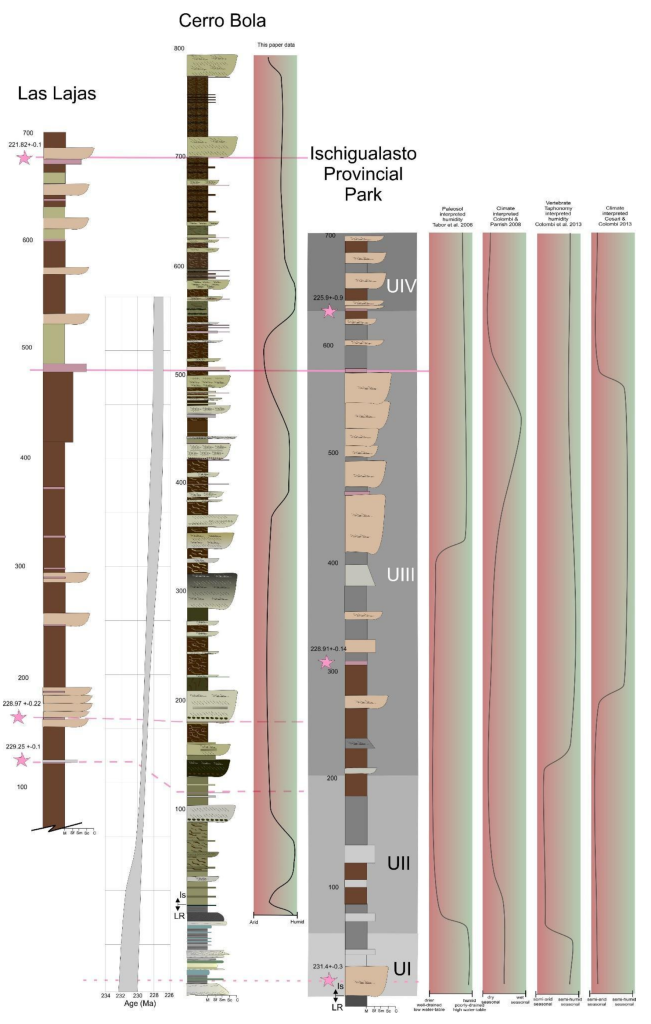
The world Anteavis roamed was one of winding rivers and thick, well-drained floodplains. Desiccation cracks and carbonate-rich soils point to semi-arid to arid conditions. Herbaceous plants left root traces on the floodplains, while silicified roots survive in old channels. Sci.News described a warm, arid savanna about two million years after the Carnian Pluvial Episode. Earlier, the end of that wet interval had helped shift the basin from lake deposits to river deposits.

The describers class Anteavis as a carnivore, and its recurved lower teeth fit that role, though its prey remains unknown. Around it, the rhynchosaur Hyperodapedon dominated—the describers count 1,855 of 2,417 vertebrate specimens from the HEH biozone, about 77%. Dinosaurs, by contrast, make up 9 of the 28 taxa, about a third, but only about 5% of specimens. The formation also yielded Pisanosaurus, long seen as an early ornithischian, though a 2017 study suggested it may be a non-dinosaurian silesaurid.
There is no direct evidence of whether Anteavis lived alone or in groups. Its world did not last. From about 228.91 million years ago, a return to humid conditions coincides with a gap in the local dinosaur record. Only about 15 million years later, in the mid-Norian, did that record recover—now characterized by larger-bodied species. Anteavis thus belongs to the earlier chapter, when—according to the describers’ body-mass analysis—dinosaurs first diversified as small-bodied species.
Anteavis Gallery
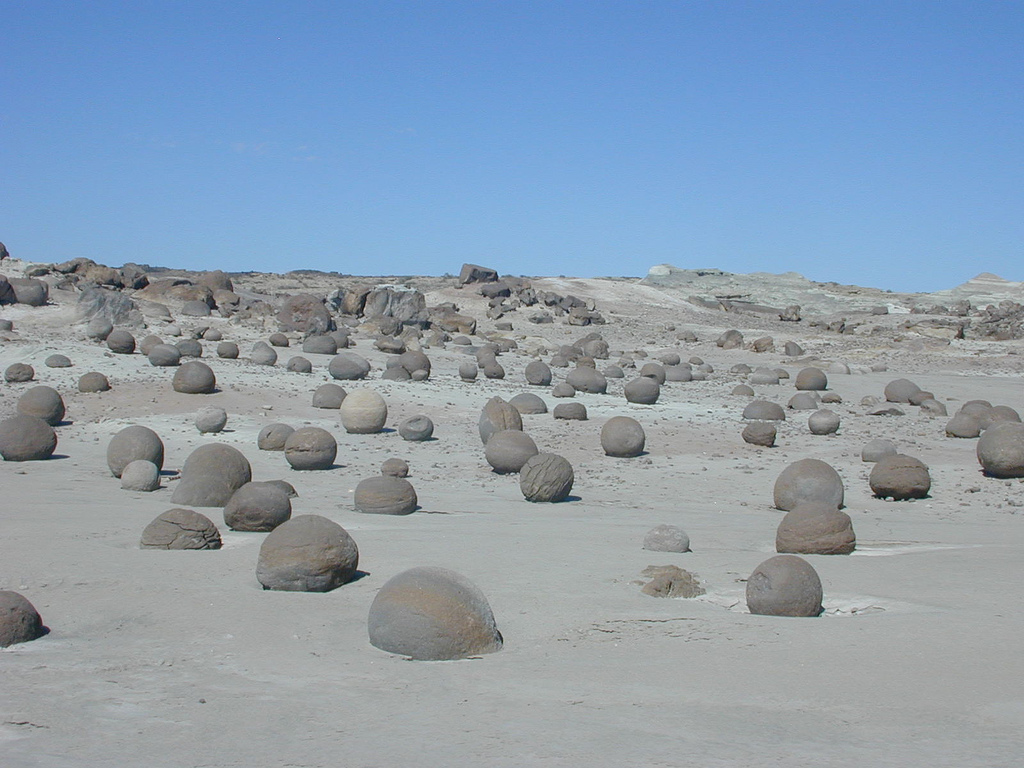
These images show Ischigualasto’s rocks and some of its dinosaurs.





Frequently Asked Questions
According to news coverage of its description, Anteavis means “ancestor of the birds” and crurilongus means “long leg.”
It lived in the late Carnian stage of the Late Triassic, between about 231.4 and 228.9 million years ago.
Its describers place it under 30 kilograms (66 pounds). News reports suggest about 18 to 20 pounds, but reported lengths disagree.
It was an early-diverging theropod and a carnivore, placed just outside Neotheropoda in every analysis of the original study.
Its only skeleton comes from the Ischigualasto Formation in Ischigualasto Provincial Park, San Juan Province, Argentina.
Its shin is 24% longer than its thigh, and its hips share features once thought exclusive to neotheropods.
Sources
The information in this article is based on various sources, drawing on scientific research, fossil evidence, and expert analysis. The aim is to provide a comprehensive and accurate overview of Anteavis. However, please be aware that our understanding of dinosaurs and their world is constantly evolving as new discoveries are made.
- https://www.nature.com/articles/s41559-025-02868-4
- https://static-content.springer.com/esm/art%3A10.1038%2Fs41559-025-02868-4/MediaObjects/41559_2025_2868_MOESM1_ESM.pdf
- https://doi.org/10.1098/rsos.261325
- https://doi.org/10.1371/journal.pone.0298242
- https://doi.org/10.3897/zookeys.63.550
- https://doi.org/10.1371/journal.pone.0004397
- https://doi.org/10.1126/science.1198467
- https://doi.org/10.1080/14772019.2017.1352623
- https://stratigraphy.org/ICSchart/ChronostratChart2024-12.pdf
- https://www.diariodecuyo.com.ar/sanjuan/importante-hallazgo-en-el-parque-ischigualasto-descubrieron-un-pequeno-dinosaurio-que-data-de-hace-unos-230-millones-de-anos-1785695.html
- https://www.tiempodesanjuan.com/san-juan/ischigualasto-asombra-la-ciencia-mundial-un-mini-dinosaurio-que-redefine-la-evolucion-n414264
- https://www.sci.news/paleontology/anteavis-crurilongus-14286.html
This article was last fact checked: TheDinosaurs Team, 25-11-2026
Featured Image Credit: Connor Ashbridge, CC BY 4.0, via Wikimedia Commons
