In the Yujingzi Basin of northwestern Gansu Province, China, pale lake shales of the Lower Cretaceous Xinminpu Group hold the bones of a large theropod with a giant arm. Paleontologists named it Suzhousaurus megatherioides in 2007 and placed it among the therizinosauroids. Its describers thought this lineage may have been primarily or wholly herbivorous. It lived late in the Early Cretaceous, during the Aptian to early Albian stages. Its upper arm bone alone measures 550 millimeters (21.7 inches)—among the longest theropod humeri known, according to its describers.
Paleontologist Li Daqing and six colleagues described the holotype, which came from what they called “a recently discovered locality.” A second partial skeleton followed in 2008, and researchers studied a lone tooth in 2017. From the first skeleton alone, its describers judged Suzhousaurus one of the largest-known Early Cretaceous therizinosauroids. In their words, it shows that the group “attained considerable body size early in its evolutionary history.”
Suzhousaurus Key Facts
| Keyword | Fact |
|---|---|
| Pronunciation | SOO-zhoh-SAWR-us (per a 2007 Drexel University press release) |
| Meaning of name | Megatherium-Like Lizard from Suzhou |
| Group | Theropoda (Therizinosauria) |
| Type Species | Suzhousaurus megatherioides |
| Diet | Herbivore (probable) |
| When it Lived | Roughly 121 to 110 MYA (estimated from stages, not radiometrically dated) |
| Period | Cretaceous |
| Epoch | Early Cretaceous (Aptian to early Albian stages) |
| Length | Not specified |
| Height | Not specified |
| Weight | About 6,830 pounds (3,100 kilograms), indirect 2014 estimate |
| Mobility | Probably moved on two legs (bipedal), per 2007 news reports |
| First Discovery | Year not specified in the original description (the Paleobiology Database records 1999), credited to Li Daqing and You Hailu in a 2007 news report |
| Described by | 2007 by D. Li, C. Peng, H. You, M.C. Lamanna, J.D. Harris, K.J. Lacovara, and J. Zhang |
| Holotype | FRDC-GSJB-99 |
| Location of first find | Yujingzi Basin, Jiuquan area, Gansu Province, China (Xinminpu Group) |
Suzhousaurus Origins, Taxonomy and Timeline
Suzhousaurus takes its name from “Suzhou,” the ancient name of the Jiuquan area where the skeleton was found, plus the Greek sauros, meaning “lizard.” Meanwhile, the species name megatherioides means “like Megatherium,” a genus of giant ground sloth. Together, 2007 news coverage rendered the full name as “giant sloth-like reptile from Suzhou.”
Suzhousaurus belongs to Therizinosauria, a peculiar branch of the theropods. In 2007, Li and colleagues classified it as a basal therizinosauroid and recovered it as the sister taxon of Nothronychus. In their tree, the pair was more derived than Beipiaosaurus and Falcarius but less derived than Alxasaurus and the family Therizinosauridae. Suzhousaurus megatherioides is the type and only known species.
The original paper dated the fossil beds only “broadly” to the late Early Cretaceous, tentatively the Aptian to Albian stages. Later, a 2013 study by Pu and colleagues listed the Xinminpu Group as Albian alone. The beds have never been dated radiometrically. However, in 2018, Suarez and colleagues used carbon isotopes to place the Yujingzi sequence in the Aptian to early Albian. Their scheme tentatively assigns Suzhousaurus to the early Albian Zhonggou Formation, above the late Aptian Xiagou Formation. That would put it roughly 121 to 110 million years ago—late in the Early Cretaceous, though not at its very end.
Discovery & Fossil Evidence
The holotype came from white to gray sandy shale marked by small, symmetrical ripples. While the 2007 paper gives no discovery year, the Paleobiology Database records the collection date as 1999. A 2007 LiveScience report credited Li Daqing and You Hailu with finding the partial skeleton. Its exact level is disputed. The Paleobiology Database files the holotype in the upper Xiagou Formation but the 2004 specimen in the Zhonggou “Lower Red Beds.” In 2019, however, Suarez and colleagues placed Suzhousaurus in red beds—an awkward fit with the holotype’s white-to-gray shale.
The holotype, cataloged as FRDC-GSJB-99, now rests in Lanzhou. It belongs to the Fossil Research and Development Center of the Third Geology and Mineral Resources Exploration Academy of Gansu. Its bones comprise 10 partial to nearly complete dorsal (back) vertebrae, ribs, and a nearly complete right scapulocoracoid (shoulder blade and coracoid). It also includes a complete right humerus (upper arm bone) and a possible pubic peduncle, the strut joining the left ilium (main hip bone) to the pubis. Rounding it out are a largely complete left pubis (a lower hip bone), a fragmentary right pubis, and unidentified fragments. However, no skull material survives.
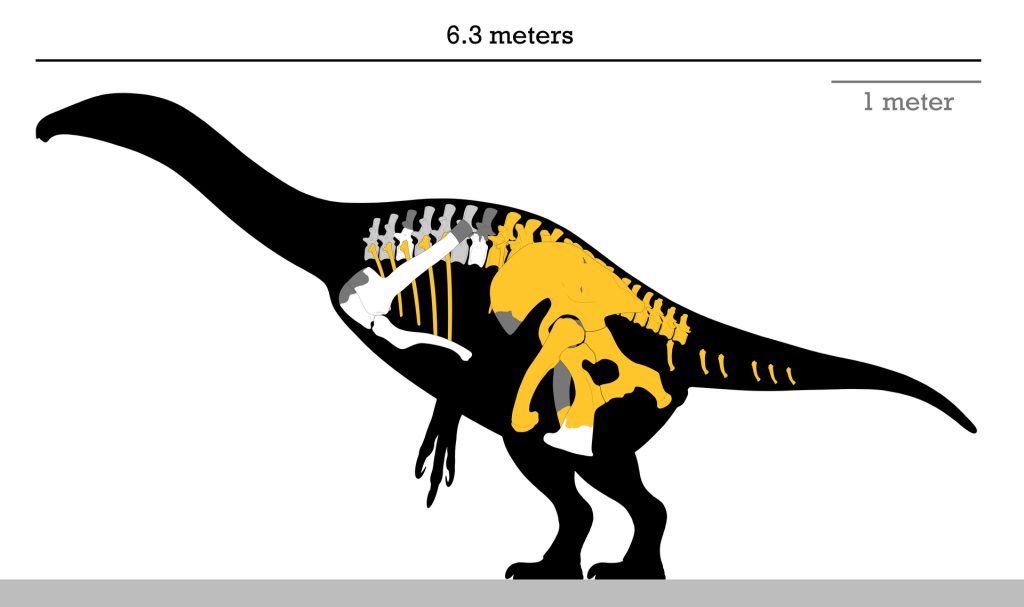

In 2008, Li, You, and Zhang Jianping described a second partial skeleton, FRDC-GSJB-2004-001, from the same basin. It includes “a well-preserved left half of the pelvic girdle,” and its pubic shaft shows the holotype’s distinctive forward concavity. Researchers have also referred an uncataloged dentary (lower jaw) tooth from the basin to the species. No specimens have yet been confirmed outside the Yujingzi Basin.
Suzhousaurus Size and Description
Without a skull or complete limbs, any portrait of Suzhousaurus rests on its back, shoulder, arm, and hips.
Short description of Suzhousaurus
Along the back, large fossae (shallow hollows)—probably made by air sacs—scooped out the sides of the vertebrae. These hollows grew shallower toward the tail, while the undersides of the vertebral bodies arched strongly upward. At the front of the series the neural spines stood almost upright, then tilted farther back toward the hips. There, the last two back vertebrae had fused together.
The shoulder girdle was “remarkably curved” seen from above. Its glenoid, the shoulder socket, faced downward as in Falcarius and Therizinosaurus, although it was shallower and less clearly defined. The describers thought the scapula and coracoid might be fused, and a 2021 list by Liao and colleagues counts them as fused. Meanwhile, the second specimen added a thin, flat, outward-flaring front blade on the ilium. Yao and colleagues in 2019 also noted a forward-bowed femur (thigh bone) whose head sits on a distinct neck.
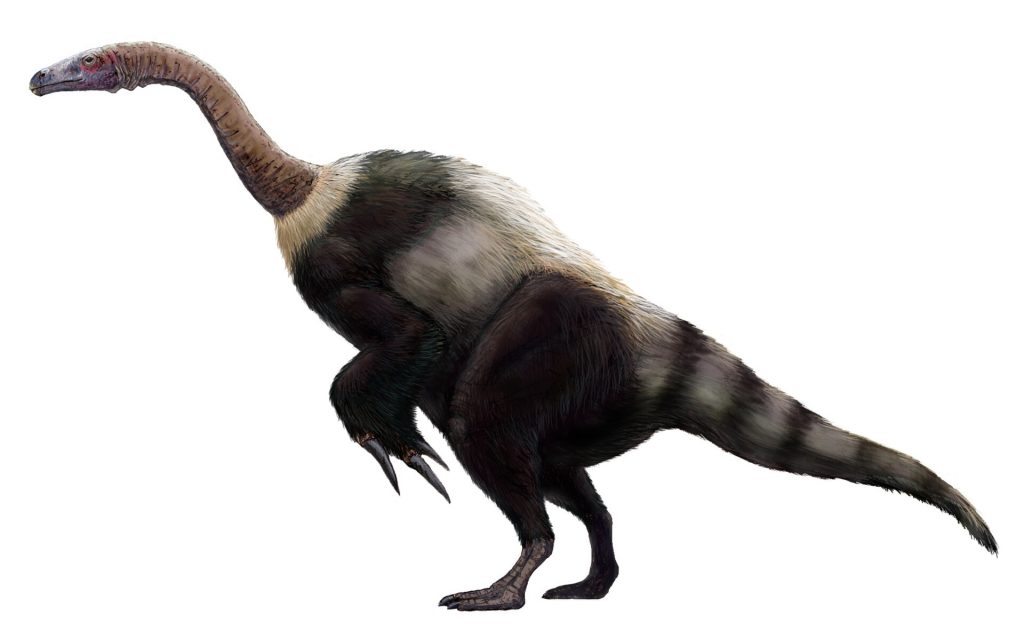

No skin or feathers are known for this animal. Still, team member Matthew Lamanna told LiveScience in 2007 that therizinosaurs were probably all feathered, so any feathered restoration rests on its relatives. The same coverage said it walked only on its hind legs, a point the scientific papers leave aside.
Size and Weight of Type Species
No peer-reviewed body length exists for Suzhousaurus. In 2007, LiveScience reported a length of about 21.3 feet (6.5 meters) from head to tail, but it did not name a source.
Instead, the firmest number is a direct measurement—a humerus 21.7 inches (550 millimeters) long. In the 2007 comparison table, the humeri of Segnosaurus and Therizinosaurus measure 560 and 760 millimeters. In 2014, Roger Benson and colleagues estimated a body mass of about 6,830 pounds (3,100 kilograms), or about 3.4 short tons. Their method scales body mass from the shaft circumference of limb bones, so the figure is indirect.
Whatever its exact weight, Suzhousaurus is the largest theropod yet named from the Yujingzi Basin. In 2010, Makovicky and colleagues ranked it as the largest theropod in the Xinminpu fauna, ahead of the ostrich-mimic Beishanlong. In their view, the pair and Gigantoraptor show giant size evolving separately in beaked, possibly herbivorous lineages.
The Dinosaur in Detail
What sets this dinosaur apart are two diagnostic traits, according to its 2007 describers. The shoulder socket is shallow and poorly defined, with a rounded, striated swelling on the shoulder blade beside it. In addition, the pubis has a strongly concave front margin—”more so than in other therizinosauroids.”
The humerus confirmed its identity—its strongly expanded ends, inner tuberosity, and hypertrophied entepicondyle (an enlarged inner elbow knob) “definitively establish” it as a therizinosauroid. However, its deltopectoral crest, the ridge that anchored the chest and shoulder muscles, covered less than the top third of the bone. In Therizinosaurus, by contrast, it runs over 60 percent of the humerus length.
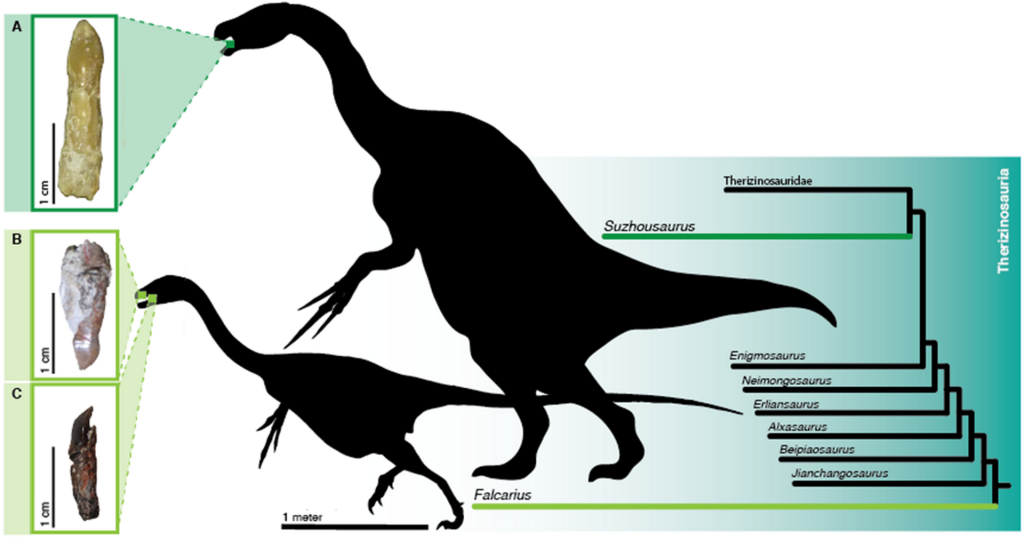

Its place in the family tree has shifted with almost every study. The 2007 analysis found 6,092 equally parsimonious trees and paired Suzhousaurus with Nothronychus. A year later, Li and colleagues concluded that it was “likely closely related to Alxasaurus.” Later studies place it outside Therizinosauridae as Zanno defined the family in 2010. Similarly, in 2019, Hartman and colleagues found it outside a clade of Segnosaurus, Erlikosaurus, and kin. In contrast, a new definition by Kobayashi and colleagues in 2022 made it the only Early Cretaceous therizinosaurid. Their 2025 study again recovered it within Therizinosauridae, close to Therizinosaurus.
Its very name could change. The 2007 authors could not rule out that it is the same species as “Nanshiungosaurus” bohlini. That species rests on neck and back vertebrae from possibly coeval Mazongshan beds, and in their view it is clearly not a true Nanshiungosaurus. If the two match, the genus Suzhousaurus would stand, but the species would become Suzhousaurus bohlini. Unfortunately, the only overlapping bones—front back vertebrae of “N.” bohlini—cannot currently be located. Taken together, Suzhousaurus remains a well-defined animal with an unsettled family tree—and, possibly, a borrowed name in waiting.
Interesting Points about Suzhousaurus
- Its species name compares it to Megatherium, the giant ground sloth, rather than to any reptile.
- At 550 millimeters, its humerus ranks among the longest theropod upper arm bones yet discovered, although no skull of the animal is known.
- A single referred lower tooth took an estimated 79 to 80 days to form, according to a 2017 growth-line study.
- In a 2022 analysis, Kobayashi and colleagues redefined the family and recovered it as the only therizinosaurid known from the Early Cretaceous.
Dinosaurs from the Same Formation
Also known from the Yujingzi Basin’s Xinminpu Group (exact level relative to Suzhousaurus not known): the early horned dinosaur Auroraceratops, the giant ornithomimosaur Beishanlong, the long-snouted tyrannosauroid Xiongguanlong, the long-necked sauropod Qiaowanlong, and the hadrosauriforms Jintasaurus and Xuwulong. Qiaowanlong was first described as a brachiosaurid. However, in 2010, Ksepka and Norell placed it on the somphospondylan branch of the titanosauriforms instead. In 2019, Suarez and colleagues split these beds into an older, late Aptian Xiagou Formation and a younger, early Albian Zhonggou Formation. They tentatively placed Suzhousaurus in the younger unit, the same one that yields most Auroraceratops finds. By contrast, the holotypes of Beishanlong and Xiongguanlong come from gray mudstones near the base of the sequence—the facies that study placed in the late Aptian. Because the correlations remain tentative, these animals may not all have lived at the same time.
Suzhousaurus in its Natural Habitat
The world Suzhousaurus roamed was a sinking, low-relief basin filled mostly with sand and mud. Its ripple-marked beds formed in a shallow lake, where gentle wave currents still touched the bottom. In the same rock sequence, thick red to purple soils up to 3.3 feet (1 meter) held plant fragments and snails. Meanwhile, pollen samples show abundant gymnosperms—but no flowering-plant pollen at all. In a 2007 Drexel press release, co-author Kenneth Lacovara described a warm, semi-arid plain dotted with shallow, ephemeral lakes.
Suzhousaurus was probably a herbivore, although the original paper made that point for therizinosauroids as a group. Its one known tooth was cone-shaped and about 0.8 inch (2.1 centimeters) long including the root. The crown alone measures 0.88 centimeter (about 0.35 inch), with a shallow wear facet near the tip. In 2017, Button and colleagues found simple enamel in the two therizinosaurs they sampled, Suzhousaurus included. That suggests most of the group did not rely heavily on processing food in the mouth. News coverage in 2007 speculated that its claws might have pulled branches toward its mouth like a ground sloth’s.
While there is no direct evidence of whether Suzhousaurus lived alone or in groups, its neighbors in time are debated. In 2010, Makovicky and colleagues called it “co-eval and sympatric” with Beishanlong, whose holotype came from gray beds with turtles, hadrosauroids, and tyrannosauroids. Yet one Beishanlong specimen came from the overlying red beds, where the 2019 scheme puts Suzhousaurus, so how far the two overlapped is unclear. The basin also holds bonebeds of basal hadrosauroids and of small horned dinosaurs, possibly Auroraceratops. In 2018, You and colleagues called the wider Mazongshan fauna “unique,” distinct from the Jehol Biota and apparently lacking parrot-beaked psittacosaurids.
Frequently Asked Questions
It means “lizard from Suzhou,” the ancient name of the Jiuquan area, and megatherioides means “like Megatherium,” the giant ground sloth.
It lived in the Early Cretaceous, probably the Aptian to early Albian stages, roughly 121 to 110 million years ago.
A 2014 study estimated about 6,830 pounds. Its humerus is 21.7 inches long, but no peer-reviewed body length exists.
It was probably a herbivore like other therizinosaurs, and its simple tooth enamel hints at little food processing in the mouth.
Its fossils come from the Xinminpu Group of the Yujingzi Basin, in the Jiuquan area of Gansu Province, China.
It was one of the largest-known Early Cretaceous therizinosauroids, with a distinctive shoulder socket and a strongly concave hip bone.
Sources
The information in this article is based on various sources, drawing on scientific research, fossil evidence, and expert analysis. The aim is to provide a comprehensive and accurate overview of Suzhousaurus. However, please be aware that our understanding of dinosaurs and their world is constantly evolving as new discoveries are made.
- https://doi.org/10.1111/j.1755-6724.2007.tb00977.x
- https://www.academia.edu/10077283
- https://doi.org/10.1139/E08-021
- https://doi.org/10.1098/rspb.2009.0236
- https://doi.org/10.1098/rspb.2009.0249
- https://doi.org/10.1098/rspb.2009.1278
- https://doi.org/10.1139/E09-067
- https://doi.org/10.1111/j.1755-6724.2011.00377.x
- https://ivpp.cas.cn/cbw/gjzdwxb/xbwzxz/201204/t20120423_3561430.html
- https://doi.org/10.1080/02724634.2017.1399136
- https://doi.org/10.1080/02724634.2017.1396995
- https://doi.org/10.7717/peerj.4129
- https://doi.org/10.1371/journal.pbio.1001853
- https://doi.org/10.1371/journal.pone.0129449
- https://doi.org/10.1371/journal.pone.0063423
- https://doi.org/10.1038/s41598-019-41560-z
- https://doi.org/10.7717/peerj.7247
- https://doi.org/10.1371/journal.pone.0257913
- https://doi.org/10.1038/s41598-022-11063-5
- https://doi.org/10.1016/j.isci.2025.112141
- https://paleobiodb.org/classic/basicTaxonInfo?taxon_no=112901
- https://drexel.edu/news/archive/2007/October/Drexel-Researcher-among-Team-that-Discovered-Giant-Feathered-Plant-Eating-Dinosaur-from-Ancient-Chin
- https://www.livescience.com/9537-big-waddling-dinosaur-discovered.html
- https://doi.org/10.1080/02724634.2018.1510412
- https://doi.org/10.1206/3700.2
This article was last fact checked: TheDinosaurs Team, 17-11-2026
Featured Image Credit: SSR2000, CC BY-SA 3.0, via Wikimedia Commons
