
Near the city of Beipiao in western Liaoning, China, lie the ancient lake beds of the lower Yixian Formation. Among their fossils is a small theropod with a fan of feathers at the tip of its tail. Named Caudipteryx zoui in 1998, it lived around 125 million years ago, during the Barremian stage of the Early Cretaceous. Its describers judged that it was likely flightless and more primitive than Archaeopteryx, long regarded as the earliest known bird. As a result, it soon became a test case in the argument over where dinosaurs end and birds begin.
In June 1998, paleontologists Ji Qiang, Philip J. Currie, Mark A. Norell, and Ji Shu-An described the genus in Nature. The same paper also redescribed a second feathered theropod, Protarchaeopteryx, which Ji Qiang and Ji Shu-An had named the year before. Since then, nearly complete skeletons, a second species, and even a fossil cell nucleus have filled out the picture. Most researchers now place Caudipteryx near the base of the oviraptorosaurs. Even so, its exact position within that group still varies between studies.
Caudipteryx Key Facts
| Keyword | Fact |
|---|---|
| Pronunciation | caw-dip-ter-iks |
| Meaning of name | Tail Feather |
| Group | Theropoda (Oviraptorosauria) |
| Type Species | Caudipteryx zoui |
| Diet | Probably mainly plants, possibly omnivorous (inferred) |
| When it Lived | Around 125 MYA |
| Period | Cretaceous |
| Epoch | Early Cretaceous (Barremian stage) |
| Length | About 3.3 feet (1 meter), Natural History Museum figure |
| Height | Not specified |
| Weight | About 11 pounds (5 kilograms), estimated from femur length |
| Mobility | Moved on two legs (bipedal) |
| First Discovery | Year not specified (described in 1998) |
| Described by | 1998 by Q. Ji, P.J. Currie, M.A. Norell, and S.-A. Ji |
| Holotype | NGMC 97-4-A |
| Location of first find | Sihetun area near Beipiao, lower Yixian Formation (originally “Chaomidianzi Formation”), western Liaoning, China |
Caudipteryx Origins, Taxonomy and Timeline
The name Caudipteryx means “tail feather,” and the American Museum of Natural History’s 1998 announcement ties it to the plume fan at the tail tip. Caudipteryx zoui is the type species. Later, in 2000, Zhou Zhonghe and Wang Xiaolin added a second species, C. dongi.
Ji and colleagues’ 1998 verdict placed it outside Avialae, the bird lineage. However, a 2002 study by Teresa Maryańska and colleagues reports that paleontologist Paul Sereno moved it into Oviraptorosauria in 1999. Their own analysis placed it as a basal, or early-branching, member. By 2019, three species had been placed in its family, Caudipteridae—C. zoui, C. dongi, and Similicaudipteryx yixianensis. That year, Qiu and colleagues added a fourth, Xingtianosaurus ganqi, also from the Yixian Formation. Caudipterids share teeth in the premaxilla (the front upper jaw bone) and a short tail. In addition, Caudipteryx has a specialized hand whose third finger is strongly reduced, to just two short phalanges (finger bones).
The original paper assigned the rocks to the “Upper Jurassic/Lower Cretaceous” Chaomidianzi Formation. In 1999, however, Swisher and colleagues showed that the lower Yixian lake beds holding Caudipteryx are not Jurassic. Argon-argon dates from tuffs in the Sihetun and Jianshangou sections came out at about 125.4 to 125.5 million years. Wang and colleagues reported those figures that same year. Then, in 2021, Zhong and colleagues bracketed the whole Yixian Formation between roughly 125.8 and 124.1 million years ago. That window, only about 1.6 million years long, falls in the Barremian stage.
Discovery & Fossil Evidence
The holotype—the specimen that anchors the name—comes from the Sihetun area near Beipiao. Ji and colleagues called the beds the “Jiulongsong Member” of their Chaomidianzi Formation. In contrast, the Paleobiology Database places them in the lower Yixian Formation’s Jianshangou member.
The holotype, NGMC 97-4-A, belongs to the National Geological Museum of China in Beijing. In 2005, Gareth Dyke and Norell labeled its skull, vertebrae (backbones), ribs, limbs, hips, gastroliths (gizzard stones), and feather imprints. The 1998 paper also figured the skull of a second specimen, NGMC 97-9-A, which Dyke and Norell called the worst preserved published specimen. Although its hind limbs are mostly complete, it lacks the ilia (upper hip bones) and sacrum.
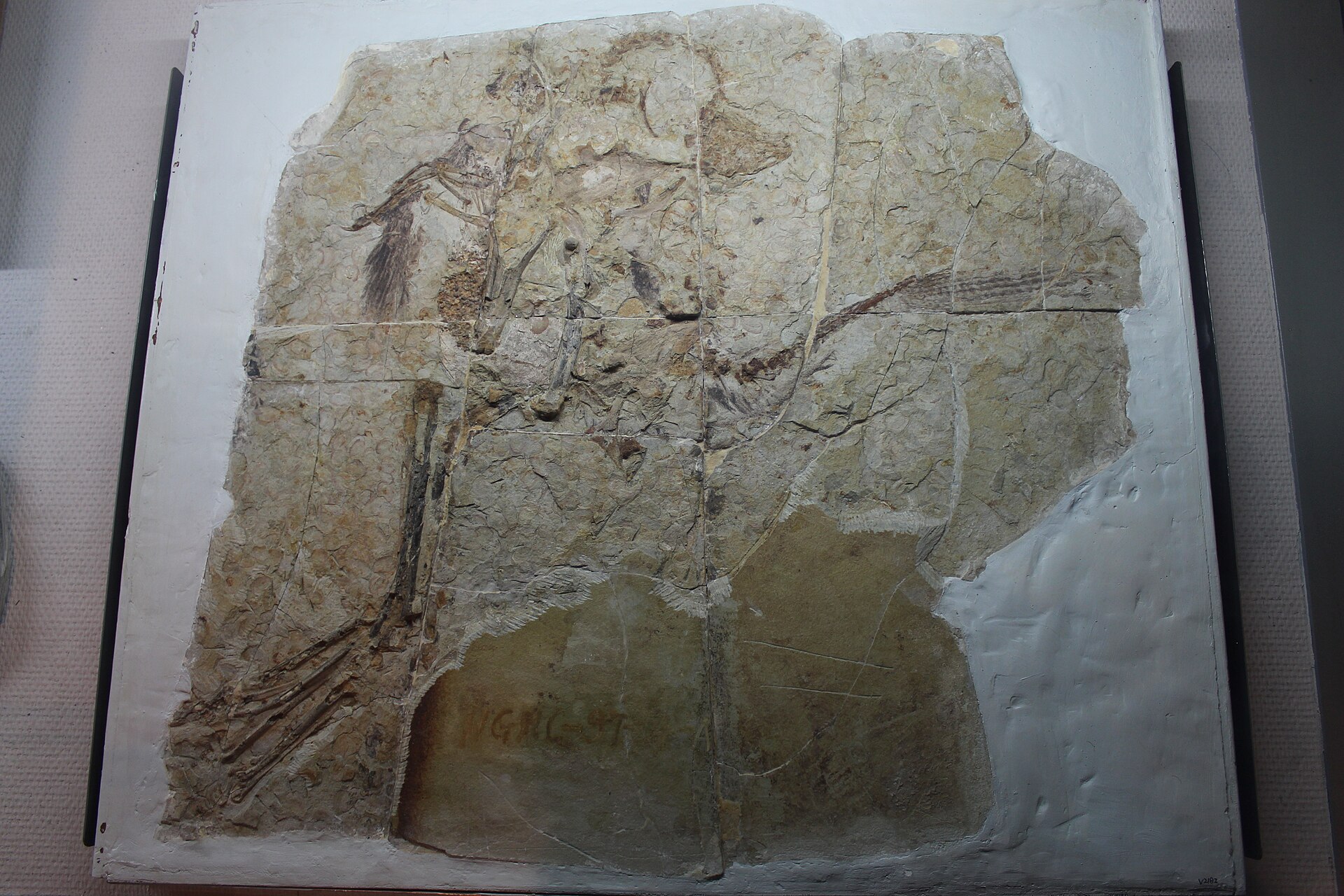

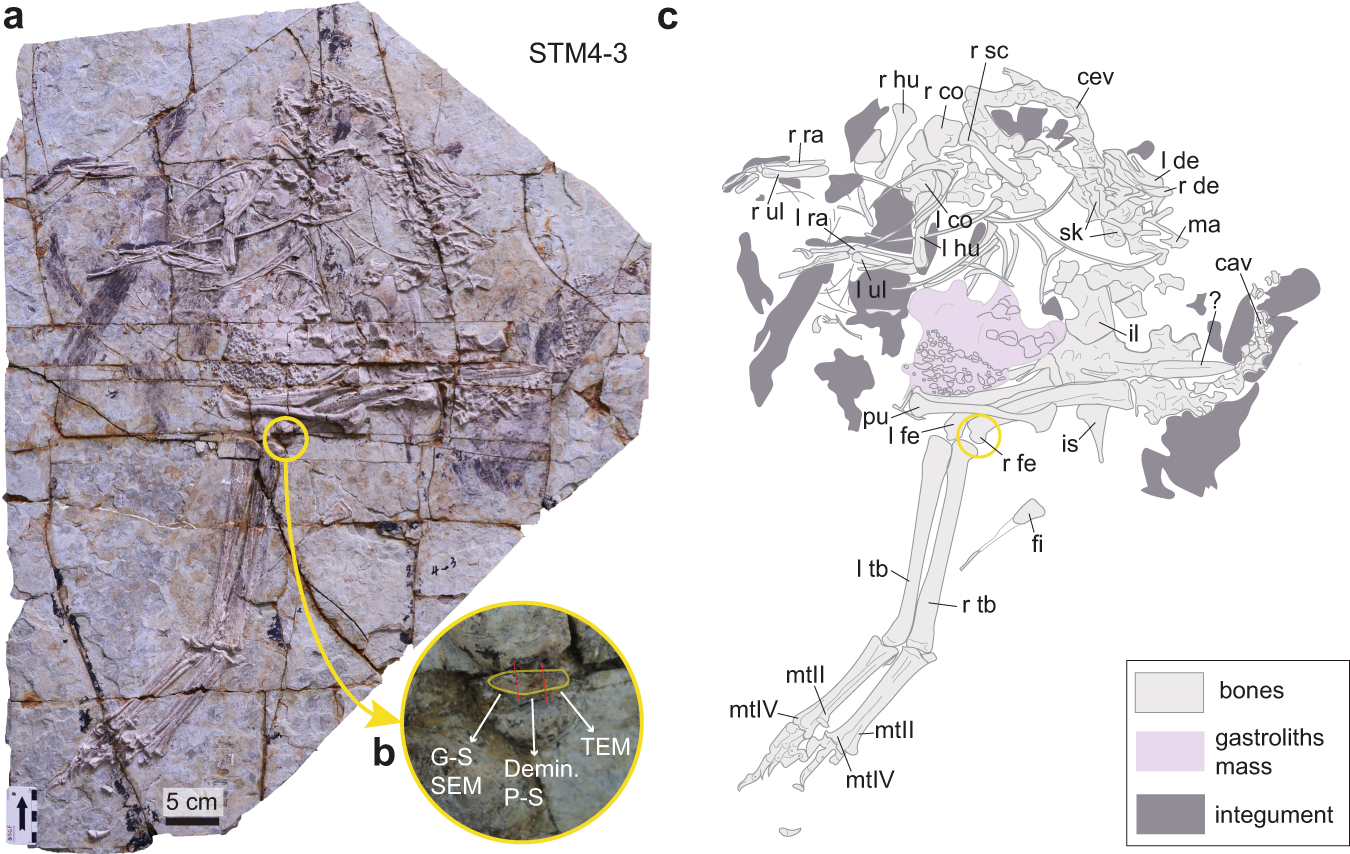
In 2000, Zhou, Wang, and colleagues described two nearly complete new specimens, and later studies cite that work for BPM 0001 and IVPP V12430. The first, at the Beipiao Paleontological Museum, is complete and well preserved but has no plumage attached. According to the Paleobiology Database, C. dongi comes from Zhangjiagou, about 1.9 miles (3 kilometers) northeast of Sihetun, where the IVPP collected in 1998. More recently, specimen STM4-3 from near Dapingfang Town in Chaoyang City added traces of feathers and integument plus a mass of gizzard stones.
Caudipteryx Size and Description
Thanks to several nearly complete skeletons, much of its anatomy is known.
Short description of Caudipteryx
Its skull was still moderately long in front of the eyes, and the premaxilla carried four recumbent, or forward-leaning, teeth. The lower jaws met at an unfused symphysis—the joint at the chin. Two oval sternal plates formed the breastbone, while the humerus (upper arm bone) was about half as long as the femur (thigh bone).
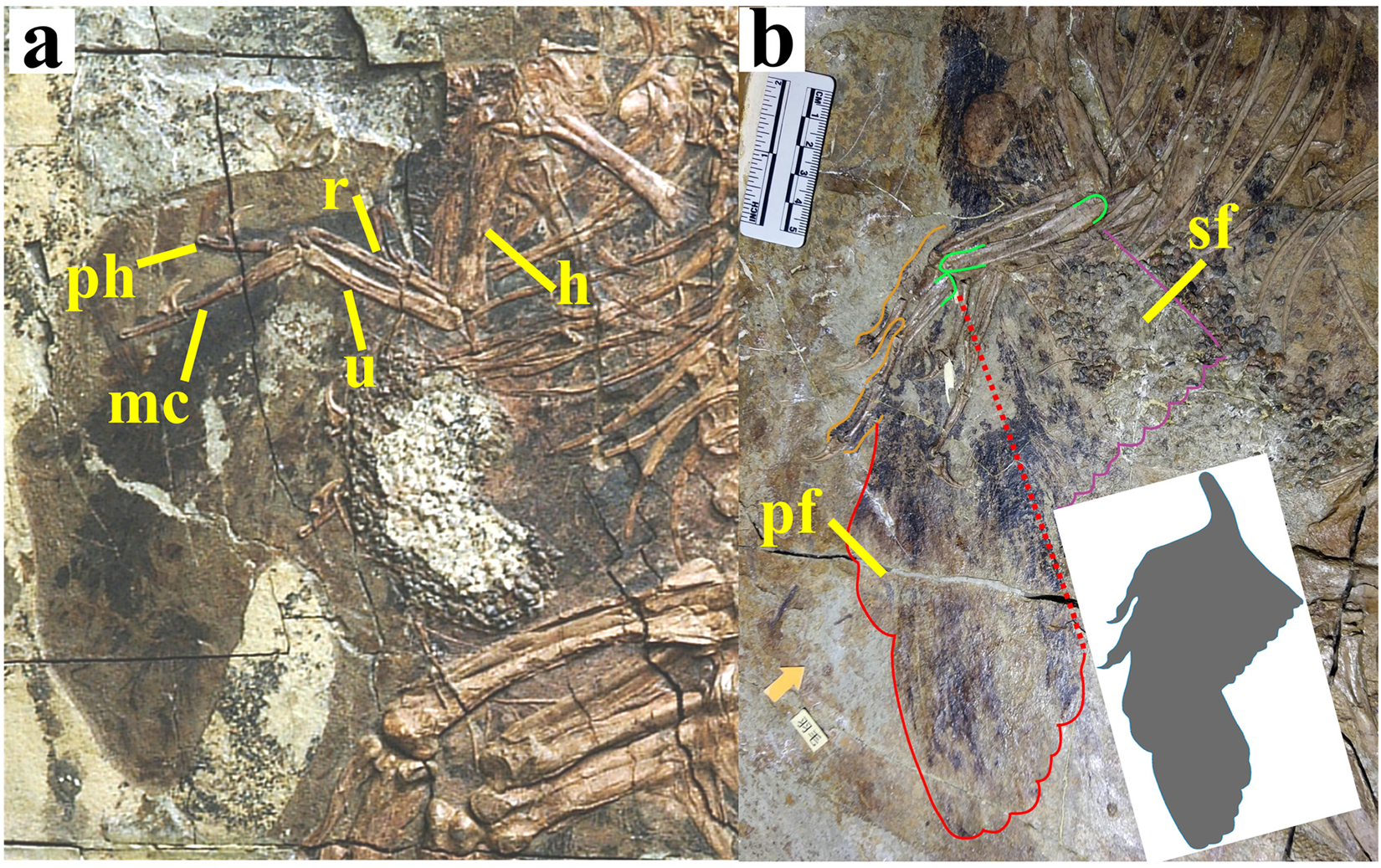
On the arms, its vaned (pennaceous) wing feathers were concentrated on the hand. Qiu and colleagues describe them as attached only to the metacarpals (hand bones), though Talori and colleagues also identified secondary feathers along the forearm. Vaned feathers also formed the tail fan. Specimen IVPP V12344, cited as C. dongi, had nine primaries, the main feathers of the hand. The tail held 22 vertebrae and lacked a pygostyle, the fused tail tip of modern birds. Even so, its last five vertebrae appear tightly joined. Fused vertebrae and well-ossified wrist and ankle bones indicate that the described skeletons belonged to adults.

Size and Weight of Type Species
We found no peer-reviewed body length for Caudipteryx, so London’s Natural History Museum figure of about 3.3 feet (1 meter) is the best available. The legs are better documented, thanks to data from the 1998 paper that Dyke and Norell tabulated. In that table, the femur of NGMC 97-9-A is 5.9 inches (149 millimeters) long, and the whole leg 17.6 inches (448 millimeters).
Body mass comes from equations that scale weight to femur length, so every figure is an estimate. In 2018 and 2019, Yaser Saffar Talori and colleagues reported 10.4 to 11.4 pounds (4.74 to 5.18 kilograms) for five specimens. Their mean was about 11 pounds (5 kilograms). Using two sets of published measurements, Dececchi and colleagues reached 12.2 pounds (5.52 kilograms) and 8.3 pounds (3.77 kilograms) in 2016. By comparison, the museum’s 4.4 pounds (2 kilograms) sits well below all of these.
Citing Dececchi’s figures, Talori’s team set basal oviraptorosaurs side by side—about 5.5 pounds for Protarchaeopteryx and 8.8 pounds for Similicaudipteryx, against about 11 for Caudipteryx.
The Dinosaur in Detail
What sets this dinosaur apart is how bird-like it looks—and how sharply researchers have disagreed over what that means. In 2000, Jones and colleagues argued that its center of mass sat forward and its leg proportions resembled those of running birds. Maryańska’s team went further in 2002. Their analysis placed oviraptorosaurs inside Avialae, as the sister group to the early bird Confuciusornis, and called them secondarily flightless.
Others pushed back. Also in 2002, Per Christiansen and Niels Bonde found its center of gravity no further forward than in other non-avian theropods. Then, in 2005, Dyke and Norell reported problems with the earlier measurements. For instance, the holotype’s trunk length cannot be measured, yet Jones’s team gave it to the millimeter. Dyke and Norell therefore saw no reason to treat Caudipteryx as anything other than a small non-avialan theropod.

Debate over what its bird-like traits mean has continued. In 2014, Persons, Currie, and Norell wrote that its exact phylogenetic position “is not clear.” A decade later, Yosef Kiat and Jingmai O’Connor revived the idea of lost flight in a new form. Nine primaries, they argued, point to a flying ancestor, while low vane asymmetry—how lopsided a feather is around its shaft—fits a flightless animal. They concluded that Caudipteryx was secondarily flightless, yet still a non-avian dinosaur rather than a bird.
Maryańska’s team also found its feathers similar to those of Archaeopteryx and Confuciusornis. In addition, their analysis ranked Avimimus and Caudipteryx as successively closer relatives of Oviraptoroidea, the more derived oviraptorosaurs. Taken together, these studies describe a mosaic of primitive and derived traits—read differently by each side of the debate.
Interesting Points about Caudipteryx
- A cartilage cell in specimen STM4-3 keeps a nucleus with fossilized threads of chromatin, only the second such case in a vertebrate.
- Pigment studies found its sampled body feathers black, while its tail feathers preserve a visible banding pattern.
- A 2018 model based on the legs of specimen BPM 0001 put its top speed at about 18 miles per hour (8 meters per second).
- The National Geographic Society unveiled Caudipteryx in Washington on 23 June 1998, two days before the description appeared in Nature.
- Soft tissue comparable to a propatagium—the skin fold along the front edge of a bird’s wing—survives on the forelimb of specimen IVPP V12430.
Contemporary Dinosaurs
Sharing the same lake shores was Sinosauropteryx, a small theropod that Chen Pei-ji and colleagues, describing it in detail in 1998, judged closely related to Compsognathus. They also credited it with the longest tail of any known theropod—quite unlike the short tail of Caudipteryx. Its remains come from the same Jianshangou member near Sihetun. However, no fossil records any interaction between the two.
Closest of all, at least in the literature, was Protarchaeopteryx robusta, named in 1997 and redescribed alongside Caudipteryx in the same 1998 paper. The 1998 paper judged that it, too, was likely flightless and more primitive than Archaeopteryx. The Paleobiology Database places it in the same Sihetun collection as the Caudipteryx holotype, but nothing more connects the two.
Adding further diversity was Sinornithosaurus, a dromaeosaurid with a filamentous integument—a covering of fine fibers. Its describers announced it in 1999 from Sihetun, which they called “the famous Mesozoic fish–dinosaur–bird locality.” Its fossils also come from the Jianshangou member.
Rounding out the cast was Beipiaosaurus, a therizinosauroid that also bore integumentary filaments. Its fossils come from the same Sihetun collection as Sinornithosaurus, again in the Jianshangou member.
Caudipteryx in its Natural Habitat
The world Caudipteryx roamed centered on lakes. At Sihetun, about 39 feet (12 meters) of gray-black lake shales alternate with volcanic tuffs, and most fossils lie in the lower 23 feet (7 meters). Wang and colleagues linked these beds to a rapid radiation and “a mass mortality event.” Plants, insects, fish, salamanders, turtles, frogs, pterosaurs, birds, the mammal Zhangheotherium, and the early flowering plant Archaefructus also appear in the same lower Yixian lake beds. In 2021, Zhang, Yin, and Wang estimated a mean annual temperature of about 43 °F (5.9 °C) at Sihetun. They also placed the site 1.7 to 2.5 miles (2.8 to 4.1 kilometers) high, with frozen winters.
Diet is inferred rather than observed. Specimens of C. zoui preserve masses of gizzard stones in place, and STM4-3 holds a white cluster of them. In 2007, Oliver Wings found that these clusters compare well with those of birds and suggest a gastric mill—a muscular stomach that grinds food. Similarly, Persons and colleagues noted that such stones, together with the beaks of later oviraptorosaurs, have been taken to suggest the group was mainly herbivorous. By contrast, London’s Natural History Museum describes Caudipteryx as omnivorous.
No direct evidence shows whether Caudipteryx lived alone or in groups, but its anatomy hints at how it moved and signaled. Persons and colleagues suggested that short, muscular oviraptorosaur tails with feather fans served for display. The same team linked its long lower legs to moderate running ability. Robot and ostrich experiments also led Talori’s team to propose that running could make small wings flap passively.
Frequently Asked Questions
It means “tail feather,” a reference to the fan of plumes at the tip of its tail.
It lived around 125 million years ago, during the Barremian stage of the Early Cretaceous.
Estimates based on femur length put it at about 11 pounds. The Natural History Museum gives a length of about 3.3 feet.
It probably ate mainly plants, though it may have been omnivorous. The inference comes from its gizzard stones and from studies of oviraptorosaurs as a group.
Its holotype comes from the lower Yixian Formation in the Sihetun area near Beipiao, in western Liaoning, China.
Some researchers argued it was a flightless bird, but most later studies treat it as a feathered, non-avian theropod dinosaur.
Sources
The information in this article is based on various sources, drawing on scientific research, fossil evidence, and expert analysis. The aim is to provide a comprehensive and accurate overview of Caudipteryx. However, please be aware that our understanding of dinosaurs and their world is constantly evolving as new discoveries are made.
- https://doi.org/10.1038/31635
- https://ideas.repec.org/a/nat/nature/v393y1998i6687d10.1038_31635.html
- https://www.app.pan.pl/archive/published/app50/app50-101.pdf
- https://www.app.pan.pl/archive/published/app47/app47-097.pdf
- https://www.app.pan.pl/archive/published/app59/app20120093.pdf
- https://www.app.pan.pl/archive/published/app52/app52-001.pdf
- https://ideas.repec.org/a/nat/nature/v406y2000i6797d10.1038_35021041.html
- https://link.springer.com/article/10.1007/BF02465486
- https://pmc.ncbi.nlm.nih.gov/articles/PMC6294793/
- https://pmc.ncbi.nlm.nih.gov/articles/PMC6497222/
- https://pmc.ncbi.nlm.nih.gov/articles/PMC4941780/
- https://pmc.ncbi.nlm.nih.gov/articles/PMC6483983/
- https://pmc.ncbi.nlm.nih.gov/articles/PMC8463611/
- https://pmc.ncbi.nlm.nih.gov/articles/PMC9951497/
- https://pmc.ncbi.nlm.nih.gov/articles/PMC10895369/
- https://pmc.ncbi.nlm.nih.gov/articles/PMC7004074/
- https://pmc.ncbi.nlm.nih.gov/articles/PMC3017133/
- https://ideas.repec.org/a/nat/nature/v400y1999i6739d10.1038_21872.html
- https://pmc.ncbi.nlm.nih.gov/articles/PMC8288181/
- https://naturalhistory.si.edu/sites/default/files/media/translated_publications/Wang%26amp%3B_99.pdf
- https://api.crossref.org/works/10.1029/2021GL094370
- https://ideas.repec.org/a/nat/nature/v391y1998i6663d10.1038_34356.html
- https://ideas.repec.org/a/nat/nature/v401y1999i6750d10.1038_45769.html
- https://ideas.repec.org/a/nat/nature/v399y1999i6734d10.1038_20670.html
- https://paleobiodb.org/data1.2/colls/single.json?id=10764&show=full&vocab=pbdb
- https://paleobiodb.org/data1.2/colls/single.json?id=55682&show=full&vocab=pbdb
- https://stratigraphy.org/ICSchart/ChronostratChart2024-12.pdf
- https://www.nhm.ac.uk/discover/dino-directory/caudipteryx.html
- https://www.sciencedaily.com/releases/1998/06/980630081903.htm
- https://csmonitor.com/1998/0624/062498.us.us.3.html
This article was last fact checked: TheDinosaurs Team, 03-11-2026
Featured Image Credit: PaleoNeolitic, CC BY 4.0, via Wikimedia Commons
