
Along the Río La Leona in southern Patagonia, the river-laid rocks of the Cerro Fortaleza Formation hold one of the largest sauropods ever described. Named Puertasaurus reuili in 2005, this giant titanosaur lived during the Late Cretaceous—probably in the Campanian or Maastrichtian stages. Its describers ranked it with Argentinosaurus as the largest sauropods then known. Yet the whole species rests on just four vertebrae—part of the neck, one back bone, and two pieces of tail.
Fossil hunters Pablo Puerta and Santiago Reuil found the specimen in January 2001, according to a 2006 newspaper report. In 2005, paleontologist Fernando Novas and three colleagues described it from those bones. Even so, their paper made history—by its authors’ account, the neck vertebra was the first cervical reported for any giant titanosaur. Few dinosaurs show so clearly how much a handful of bones can reveal—and how much they leave open.
Puertasaurus Key Facts
| Keyword | Fact |
|---|---|
| Pronunciation | PWER-ta-sore-us |
| Meaning of name | Puerta’s Reptile |
| Group | Sauropoda |
| Type Species | Puertasaurus reuili |
| Diet | Herbivore |
| When it Lived | 84 to 66 MYA (dating debated) |
| Period | Cretaceous |
| Epoch | Late Cretaceous (Campanian to Maastrichtian stages) |
| Length | Not specified in the original description. Rough published figures, not measurements: about 98 feet (30 meters) (Natural History Museum, London) and 115 to 131 feet (35 to 40 meters) (Novas, 2006 press report) |
| Height | Not specified |
| Weight | Not specified in the original description. Rough published figures, not measurements: about 55 tons (Natural History Museum, London) and 88 to 110 tons (Novas, 2006 press report) |
| Mobility | Moved on all four legs (quadrupedal) |
| First Discovery | 2001 by Pablo Puerta and Santiago Reuil |
| Described by | 2005 by F.E. Novas, L. Salgado, J. Calvo, and F. Agnolin |
| Holotype | MPM 10002 |
| Location of first find | Cerro Los Hornos, La Leona, Cerro Fortaleza Formation (originally Pari Aike Formation), Santa Cruz Province, Argentina |
Puertasaurus Origins, Taxonomy and Timeline
Unlike many dinosaur names, Puertasaurus reuili says nothing about anatomy. Instead, it honors Pablo Puerta and Santiago Reuil, whom the describers called “remarkable fossil-hunters who discovered and prepared the specimen”. The paper does not split the honor between genus and species, although later references gloss the genus as “Puerta’s reptile”. Together, the name honors the people in the field rather than the animal.
In 2005, Novas and colleagues placed Puertasaurus in Titanosauria and, more narrowly, the family Titanosauridae. Their verdict was cautious—”a possible basal titanosaurid”. Several later analyses placed it in Lognkosauria, a titanosaur clade defined around Mendozasaurus and Futalognkosaurus. Puertasaurus reuili is the type and only known species.
The original paper dated the bones to the early Maastrichtian, the final stage of the Cretaceous period. However, later work reassigned the beds to the Cerro Fortaleza Formation. Kenneth Lacovara and colleagues placed it in the Campanian–Maastrichtian, roughly 84 to 66 million years ago. In 2019, Novas and colleagues cited zircon dating by Sickmann and colleagues (2018) that points to a Campanian age of around 76.2 million years. Even so, they noted that the fossils fit that date poorly. On most estimates, Puertasaurus lived within the last 20 million years of the Cretaceous, although the formation’s age is still debated.
Discovery & Fossil Evidence
The site lies at Cerro Los Hornos, near La Leona in Santa Cruz Province, Argentina. According to the 2006 newspaper report, Puerta first spotted the bones and Reuil extracted the vertebrae. When Novas presented the remains in July 2006, he said a vertebra had looked like a giant wheel. Novas’s team first assigned the beds to the Pari Aike Formation, a referral that Lacovara’s team rejected in 2014.
The holotype, MPM 10002, belongs to the Museo Padre Molina in Río Gallegos. It consists of “four disarticulated vertebrae”—most of a cervical (neck vertebra), a complete dorsal (back vertebra), and the centra (vertebral bodies) of two caudals (tail vertebrae). The abstract pins them down as the ninth neck, second back, and two mid-tail vertebrae. They lay in a lens of fine, gray sandstone containing highly carbonized remains of cycads and conifers.
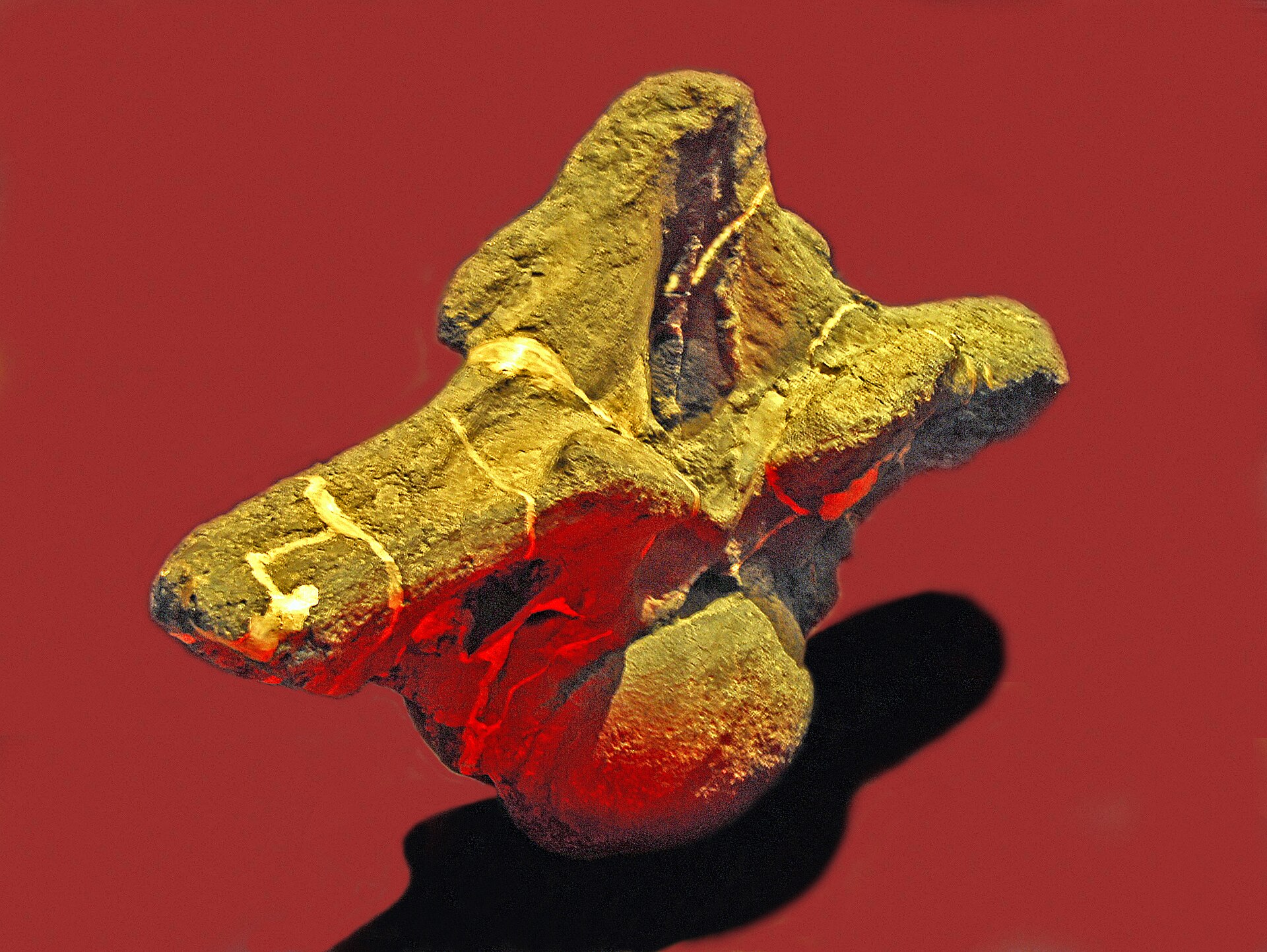

In 2014, Lacovara and colleagues rated the skeleton about 1.6 percent complete, the lowest of the giant titanosaurs they compared. MPM 10002 remains the type and only known specimen.
Puertasaurus Size and Description
Short description of Puertasaurus
The skull, limbs, and hips are all unknown, so any full-body picture draws on related titanosaurs. The known neck vertebra is 118 centimeters (3.9 feet) long and 140 centimeters (4.6 feet) wide, including its fused ribs. Its centrum is low and very flattened, and it lacks pleurocoels—the deep side openings common in sauropod vertebrae. Above it rose a strongly inflated neural spine (the bony blade atop the vertebra), wider than the centrum itself. The describers suggested this spine anchored “a powerful neck ligament and cervical muscles”.
Farther back, the second dorsal was extremely short and strongly opisthocoelous, meaning its front face bulged forward like a ball. In the mid-tail, the two centra are procoelous, cupped at the front. Like all sauropods, it moved on four columnar limbs, though none of its own limb bones are known. Skin impressions or soft tissue are not preserved, so any discussion of its outer covering is speculative.

Size and Weight of Type Species
The 2005 paper gives no length or weight, only that Puertasaurus was among the largest known sauropods. Novas offered the boldest figures in a 2006 newspaper report—115 to 131 feet (35 to 40 meters) long and 80 to 100 metric tons (88 to 110 short tons), with no method stated. In a paper published in 2024, co-describer Jorge Calvo wrote that it “could probably reach almost 40 meters in length and 80 tons”. Meanwhile, London’s Natural History Museum gives about 98 feet (30 meters) and roughly 50 metric tons (about 55 short tons).
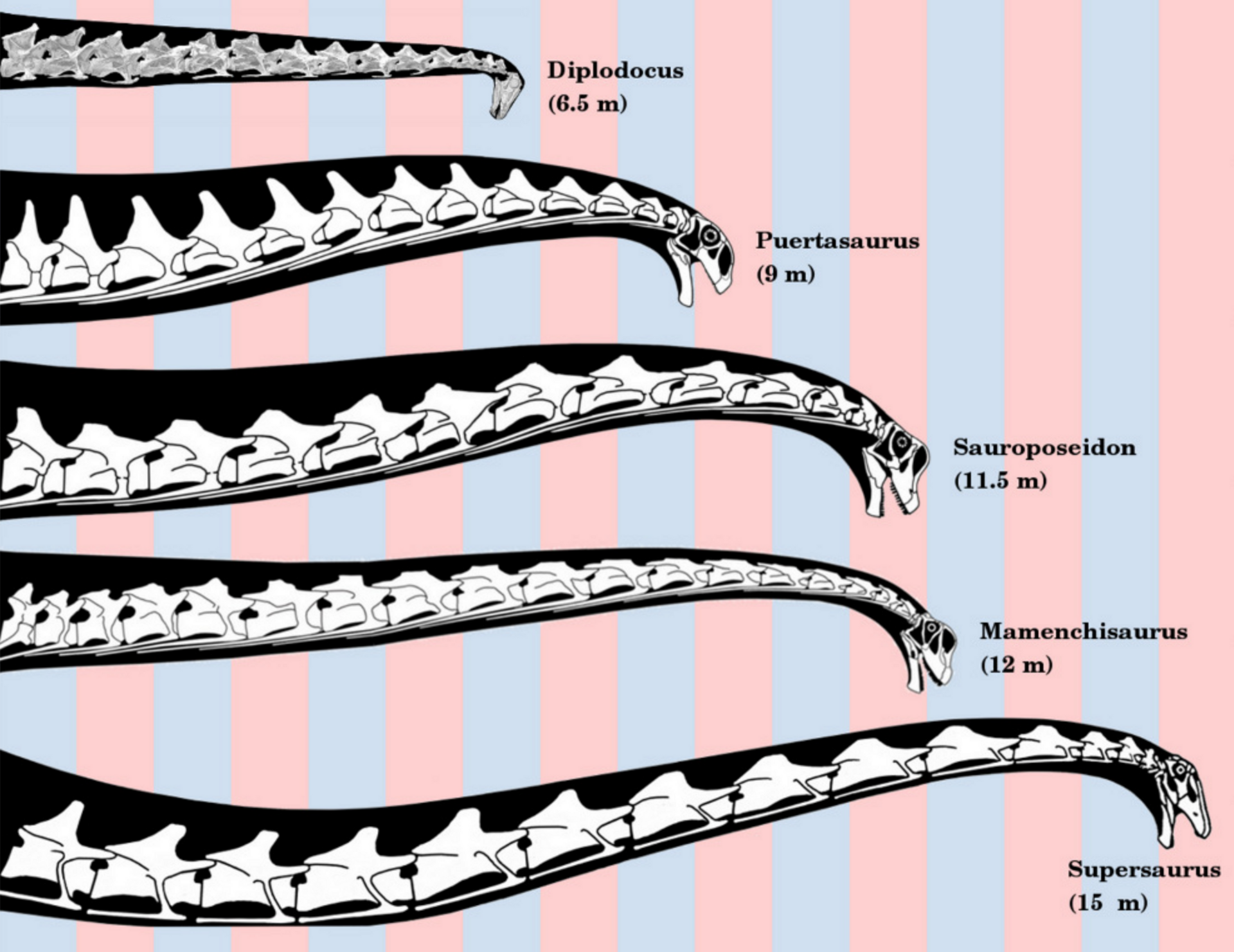
The neck alone was long. In 2013, paleontologists Michael Taylor and Mathew Wedel scaled the cervical against Malawisaurus and estimated the whole neck at about 30 feet (9 meters). In 2022, Taylor suggested it probably had one of the longest titanosaur necks known, at around 9 to 10 meters, while warning that the material is meager.
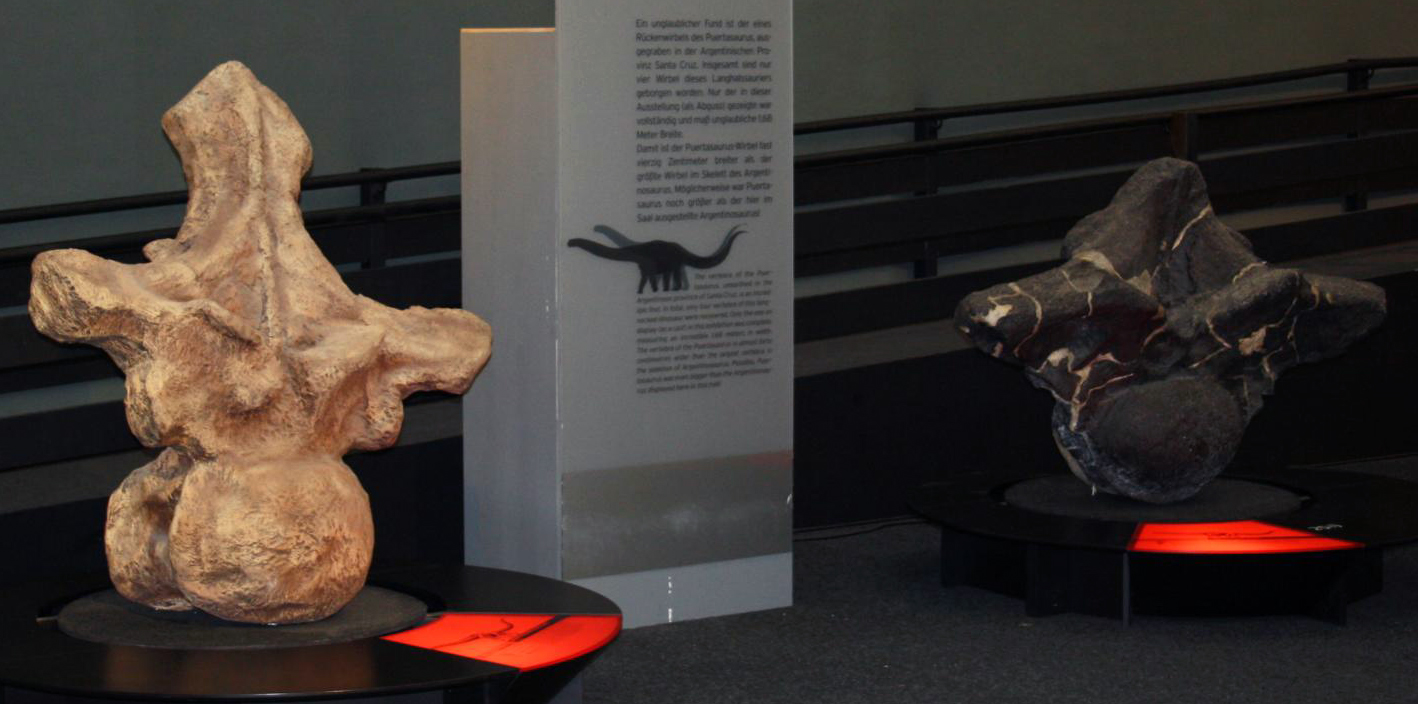

Without limb bones, standard scaling equations give no answer—a point José Carballido and colleagues made in 2017. Instead, they found its front back vertebrae about 10 percent smaller than those of Patagotitan, which they estimated at 69 metric tons. They calculated no mass of their own for Puertasaurus, citing only earlier rough estimates above 60 metric tons. Lacovara’s team concluded that ranking it against other giants “is presently not possible”. Every figure, then, remains a rough estimate.
The Dinosaur in Detail
What sets this dinosaur apart is the sheer breadth of its bones. The second dorsal stands 106 centimeters (3.5 feet) tall but spans 168 centimeters (5.5 feet) across its wing-like transverse processes—the bony projections on each side. That is nearly 45 centimeters more than a back vertebra (possibly the fourth) of Argentinosaurus. In the describers’ words, it is “considerably wider (in absolute terms) than in other known sauropod”. Calvo later called it “the widest ever found”.
The neck is just as unusual. With the possible exception of Mendozasaurus, Puertasaurus has “the proportionally widest cervical neural spine known in any titanosaur,” according to Lacovara’s team. Such low, wide neck bones led the 2005 authors to argue that neck shape varied more among sauropods than once suspected. Its one known front dorsal is also extremely short, its centrum about as wide as it is long. In 2005, the describers found no other titanosauriform with such short front dorsals, although later finds show some close relatives approach this condition.
Lacovara’s team cited differences in the neck spine and back laminae (bony ridges) that set it apart from Dreadnoughtus. In 2016, Bandeira and colleagues first tested its relationships, recovering it near the clade formed by Austroposeidon and Lognkosauria. Carballido’s 2017 analysis then placed it inside Lognkosauria, though among its most unstable members. A 2024 analysis pruned it as too unstable to place, and a 2026 study left it out of one of its two analyses for the same reason. Taken together, its bones show a giant built on unusually broad lines—its exact branch still unresolved.
Interesting Points about Puertasaurus
- The name honors two fossil hunters, Pablo Puerta and Santiago Reuil, who discovered and prepared the specimen.
- Its neck vertebra was the first cervical vertebra documented for any giant titanosaur, according to its describers.
- At 168 centimeters (5.5 feet) across, its second back vertebra was wider than that of any other known sauropod, according to its 2005 describers.
- In 2014, Lacovara and colleagues rated it about 1.6 percent complete, the lowest of the giant titanosaurs they compared.
- Although its describers placed it in the early Maastrichtian, later studies assign its rocks to the Campanian or Campanian–Maastrichtian—a dating still under debate.
Contemporary Dinosaurs
Also preserved in the Cerro Fortaleza Formation was Dreadnoughtus, a gigantic titanosaur known from two partial skeletons. Lacovara’s team restored it at around 85 feet (26 meters) long and about 59.3 metric tons, although a 2015 modeling study by Bates and colleagues judged that mass “highly implausible”. Puertasaurus came from an exposure about 8 miles (13 kilometers) northwest of its site. Because the outcrops are poorly correlated, those authors noted that the two giants may have been separated by “hundreds of thousands of years or more”—so they came from the same rock unit, but not necessarily from the same time or place.
Found on the same hill was Talenkauen, a basal iguanodontian ornithopod now usually placed among the elasmarians. Known from an almost complete skeleton, it was no more than about 13 feet (4 meters) long. Its chest bore plate-like structures interpreted as uncinate processes, small rib struts. No source records any interaction between them.
Adding a predator to the fauna was Orkoraptor burkei, a large theropod later identified as a megaraptoran. Its holotype also comes from Los Hornos Hill, and it is very probably the “large, yet undescribed” theropod listed in the 2005 Puertasaurus paper. Lacovara’s team reported shed teeth “probably referable to” it beside probable tooth marks on a Dreadnoughtus tail vertebra, hinting at scavenging. No such evidence links it to Puertasaurus.
Finally, there was Austrocheirus isasii, which its describers called the first known medium-sized Late Cretaceous abelisauroid with unreduced hands. However, a 2024 restudy found its relationships uncertain. Its bones came from Hoyada Arroyo Seco, about 2.5 miles (4 kilometers) south of Los Hornos Hill. Later studies, including that 2024 restudy of the formation’s fossils, place it in the Cerro Fortaleza Formation. Its link to Puertasaurus therefore rests on the formation alone.
Puertasaurus in its Natural Habitat
The world Puertasaurus roamed was probably a low-lying, forested floodplain. Lacovara’s team described river channels, crevasse splays (fans of sediment from breached banks), and floodplains. Organic-rich soils, carbonized roots, and abundant silicified wood “all indicate a poorly drained, low-lying, forested terrain”. Other researchers also note paralic (coastal-margin), river, and river-tidal settings.
As a sauropod, Puertasaurus was a herbivore—although no fossil shows which plants it favored. The cycads and conifers around its bones reveal what grew nearby, but not what it ate. How it held and used its long neck has not been studied directly. Its describers noted in 2005 that such low, wide necks had never been examined mechanically.
While there is no direct evidence of whether Puertasaurus lived alone or in groups, its bones belong to a varied fauna. Titanosaur remains are common in the formation, alongside crocodyliform teeth, fish scales, and a probable nodosaurid tooth. In 2005, Novas and colleagues proposed that South American giants “may reflect the evolution in progressive isolation” on the continent. They also argued that gigantism lasted to the end of the Mesozoic, a point resting on the later-questioned Maastrichtian age.
Frequently Asked Questions
It honors fossil hunters Pablo Puerta and Santiago Reuil, and the genus is often glossed as “Puerta’s reptile.”
It lived in the Late Cretaceous, between about 84 and 66 million years ago, though the dating is debated.
No measured size exists. Rough published figures run from about 98 feet and 55 short tons (museum) to 131 feet and 110 short tons (a 2006 press report).
Like other sauropods, it was a herbivore, though no direct evidence of its diet is known.
It was found at Cerro Los Hornos, La Leona, in Santa Cruz Province, Argentina.
Its second back vertebra is 168 centimeters (5.5 feet) wide, and its neck vertebra was the first documented for any giant titanosaur.
Sources
The information in this article is based on various sources, drawing on scientific research, fossil evidence, and expert analysis. The aim is to provide a comprehensive and accurate overview of Puertasaurus. However, please be aware that our understanding of dinosaurs and their world is constantly evolving as new discoveries are made.
- https://doi.org/10.22179/REVMACN.7.340
- https://revista.macn.gob.ar/index.php/RevMus/article/view/340
- https://revista.macn.gob.ar/index.php/RevMus/article/download/340/324/671
- https://doi.org/10.1038/srep06196
- https://doi.org/10.22179/revmacn.21.655
- https://doi.org/10.1371/journal.pone.0256233
- https://doi.org/10.1098/rspb.2017.1219
- https://spiral.imperial.ac.uk/handle/10044/1/53967
- https://doi.org/10.1038/srep19165
- https://doi.org/10.1371/journal.pone.0163373
- https://doi.org/10.7717/peerj.36
- https://doi.org/10.7717/peerj.12810
- https://doi.org/10.1111/j.1469-185X.2010.00137.x
- https://doi.org/10.1186/s12862-024-02280-9
- https://doi.org/10.1038/s41598-026-47482-x
- https://doi.org/10.7203/metode.14.24556
- https://metode.org/wp-content/uploads/2023/11/Puertasaurus-reuili-ENG.pdf
- https://www.ameghiniana.org.ar/index.php/ameghiniana/article/download/804/1546
- https://doi.org/10.11646/zootaxa.2450.1.1
- https://doi.org/10.1016/j.cretres.2008.01.001
- https://doi.org/10.1111/bre.12272
- https://doi.org/10.5027/andgeoV39n3-a01
- https://paleobiodb.org/classic/checkTaxonInfo?taxon_no=83419
- https://www.nhm.ac.uk/discover/dino-directory/puertasaurus.html
- https://www.elsol.com.ar/el-pais/santa-cruz-hallan-fosiles-de-dinosaurio/
- https://doi.org/10.1098/rsbl.2015.0215
- https://doi.org/10.1016/j.cretres.2023.105735
This article was last fact checked: TheDinosaurs Team, 03-11-2026
Featured Image Credit: Slate Weasel, CC0 1.0, via Wikimedia Commons
