
Near Kundur in Russia’s Amur Region, a highway cut exposes the Udurchukan Formation, laid down on an ancient river plain. There, its rocks yielded a duckbill with a helmet-shaped crest. Named Olorotitan arharensis in 2003, it was a hadrosaurid—a member of the duck-billed dinosaur family. It lived during the Maastrichtian stage of the Late Cretaceous, roughly 72.2 to 66.0 million years ago. Its describers hailed it as the most complete dinosaur skeleton ever discovered in Russia—and the most complete lambeosaurine, or hollow-crested hadrosaur, outside western North America.
The Kundur locality came to light in 1990, when Vladimir A. Nagornyi of the Far Eastern Institute of Mineral Resources found bones in a highway section. Large-scale digging began in 1999, and the skeleton turned up that same year. In 2003, paleontologists Pascal Godefroit, Yuri Bolotsky, and Vladimir Alifanov described the animal and used it to argue for an Asian origin of lambeosaurines. A full osteology—a detailed bone-by-bone study—followed in 2012 and revised several of the first observations. Later studies have also used Olorotitan to trace how lambeosaurines moved between Asia and North America.
Olorotitan Key Facts
| Keyword | Fact |
|---|---|
| Pronunciation | Not specified |
| Meaning of name | Gigantic Swan |
| Group | Ornithopoda (Hadrosauridae, Lambeosaurinae) |
| Type Species | Olorotitan arharensis |
| Diet | Herbivore |
| When it Lived | 72.2 to 66.0 MYA |
| Period | Cretaceous |
| Epoch | Late Cretaceous (Maastrichtian stage) |
| Length | About 26 feet (8 meters) |
| Height | About 11.5 feet (3.5 meters) at the hip |
| Weight | 5,809 to 7,544 pounds (2,635 to 3,422 kilograms), 2012 estimate |
| Mobility | Moved mainly on two legs (bipedal), according to a 2012 study |
| First Discovery | 1999 by Russian–Belgian excavations at Kundur (site found 1990 by Vladimir A. Nagornyi) |
| Described by | 2003 by P. Godefroit, Y. Bolotsky, and V. Alifanov |
| Holotype | AEHM 2/845 |
| Location of first find | Kundur, Udurchukan Formation, Arhara County, Amur Region, Russia |
Olorotitan Origins, Taxonomy and Timeline
The name Olorotitan means “gigantic swan,” as its describers explained in 2003. The species name arharensis points to Arhara County, where the holotype—the name-bearing specimen—was found. Together, the name pairs a graceful image with a precise spot on the map.
In 2003, Godefroit and colleagues placed Olorotitan within Dinosauria, Ornithopoda, Hadrosauridae, and finally Lambeosaurinae. They based that last step on seven synapomorphies (shared derived traits). These included the hollow crest and a nostril opening fully surrounded by the premaxilla, the front bone of the upper jaw. Their analysis of 36 characters produced a single tree, with Olorotitan as the sister of the North American Corythosaurus and Hypacrosaurus. Olorotitan arharensis is the type and only known species.
The original paper placed the Kundur beds in the Wodehouseia spinata–Aquilapollenites subtilis pollen zone, of “Middle” or Late Maastrichtian age. That stage spans roughly 72.2 to 66.0 million years ago, at the very end of the Cretaceous period. Pinning down the substage has proved harder, however. In 2001, Markevich and Bugdaeva had dated Kundur to the early Maastrichtian. By contrast, Godefroit’s team favored a late Maastrichtian age from 2004 onward, as did several later studies. Still, the 2012 osteology notes that independent age indicators “are yet to be found,” so the question remains open.
Discovery & Fossil Evidence
Large-scale excavations at Kundur began in 1999, led by the Amur KNII FEB RAS with the Royal Belgian Institute of Natural Sciences and several Russian institutes. The bonebed covers at least 1,000 square meters (about 10,800 square feet), yet the fossil horizon is no thicker than 1.5 meters (about 5 feet). The 2003 paper places the dig in the 1999 to 2001 field campaigns. Yet its own acknowledgments, like a 2005 study, mention only the 2000 and 2001 seasons. According to the 2012 osteology, the skeleton was found in 1999 and fully excavated in 2001.
The holotype, AEHM 2/845, is housed at the Amur Natural History Museum in Blagoveschensk. It lay on its left flank, with the skull, backbone, and shoulder girdle mostly complete and still articulated. By contrast, the limbs were more scattered, and the hands and feet were missing entirely. Several back vertebrae, ribs, the pubes (lower hip bones), the left forearm, and the right humerus and hind limb were also absent.
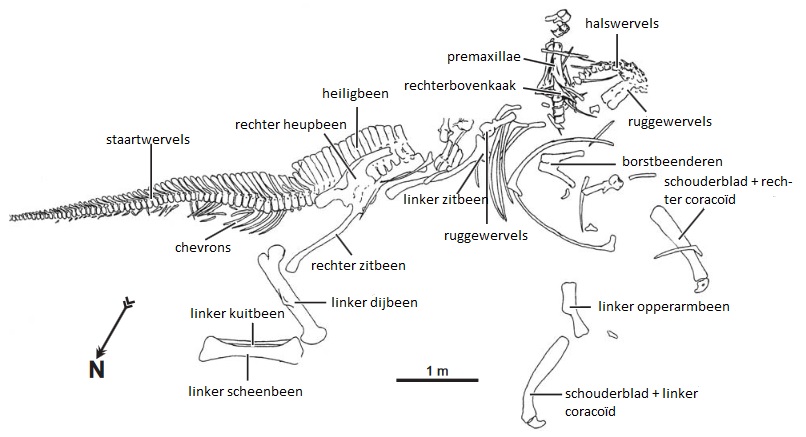

Smaller, more fragmentary skeletons from Kundur may also belong to the species. A referred specimen, AEHM 2/846, is probably a younger adult of about the same size. In 2012, Godefroit and colleagues concluded that the holotype was buried within a few days of death. A sediment gravity flow—a fast-moving slurry of mud and debris—could account for that quick burial. They also noted a square-ish hole in the skull roof. Its outline and size might match shed teeth of a large theropod (“tyrannosaurid”) from the same layer. They hypothesized that a theropod killed the animal, or that predators or scavengers fed on it. No additional specimens have been reported outside Kundur.
Olorotitan Size and Description
Short description of Olorotitan
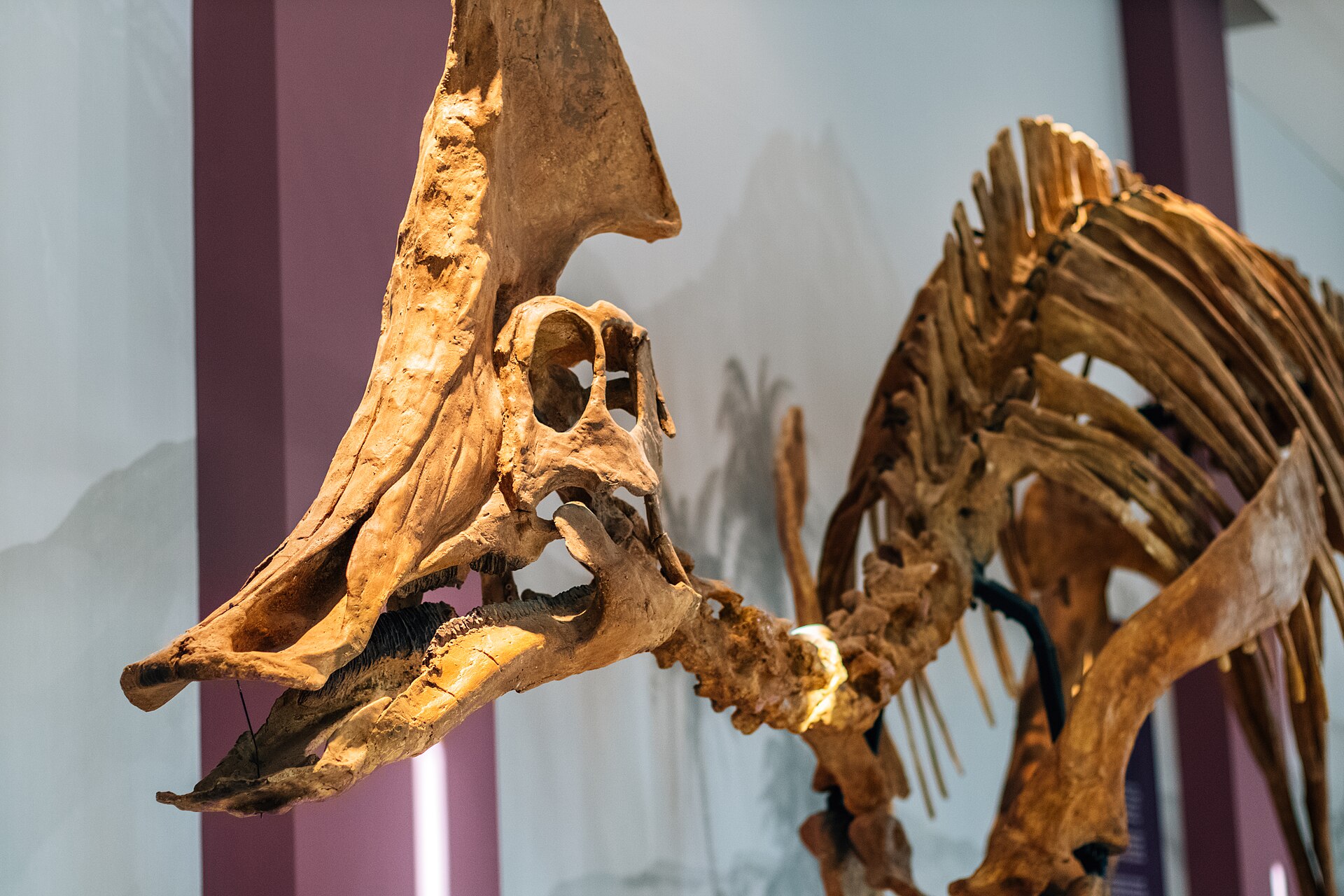
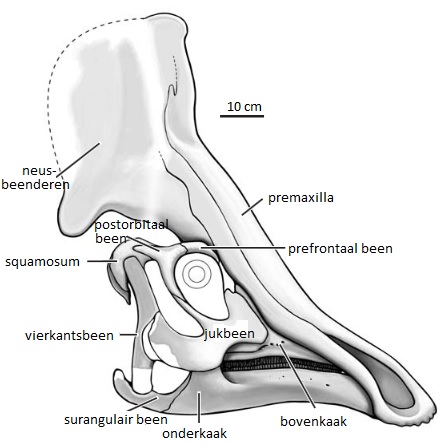
A large, helmet-like hollow crest crowned the head. It rose higher than the rest of the skull and swept back well beyond the occiput, or rear of the skull. The nasal bones formed most of its back portion, but crushing hides the internal nasal passage. Behind the head came a neck of 18 cervical vertebrae, more than in any other known hadrosaurid. By comparison, hadrosaurines—duckbills without hollow crests—had 12 or 13, and Parasaurolophus walkeri had 13.
Its dorsal (back) vertebrae were opisthocoelous—convex at the front and cupped at the back. Earlier work called that shape unusual among hadrosaurids, though Amurosaurus shares it. The tail held 70 vertebrae, with ossified (bone-hardened) tendons running as far as the 19th. In the hind limb, the tibia, or shin bone, matched the femur, or thigh bone, in length. Godefroit and colleagues took its forelimb proportions to mean it moved mainly on two legs. Still, hadrosaurid trackways show that some walked on both two and four.

Size and Weight of Type Species
In 2012, Godefroit and colleagues gave the mounted holotype a length of 26 feet (8 meters). Posed on all fours, it stands about 11.5 feet (3.5 meters) tall at the hip. Both figures come from the reconstructed skeleton and match values calculated in a 2005 study.
Weight is less certain, and the 2012 team derived it from limb-bone circumferences using 1985 equations by Anderson and colleagues. The result was 5,809 pounds (2,635 kilograms) for a bipedal animal and 7,544 pounds (3,422 kilograms) for a quadrupedal one. They judged the true figure likely to fall between the two. Meanwhile, its 3.6-foot (1.1-meter) femur matches the average for adult North American hadrosaurids.
The 2003 paper gave no body length or weight, instead describing Olorotitan as comparable in size with Parasaurolophus cyrtocristatus, a “rather large lambeosaurine.” In size, then, it was a fairly typical big hadrosaurid—its crest and neck are what set it apart.
The Dinosaur in Detail
What sets Olorotitan apart is its crest, which reaches even higher than that of Lambeosaurus magnicristatus. In 2003, its describers stressed that it differs from every North American lambeosaurine crest, extending farther back than other helmet crests. Its square predentary, a toothless bone tipping the lower jaw, reminded them of the Asian Tsintaosaurus. So did the maxilla, or upper jaw bone.

Several original observations have since been revised. The 2003 paper counted 15 or 16 sacral (hip) vertebrae, far above the usual 10 to 12 in adult hadrosaurids. By 2012, however, Godefroit and colleagues judged it highly probable that extra back and perhaps tail vertebrae had fused onto this old animal’s hips. Indeed, the referred specimen AEHM 2/846 shows the usual numbers. Around the 20th tail vertebra, the tips of neighboring spines also lock together like a knob in a cup. The 2003 team thought this too regular to be pathological, although they could not rule that out. The 2012 osteology allowed either a pathological or a growth-related cause. Then, in 2025, Bertozzo and colleagues described broken, remodeled spines from the ninth tail vertebra onward and judged a pathological origin more probable.
Its exact place on the family tree remains unsettled. The 2012 study recovered it as the sister of Corythosaurus and Hypacrosaurus, yet called those links “particularly weakly supported.” Prieto-Márquez had placed it lower in 2010. Then, in 2013, his team found its position “labile”—sometimes next to the Iberian Arenysaurus and Blasisaurus. Taken together, more recent analyses keep Olorotitan among the helmet-crested lambeosaurines—just not in one fixed seat.
Interesting Points about Olorotitan
- With 18 cervical vertebrae, Olorotitan had more neck bones than any other known hadrosaurid, according to the 2012 osteology.
- The holotype was probably an old adult, with fused bones in the chest, lower leg, and hips, plus many repaired fractures.
- In 2017, Xing and colleagues recovered Olorotitan as the first lineage of the helmet-crested Lambeosaurini to branch off.
- Its 2003 describers used it to argue that lambeosaurines arose in Asia and reached North America, probably across a Beringian land route.
Contemporary Dinosaurs
Sharing the Kundur locality itself was Kundurosaurus nagornyi, a flat-headed saurolophine hadrosaurid known from scattered skull and skeleton bones. Its describers suggested it might be a second species of Kerberosaurus, leaving its status as a separate genus uncertain. Lambeosaurines and flat-headed hadrosaurines lie in the same layers at Kundur. A 2005 study read this as a sign that both could share the same habitats. Even so, Godefroit and colleagues noted in 2012 that Olorotitan and Kundurosaurus are known only from Kundur. They linked this patchy pattern to habitat partitioning and competition for food.
At Blagoveschensk, another site in the same Udurchukan Formation, lived Kerberosaurus manakini, also a flat-headed saurolophine. Its bonebed lies in the same pollen zone as Kundur. A 2025 study treated the two bonebeds as coeval and geographically close, although earlier pollen work had dated Blagoveschensk slightly younger.
Dominating the Blagoveschensk bonebed was Amurosaurus riabinini, which Godefroit and colleagues regard as an early-branching lambeosaurine. It makes up more than 90 percent of the bones recovered there. In their view, it contrasts with Olorotitan, which the 2012 analysis placed on the Corythosaurus branch. Godefroit and colleagues argued in 2012 that such different lineages in one region show independent spread between Asia and North America.
From a neighboring region comes Charonosaurus jiayinensis, a lambeosaurine from the Yuliangze Formation at Jiayin, on the Chinese bank of the Amur in Heilongjiang. Jiayin also lies near the borders of the Zeya–Bureya Basin, in the same pollen zone, and the 2003 paper treated it as synchronous with Kundur. Because it belongs to a separate formation, however, Charonosaurus represents the wider Amur fauna rather than Olorotitan‘s own floodplain.
Olorotitan in its Natural Habitat
The world Olorotitan roamed was an alluvial plain crossed by a gravel-bedded, meandering river. Pollen points to a subtropical climate, while ancient soils suggest warm, humid conditions with a seasonal shortage of rain. Bald cypress (Taxodium) and aquatic plants grew in the area, and the turtle Amuremys planicostata and crocodiles shared the scene. So did a multituberculate mammal known from a single tooth—the first Late Cretaceous mammal fossil from Russia.
As a herbivore, Olorotitan processed plants with a dental battery—rows of tightly packed teeth. The 2012 study counted about 38 dentary (lower jaw) tooth rows, up from roughly 32 in 2003, plus about 45 in the maxilla. Lambeosaurines were the dominant plant-eaters of the Amur region, which, unlike western North America, has yielded no ceratopsids, or horned dinosaurs. Godefroit and colleagues judged paleoecology a likelier cause than the opening of the Bering Strait.
While there is no direct evidence of how Olorotitan used its crest, hadrosaurid crests in general may have served for visual and vocal communication. In 2025, Bertozzo and colleagues proposed that recurring tail injuries in hadrosaurids, including this holotype, were most likely caused by mating, and that injured individuals might be females. Hadrosaurids dominate the Kundur fossils, so Olorotitan belonged to the most common group of large animals there—at least according to the current fossil record.
Frequently Asked Questions
It means “gigantic swan,” and the species name arharensis refers to Arhara County in Russia’s Amur Region.
It lived in the Late Cretaceous Maastrichtian stage, between 72.2 and 66.0 million years ago, though the exact substage is debated.
The mounted holotype measures about 26 feet long and 11.5 feet tall at the hip. Its estimated weight is 5,809 to 7,544 pounds.
It was a herbivore that chewed plants with a dental battery of tightly packed tooth rows.
Its fossils come from the Udurchukan Formation at Kundur, in the Amur Region of Far Eastern Russia.
It combined a tall, helmet-like hollow crest with 18 neck vertebrae, more than any other known hadrosaurid.
Sources
The information in this article is based on various sources, drawing on scientific research, fossil evidence, and expert analysis. The aim is to provide a comprehensive and accurate overview of Olorotitan. However, please be aware that our understanding of dinosaurs and their world is constantly evolving as new discoveries are made.
- https://doi.org/10.1016/S1631-0683(03)00017-4
- https://sciencepress.mnhn.fr/en/periodiques/comptes-rendus-palevol/2/2/remarkable-hollow-crested-hadrosaur-russia-asian-origin-lambeosaurines
- https://www.app.pan.pl/archive/published/app57/app20110051.pdf
- https://doi.org/10.1017/S0016756805001226
- https://www.vliz.be/imisdocs/publications/ocrd/279577.pdf
- https://doi.org/10.1371/journal.pone.0036849
- https://doi.org/10.1371/journal.pone.0069835
- https://doi.org/10.1371/journal.pone.0175253
- https://doi.org/10.1016/j.isci.2025.113739
- https://doi.org/10.2110/palo.2006.p06-031r
- https://doi.org/10.1371/journal.pone.0078899
- https://stratigraphy.org/ICSchart/ChronostratChart2024-12.pdf
This article was last fact checked: TheDinosaurs Team, 03-11-2026
Featured Image Credit: Durbed, CC BY-SA 3.0, via Wikimedia Commons
