
In Egypt’s Bahariya Oasis, the coastal rocks of the Bahariya Formation once yielded a predator whose thigh bone nearly matched that of Tyrannosaurus rex—a skeleton no museum can show today. Named Tameryraptor markgrafi in 2025, this carcharodontosaurid theropod lived in the early Cenomanian of the Late Cretaceous, sometime between 100.5 and 93.9 million years ago. Its bones were destroyed in Munich in 1944, during the Second World War. Even so, old drawings, a brain cast, and two archive photographs were enough to name it.
Collector Richard Markgraf reported the skeleton to German paleontologist Ernst Stromer in April 1914. In 1931, Stromer made it the basis of a new genus, Carcharodontosaurus. In 2025, paleontologists Maximilian Kellermann, Elena Cuesta, and Oliver Rauhut concluded it differs from the Moroccan skull that now anchors that name. Another 2025 study recovered the two as closest relatives, but said this neither supports nor rules out a separate genus. Either way, its story shows how much old archives can still give back.
Tameryraptor Key Facts
| Keyword | Fact |
|---|---|
| Pronunciation | Not specified |
| Meaning of name | Thief From the Beloved Land |
| Group | Theropoda |
| Type Species | Tameryraptor markgrafi |
| Diet | Carnivore |
| When it Lived | Within 100.5 to 93.9 MYA (early Cenomanian) |
| Period | Cretaceous |
| Epoch | Late Cretaceous (Cenomanian stage) |
| Length | About 33 feet (10 meters) per a 2025 press release, not estimated in the 2025 study |
| Height | Not specified |
| Weight | Not specified |
| Mobility | Not specified |
| First Discovery | 1914 by Richard Markgraf |
| Described by | 1931 by Ernst Stromer (as Carcharodontosaurus saharicus), named 2025 by M. Kellermann, E. Cuesta, and O.W.M. Rauhut |
| Holotype | SNSB-BSPG 1922 X 46 (destroyed in 1944) |
| Location of first find | Near Ain Gedid, western foot of Gebel Harra, Bahariya Formation, Bahariya Oasis, Western Desert, Egypt |
Tameryraptor Origins, Taxonomy and Timeline
The name Tameryraptor joins “Ta-mery,” an informal ancient Egyptian name for the country meaning “beloved land,” with raptor, Latin for “thief.” The species name markgrafi honors Richard Markgraf, the Austrian fossil collector who found most of Stromer’s dinosaur remains. Together, the full name nods to the country and to the man who found the bones.
Tameryraptor belongs to Theropoda, the group of mostly meat-eating dinosaurs, and within it to Allosauroidea. In 2025, Kellermann and colleagues also named a new clade, Carcharodontosauriformes, for carcharodontosaurids and their closest kin. In every one of their analyses, the Egyptian animal came out as a derived (advanced) carcharodontosaurid outside the subgroup Carcharodontosaurinae. Their tree placed Acrocanthosaurus as the sister of a group uniting the Carcharodontosaurini, Carcharodontosaurus iguidensis, and Tameryraptor. Tameryraptor markgrafi is the type and only known species.
The Bahariya rocks belong to the Cenomanian stage, roughly 100.5 to 93.9 million years ago. Stromer called them the “lowermost Cenomanian,” and a 2019 wildfire study describes them as early Cenomanian. However, none gives a radiometric date, so the press-release figure of about 95 million years is only approximate. In this opening act of the Late Cretaceous, Bahariya’s coastal lowlands held a surprising number of giant predators.
Discovery & Fossil Evidence
Markgraf reported the find to Stromer on April 13 and 23, 1914. The skeleton lay 2 km (1.2 miles) from Ain Gedid, at the western foot of Gebel Harra. He dug the bones from hard, gypsum-free marl (a lime-rich mudstone), along with turtle remains, small lungfish teeth, and weathered crocodilian bones. From how they lay, their size, and preservation, Stromer judged that the bones came from one individual. Unfortunately, poor packing broke many of them on the way to Munich.
The holotype—the name-bearing specimen—was SNSB-BSPG 1922 X 46, held in Munich’s Bavarian State Collection for Paleontology and Geology. It included nearly complete nasals, the paired bones of the snout roof. Much of the left maxilla—the main upper jaw bone—survived too, along with part of the braincase and several teeth. From the body came three neck vertebrae, one tail vertebra, a rib, two chevrons, parts of the hips, both femora (thigh bones), and the left fibula. In 2025, Kellermann and colleagues set aside an isolated ilium (upper hip bone) that Stromer had tentatively added in 1934, since it does not overlap the rest.
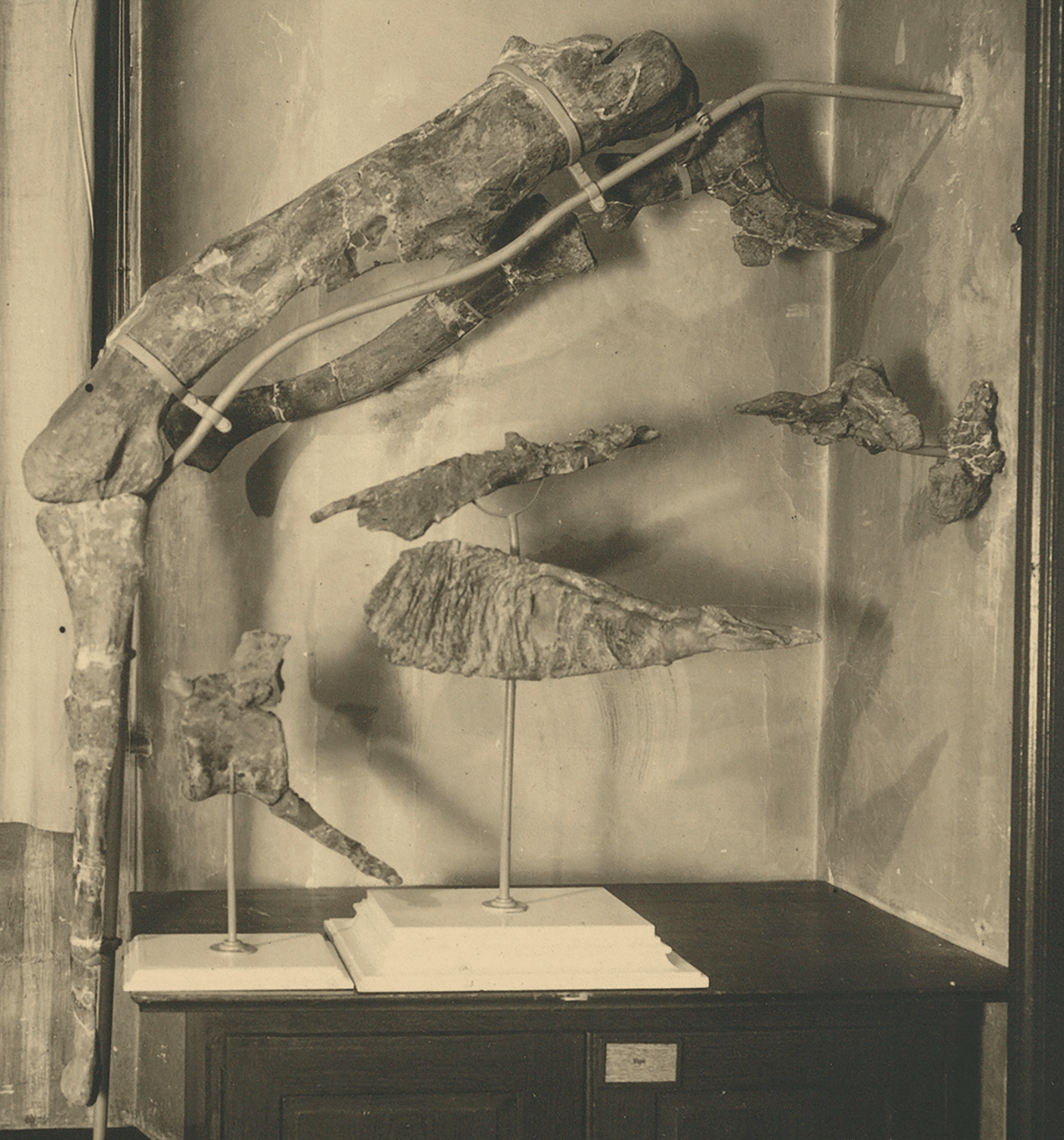

All of the material perished in 1944, along with the museum in Munich’s Alte Akademie. What survives is Stromer’s descriptions and drawings, a photo of the left maxilla, and a Berlin endocast (a cast of the brain cavity). Kellermann’s team also rediscovered a photograph of the mounted skeleton, and both archive photos predate April 1944. Naming a species from lost material runs against a recommendation of the zoological naming code, so the authors argued for an exceptional case. They also call it the only African carcharodontosaurid known from even a partial skeleton behind the skull.
Tameryraptor Size and Description
Short description of Tameryraptor
Where the two nasals met, they formed a low, roof-like crest. From their inner rims rose a bump about 3 cm (1.2 in) high—a small nasal “horn.” The bone surface was rugose, or roughened, with pits and rounded bumps. In 1931, Stromer suggested that these bumps carried horny coverings. He also thought a horn sat on a bump of the parietal, at the back of the skull roof.
The maxilla preserved 12 tooth sockets, but its front was incomplete, so the original count is uncertain. Every tooth still in the jaws was a replacement tooth. Stromer described them as highly symmetrical, flattened side to side, and finely serrated, with 9 to 10 denticles per 5 mm (0.2 in). Behind the head, the middle neck vertebrae were strongly opisthocoelous, with a convex front face and a concave rear face. Farther back, the ischium, a lower hip bone, was held almost horizontally. That matches Siats—which the same study places among megaraptorans—and differs from carcharodontosaurids such as Acrocanthosaurus. The find held only bones, so any picture of its skin is speculative.

Size and Weight of Type Species
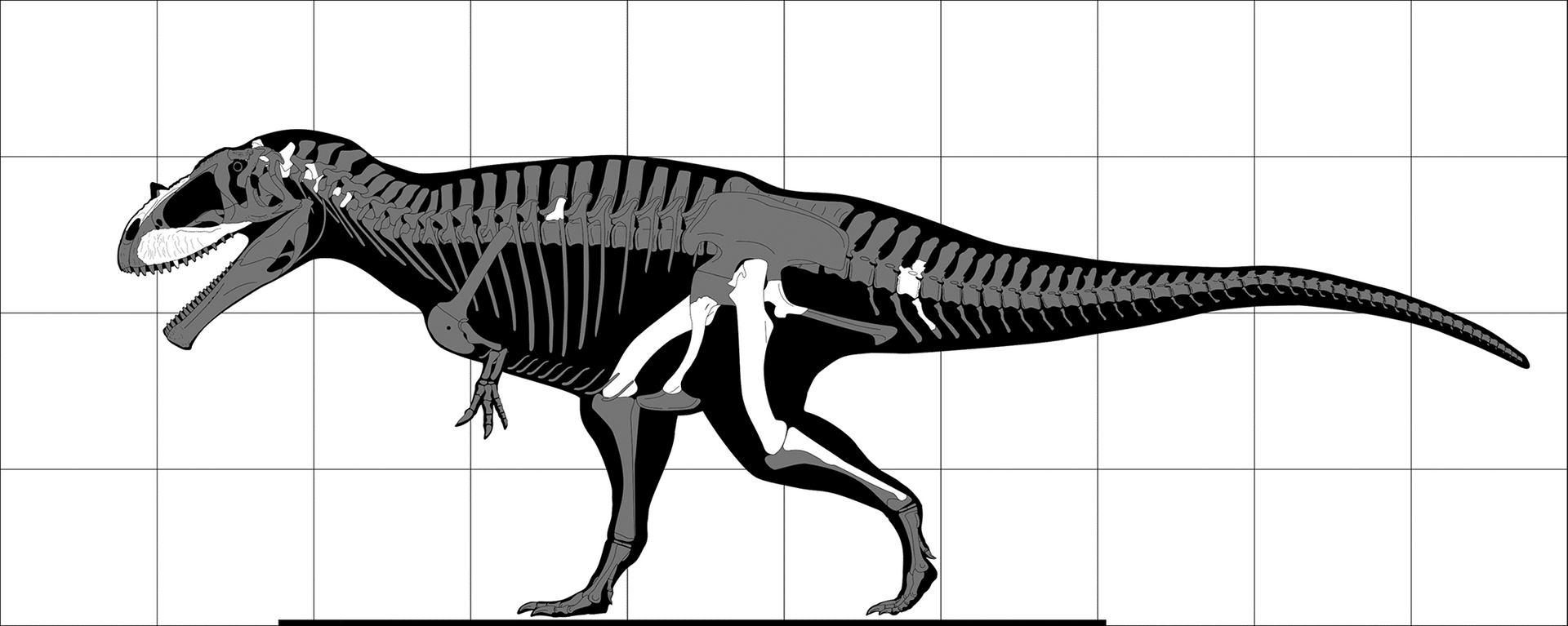
Neither the 2025 description nor later studies estimate its length in their text, although the 2025 skeletal reconstruction is drawn on a 1-meter grid. Stromer gave the femur as 126 cm (4.1 feet) long, though its crushed shaft could only be partly pieced together. He called it over twice the size of the femur in Ceratosaurus nasicornis and almost as large as in Tyrannosaurus rex. The fibula measured 88 cm (2.9 feet), while Stromer estimated the missing tibia at about 1 meter (3.3 feet) from limb proportions.
In his 1931 diagnosis, Stromer gave its size as like that of Gorgosaurus libratus. A 2025 press release from the Bavarian State Collections put its length at about 33 feet (10 meters), without explanation. Neither the original description nor the 2025 study gives a height or a body mass. Even incomplete, the right nasal reached 54 cm (21 inches). In the upper jaw, one unerupted replacement tooth measured 68 mm (2.7 inches) high.
The Dinosaur in Detail
What sets this dinosaur apart is its small nasal horn, which the 2025 authors list as unique to it. No other carcharodontosaurid is known to have one, and it was less pronounced than the horn of Ceratosaurus. Its frontals, paired skull-roof bones, were vaulted along the midline, another unique trait. The endocast also shows a relatively enlarged cerebrum, 52 mm (2 inches) wide, against 53 mm in the considerably larger C. saharicus.
Its middle neck vertebrae had a single, undivided air-sac opening on each side, whereas Acrocanthosaurus, Tyrannotitan, and Giganotosaurus had divided ones. An anterior tail vertebra also carried pneumatic (air-filled) openings, an unusual feature shared with megaraptorans. Meanwhile, the femur bore a spike-like accessory trochanter—a bony muscle attachment—known among allosauroids only in Neovenator and Acrocanthosaurus.
Yet in 2007, paleontologists Brusatte and Sereno made a Moroccan skull from the Kem Kem beds the neotype—a replacement name-bearer—of C. saharicus. As Kellermann’s team quotes them, they called it identical to Stromer’s Egyptian material. Still, placing Tameryraptor beside the neotype costs only one or two extra steps (added evolutionary changes) in Kellermann’s own analyses.
Later in 2025, Cau and Paterna recoded the specimen and recovered it as the neotype’s sister taxon. Even so, they said this neither supports nor rejects a separate genus, and they still use the name Tameryraptor. Both peer reviewers of the 2025 paper questioned naming a taxon from bones destroyed in 1944, and one still declined to endorse it after revision. In reply, the authors argued that the two differ as much as other accepted carcharodontosaurid genera do. Taken together, Tameryraptor stands as a named genus whose exact distance from Carcharodontosaurus remains open.
Interesting Points about Tameryraptor
- Stromer’s 1931 study of this skeleton founded the name Carcharodontosaurus, after teeth he likened to those of the shark Carcharodon.
- Stromer even noted that the animal’s distinctness could justify a family Carcharodontosauridae, a name still in use.
- The 2025 study grew out of first author Maximilian Kellermann’s Master’s thesis at LMU Munich.
- Rauhut remarked that “it can be worthwhile for paleontologists to dig not only in the ground, but also in old archives.”
- The 2025 authors could not rule out that the nasal horn reflects sexual dimorphism, though no such dimorphism is known in horned theropods.
Contemporary Dinosaurs
Sharing the Bahariya landscape was Spinosaurus, the spinosaurid whose original holotype Stromer described from these rocks in 1915. A Moroccan skeleton was later proposed as its neotype, a move others have rejected. With the 1915 holotype’s exact layer unverified, the two are known only to share a formation and stage. Stromer’s “Spinosaurus B,” a second spinosaurid skeleton, came from the same site near Ain Gedid as Tameryraptor, but its species is debated.
Some remains Stromer referred to Bahariasaurus came from his layer p, the same bed that yielded Tameryraptor. However, its holotype came from Gebel Ghorabi, and other referred bones from the higher layer m. Its relationships are still debated—Salem and colleagues called it a “bahariasaurid,” while Cau and Paterna placed it among the abelisauroids. Even so, no direct interaction between the two is recorded.
Among the plant-eaters was Aegyptosaurus, a titanosaurid sauropod that Stromer described in 1932. His diagnosis called it almost twice as large as Titanosaurus australis. Its holotype came from layer m, a higher bed than the Tameryraptor horizon but in the same formation and stage. Whether the two ever crossed paths is unknown.
Towering over the coast was Paralititan, a giant titanosaurid named in 2001 from mangrove deposits of the formation. Its humerus, or upper arm bone, measured 1.69 meters (5.5 feet), longer than that of any Cretaceous sauropod then known. Later work places its site in the Gebel El Dist Member, but how that level relates to Stromer’s layer p is unresolved.
Tameryraptor in its Natural Habitat
The world Tameryraptor knew was a coast. The lower Bahariya Formation records rivers that graded upward into estuaries. Higher up, strong tides left their mark, with some lagoon deposits. The plant fossils point to a mosaic of coastal settings. Some levels preserve the fern Weichselia reticulata, long read as part of mangrove-like vegetation. By contrast, a 2025 study of leaves from the Paralititan site found that most leaf types came from flowering plants of floodplains and ponds. Among them was the aquatic Nelumbites. Meanwhile, charcoal at six levels records repeated wildfires.
As a large theropod, Tameryraptor was almost certainly a carnivore, though its prey is unknown. Salem and colleagues count the African carcharodontosaurids among a “triumvirate of large carnivorous dinosaurs” in the region. In 2001, Smith and colleagues suggested that titanosaurids “and their predators” may have habitually entered mangrove environments—though they meant the Bahariya fauna in general.
Nothing shows how Tameryraptor hunted or whether it lived alone, but it belonged to a strikingly predator-rich fauna. Stromer first noticed that very large predators seem unusually common at Bahariya compared with herbivores—a puzzle now called “Stromer’s Riddle.”
Frequently Asked Questions
It means “thief from the beloved land,” and the species name markgrafi honors fossil collector Richard Markgraf.
It lived in the early Cenomanian stage of the Late Cretaceous, within 100.5 to 93.9 million years ago.
The 2025 study gives no length estimate in its text. Its femur was about 126 cm (4.1 feet) long, and a 2025 press release gives about 33 feet.
It was a carnivore, one of several large predators in a fauna unusually rich in big meat-eaters.
Its bones came from the Bahariya Formation near Ain Gedid, at the foot of Gebel Harra in Egypt’s Bahariya Oasis.
Its describers treat it as distinct from Carcharodontosaurus. A second 2025 study recovered the two as closest relatives but said its result neither supports nor rules out a separate genus.
Sources
The information in this article is based on various sources, drawing on scientific research, fossil evidence, and expert analysis. The aim is to provide a comprehensive and accurate overview of Tameryraptor. However, please be aware that our understanding of dinosaurs and their world is constantly evolving as new discoveries are made.
- https://doi.org/10.1371/journal.pone.0311096
- https://archiv.badw.de/de/005955625/005955625.pdf
- https://archiv.badw.de/de/005955626/005955626.pdf
- https://publikationen.badw.de/de/006296947/006296947.pdf
- https://doi.org/10.3301/IJG.2025.10
- https://doi.org/10.1098/rsos.220106
- https://doi.org/10.1126/science.1060561
- https://doi.org/10.1186/s42501-019-0042-6
- https://doi.org/10.1186/s13358-025-00387-0
- https://www.ncbi.nlm.nih.gov/pmc/articles/PMC7188693/
- https://stratigraphy.org/ICSchart/ChronostratChart2024-12.pdf
- https://snsb.de/en/raubsaurier-auf-fotos/
- https://www.mgap.geo.uni-muenchen.de/publications_students/a-new-dinosaur-old-fossil/index.html
This article was last fact checked: TheDinosaurs Team, 03-11-2026
Featured Image Credit: Joschua Knüppe, CC BY 4.0, via Wikimedia Commons
